Czech Republic Printed Circuit Boards Market: Import Trend Analysis
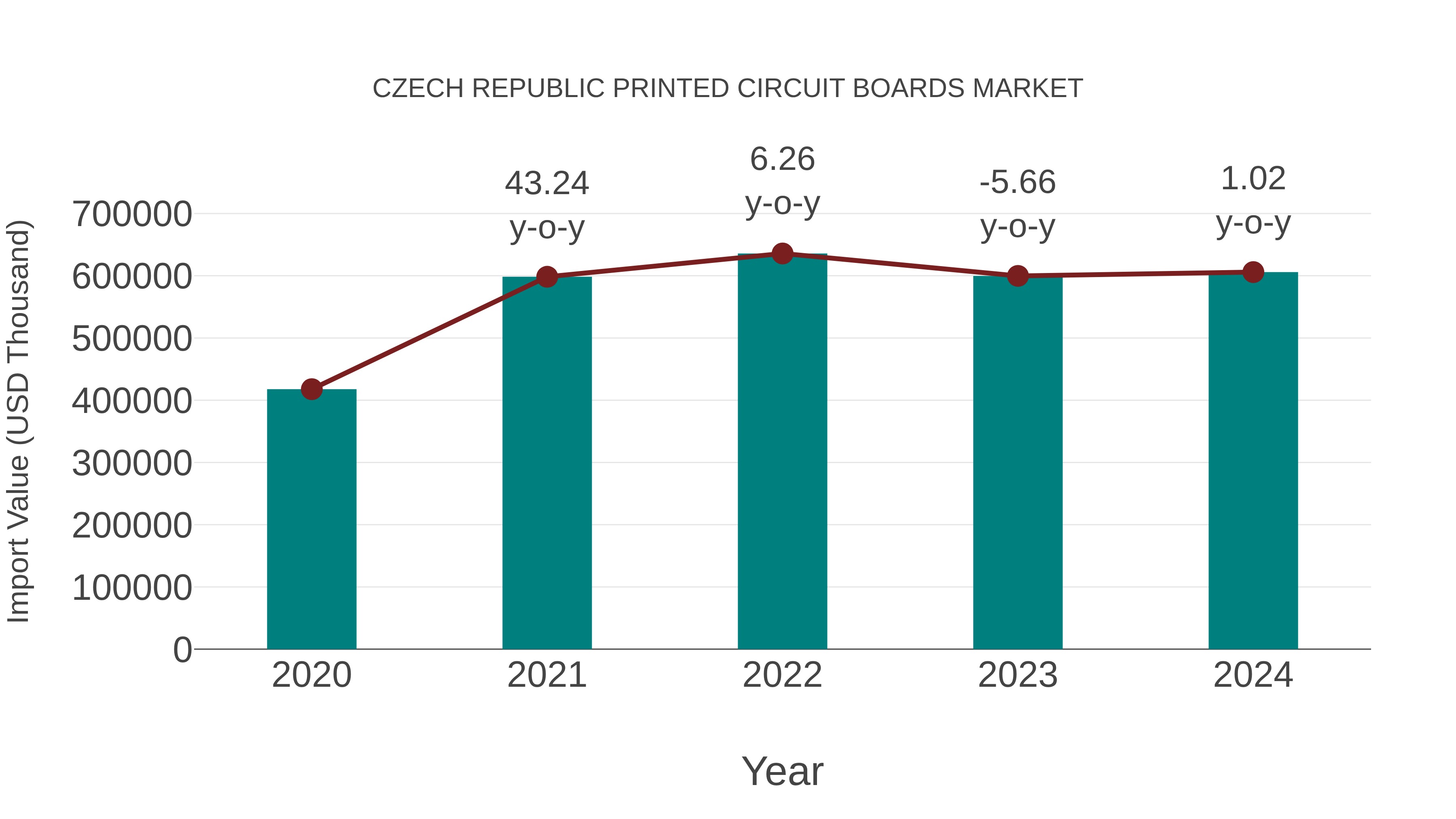
The Czech Republic printed circuit boards market witnessed a steady increase in imports from 2020 to 2024. The compound annual growth rate (CAGR) of 9.74% during 20202024, along with a year-on-year growth rate of 1.02% in 20232024, contributed to the overall rise in imported printed circuit boards during this period.
Czech Republic Printed Circuit Boards Market Synopsis
The Czech Republic Printed Circuit Boards Market is estimated to witness a CAGR of 5.4% during the forecast period 2020-2026. The market growth in the region has been driven by factors, such as increasing demand for flexible and rigid printed circuit boards (PCBs) from various industries and rising emphasis on miniaturization of electronic components. Moreover, development of efficient PCBs with low cost and high performance, expanding automotive electronics industry are also further driving the market growth in Czech Republic.
Also, emergence of electric vehicles in the country is anticipated to contribute positively towards the growth prospects of this sector over next few years due to their need for advanced electrical systems including power distribution circuits which require highly developed PCBs technology that can withstand extreme temperatures generated out by these cars while operating at high speeds over long distances. Additionally, growing trend for Internet Of Things (IOT) networking solutions will create an additional opportunity for manufacturers who focus on building smaller sized PCBS? that have multiple network functions integrated into them.
Furthermore, various government initiatives encouraging foreign investments & technological advancements along with presence of prominent players like AT&S AG , Nextek Inc., Rigid-Flex International Corporation etc are some other key factors contributing positively towards regional market landscape . However , adverse environmental effects caused due incorrect disposal techniques used by manufacturers coupled with complexity associated with producing multi layer structures may hinder overall market growth rate across Czech Republic during assessment period.
Key Highlights of the Report:
- Czech Republic Printed Circuit Boards Market Outlook
- Market Size of Czech Republic Printed Circuit Boards Market, 2019
- Forecast of Czech Republic Printed Circuit Boards Market, 2026
- Historical Data and Forecast of Czech Republic Printed Circuit Boards Revenues & Volume for the Period 2016 - 2026
- Czech Republic Printed Circuit Boards Market Trend Evolution
- Czech Republic Printed Circuit Boards Market Drivers and Challenges
- Czech Republic Printed Circuit Boards Price Trends
- Czech Republic Printed Circuit Boards Porter's Five Forces
- Czech Republic Printed Circuit Boards Industry Life Cycle
- Historical Data and Forecast of Czech Republic Printed Circuit Boards Market Revenues & Volume By Types for the Period 2016 - 2026
- Historical Data and Forecast of Czech Republic Printed Circuit Boards Market Revenues & Volume By Single Sided for the Period 2016 - 2026
- Historical Data and Forecast of Czech Republic Printed Circuit Boards Market Revenues & Volume By Double Sided for the Period 2016 - 2026
- Historical Data and Forecast of Czech Republic Printed Circuit Boards Market Revenues & Volume By Multi-Layer for the Period 2016 - 2026
- Historical Data and Forecast of Czech Republic Printed Circuit Boards Market Revenues & Volume By HDI for the Period 2016 - 2026
- Historical Data and Forecast of Czech Republic Printed Circuit Boards Market Revenues & Volume By Substrate for the Period 2016 - 2026
- Historical Data and Forecast of Czech Republic Printed Circuit Boards Market Revenues & Volume By Rigid for the Period 2016 - 2026
- Historical Data and Forecast of Czech Republic Printed Circuit Boards Market Revenues & Volume By Flexible for the Period 2016 - 2026
- Historical Data and Forecast of Czech Republic Printed Circuit Boards Market Revenues & Volume By Rigid-Flex for the Period 2016 - 2026
- Historical Data and Forecast of Czech Republic Printed Circuit Boards Market Revenues & Volume By End-users for the Period 2016 - 2026
- Historical Data and Forecast of Czech Republic Printed Circuit Boards Market Revenues & Volume By Industrial Electronics for the Period 2016 - 2026
- Historical Data and Forecast of Czech Republic Printed Circuit Boards Market Revenues & Volume By Healthcare for the Period 2016 - 2026
- Historical Data and Forecast of Czech Republic Printed Circuit Boards Market Revenues & Volume By Aerospace & Defense for the Period 2016 - 2026
- Historical Data and Forecast of Czech Republic Printed Circuit Boards Market Revenues & Volume By Automotive for the Period 2016 - 2026
- Historical Data and Forecast of Czech Republic Printed Circuit Boards Market Revenues & Volume By IT & Telecom for the Period 2016 - 2026
- Historical Data and Forecast of Czech Republic Printed Circuit Boards Market Revenues & Volume By Consumer Electronics for the Period 2016 - 2026
- Historical Data and Forecast of Czech Republic Printed Circuit Boards Market Revenues & Volume By Others for the Period 2016 - 2026
- Czech Republic Printed Circuit Boards Import Export Trade Statistics
- Market Opportunity Assessment By Types
- Market Opportunity Assessment By Substrate
- Market Opportunity Assessment By End-users
- Czech Republic Printed Circuit Boards Top Companies Market Share
- Czech Republic Printed Circuit Boards Competitive Benchmarking By Technical and Operational Parameters
- Czech Republic Printed Circuit Boards Company Profiles
- Czech Republic Printed Circuit Boards Key Strategic Recommendations






































