Ecuador Fruit Pulp Market Top 5 Importing Countries and Market Competition (HHI) Analysis
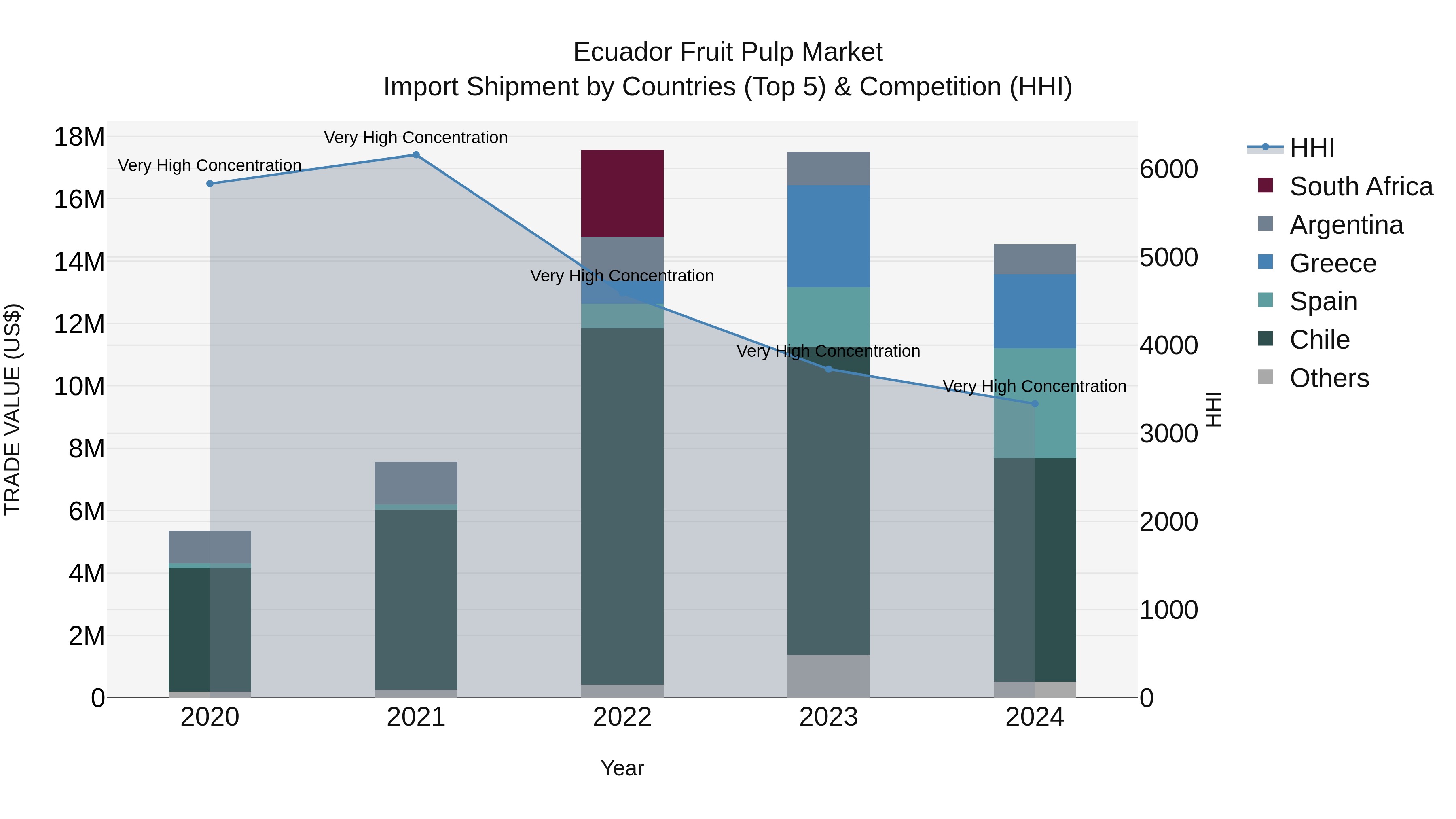
Despite a high concentration with the top exporting countries, Ecuador`s fruit pulp import Market Top 5 Importing Countries and Market Competition (HHI) Analysis experienced significant growth with a CAGR of 28.33% from 2020 to 2024. However, there was a slight decline in growth rate from 2023 to 2024 at -16.93%. The top countries exporting to Ecuador in 2024 include Chile, Spain, Greece, Argentina, and Peru, showcasing a diverse range of sources for fruit pulp imports. This data highlights the continued importance of these trade relationships in supplying Ecuador`s demand for fruit pulp.
Ecuador Fruit Pulp Market Overview
The fruit pulp market in Ecuador is benefiting from the country`s rich agricultural landscape and growing consumer demand for natural ingredients. Fruit pulp is widely used in the food and beverage industry for products such as juices, smoothies, and desserts. The increasing trend towards health and wellness is driving the demand for natural fruit-based products. Manufacturers are focusing on quality and sustainability, exploring innovative processing techniques to preserve flavor and nutrition.
Drivers of the market
The fruit pulp market in Ecuador is driven by the increasing demand for natural and healthy food products. As consumers become more health-conscious, the demand for fruit-based products, such as juices, smoothies, and desserts, is rising. The growth of the food and beverage industry, coupled with the trend towards clean label products, is supporting the fruit pulp market. Additionally, advancements in processing technologies and the expansion of distribution channels are enhancing the availability and appeal of fruit pulp products.
Challenges of the market
Ecuadors fruit pulp market is challenged by high processing costs and seasonal fluctuations in fruit supply. Export opportunities are limited by quality standards in international markets, requiring investments in improved processing technology.
Government Policy of the market
Ecuador`s government is focusing on the fruit pulp market to promote local agriculture and food processing industries. Policies are being developed to support farmers and manufacturers in producing high-quality fruit pulp that meets health and safety standards. The government encourages research initiatives aimed at enhancing processing techniques and product quality. Public awareness campaigns will educate consumers about the nutritional benefits of fruit pulp and its uses in various food applications.
Key Highlights of the Report:
- Ecuador Fruit Pulp Market Outlook
- Market Size of Ecuador Fruit Pulp Market, 2024
- Forecast of Ecuador Fruit Pulp Market, 2031
- Historical Data and Forecast of Ecuador Fruit Pulp Revenues & Volume for the Period 2021-2031
- Ecuador Fruit Pulp Market Trend Evolution
- Ecuador Fruit Pulp Market Drivers and Challenges
- Ecuador Fruit Pulp Price Trends
- Ecuador Fruit Pulp Porter`s Five Forces
- Ecuador Fruit Pulp Industry Life Cycle
- Historical Data and Forecast of Ecuador Fruit Pulp Market Revenues & Volume By Fruit Type for the Period 2021-2031
- Historical Data and Forecast of Ecuador Fruit Pulp Market Revenues & Volume By Mango for the Period 2021-2031
- Historical Data and Forecast of Ecuador Fruit Pulp Market Revenues & Volume By Strawberry for the Period 2021-2031
- Historical Data and Forecast of Ecuador Fruit Pulp Market Revenues & Volume By Apple for the Period 2021-2031
- Historical Data and Forecast of Ecuador Fruit Pulp Market Revenues & Volume By Guava for the Period 2021-2031
- Historical Data and Forecast of Ecuador Fruit Pulp Market Revenues & Volume By Berries for the Period 2021-2031
- Historical Data and Forecast of Ecuador Fruit Pulp Market Revenues & Volume By Citrus Fruits for the Period 2021-2031
- Historical Data and Forecast of Ecuador Fruit Pulp Market Revenues & Volume By Others for the Period 2021-2031
- Historical Data and Forecast of Ecuador Fruit Pulp Market Revenues & Volume By Form for the Period 2021-2031
- Historical Data and Forecast of Ecuador Fruit Pulp Market Revenues & Volume By Liquid for the Period 2021-2031
- Historical Data and Forecast of Ecuador Fruit Pulp Market Revenues & Volume By Powder for the Period 2021-2031
- Historical Data and Forecast of Ecuador Fruit Pulp Market Revenues & Volume By Application for the Period 2021-2031
- Historical Data and Forecast of Ecuador Fruit Pulp Market Revenues & Volume By Food and Beverages for the Period 2021-2031
- Historical Data and Forecast of Ecuador Fruit Pulp Market Revenues & Volume By Distribution for the Period 2021-2031
- Historical Data and Forecast of Ecuador Fruit Pulp Market Revenues & Volume By E-Commerce for the Period 2021-2031
- Historical Data and Forecast of Ecuador Fruit Pulp Market Revenues & Volume By Convenience Stores for the Period 2021-2031
- Historical Data and Forecast of Ecuador Fruit Pulp Market Revenues & Volume By Supermarkets/Hypermarkets for the Period 2021-2031
- Historical Data and Forecast of Ecuador Fruit Pulp Market Revenues & Volume By Specialty Stores for the Period 2021-2031
- Historical Data and Forecast of Ecuador Fruit Pulp Market Revenues & Volume By Others for the Period 2021-2031
- Ecuador Fruit Pulp Import Export Trade Statistics
- Market Opportunity Assessment By Fruit Type
- Market Opportunity Assessment By Form
- Market Opportunity Assessment By Application
- Market Opportunity Assessment By Distribution
- Ecuador Fruit Pulp Top Companies Market Share
- Ecuador Fruit Pulp Competitive Benchmarking By Technical and Operational Parameters
- Ecuador Fruit Pulp Company Profiles
- Ecuador Fruit Pulp Key Strategic Recommendations






































