Egypt Edible Oil Market Size Growth Rate
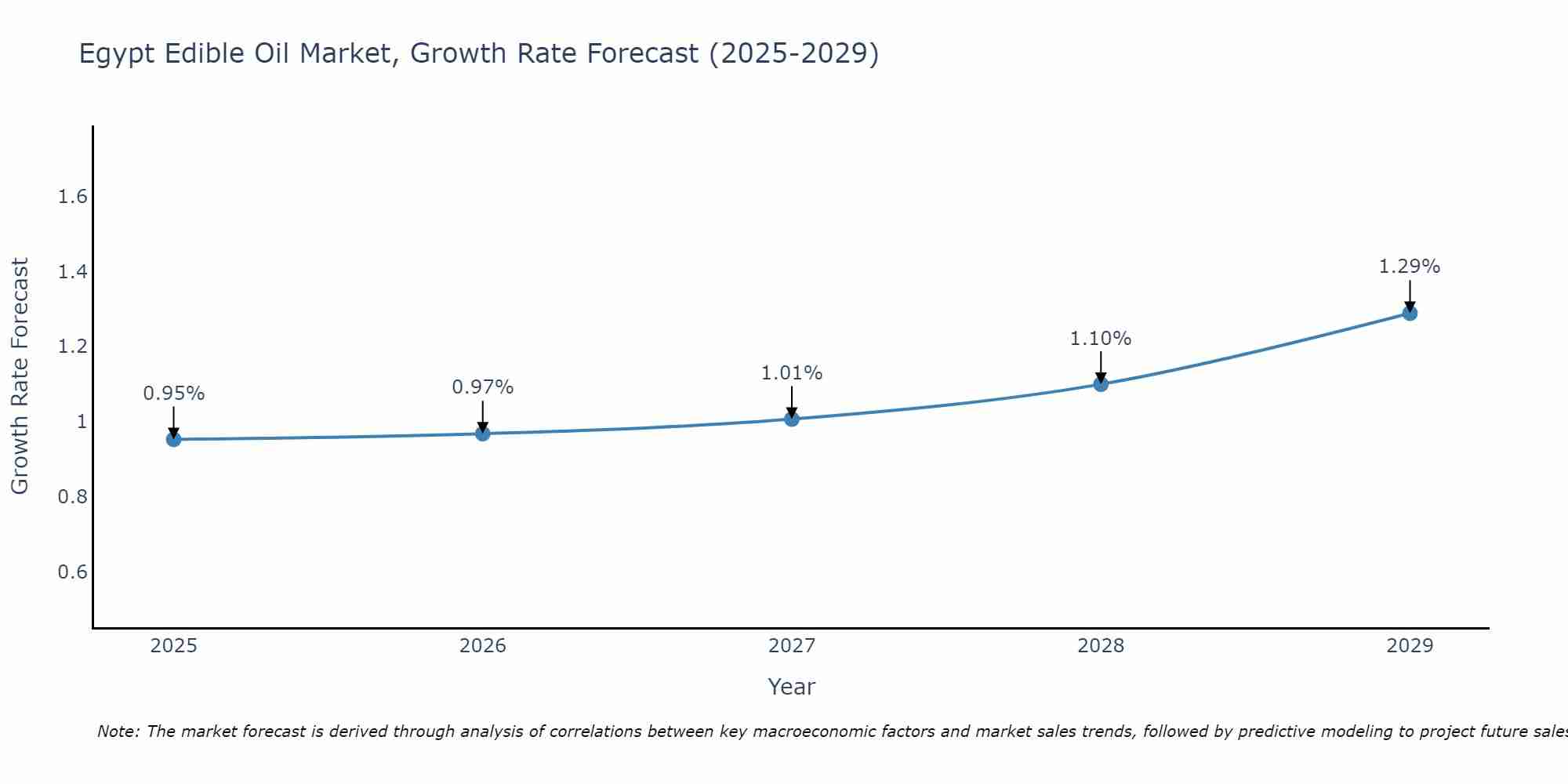
The Egypt Edible Oil Market is likely to experience consistent growth rate gains over the period 2025 to 2029. From 0.95% in 2025, the growth rate steadily ascends to 1.29% in 2029.
Egypt Edible Oil Market Overview
The Egypt edible oil market is characterized by a growing consumer demand for healthier cooking oils, such as sunflower oil and olive oil, driven by increasing awareness of the health benefits associated with these oils. The market is also influenced by the country`s economic conditions, population growth, and dietary preferences. Key players in the market include local brands like Oleev and Afia, as well as international brands like Lurpak and Bertolli. The market is competitive, with companies focusing on product innovation, quality, and pricing strategies to maintain and increase their market share. Retail channels, including supermarkets, hypermarkets, and online platforms, play a crucial role in distributing edible oils to consumers across Egypt. Overall, the Egypt edible oil market presents opportunities for growth and expansion, particularly for companies offering healthier and premium oil products.
Egypt Edible Oil Market Trends
Currently, the Egypt Edible Oil Market is experiencing a shift towards healthier options, with a growing demand for oils such as olive oil and sunflower oil due to their perceived health benefits. Consumers are becoming more health-conscious and are opting for oils that are lower in saturated fats and higher in unsaturated fats. Additionally, there is a trend towards locally sourced and organic edible oils, as consumers are placing a greater emphasis on sustainability and environmental impact. The market is also seeing increased competition among manufacturers, leading to product innovation and the introduction of new variants to cater to changing consumer preferences. Overall, the Egypt Edible Oil Market is evolving to meet the demands of a more health-conscious and environmentally conscious consumer base.
Egypt Edible Oil Market Challenges
In the Egypt Edible Oil Market, some of the key challenges faced include the fluctuation in global oil prices impacting the cost of imported edible oils, leading to pricing concerns for both consumers and producers. Additionally, the market is highly competitive with both domestic and international players vying for market share, resulting in pressure on margins and the need for constant innovation to stay competitive. Moreover, issues such as food safety regulations, supply chain disruptions, and changing consumer preferences towards healthier alternatives like olive oil pose further challenges for the industry players. Overall, navigating through these challenges requires strategic planning, efficient supply chain management, product differentiation, and a deep understanding of consumer preferences in order to sustain growth and profitability in the Egypt Edible Oil Market.
Egypt Edible Oil Market Investment Opportunities
The Egypt Edible Oil Market presents various investment opportunities due to the country`s growing population and increasing consumption of edible oils. Potential investments could include establishing production facilities for popular edible oils such as sunflower oil, soybean oil, and palm oil to meet the rising demand. Additionally, investing in distribution networks and marketing strategies to reach a wider consumer base could be beneficial. With a focus on quality, packaging innovation, and sustainability practices, investors can differentiate their products in the market and capture a larger market share. Moreover, exploring opportunities for value-added products like organic or specialty oils could cater to the evolving consumer preferences in Egypt and potentially yield higher profit margins in the long run.
Egypt Edible Oil Market Government Policy
Government policies related to the Egypt Edible Oil Market primarily revolve around ensuring food security and regulating the import and production of edible oils. The government has implemented measures such as tariff adjustments, subsidies, and import restrictions to stabilize prices and support local producers. Additionally, Egypt has introduced quality control standards and inspections to maintain the safety and quality of edible oils in the market. The government aims to reduce dependency on imports and promote domestic production through various incentives and support programs. Overall, the policies are geared towards maintaining a stable supply of edible oils, protecting consumers, and supporting the growth of the domestic edible oil industry.
Egypt Edible Oil Market Future Outlook
The Egypt Edible Oil Market is expected to witness steady growth in the coming years due to factors such as population growth, increasing disposable income, and changing dietary habits. The market is likely to benefit from the rising awareness among consumers regarding the health benefits of different types of edible oils, leading to a shift towards healthier options such as olive oil and sunflower oil. Additionally, the growing food processing industry in Egypt is expected to drive the demand for edible oils as a key ingredient in various food products. However, challenges such as price fluctuations in raw materials and intense competition among market players may impact market growth. Overall, with the increasing focus on health and wellness, the Egypt Edible Oil Market is poised for expansion in the foreseeable future.
Key Highlights of the Report:
- Egypt Edible Oil Market Outlook
- Market Size of Egypt Edible Oil Market, 2021
- Forecast of Egypt Edible Oil Market, 2031
- Historical Data and Forecast of Egypt Edible Oil Revenues & Volume for the Period 2018 - 2031
- Egypt Edible Oil Market Trend Evolution
- Egypt Edible Oil Market Drivers and Challenges
- Egypt Edible Oil Price Trends
- Egypt Edible Oil Porter's Five Forces
- Egypt Edible Oil Industry Life Cycle
- Historical Data and Forecast of Egypt Edible Oil Market Revenues & Volume By Type for the Period 2018 - 2031
- Historical Data and Forecast of Egypt Edible Oil Market Revenues & Volume By Palm Oil for the Period 2018 - 2031
- Historical Data and Forecast of Egypt Edible Oil Market Revenues & Volume By Soybean Oil for the Period 2018 - 2031
- Historical Data and Forecast of Egypt Edible Oil Market Revenues & Volume By Mustard Oil for the Period 2018 - 2031
- Historical Data and Forecast of Egypt Edible Oil Market Revenues & Volume By Sunflower Oil for the Period 2018 - 2031
- Historical Data and Forecast of Egypt Edible Oil Market Revenues & Volume By Others for the Period 2018 - 2031
- Historical Data and Forecast of Egypt Edible Oil Market Revenues & Volume By for the Period 2018 - 2031
- Historical Data and Forecast of Egypt Edible Oil Market Revenues & Volume By Packaging Type for the Period 2018 - 2031
- Historical Data and Forecast of Egypt Edible Oil Market Revenues & Volume By Pouches for the Period 2018 - 2031
- Historical Data and Forecast of Egypt Edible Oil Market Revenues & Volume By Jars for the Period 2018 - 2031
- Historical Data and Forecast of Egypt Edible Oil Market Revenues & Volume By Cans for the Period 2018 - 2031
- Historical Data and Forecast of Egypt Edible Oil Market Revenues & Volume By Bottles for the Period 2018 - 2031
- Historical Data and Forecast of Egypt Edible Oil Market Revenues & Volume By for the Period 2018 - 2031
- Historical Data and Forecast of Egypt Edible Oil Market Revenues & Volume By Pack Size for the Period 2018 - 2031
- Historical Data and Forecast of Egypt Edible Oil Market Revenues & Volume By Less than 1 Litres for the Period 2018 - 2031
- Historical Data and Forecast of Egypt Edible Oil Market Revenues & Volume By 1 Litres for the Period 2018 - 2031
- Historical Data and Forecast of Egypt Edible Oil Market Revenues & Volume By 1 Litres - 5 litres for the Period 2018 - 2031
- Historical Data and Forecast of Egypt Edible Oil Market Revenues & Volume By 5 Litres - 10 Litres for the Period 2018 - 2031
- Historical Data and Forecast of Egypt Edible Oil Market Revenues & Volume By 10 Litres and Above for the Period 2018 - 2031
- Historical Data and Forecast of Egypt Edible Oil Market Revenues & Volume By for the Period 2018 - 2031
- Historical Data and Forecast of Egypt Edible Oil Market Revenues & Volume By Packaging Material for the Period 2018 - 2031
- Historical Data and Forecast of Egypt Edible Oil Market Revenues & Volume By Metal for the Period 2018 - 2031
- Historical Data and Forecast of Egypt Edible Oil Market Revenues & Volume By Plastic for the Period 2018 - 2031
- Historical Data and Forecast of Egypt Edible Oil Market Revenues & Volume By Paper for the Period 2018 - 2031
- Historical Data and Forecast of Egypt Edible Oil Market Revenues & Volume By Others for the Period 2018 - 2031
- Historical Data and Forecast of Egypt Edible Oil Market Revenues & Volume By Application for the Period 2018 - 2031
- Historical Data and Forecast of Egypt Edible Oil Market Revenues & Volume By HoReCa for the Period 2018 - 2031
- Historical Data and Forecast of Egypt Edible Oil Market Revenues & Volume By Home Users for the Period 2018 - 2031
- Historical Data and Forecast of Egypt Edible Oil Market Revenues & Volume By Food Processing Industry for the Period 2018 - 2031
- Historical Data and Forecast of Egypt Edible Oil Market Revenues & Volume By for the Period 2018 - 2031
- Historical Data and Forecast of Egypt Edible Oil Market Revenues & Volume By Distribution Channel for the Period 2018 - 2031
- Historical Data and Forecast of Egypt Edible Oil Market Revenues & Volume By Direct/Institutional Sales for the Period 2018 - 2031
- Historical Data and Forecast of Egypt Edible Oil Market Revenues & Volume By Supermarkets and Hypermarkets for the Period 2018 - 2031
- Historical Data and Forecast of Egypt Edible Oil Market Revenues & Volume By Convenience Stores for the Period 2018 - 2031
- Historical Data and Forecast of Egypt Edible Oil Market Revenues & Volume By Online for the Period 2018 - 2031
- Historical Data and Forecast of Egypt Edible Oil Market Revenues & Volume By Others for the Period 2018 - 2031
- Egypt Edible Oil Import Export Trade Statistics
- Market Opportunity Assessment By Type
- Market Opportunity Assessment By Packaging Type
- Market Opportunity Assessment By Pack Size
- Market Opportunity Assessment By Packaging Material
- Market Opportunity Assessment By Application
- Market Opportunity Assessment By Distribution Channel
- Egypt Edible Oil Top Companies Market Share
- Egypt Edible Oil Competitive Benchmarking By Technical and Operational Parameters
- Egypt Edible Oil Company Profiles
- Egypt Edible Oil Key Strategic Recommendations






































