Egypt Insurance Telematics Market Size & Growth Rate (2026-2032)
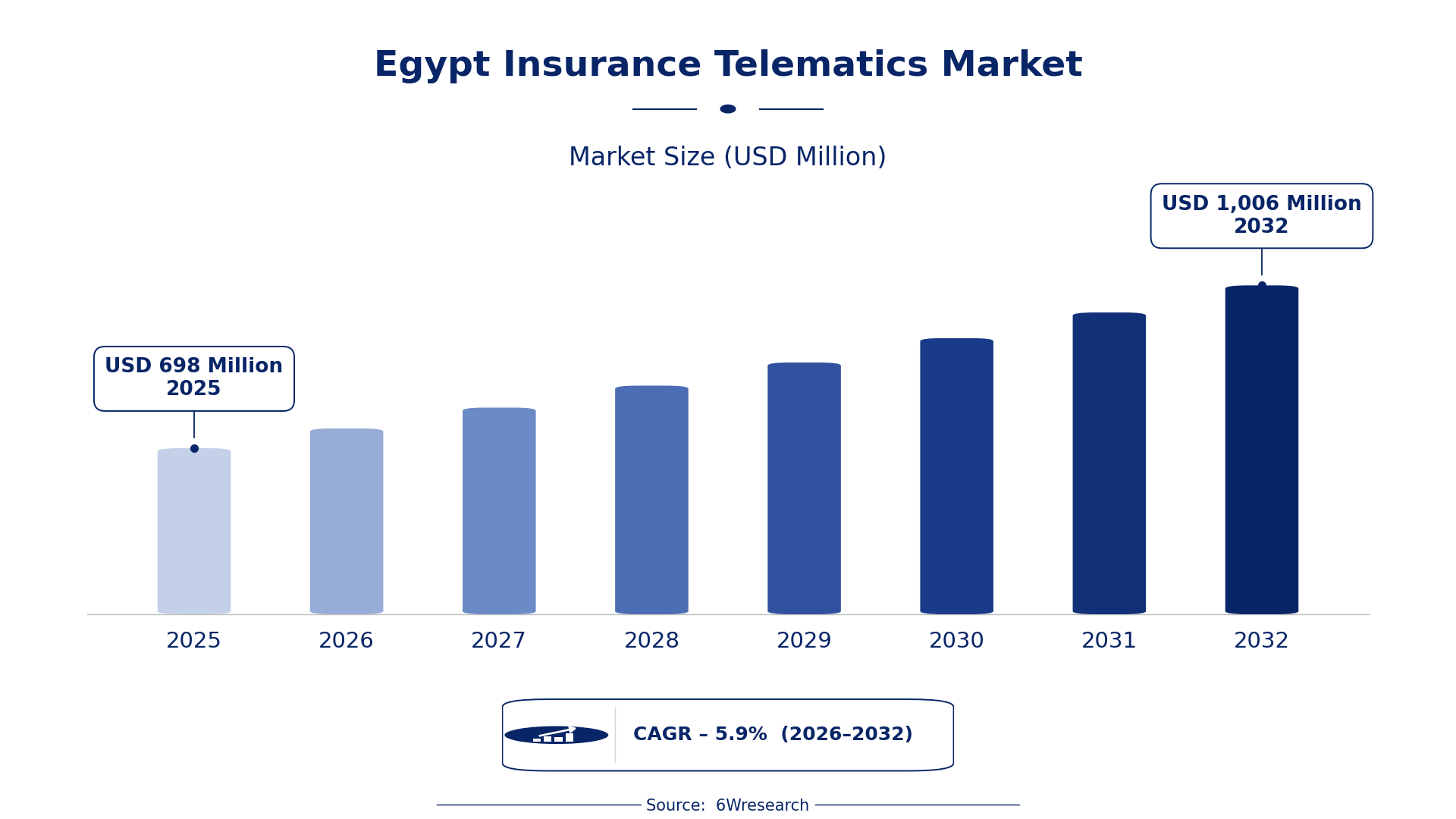
The Egypt Insurance Telematics Market was estimated at USD 698 Million in 2025 and is projected to reach USD 1006 Million by 2032, growing at a CAGR of 5.9% from 2026 to 2032.
Egypt Insurance Telematics Market Synopsis
The insurance telematics sector in Egypt is experiencing a notable shift as insurers increasingly integrate telematics solutions into their offerings. This technology enables insurers to track driving behaviors and assess risks more accurately, facilitating the development of usage-based insurance models. As the demand for personalized and data-driven insurance products surges, telematics is becoming essential for both insurers and policyholders.
The drive towards connected vehicle technologies is a critical factor boosting the Egypt Insurance Telematics Market. Insurers are not only enhancing customer engagement through personalized services but are also looking to improve their operational efficiency. However, challenges remain, particularly concerning consumer awareness and the costs associated with implementing these advanced solutions.
Egypt Insurance Telematics Market Year-wise Growth Rate and Key Drivers
This graph illustrates the annual growth rates of the Egypt Insurance Telematics Market from 2021 to 2032, highlighting a steady upward trajectory and projected expansion over the forecast period.
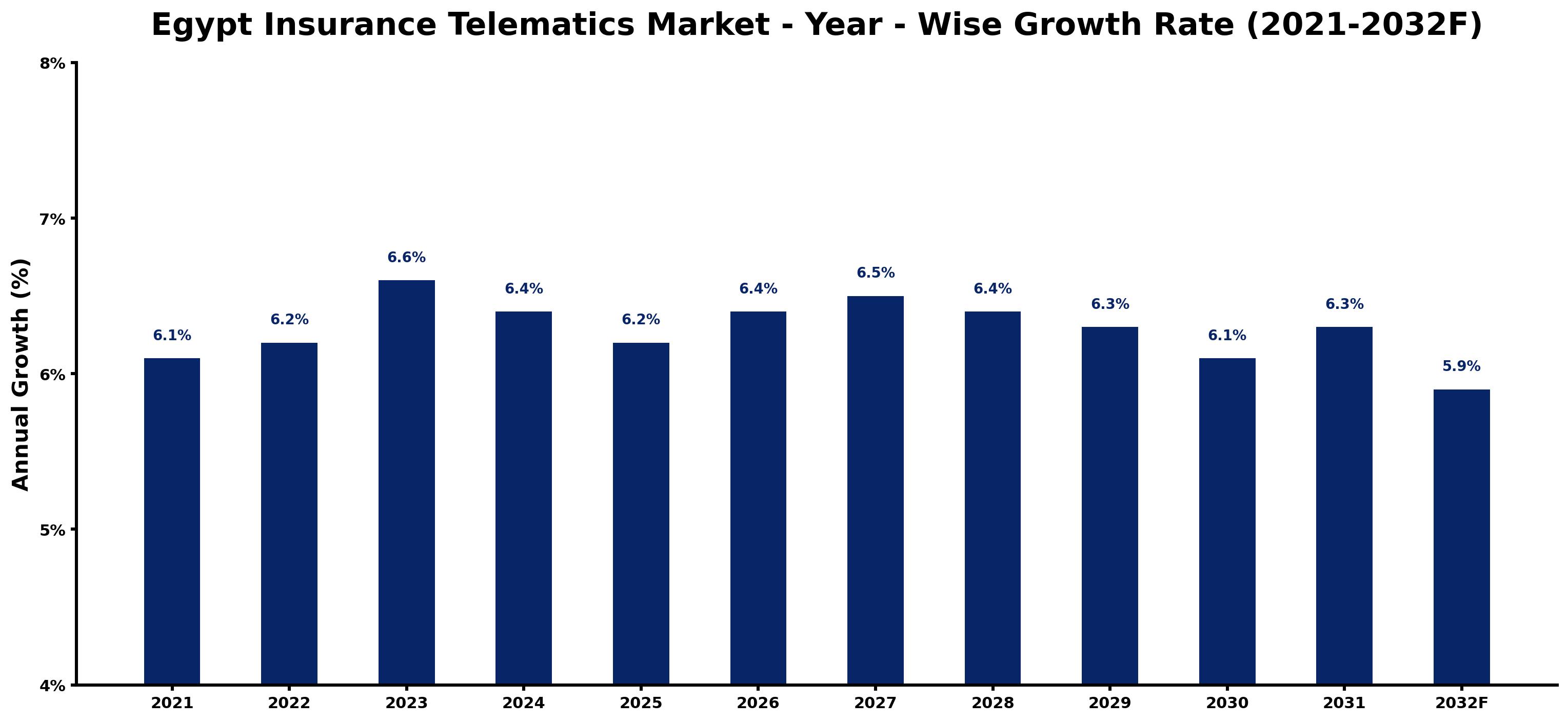
The table below presents the year‑wise growth rates along with the key drivers influencing the market
| Year | Growth Rate | Major Drivers |
| 2021 | 6.1% | Integration of telematics in local insurance policies. |
| 2022 | 6.2% | Government incentives for smart vehicle technology adoption. |
| 2023 | 6.6% | Rising consumer awareness of usage-based insurance options. |
| 2024 | 6.4% | Increased demand for vehicle safety features among consumers. |
| 2025 | 6.2% | Partnerships between insurers and telematics service providers. |
| 2026 | 6.4% | Boost in smartphone penetration enhancing telematics solutions. |
| 2027 | 6.5% | Regulatory push for road safety data collection initiatives. |
| 2028 | 6.4% | Growing interest in personalized insurance premium models. |
| 2029 | 6.3% | Insurance companies leveraging AI for telematics analytics. |
| 2030 | 6.1% | Collaboration with local automotive manufacturers on telematics. |
| 2031 | 6.3% | Young population driving demand for tech-savvy insurance. |
| 2032 | 5.9% | Emerging focus on sustainability in vehicle insurance options. |
Note: Market size estimations and growth projections presented in this report are based on 6Wresearch's proprietary forecasting methodology, utilizing the latest available industry data, government publications, and primary research inputs.
Egypt Insurance Telematics Market Key Takeaways
Below are some of the specific key takeaways from the market, including:
- The market is leveraging real-time data collection to offer personalized insurance products.
- Investments in telematics are rising as insurers focus on reducing risks and enhancing road safety.
- Consumer awareness remains a barrier to broader adoption of telematics solutions.
- Regulatory frameworks are evolving to address data privacy and compliance issues.
- Technological advancements are driving competitive strategies among insurers.
Evaluation of Restraints in Egypt Insurance Telematics Market
The Egypt Insurance Telematics Market faces notable restraints that could hinder its growth trajectory. A significant barrier is the low consumer awareness regarding telematics technology and its benefits, which can lead to resistance from traditional drivers. Many potential users are unaware of how data can impact their premiums and overall risk management. on top of that, smaller insurance firms often find the costs associated with implementing telematics solutions prohibitively high, limiting their ability to compete. Regulatory challenges surrounding data privacy add another layer of complexity, requiring compliance investments that can be daunting for smaller players.
Egypt Insurance Telematics Market Trends
Key trends are shaping the Egypt Insurance Telematics Market, particularly the rise of connected vehicle technology. With more vehicles equipped with telematics devices, insurers can gather extensive data on driver behavior, paving the way for innovative insurance models that reward safe driving. Additionally, there is a growing emphasis on integrating artificial intelligence to enhance data analysis, enabling insurers to better predict risks and tailor offerings. Consumer demand for transparent pricing and personalized insurance experiences continues to drive market dynamics.
Egypt Insurance Telematics Market Opportunities
The future holds genuine growth prospects for the Egypt Insurance Telematics Market. As awareness of telematics technology increases, insurers have the chance to expand their customer base by offering more competitive and tailored insurance products. There is significant potential for partnerships between insurers and technology providers to develop innovative solutions that enhance data accuracy and customer engagement. on top of that, as government policies increasingly support the adoption of telematics, insurers can capitalize on this momentum to enhance their market presence.
Government Initiatives in the Egypt Insurance Telematics Market
The Egyptian government is actively fostering the growth of the insurance telematics sector through supportive policies and initiatives. These efforts aim to enhance the effectiveness of vehicle insurance services and encourage the adoption of technology that improves risk assessment and customer engagement. With a focus on regulatory compliance and consumer rights, the government is setting the stage for a more robust insurance telematics market.
- A regulatory framework established in 2023 mandates the use of telematics for risk assessment in vehicle insurance.
- A recently completed initiative in early 2024 focused on enhancing data privacy protections for consumers using telematics devices.
- Current efforts are underway to develop educational campaigns aimed at increasing consumer awareness of telematics benefits.
- A planned public-private partnership expected to launch in 2025 aims to subsidize telematics device installations for small insurers.
- Ongoing consultations with stakeholders to refine data usage policies are expected to conclude by mid-2025.
Future Insights of the Egypt Insurance Telematics Market
Looking ahead to 2026-2032, the Egypt Insurance Telematics Market is likely to experience accelerated growth as technological advancements continue to evolve. The increasing availability of connected vehicles will provide insurers with unprecedented access to real-time data. This data will not only enable more accurate risk assessments but will also facilitate the development of innovative insurance products tailored to individual driving behaviors. As consumer awareness grows and regulatory frameworks support technology adoption, the market is well-positioned for expansion.
Egypt Insurance Telematics Market Latest Developments
In the past year, the Egypt Insurance Telematics Market has seen a flurry of activity as insurers and technology providers navigate the evolving landscape. Initiatives aimed at enhancing telematics capabilities and consumer engagement are gaining traction. The focus is increasingly on integrating advanced analytics and artificial intelligence to refine underwriting processes and claims management.
- A major technology vendor launched an upgraded telematics solution in early 2024, enhancing data accuracy for insurers.
- In mid-2024, a regional insurer initiated a pilot program to test usage-based insurance models, showcasing the potential for lower premiums for safe drivers.
- Ongoing collaborations between insurers and automotive manufacturers are set to enhance the integration of telematics into new vehicle models.
- A planned rollout of a comprehensive telematics education program targeting consumers is expected to begin in late 2025.
- A new partnership formed in early 2024 aims to streamline data sharing between insurers and telematics providers, enhancing operational efficiency.
Egypt Insurance Telematics Market - Key Attractiveness of the Report
- 10 Years of Market Numbers
- Historical Data Starting from 2022 to 2025
- Base Year: 2025
- Forecast Data until 2032
- Key Performance Indicators Impacting the Market
- Major Upcoming Developments and Projects
Key Highlights of the Report:
- Egypt Insurance Telematics Market Outlook
- Market Size of Egypt Insurance Telematics Market, 2025
- Forecast of Egypt Insurance Telematics Market, 2032
- Historical Data and Forecast of Egypt Insurance Telematics Revenues & Volume for the Period 2022-2032F
- Egypt Insurance Telematics Market Trend Evolution
- Egypt Insurance Telematics Market Drivers and Challenges
- Egypt Insurance Telematics Price Trends
- Egypt Insurance Telematics Porter's Five Forces
- Egypt Insurance Telematics Industry Life Cycle
- Historical Data and Forecast of Egypt Insurance Telematics Market Revenues & Volume By End User for the Period 2022-2032F
- Historical Data and Forecast of Egypt Insurance Telematics Market Revenues & Volume By Small for the Period 2022-2032F
- Historical Data and Forecast of Egypt Insurance Telematics Market Revenues & Volume By Medium Enterprises for the Period 2022-2032F
- Historical Data and Forecast of Egypt Insurance Telematics Market Revenues & Volume By Large Enterprises for the Period 2022-2032F
- Historical Data and Forecast of Egypt Insurance Telematics Market Revenues & Volume By Deployment Type for the Period 2022-2032F
- Historical Data and Forecast of Egypt Insurance Telematics Market Revenues & Volume By Cloud for the Period 2022-2032F
- Historical Data and Forecast of Egypt Insurance Telematics Market Revenues & Volume By On-Premises for the Period 2022-2032F
- Historical Data and Forecast of Egypt Insurance Telematics Market Revenues & Volume By Organization Size for the Period 2022-2032F
- Historical Data and Forecast of Egypt Insurance Telematics Market Revenues & Volume By Small and Medium Enterprises (SMEs) for the Period 2022-2032F
- Historical Data and Forecast of Egypt Insurance Telematics Market Revenues & Volume By Large Enterprises for the Period 2022-2032F
- Egypt Insurance Telematics Import Export Trade Statistics
- Market Opportunity Assessment By End User
- Market Opportunity Assessment By Deployment Type
- Market Opportunity Assessment By Organization Size
- Egypt Insurance Telematics Top Companies Market Share
- Egypt Insurance Telematics Competitive Benchmarking By Technical and Operational Parameters
- Egypt Insurance Telematics Company Profiles
- Egypt Insurance Telematics Key Strategic Recommendations






































