Egypt Managed Security Services Market Summary
The egypt managed security services market was estimated at USD 431 Million in 2025 and is projected to reach USD 566 Million by 2032, growing at a CAGR of 4.4% from 2026 to 2032.
Egypt Managed Security Services Market Year-wise Growth Rate and Key Drivers
This graph highlights how the Egypt Managed Security Services Market has steadily grown over the past five years, supported by major growth factors.
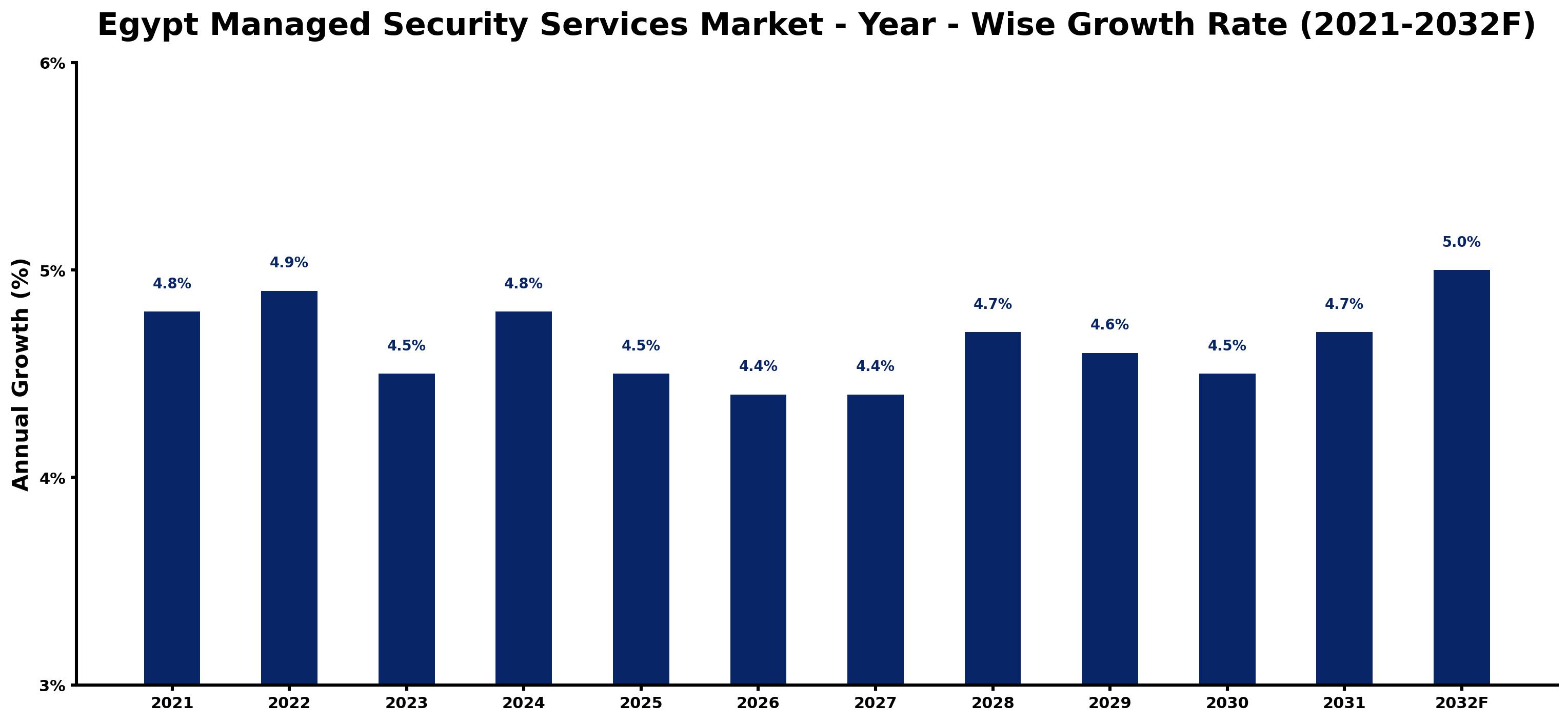
The table below presents the year wise growth rates along with the key drivers influencing the market
| Year | Growth Rate | Major Drivers |
| 2021 | 4.8% | Emerging cybersecurity threats prompted businesses to rethink their security infrastructures. |
| 2022 | 4.9% | Increased digital transformation initiatives accelerated investment in managed security solutions. |
| 2023 | 4.5% | Local enterprises faced sophisticated attacks, underscoring the need for specialized security services. |
| 2024 | 4.8% | Financial institutions prioritized advanced threat detection, boosting managed service providers' relevance. |
| 2025 | 4.5% | Collaborations between tech firms and government enhanced cybersecurity frameworks across critical sectors. |
| 2026 | 4.4% | The growing number of IoT devices introduced complex security challenges for businesses. |
| 2027 | 4.4% | Cybersecurity insurance demand increased, reflecting organizations' awareness of potential risks. |
| 2028 | 4.7% | Evolving regulatory landscapes necessitated compliance-focused managed security offerings from providers. |
| 2029 | 4.6% | Investment in AI-driven analytics transformed threat response capabilities across managed services. |
| 2030 | 4.5% | Rising cybercrime incidents led to heightened awareness of managed security's importance. |
| 2031 | 4.7% | Corporate partnerships amplified the development of tailored cybersecurity solutions for diverse sectors. |
| 2032 | 5.0% | Emerging markets embraced managed security services, influencing regional growth dynamics significantly. |
Note - Market size estimations and growth projections presented in this report are based on 6Wresearch's advanced forecasting approach, validated with industry datasets as of June 2026.
Egypt Managed Security Services Market Synopsis
The Egypt Managed Security Services Market is projected to reach 4.4% and witness significant growth during the forecast period (2026-2032). This growth is primarily driven by an increasing demand for enhanced security solutions among large organizations. The rising awareness of data breaches and the prevalence of cyber-attacks have catalyzed the adoption of managed security services across various sectors, including Banking, Financial Services and Insurance (BFSI), manufacturing, IT telecommunications, government, and more. Technological advancements, particularly in cloud computing and the Internet of Things (IoT), have further propelled the market, leading to heightened demand for these security services. The expanding volume of digital transactions, particularly through e-commerce platforms, is expected to contribute significantly to market growth. Moreover, supportive initiatives from the national government are fostering a conducive environment for industry expansion, which is crucial for the future of the Egypt managed security services market.
Egypt Managed Security Services Market Growth Drivers
Multiple factors are driving the growth of the Egypt managed security services market. First, the increasing frequency of cyber threats is motivating organizations to invest in robust security measures. This trend is particularly evident in sectors handling sensitive information, such as financial services and healthcare.
- The surge in digital transactions has made organizations more vulnerable to cyber-attacks, thus enhancing the urgency for managed security solutions.
- With the rapid adoption of cloud services, businesses are seeking specialized managed security services to safeguard their online infrastructures.
- Increased regulatory compliance requirements are compelling organizations to secure sensitive data, driving the demand for these services.
- Awareness among enterprises about the cost-effectiveness of outsourcing security functions is leading to greater acceptance of managed security services.
- The growing IoT ecosystem is introducing new vulnerabilities, creating a pressing need for comprehensive security management strategies.
Egypt Managed Security Services Market Challenges and Restraints
Despite the promising growth prospects, there are challenges that the Egypt managed security services market may face. These obstacles could hinder the pace of adoption and implementation of managed security solutions.
- The shortage of skilled cybersecurity professionals in Egypt can impede the effective deployment and management of security services.
- Concerns regarding data privacy and compliance with local regulations pose significant barriers to the implementation of third-party security services.
- High costs associated with advanced security solutions could deter small and medium-sized enterprises from adopting managed services.
- The rapidly evolving nature of cyber threats necessitates constant updates and improvements in security measures, posing an operational challenge for service providers.
- The perception among some organizations that in-house security measures are sufficient can limit the market for managed services.
Egypt Managed Security Services Market Government Investment and Initiatives
The Egyptian government has recognized the critical importance of cybersecurity within its digital transformation agenda. As such, it has initiated several policies and investments aimed at bolstering the managed security services market. These initiatives include increased funding for cybersecurity infrastructure and programs designed to enhance national security. Furthermore, the government is actively collaborating with private sector partners to develop specialized training programs to cultivate local cybersecurity talent. Additional public-private partnerships are being fostered to encourage innovation in security technologies, which is expected to stimulate the overall growth of the market. Moreover, legislative efforts are underway to establish a comprehensive cybersecurity framework, which will provide institutions with clear guidelines and standards for security management, thus contributing positively to the managed security services landscape.
Egypt Managed Security Services Market Latest Developments (May 2025 - June 2026)
Recent developments in the Egypt managed security services market reflect an ongoing commitment to strengthening cybersecurity measures across various sectors. The period from May 2025 to June 2026 has seen increased collaboration between government agencies and private enterprises, aimed at fostering innovation in security solutions. Initiatives promoting public awareness regarding the significance of cybersecurity have garnered attention, leading to an uptick in demand for managed services. Furthermore, industry stakeholders are harnessing advanced technologies, such as artificial intelligence and machine learning, to enhance the effectiveness of security operations. As businesses increasingly migrate to cloud environments, managed service providers are adapting their offerings to meet the evolving threat landscape, ensuring that organizations are better equipped to face emerging cyber challenges. Overall, the market is experiencing a transformative phase, positioning itself for sustained growth in the coming years.
Egypt Managed Security Services Market - Key Attractiveness of the Report
- 10 Years of Market Numbers
- Historical Data Starting from 2022 to 2025
- Base Year: 2025
- Forecast Data until 2032
- Key Performance Indicators Impacting the Market
- Major Upcoming Developments and Projects
Key Highlights of the Report:
- Egypt Managed Security Services Market Outlook
- Market Size of Egypt Managed Security Services Market, 2025
- Forecast of Egypt Managed Security Services Market, 2032
- Historical Data and Forecast of Egypt Managed Security Services Revenues & Volume for the Period 2022-2032
- Egypt Managed Security Services Market Trend Evolution
- Egypt Managed Security Services Market Drivers and Challenges
- Egypt Managed Security Services Price Trends
- Egypt Managed Security Services Porter's Five Forces
- Egypt Managed Security Services Industry Life Cycle
- Historical Data and Forecast of Egypt Managed Security Services Market Revenues & Volume By Type for the Period 2022-2032
- Historical Data and Forecast of Egypt Managed Security Services Market Revenues & Volume By Unified threat management for the Period 2022-2032
- Historical Data and Forecast of Egypt Managed Security Services Market Revenues & Volume By DDoS for the Period 2022-2032
- Historical Data and Forecast of Egypt Managed Security Services Market Revenues & Volume By Managed SIEM for the Period 2022-2032
- Historical Data and Forecast of Egypt Managed Security Services Market Revenues & Volume By Managed endpoint threat detection for the Period 2022-2032
- Historical Data and Forecast of Egypt Managed Security Services Market Revenues & Volume By Managed two factor authentication for the Period 2022-2032
- Historical Data and Forecast of Egypt Managed Security Services Market Revenues & Volume By Compliance management for the Period 2022-2032
- Historical Data and Forecast of Egypt Managed Security Services Market Revenues & Volume By Vulnerability management for the Period 2022-2032
- Historical Data and Forecast of Egypt Unified threat management Managed Security Services Market Revenues & Volume By Others for the Period 2022-2032
- Historical Data and Forecast of Egypt Managed Security Services Market Revenues & Volume By Deployment for the Period 2022-2032
- Historical Data and Forecast of Egypt Managed Security Services Market Revenues & Volume By Cloud-based for the Period 2022-2032
- Historical Data and Forecast of Egypt Managed Security Services Market Revenues & Volume By On-premise for the Period 2022-2032
- Historical Data and Forecast of Egypt Managed Security Services Market Revenues & Volume By Organization for the Period 2022-2032
- Historical Data and Forecast of Egypt Managed Security Services Market Revenues & Volume By Small and medium enterprises for the Period 2022-2032
- Historical Data and Forecast of Egypt Managed Security Services Market Revenues & Volume By Large enterprises for the Period 2022-2032
- Historical Data and Forecast of Egypt Managed Security Services Market Revenues & Volume By Applications for the Period 2022-2032
- Historical Data and Forecast of Egypt Managed Security Services Market Revenues & Volume By BFSI for the Period 2022-2032
- Historical Data and Forecast of Egypt Managed Security Services Market Revenues & Volume By Government/defense for the Period 2022-2032
- Historical Data and Forecast of Egypt Managed Security Services Market Revenues & Volume By Healthcare for the Period 2022-2032
- Historical Data and Forecast of Egypt Managed Security Services Market Revenues & Volume By Manufacturing for the Period 2022-2032
- Historical Data and Forecast of Egypt Managed Security Services Market Revenues & Volume By Telecom & IT for the Period 2022-2032
- Historical Data and Forecast of Egypt Managed Security Services Market Revenues & Volume By Retail for the Period 2022-2032
- Historical Data and Forecast of Egypt Managed Security Services Market Revenues & Volume By Others for the Period 2022-2032
- Egypt Managed Security Services Import Export Trade Statistics
- Market Opportunity Assessment By Type
- Market Opportunity Assessment By Deployment
- Market Opportunity Assessment By Organization
- Market Opportunity Assessment By Applications
- Egypt Managed Security Services Top Companies Market Share
- Egypt Managed Security Services Competitive Benchmarking By Technical and Operational Parameters
- Egypt Managed Security Services Company Profiles
- Egypt Managed Security Services Key Strategic Recommendations






































