Egypt Oil Country Tubular Goods Market Size, Share & Growth Rate
The Egypt Oil Country Tubular Goods Market was estimated at USD 266 Million in 2025 and is projected to reach USD 358 Million by 2032, growing at a CAGR of 4.3% from 2026 to 2032. This growth is primarily driven by increased exploration and production activities in Egypt's oil and gas sector, spurred by recent discoveries of substantial hydrocarbon reserves. Furthermore, ongoing investments in infrastructure development and a focus on advanced, high-quality OCTG products are expected to sustain this positive trajectory.
Egypt Oil Country Tubular Goods Market Year-wise Growth Rate and Key Drivers
This graph highlights how the Egypt Oil Country Tubular Goods Market has steadily grown over the years, supported by major growth factors.
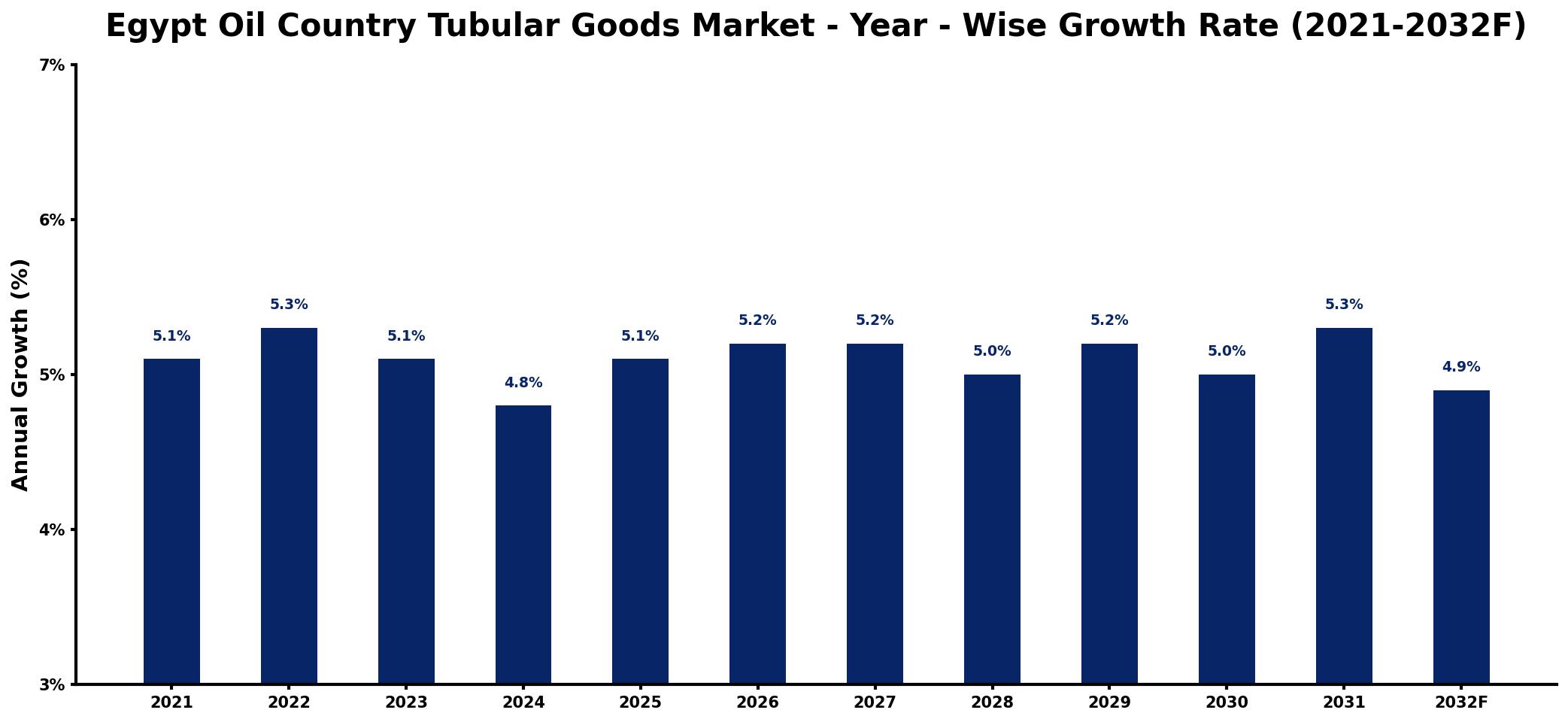
The table below presents the year‑wise growth rates along with the key drivers influencing the market
| Year | Growth Rate | Major Drivers |
| 2021 | 5.1% | Increased energy sector investments |
| 2022 | 5.3% | Expansion of drilling activities |
| 2023 | 5.1% | Growing demand for infrastructure |
| 2024 | 4.8% | Rising exploration project funding |
| 2025 | 5.1% | Enhanced production capabilities planned |
| 2026 | 5.2% | Strengthened international partnerships formed |
| 2027 | 5.2% | Boost in renewable energy initiatives |
| 2028 | 5.0% | Innovations in extraction technologies |
| 2029 | 5.2% | Increased transportation network development |
| 2030 | 5.0% | Strengthened regulatory frameworks established |
| 2031 | 5.3% | Growth in export market opportunities |
| 2032 | 4.9% | Emergence of new market players |
Note: Market size estimations and growth projections presented in this report are based on 6Wresearch's proprietary forecasting methodology, utilizing the latest available industry data, government publications, and primary research inputs.
Egypt Oil Country Tubular Goods Market Synopsis
The burgeoning exploration and production activities in Egypt are the strongest forces shaping the Oil Country Tubular Goods (OCTG) market today. With the government actively encouraging investment in the oil and gas sector, the demand for essential OCTG products such as casing, tubing, and drill pipes continues to rise, making it a critical component of the industry.
Alongside this strong demand, the market is characterized by a noticeable shift towards higher quality and technologically advanced OCTG solutions. Industry stakeholders are increasingly prioritizing cost-effective and environmentally sustainable practices, aligning with the global trends of innovation and sustainability in the oil and gas sector.
Egypt Oil Country Tubular Goods Market Key Takeaways
- The market is projected to grow steadily, driven by rising exploration and production activities.
- Increased focus on high-quality, technologically advanced OCTG products is reshaping market offerings.
- Investment in infrastructure development presents significant opportunities for stakeholders.
- Regulatory frameworks are designed to support local manufacturers while managing import competition.
- Geopolitical factors and fluctuating oil prices remain important considerations for market participants.
Evaluation of Restraints in Egypt Oil Country Tubular Goods Market
Despite the promising growth prospects, several restraints hinder the full potential of the Egypt Oil Country Tubular Goods market. Fluctuating global oil prices present a major risk, directly affecting demand for OCTG products. Furthermore, local manufacturers face stiff competition from international companies, which can undermine domestic production capabilities. Regulatory uncertainties, coupled with geopolitical instability in the region, add further complexity, potentially disrupting supply chains and deterring investment decisions.
Egypt Oil Country Tubular Goods Market Trends
The Egypt OCTG market is witnessing several key trends that influence both demand and technology. Notably, there is an increasing emphasis on the development of environmentally sustainable products and practices. Companies are prioritizing R&D to innovate and enhance their offerings, ensuring they meet stringent operational and regulatory requirements. Additionally, the shift towards cost-effective solutions is prompting companies to explore more efficient manufacturing processes and materials.
Egypt Oil Country Tubular Goods Market Opportunities
Investment opportunities in the Egypt Oil Country Tubular Goods market are ripe, particularly given the countrys strategic location as a key energy player in the region. The ongoing discovery of new oil and gas reserves fuels demand for OCTG products, while the governments support for local production enhances the appeal for investors. Furthermore, expanding infrastructure projects within Egypt's oil and gas sector create a conducive environment for long-term investments in manufacturing and distribution.
Government Initiatives in the Egypt Oil Country Tubular Goods Market
The Egyptian government has implemented various initiatives to regulate and promote the Oil Country Tubular Goods market. These include establishing technical standards aimed at ensuring product quality and safety, alongside licensing requirements for companies operating within this sector. To protect local manufacturers, the government has imposed tariffs on imported OCTG products while providing incentives to encourage investment in domestic production, thereby fostering a more competitive market environment.
Future Insights of the Egypt Oil Country Tubular Goods Market
Looking ahead to the period from 2026 to 2032, the future of the Egypt Oil Country Tubular Goods market appears bright. As exploration and production efforts ramp up, the demand for OCTG products is expected to follow suit, driven by ongoing investments in the sector. However, stakeholders must remain vigilant regarding external factors such as oil price fluctuations and regional geopolitical tensions, as these could significantly impact market dynamics and investment strategies.
Egypt Oil Country Tubular Goods Market Latest Developments (2025 - 2026)
Recent developments in the Egypt Oil Country Tubular Goods market have emphasized a growing trend toward innovation and sustainability. Companies are increasingly launching advanced OCTG products designed to enhance drilling efficiency while meeting global environmental standards. Additionally, partnerships between domestic and international firms are being forged to bolster production capabilities and share technological advancements, positioning the Egyptian market as a competitive player in the regional landscape.
Egypt Oil Country Tubular Goods Market - Key Attractiveness of the Report
- 10 Years of Market Numbers
- Historical Data Starting from 2022 to 2025
- Base Year: 2025
- Forecast Data until 2032
- Key Performance Indicators Impacting the Market
- Major Upcoming Developments and Projects
Key Highlights of the Report:
- Egypt Oil Country Tubular Goods Market Outlook
- Market Size of Egypt Oil Country Tubular Goods Market, 2025
- Forecast of Egypt Oil Country Tubular Goods Market, 2032
- Historical Data and Forecast of Egypt Oil Country Tubular Goods Revenues & Volume for the Period 2022-2032F
- Egypt Oil Country Tubular Goods Market Trend Evolution
- Egypt Oil Country Tubular Goods Market Drivers and Challenges
- Egypt Oil Country Tubular Goods Price Trends
- Egypt Oil Country Tubular Goods Porter's Five Forces
- Egypt Oil Country Tubular Goods Industry Life Cycle
- Historical Data and Forecast of Egypt Oil Country Tubular Goods Market Revenues & Volume By Manufacturing Process for the Period 2022-2032F
- Historical Data and Forecast of Egypt Oil Country Tubular Goods Market Revenues & Volume By Seamless for the Period 2022-2032F
- Historical Data and Forecast of Egypt Oil Country Tubular Goods Market Revenues & Volume By Electric Resistance Welded for the Period 2022-2032F
- Historical Data and Forecast of Egypt Oil Country Tubular Goods Market Revenues & Volume By Grade for the Period 2022-2032F
- Historical Data and Forecast of Egypt Oil Country Tubular Goods Market Revenues & Volume By Premium Grade for the Period 2022-2032F
- Historical Data and Forecast of Egypt Oil Country Tubular Goods Market Revenues & Volume By API Grade for the Period 2022-2032F
- Egypt Oil Country Tubular Goods Import Export Trade Statistics
- Market Opportunity Assessment By Manufacturing Process
- Market Opportunity Assessment By Grade
- Egypt Oil Country Tubular Goods Top Companies Market Share
- Egypt Oil Country Tubular Goods Competitive Benchmarking By Technical and Operational Parameters
- Egypt Oil Country Tubular Goods Company Profiles
- Egypt Oil Country Tubular Goods Key Strategic Recommendations






































