Egypt Ploughing and Cultivating Machinery Market Size, Share & Growth Rate
The Egypt Ploughing and Cultivating Machinery Market was estimated at USD 433 Million in 2025 and is projected to reach USD 589 Million by 2032, growing at a CAGR of 4.5% from 2026 to 2032. This growth trajectory is being fueled by a notable shift towards mechanization in agriculture, supported by government initiatives aimed at modernizing farming techniques. The rising demand for sustainable farming and the need for efficiency in crop production further underscore the positive outlook for this market.
Egypt Ploughing and Cultivating Machinery Market Year-wise Growth Rate and Key Drivers
This graph highlights how the Egypt Ploughing and Cultivating Machinery Market has steadily grown over the years, supported by major growth factors.
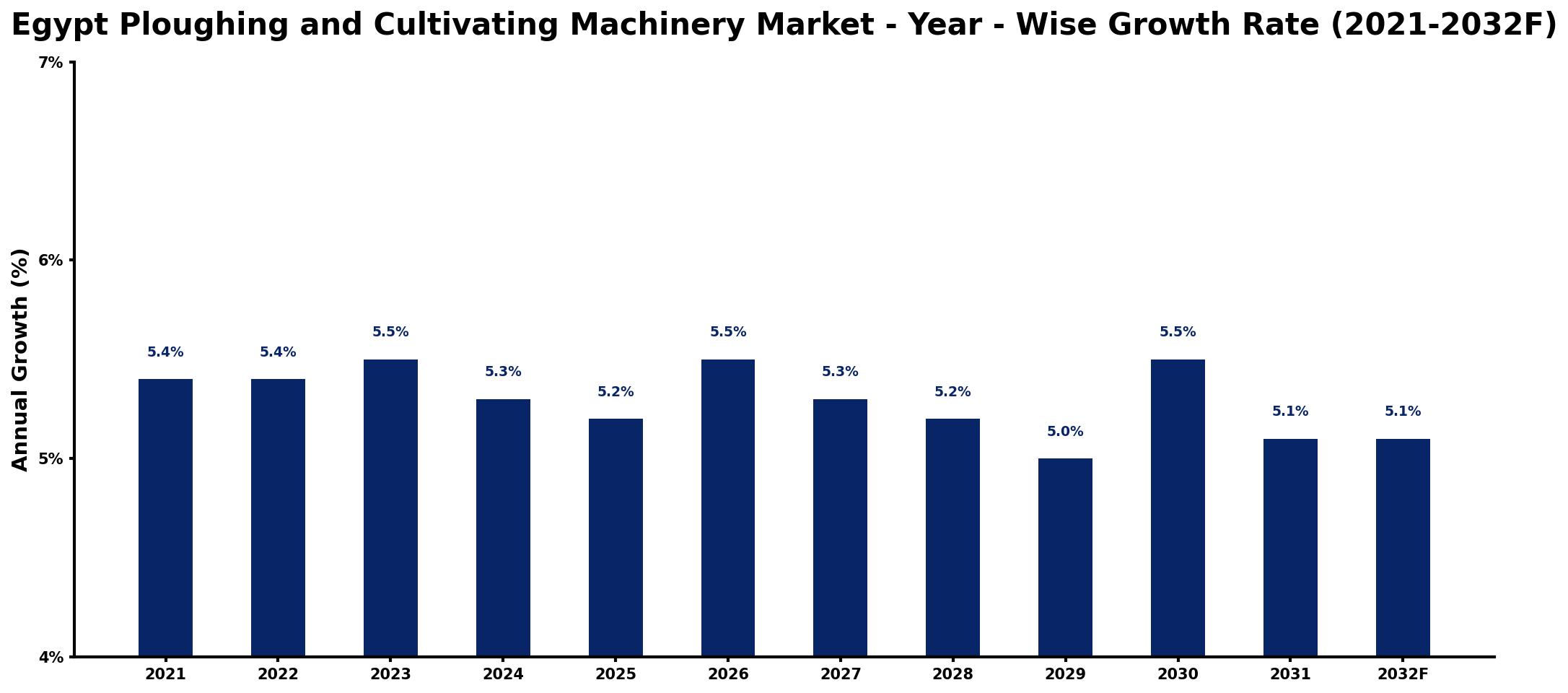
The table below presents the year‑wise growth rates along with the key drivers influencing the market
| Year | Growth Rate | Major Drivers |
| 2021 | 5.4% | Increased agricultural investment initiatives |
| 2022 | 5.4% | Growing demand for sustainable practices |
| 2023 | 5.5% | Expansion of rural infrastructure projects |
| 2024 | 5.3% | Rising interest in mechanized farming |
| 2025 | 5.2% | Increased focus on food security |
| 2026 | 5.5% | Technological advancements in farming |
| 2027 | 5.3% | Growth of export-oriented agriculture |
| 2028 | 5.2% | Emerging agro-tech startups support |
| 2029 | 5.0% | Government incentives for agriculture modernization |
| 2030 | 5.5% | Strengthened supply chain networks |
| 2031 | 5.1% | Enhanced farmer training programs |
| 2032 | 5.1% | Increased access to financing options |
Note: Market size estimations and growth projections presented in this report are based on 6Wresearch's proprietary forecasting methodology, utilizing the latest available industry data, government publications, and primary research inputs.
Egypt Ploughing and Cultivating Machinery Market Synopsis
The Egyptian agricultural landscape is undergoing a transformative phase, marked by an increasing embrace of ploughing and cultivating machinery. This shift reflects a broader movement towards efficient, modern farming practices, driven by the necessity for higher productivity and reduced reliance on manual labor.
Farmers are now more inclined to invest in advanced machinery that not only enhances productivity but also contributes to sustainable farming methods. The integration of technology, such as smart sensors and precision agriculture solutions, is further propelling this evolution, ensuring that farmers can optimize their operations in an increasingly competitive market.
Egypt Ploughing and Cultivating Machinery Market Key Takeaways
- Rising adoption of modern agricultural practices is driving demand for advanced ploughing and cultivating machinery.
- Government incentives play a crucial role in encouraging farmers to invest in mechanization.
- Technological advancements are reshaping the market landscape, promoting sustainable farming solutions.
- There is a notable shift towards multifunctional machinery, enhancing efficiency and cost-effectiveness.
- Increasing awareness among farmers regarding the benefits of modern machinery is expected to further boost market growth.
Evaluation of Restraints in Egypt Ploughing and Cultivating Machinery Market
Despite the promising outlook for the Egypt Ploughing and Cultivating Machinery Market, several challenges persist. The high cost of machinery remains a significant barrier, particularly for smallholders who may struggle to secure financing. Moreover, the prevalence of traditional farming methods, along with a considerable informal sector, complicates the transition to mechanized practices. Water scarcity and diverse soil conditions further add layers of complexity, potentially hindering the effectiveness of modern equipment in certain regions. Addressing these issues will be essential for unlocking the full potential of the market.
Egypt Ploughing and Cultivating Machinery Market Trends
The market is witnessing a compelling shift towards advanced technology, with farmers increasingly utilizing GPS-guided machinery and smart sensors to enhance operational efficiency. There is a growing preference for multifunctional equipment that can perform a range of tasks, such as ploughing, seeding, and fertilizing, all in one go. Furthermore, eco-friendly machinery is gaining traction, aligning with the global emphasis on sustainable agricultural practices. The digital transformation in agriculture, characterized by farm management platforms and data analytics, is also revolutionizing how farmers approach their operations.
Egypt Ploughing and Cultivating Machinery Market Opportunities
Investment prospects in the Egypt Ploughing and Cultivating Machinery Market are robust, propelled by the countrys commitment to agricultural modernization. As the demand for food production surges, opportunities abound for suppliers of high-quality machinery and related maintenance services. Additionally, collaborations with local agricultural organizations and participation in government initiatives can create further avenues for growth, ultimately contributing to the market's long-term profitability and sustainability.
Government Initiatives in the Egypt Ploughing and Cultivating Machinery Market
The Egyptian government has implemented a series of policies aimed at bolstering the ploughing and cultivating machinery market. Initiatives like the Modernization of Agriculture Project focus on encouraging the adoption of cutting-edge technologies among farmers. Financial subsidies and incentives are available to assist farmers in purchasing advanced machinery. Moreover, regulatory measures are in place to uphold quality and safety standards for imported equipment, which is crucial for fostering a reliable market environment.
Future Insights of the Egypt Ploughing and Cultivating Machinery Market
Looking ahead, the Egypt Ploughing and Cultivating Machinery Market is set to experience notable growth driven by ongoing modernization efforts and increased governmental support. As more farmers recognize the advantages of mechanization, the market will likely witness heightened adoption of innovative agricultural practices. The integration of precision agriculture and smart farming technologies is expected to further enhance productivity, paving the way for a future characterized by efficiency and sustainability in Egyptian agriculture.
Egypt Ploughing and Cultivating Machinery Market Latest Developments (2025 - 2026)
Recent industry developments indicate a strong focus on technological advancements within the market. Key players are increasingly investing in research and development to introduce more efficient and multifunctional equipment. Additionally, there has been a significant uptick in partnerships between local companies and international suppliers, aiming to enhance the range of available machinery and services. Overall, the market is poised for exciting developments as it adapts to evolving agricultural needs.
Egypt Ploughing and Cultivating Machinery Market - Key Attractiveness of the Report
- 10 Years of Market Numbers
- Historical Data Starting from 2022 to 2025
- Base Year: 2025
- Forecast Data until 2032
- Key Performance Indicators Impacting the Market
- Major Upcoming Developments and Projects
Key Highlights of the Report:
- Egypt Ploughing and Cultivating Machinery Market Outlook
- Market Size of Egypt Ploughing and Cultivating Machinery Market, 2025
- Forecast of Egypt Ploughing and Cultivating Machinery Market, 2032
- Historical Data and Forecast of Egypt Ploughing and Cultivating Machinery Revenues & Volume for the Period 2022-2032F
- Egypt Ploughing and Cultivating Machinery Market Trend Evolution
- Egypt Ploughing and Cultivating Machinery Market Drivers and Challenges
- Egypt Ploughing and Cultivating Machinery Price Trends
- Egypt Ploughing and Cultivating Machinery Porter's Five Forces
- Egypt Ploughing and Cultivating Machinery Industry Life Cycle
- Historical Data and Forecast of Egypt Ploughing and Cultivating Machinery Market Revenues & Volume By Type for the Period 2022-2032F
- Historical Data and Forecast of Egypt Ploughing and Cultivating Machinery Market Revenues & Volume By Ploughs for the Period 2022-2032F
- Historical Data and Forecast of Egypt Ploughing and Cultivating Machinery Market Revenues & Volume By Harrows for the Period 2022-2032F
- Historical Data and Forecast of Egypt Ploughing and Cultivating Machinery Market Revenues & Volume By Others for the Period 2022-2032F
- Historical Data and Forecast of Egypt Ploughing and Cultivating Machinery Market Revenues & Volume By Application for the Period 2022-2032F
- Historical Data and Forecast of Egypt Ploughing and Cultivating Machinery Market Revenues & Volume By Soil Loosening for the Period 2022-2032F
- Historical Data and Forecast of Egypt Ploughing and Cultivating Machinery Market Revenues & Volume By Clod Size Reduction for the Period 2022-2032F
- Historical Data and Forecast of Egypt Ploughing and Cultivating Machinery Market Revenues & Volume By Clod Sorting for the Period 2022-2032F
- Historical Data and Forecast of Egypt Ploughing and Cultivating Machinery Market Revenues & Volume By Others for the Period 2022-2032F
- Egypt Ploughing and Cultivating Machinery Import Export Trade Statistics
- Market Opportunity Assessment By Type
- Market Opportunity Assessment By Application
- Egypt Ploughing and Cultivating Machinery Top Companies Market Share
- Egypt Ploughing and Cultivating Machinery Competitive Benchmarking By Technical and Operational Parameters
- Egypt Ploughing and Cultivating Machinery Company Profiles
- Egypt Ploughing and Cultivating Machinery Key Strategic Recommendations






































