Estonia Luxury Furniture Market Top 5 Importing Countries and Market Competition (HHI) Analysis
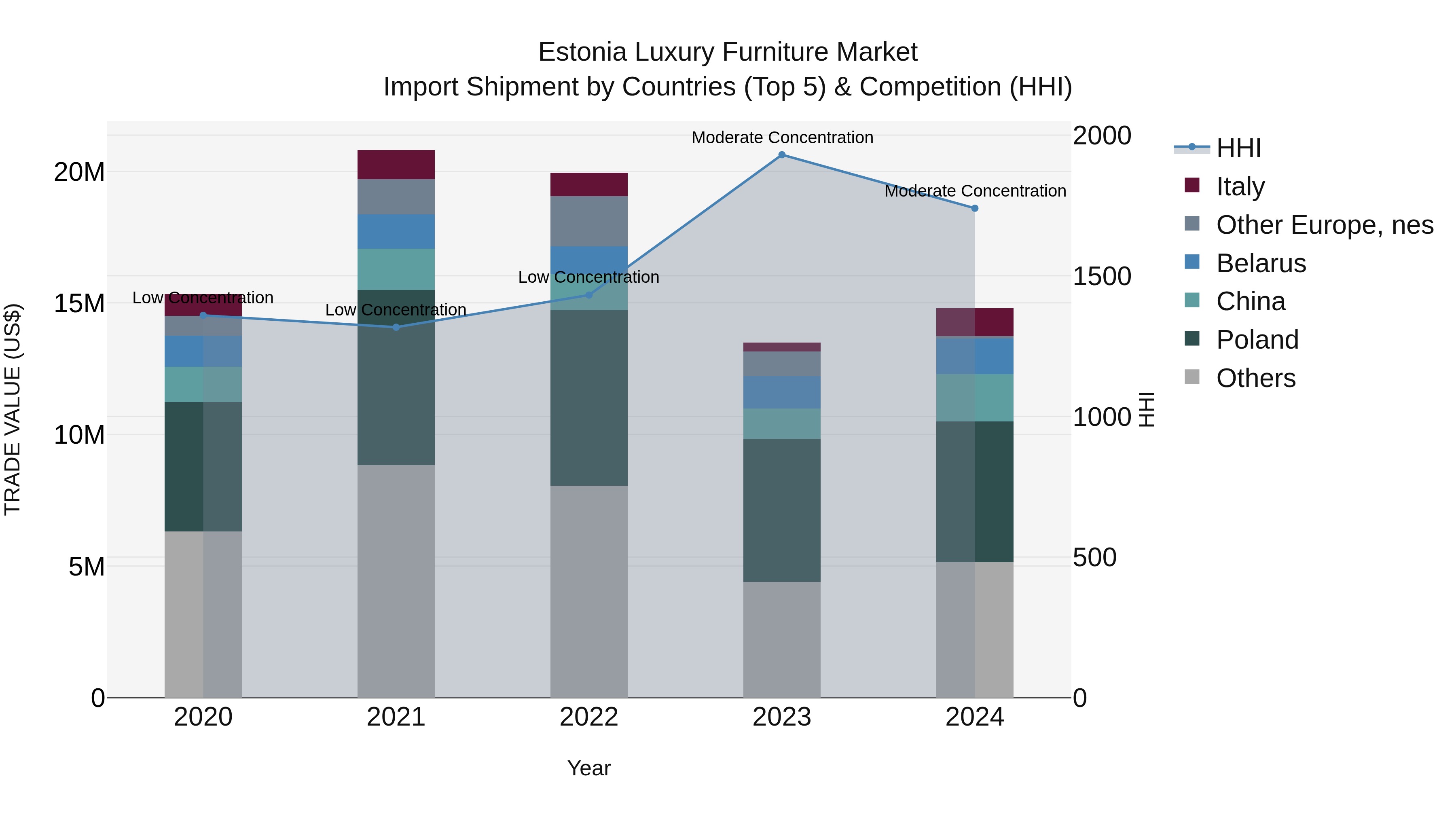
Estonia`s luxury furniture import market in 2024 continues to be driven by top exporting countries such as Poland, China, Lithuania, Belarus, and Italy. Despite a slight decline in the compound annual growth rate (CAGR) from 2020-2024, the market saw a notable growth spurt in 2024 with a 9.7% increase compared to the previous year. The market concentration, as measured by the Herfindahl-Hirschman Index (HHI), remained at a moderate level in 2024, indicating a healthy level of competition among import sources. This data suggests a resilient and dynamic luxury furniture import market in Estonia.
Key Highlights of the Report:
- Estonia Luxury Furniture Market Outlook
- Market Size of Estonia Luxury Furniture Market, 2025
- Forecast of Estonia Luxury Furniture Market, 2032
- Historical Data and Forecast of Estonia Luxury Furniture Revenues & Volume for the Period 2022 - 2032
- Estonia Luxury Furniture Market Trend Evolution
- Estonia Luxury Furniture Market Drivers and Challenges
- Estonia Luxury Furniture Price Trends
- Estonia Luxury Furniture Porter's Five Forces
- Estonia Luxury Furniture Industry Life Cycle
- Historical Data and Forecast of Estonia Luxury Furniture Market Revenues & Volume By Raw Material for the Period 2022 - 2032
- Historical Data and Forecast of Estonia Luxury Furniture Market Revenues & Volume By Wood for the Period 2022 - 2032
- Historical Data and Forecast of Estonia Luxury Furniture Market Revenues & Volume By Metal for the Period 2022 - 2032
- Historical Data and Forecast of Estonia Luxury Furniture Market Revenues & Volume By Glass for the Period 2022 - 2032
- Historical Data and Forecast of Estonia Luxury Furniture Market Revenues & Volume By Leather for the Period 2022 - 2032
- Historical Data and Forecast of Estonia Luxury Furniture Market Revenues & Volume By Plastic for the Period 2022 - 2032
- Historical Data and Forecast of Estonia Luxury Furniture Market Revenues & Volume By Multiple for the Period 2022 - 2032
- Historical Data and Forecast of Estonia Luxury Furniture Market Revenues & Volume By Application for the Period 2022 - 2032
- Historical Data and Forecast of Estonia Luxury Furniture Market Revenues & Volume By Domestic for the Period 2022 - 2032
- Historical Data and Forecast of Estonia Luxury Furniture Market Revenues & Volume By Commercial for the Period 2022 - 2032
- Historical Data and Forecast of Estonia Luxury Furniture Market Revenues & Volume By Distribution Channel for the Period 2022 - 2032
- Historical Data and Forecast of Estonia Luxury Furniture Market Revenues & Volume By Conventional Furniture Stores for the Period 2022 - 2032
- Historical Data and Forecast of Estonia Luxury Furniture Market Revenues & Volume By Specialty Stores for the Period 2022 - 2032
- Historical Data and Forecast of Estonia Luxury Furniture Market Revenues & Volume By Online Retailers for the Period 2022 - 2032
- Historical Data and Forecast of Estonia Luxury Furniture Market Revenues & Volume By Design for the Period 2022 - 2032
- Historical Data and Forecast of Estonia Luxury Furniture Market Revenues & Volume By Modern for the Period 2022 - 2032
- Historical Data and Forecast of Estonia Luxury Furniture Market Revenues & Volume By Contemporary for the Period 2022 - 2032
- Estonia Luxury Furniture Import Export Trade Statistics
- Market Opportunity Assessment By Raw Material
- Market Opportunity Assessment By Application
- Market Opportunity Assessment By Distribution Channel
- Market Opportunity Assessment By Design
- Estonia Luxury Furniture Top Companies Market Share
- Estonia Luxury Furniture Competitive Benchmarking By Technical and Operational Parameters
- Estonia Luxury Furniture Company Profiles
- Estonia Luxury Furniture Key Strategic Recommendations






































