Fiji Canned Tuna Market Top 5 Importing Countries and Market Competition (HHI) Analysis
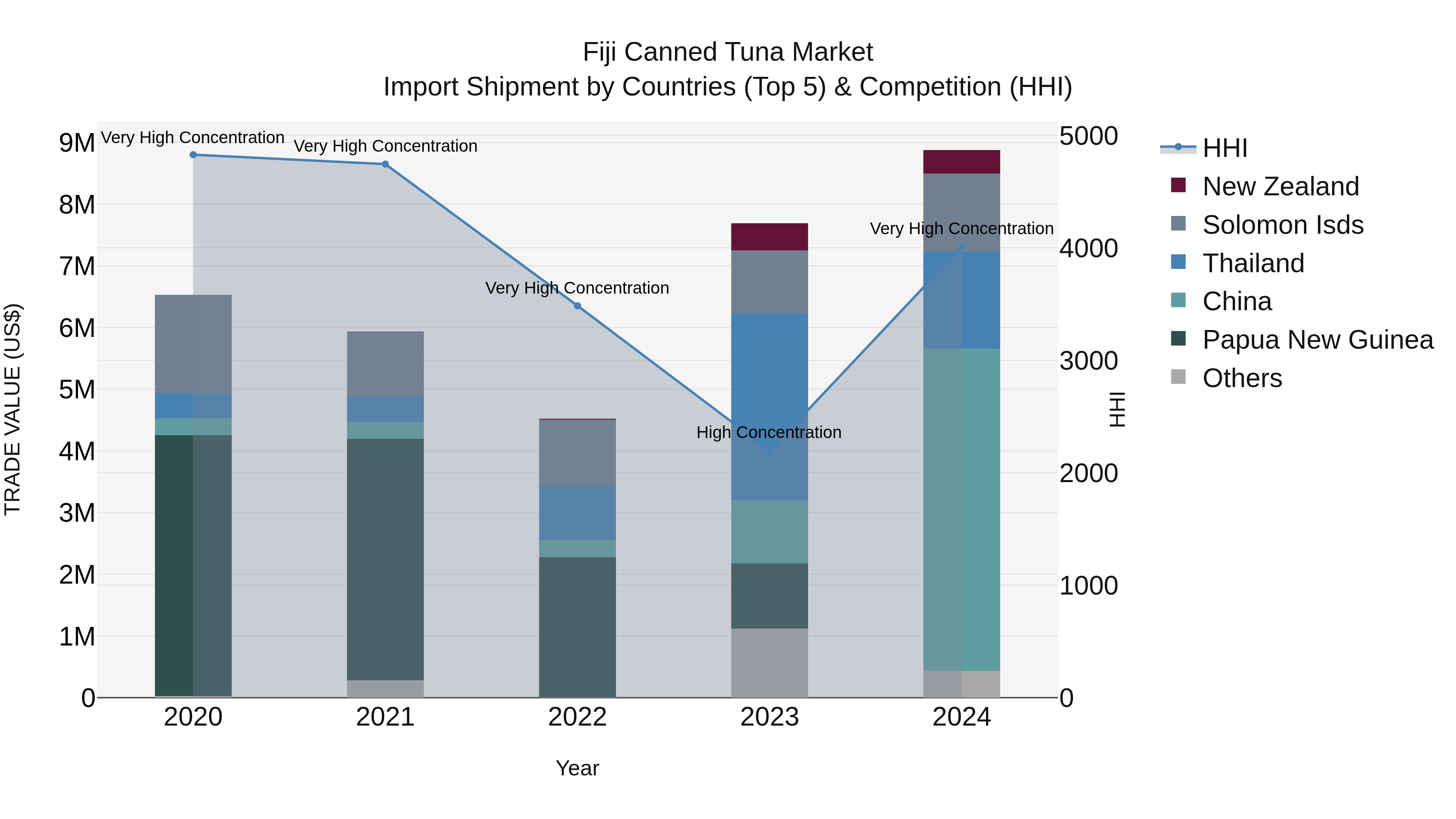
The canned tuna import market in Fiji continues to show strong growth, with a Compound Annual Growth Rate (CAGR) of 7.96% from 2020 to 2024. In 2024, the top exporting countries to Fiji are China, Thailand, Solomon Islands, New Zealand, and Federated States of Micronesia. The market concentration, as measured by the Herfindahl-Hirschman Index (HHI), has increased significantly, indicating very high concentration in 2024 compared to 2023. The impressive growth rate of 15.38% from 2023 to 2024 suggests a growing demand for canned tuna in Fiji, with key players dominating the market.
Canned Tuna Market: Fiji vs Top 5 Major Economies in 2027 (Asia)
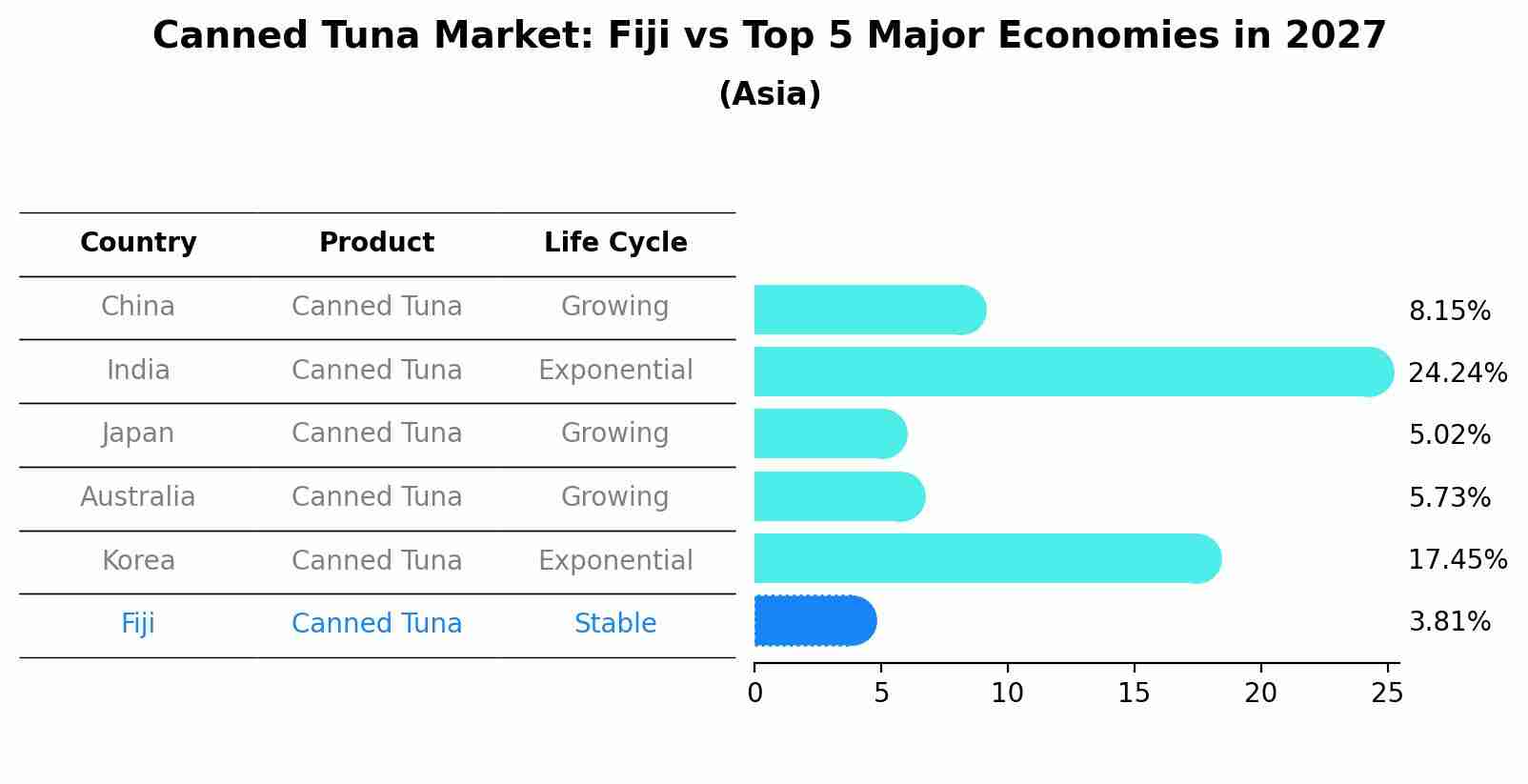
By 2027, the Canned Tuna market in Fiji is anticipated to reach a growth rate of 3.81%, as part of an increasingly competitive Asia region, where China remains at the forefront, supported by India, Japan, Australia and South Korea, driving innovations and market adoption across sectors.
Fiji Canned Tuna Market Overview
The canned tuna market in Fiji is a major part of the countrys food processing and export industries. With Fiji being one of the leading tuna exporters in the Pacific, the demand for canned tuna remains strong, both for local consumption and international markets. As global seafood consumption grows, the canned tuna market in Fiji is likely to see continued growth.
Drivers of the market
The canned tuna market in Fiji is growing due to the high demand for this convenient and nutritious food product. Tuna is an important part of the local diet, and canned tuna offers a practical, long-shelf-life option for consumers. Additionally, as Fiji strengthens its seafood export sector, canned tuna remains a key product in the countrys international trade.
Challenges of the market
The canned tuna market in Fiji faces challenges due to the volatility in global tuna prices, which can affect the cost structure of locally processed tuna. Additionally, the sustainability of tuna fishing is a growing concern, with increasing demand for sustainable and ethically sourced products. The market is also affected by the dominance of international brands, which often benefit from economies of scale and global distribution networks.
Government Policy of the market
The canned tuna market in Fiji is strongly influenced by government policies related to fisheries management, food safety, and trade regulations. The government promotes sustainable tuna fishing practices, with a focus on ensuring that the industry remains environmentally responsible and economically viable. Food safety regulations govern the labeling, preservation, and quality of canned tuna products, ensuring they meet local and international standards. Additionally, trade agreements and tariffs affect Fijis ability to export canned tuna, shaping market growth, particularly in international markets that demand sustainably sourced products.
Key Highlights of the Report:
- Fiji Canned Tuna Market Outlook
- Market Size of Fiji Canned Tuna Market, 2024
- Forecast of Fiji Canned Tuna Market, 2031
- Historical Data and Forecast of Fiji Canned Tuna Revenues & Volume for the Period 2021-2031
- Fiji Canned Tuna Market Trend Evolution
- Fiji Canned Tuna Market Drivers and Challenges
- Fiji Canned Tuna Price Trends
- Fiji Canned Tuna Porter`s Five Forces
- Fiji Canned Tuna Industry Life Cycle
- Historical Data and Forecast of Fiji Canned Tuna Market Revenues & Volume By Product for the Period 2021-2031
- Historical Data and Forecast of Fiji Canned Tuna Market Revenues & Volume By Skipjack for the Period 2021-2031
- Historical Data and Forecast of Fiji Canned Tuna Market Revenues & Volume By Yellowfin for the Period 2021-2031
- Historical Data and Forecast of Fiji Canned Tuna Market Revenues & Volume By Others for the Period 2021-2031
- Historical Data and Forecast of Fiji Canned Tuna Market Revenues & Volume By Distribution Channel for the Period 2021-2031
- Historical Data and Forecast of Fiji Canned Tuna Market Revenues & Volume By Hypermarket & Supermarket for the Period 2021-2031
- Historical Data and Forecast of Fiji Canned Tuna Market Revenues & Volume By Specialty Stores for the Period 2021-2031
- Historical Data and Forecast of Fiji Canned Tuna Market Revenues & Volume By Online for the Period 2021-2031
- Fiji Canned Tuna Import Export Trade Statistics
- Market Opportunity Assessment By Product
- Market Opportunity Assessment By Distribution Channel
- Fiji Canned Tuna Top Companies Market Share
- Fiji Canned Tuna Competitive Benchmarking By Technical and Operational Parameters
- Fiji Canned Tuna Company Profiles
- Fiji Canned Tuna Key Strategic Recommendations






































