Fiji Connector Market Top 5 Importing Countries and Market Competition (HHI) Analysis
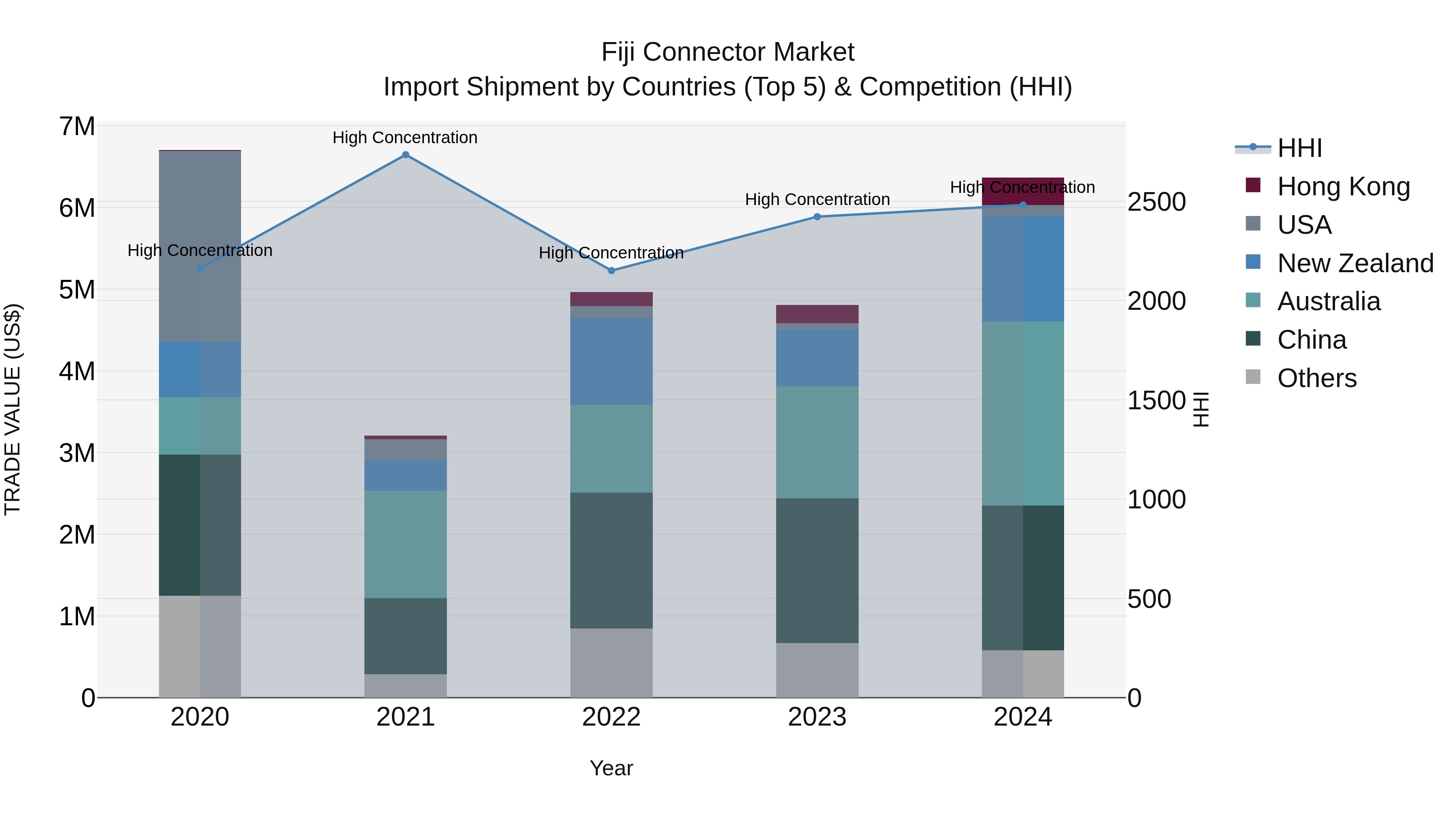
In 2024, Fiji`s connector import shipments continued to be dominated by top exporting countries such as Australia, China, New Zealand, Hong Kong, and South Korea. The high Herfindahl-Hirschman Index (HHI) indicates a concentrated market. Despite a slight negative compound annual growth rate (CAGR) from 2020 to 2024, there was a notable growth spike of 32.41% from 2023 to 2024. This suggests potential shifts in market dynamics and opportunities for stakeholders in the connector import industry to capitalize on emerging trends and market developments in Fiji.
Connector Market: Fiji vs Top 5 Major Economies in 2027 (Asia)
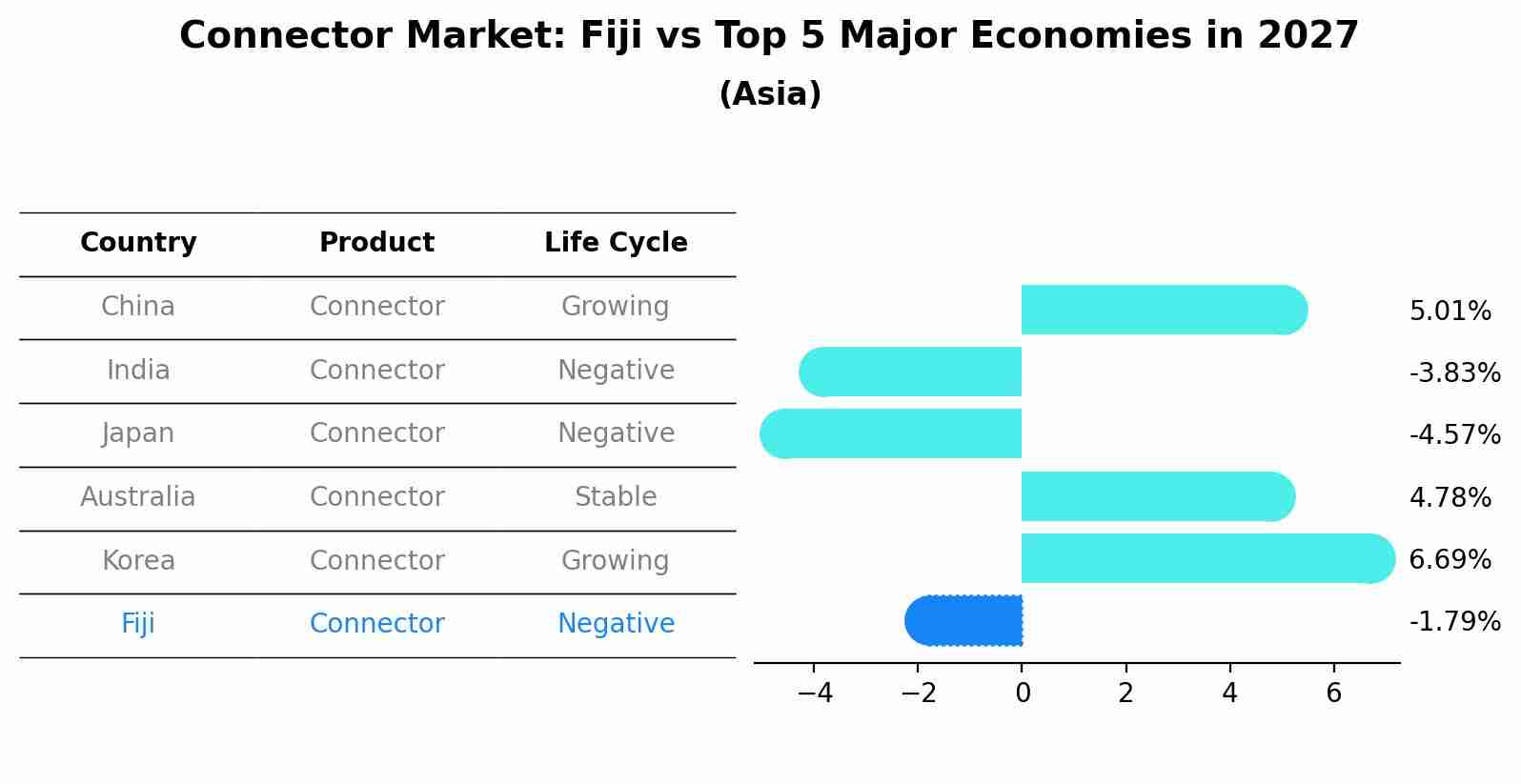
The Connector market in Fiji is projected to grow at a negative growth rate of -1.79% by 2027, highlighting the country's increasing focus on advanced technologies within the Asia region, where China holds the dominant position, followed closely by India, Japan, Australia and South Korea, shaping overall regional demand.
Fiji Connector Market Overview
The connector market in Fiji is evolving with the demand for high-quality, durable connectors used across industries such as automotive, electronics, and telecommunications. Connectors are essential for linking different components within electronic systems and machines, and as the countrys industrial and technological sectors expand, the demand for connectors continues to rise. Fijis growing infrastructure development and increasing adoption of consumer electronics are key factors driving the market for connectors.
Drivers of the market
The connector market in Fiji is growing as industries demand more reliable and high-performance interconnection solutions for a wide range of electronic devices and systems. The expansion of sectors like telecommunications, automotive, and consumer electronics is driving the demand for connectors that support high-speed data transmission and durability.
Challenges of the market
Fijis connector market faces challenges related to the high costs of importing connectors and components, which are essential for the countrys electronics and manufacturing sectors. There is limited local production of connectors, and many industries rely on international suppliers to meet their needs. Additionally, the market is constrained by the relatively small size of the local electronics industry, which reduces the demand for specialized connectors.
Government Policy of the market
Policies promoting electronics manufacturing and renewable energy infrastructure indirectly benefit the connector market. Fiji also enforces quality and safety standards for imported and locally manufactured connectors.
Key Highlights of the Report:
- Fiji Connector Market Outlook
- Market Size of Fiji Connector Market, 2024
- Forecast of Fiji Connector Market, 2031
- Historical Data and Forecast of Fiji Connector Revenues & Volume for the Period 2021-2031
- Fiji Connector Market Trend Evolution
- Fiji Connector Market Drivers and Challenges
- Fiji Connector Price Trends
- Fiji Connector Porter`s Five Forces
- Fiji Connector Industry Life Cycle
- Historical Data and Forecast of Fiji Connector Market Revenues & Volume By Product for the Period 2021-2031
- Historical Data and Forecast of Fiji Connector Market Revenues & Volume By PCB Connectors for the Period 2021-2031
- Historical Data and Forecast of Fiji Connector Market Revenues & Volume By IO Connectors for the Period 2021-2031
- Historical Data and Forecast of Fiji Connector Market Revenues & Volume By Circular Connectors for the Period 2021-2031
- Historical Data and Forecast of Fiji Connector Market Revenues & Volume By Fiber Optic Connectors for the Period 2021-2031
- Historical Data and Forecast of Fiji Connector Market Revenues & Volume By RF Coaxial Connectors for the Period 2021-2031
- Historical Data and Forecast of Fiji Connector Market Revenues & Volume By Others for the Period 2021-2031
- Historical Data and Forecast of Fiji Connector Market Revenues & Volume By End Use for the Period 2021-2031
- Historical Data and Forecast of Fiji Connector Market Revenues & Volume By Telecom for the Period 2021-2031
- Historical Data and Forecast of Fiji Connector Market Revenues & Volume By Transportation for the Period 2021-2031
- Historical Data and Forecast of Fiji Connector Market Revenues & Volume By Automotive for the Period 2021-2031
- Historical Data and Forecast of Fiji Connector Market Revenues & Volume By Industrial for the Period 2021-2031
- Historical Data and Forecast of Fiji Connector Market Revenues & Volume By Computer & Peripherals for the Period 2021-2031
- Historical Data and Forecast of Fiji Connector Market Revenues & Volume By Others for the Period 2021-2031
- Fiji Connector Import Export Trade Statistics
- Market Opportunity Assessment By Product
- Market Opportunity Assessment By End Use
- Fiji Connector Top Companies Market Share
- Fiji Connector Competitive Benchmarking By Technical and Operational Parameters
- Fiji Connector Company Profiles
- Fiji Connector Key Strategic Recommendations






































