Finland Tennis Shoes Market Size (2020-2030)
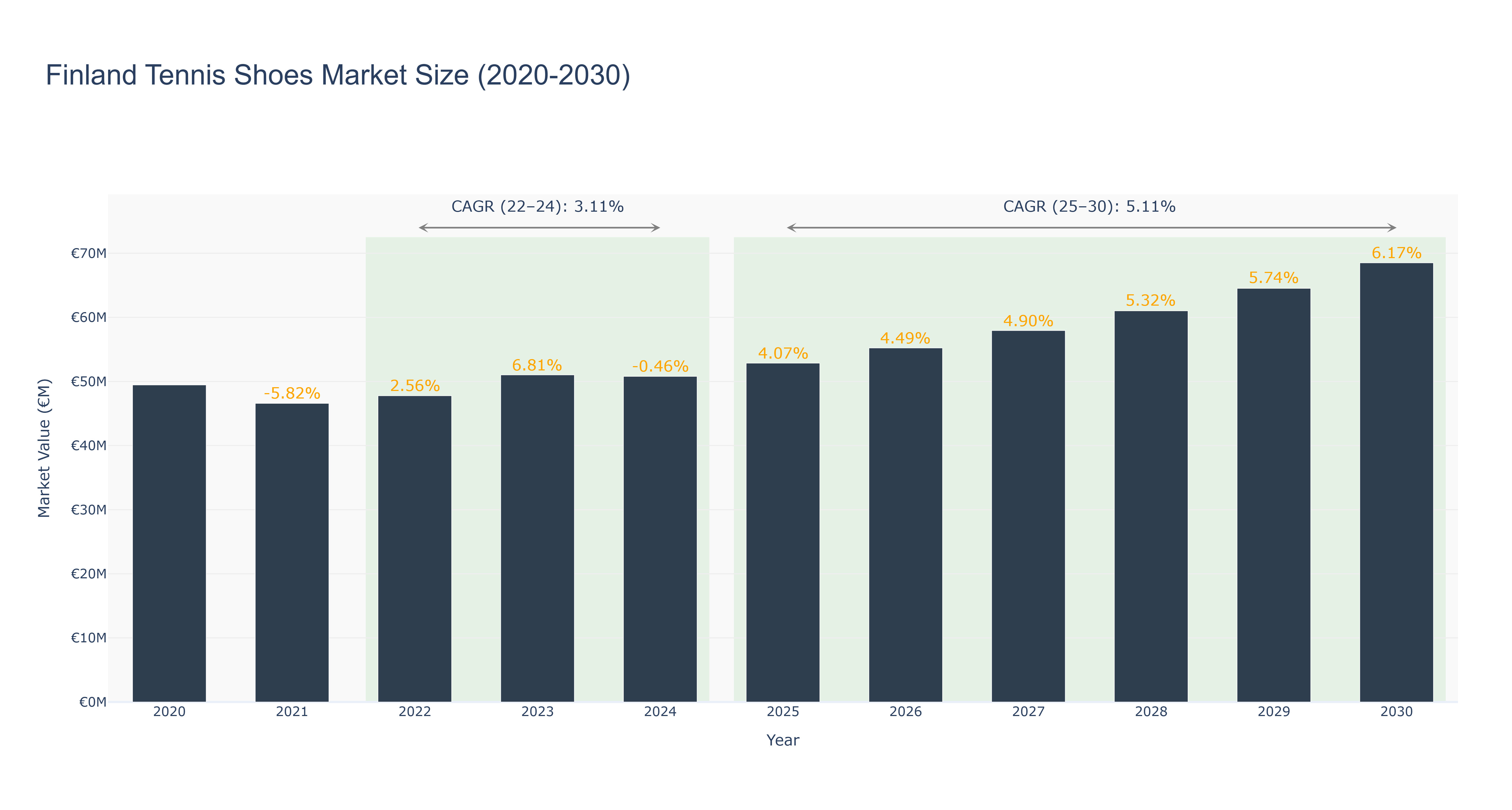
Finland Tennis Shoes Market has shown a steady growth trajectory over the past decade. The peak market size was €68.51 million in 2030, with a forecasted increase from €47.77 million in 2022 to €68.51 million in 2030. The CAGR values reflect this growth, with a CAGR of 3.11% from 2022 to 2024 and a higher CAGR of 5.11% from 2025 to 2030. The market experienced a slight decline in 2021, attributed to external economic factors affecting consumer spending. However, the subsequent years saw consistent growth driven by increasing consumer demand for athletic footwear and a focus on health and fitness trends. Looking ahead, Finland is set to introduce a national initiative promoting sports participation, which is expected to further boost the demand for tennis shoes in the market. Industry drivers for the Finland Tennis Shoes Market include rising health consciousness, active lifestyle trends, and growing participation in sports activities. These factors are expected to continue driving the market growth in the coming years.
Finland Tennis Shoes Market: Production & Trade Performance (2019-2025)
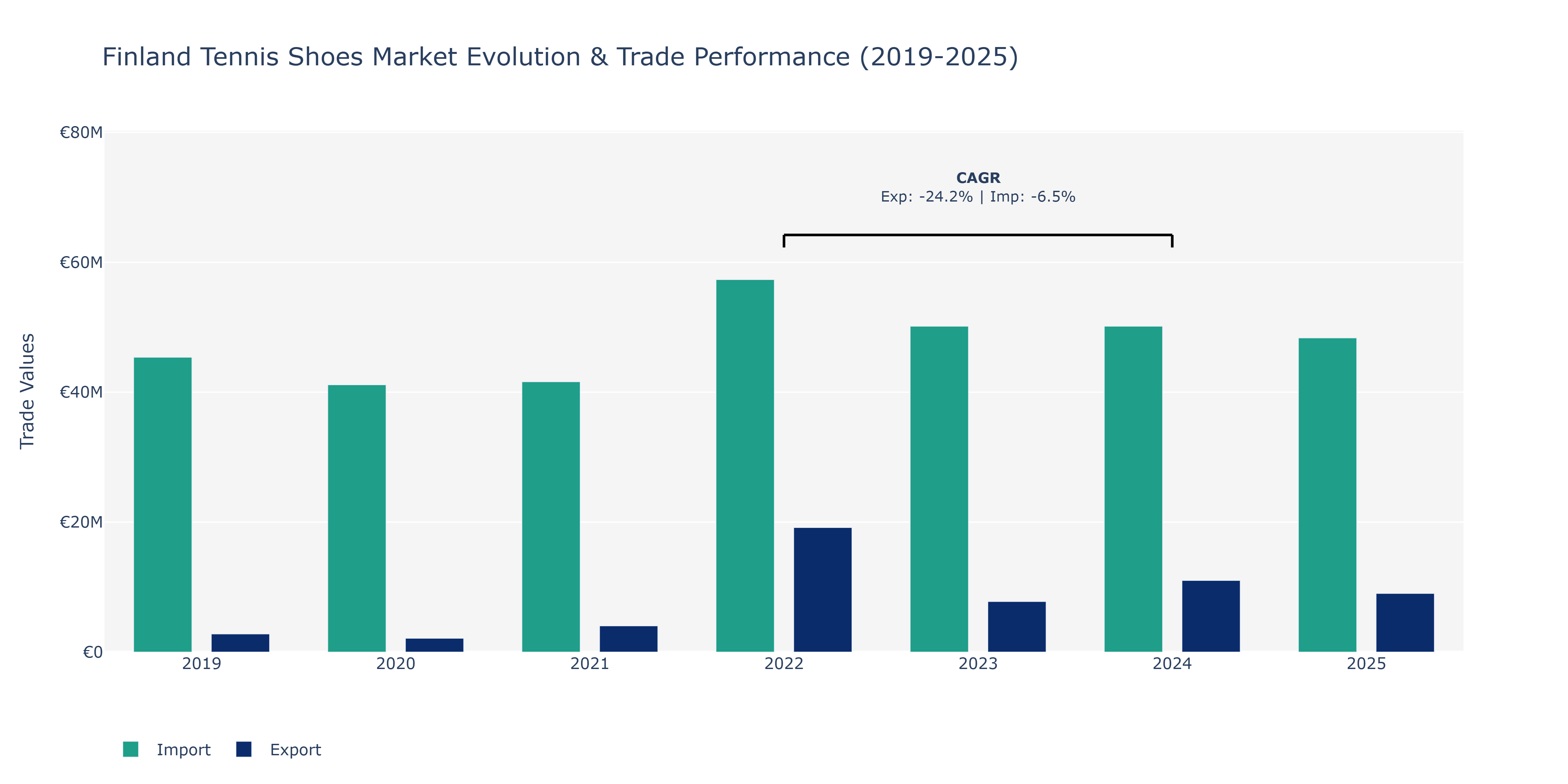
The Finland Tennis Shoes Market witnessed varied trends in Exports and Imports over the years. In 2019, Exports stood at €2.78 million, while Imports were significantly higher at €45.37 million. Subsequently, both Exports and Imports experienced a decline in 2020, reaching €2.12 million and €41.14 million, respectively. However, in 2021, Exports surged to €4.02 million, showcasing a notable recovery, while Imports remained relatively stable at €41.6 million. The market saw a substantial spike in Exports in 2022, reaching €19.15 million, possibly due to increased demand or strategic market positioning. Interestingly, despite a slight decrease in 2023, Exports remained relatively high at €7.76 million, indicating market stability. Imports, on the other hand, fluctuated moderately during this period, hovering around €50.15 million. The subsequent years showed a more stable trend for both Exports and Imports, with 2025 recording Exports at €9.02 million and Imports at €48.35 million. These fluctuations could be attributed to evolving consumer preferences, global economic conditions, and shifts in supply chain dynamics within the footwear industry.
Key Highlights of the Report:
- Finland Tennis Shoes Market Outlook
- Market Size of Finland Tennis Shoes Market, 2024
- Forecast of Finland Tennis Shoes Market, 2031
- Historical Data and Forecast of Finland Tennis Shoes Revenues & Volume for the Period 2021-2031
- Finland Tennis Shoes Market Trend Evolution
- Finland Tennis Shoes Market Drivers and Challenges
- Finland Tennis Shoes Price Trends
- Finland Tennis Shoes Porter`s Five Forces
- Finland Tennis Shoes Industry Life Cycle
- Historical Data and Forecast of Finland Tennis Shoes Market Revenues & Volume By Playing Surface for the Period 2021-2031
- Historical Data and Forecast of Finland Tennis Shoes Market Revenues & Volume By Hard Court Tennis Shoes for the Period 2021-2031
- Historical Data and Forecast of Finland Tennis Shoes Market Revenues & Volume By Clay Court Tennis Shoes for the Period 2021-2031
- Historical Data and Forecast of Finland Tennis Shoes Market Revenues & Volume By Grass Court Tennis Shoes for the Period 2021-2031
- Historical Data and Forecast of Finland Tennis Shoes Market Revenues & Volume By User for the Period 2021-2031
- Historical Data and Forecast of Finland Tennis Shoes Market Revenues & Volume By Men for the Period 2021-2031
- Historical Data and Forecast of Finland Tennis Shoes Market Revenues & Volume By Women for the Period 2021-2031
- Historical Data and Forecast of Finland Tennis Shoes Market Revenues & Volume By Kids for the Period 2021-2031
- Historical Data and Forecast of Finland Tennis Shoes Market Revenues & Volume By Distribution Channel for the Period 2021-2031
- Historical Data and Forecast of Finland Tennis Shoes Market Revenues & Volume By Supermarket/Hypermarket for the Period 2021-2031
- Historical Data and Forecast of Finland Tennis Shoes Market Revenues & Volume By Specialty Stores for the Period 2021-2031
- Historical Data and Forecast of Finland Tennis Shoes Market Revenues & Volume By E-commerce for the Period 2021-2031
- Historical Data and Forecast of Finland Tennis Shoes Market Revenues & Volume By Others for the Period 2021-2031
- Finland Tennis Shoes Import Export Trade Statistics
- Market Opportunity Assessment By Playing Surface
- Market Opportunity Assessment By User
- Market Opportunity Assessment By Distribution Channel
- Finland Tennis Shoes Top Companies Market Share
- Finland Tennis Shoes Competitive Benchmarking By Technical and Operational Parameters
- Finland Tennis Shoes Company Profiles
- Finland Tennis Shoes Key Strategic Recommendations






































