France Auto Parts And Accessories Market Size, Share & Growth Rate
The France Auto Parts And Accessories Market was estimated at USD 127 Million in 2025 and is projected to reach USD 140 Million by 2032, growing at a CAGR of 1.4% from 2026 to 2032. This growth trajectory is primarily driven by the robust automotive sector in France, coupled with a rising demand for advanced and high-quality components as vehicle technologies evolve. Additionally, the shift towards sustainable automotive solutions is influencing the market, pushing companies to innovate and adapt to changing consumer preferences.
France Auto Parts And Accessories Market Year-wise Growth Rate and Key Drivers
This graph highlights how the France Auto Parts And Accessories Market has steadily grown over the years, supported by major growth factors.
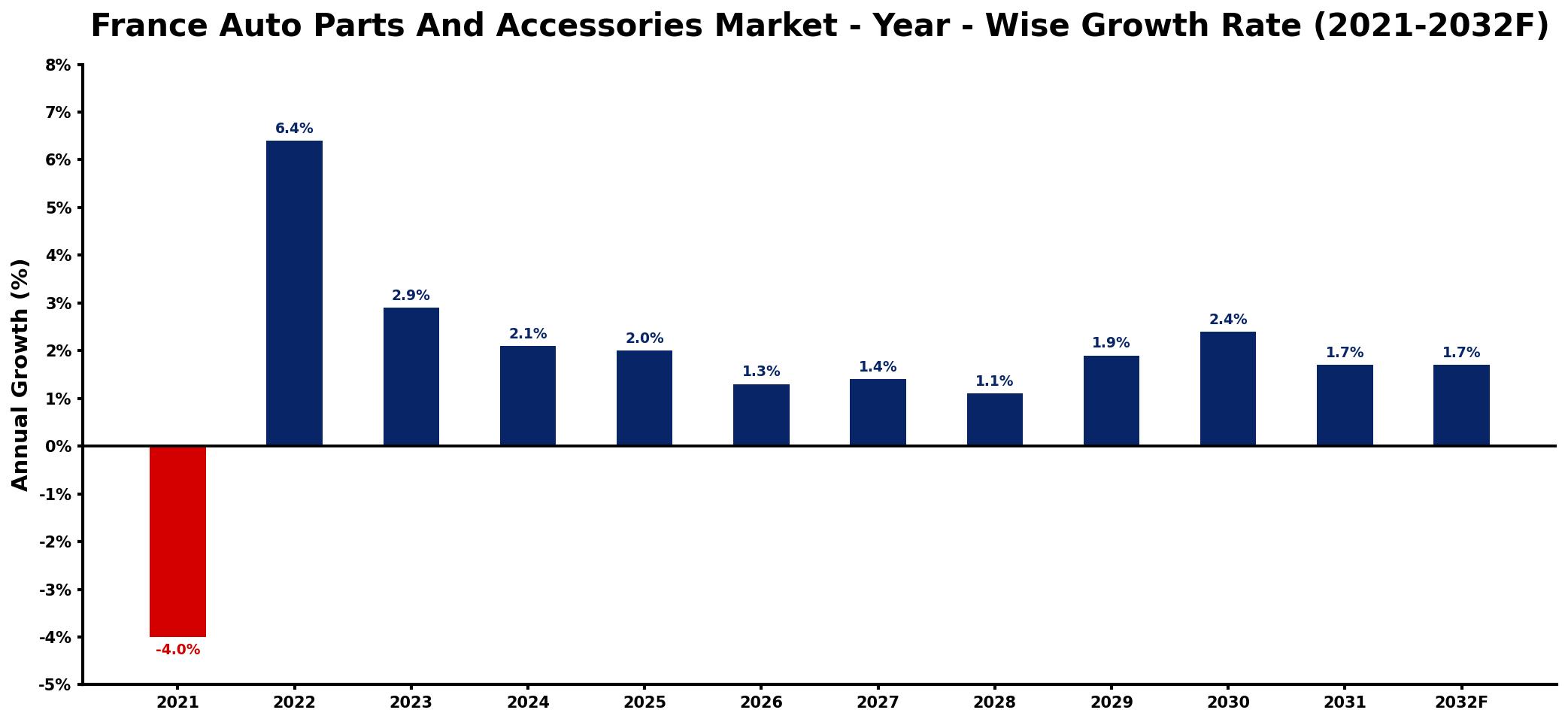
The table below presents the year‑wise growth rates along with the key drivers influencing the market
| Year | Growth Rate | Major Drivers |
| 2021 | -4.0% | decrease in consumer spending habits |
| 2022 | 6.4% | rise in electric vehicle adoption |
| 2023 | 2.9% | increased focus on sustainability |
| 2024 | 2.1% | growing demand for online sales |
| 2025 | 2.0% | expansion of aftersales service networks |
| 2026 | 1.3% | technological advancements in manufacturing |
| 2027 | 1.4% | increased government infrastructure investments |
| 2028 | 1.1% | growth in vehicle leasing trends |
| 2029 | 1.9% | enhanced consumer financing options |
| 2030 | 2.4% | surge in urban mobility solutions |
| 2031 | 1.7% | rising popularity of car sharing |
| 2032 | 1.7% | development of smart vehicle technologies |
Note: Market size estimations and growth projections presented in this report are based on 6Wresearch's proprietary forecasting methodology, utilizing the latest available industry data, government publications, and primary research inputs.
France Auto Parts And Accessories Market Synopsis
The France auto parts and accessories market is witnessing a notable transformation, characterized by a burgeoning interest in electric and hybrid vehicle components. As manufacturers ramp up efforts to reduce carbon emissions, the market is increasingly populated with innovative, eco-friendly products aimed at meeting the demands of environmentally-conscious consumers.
With a growing emphasis on customization, consumers are actively seeking unique accessories that enhance both the performance and aesthetic appeal of their vehicles. E-commerce has emerged as a pivotal distribution channel, enabling consumers to access a wider variety of products with remarkable convenience, which is further energizing market dynamics.
France Auto Parts And Accessories Market Key Takeaways
- The market is propelled by strong automotive sales and an increasing focus on technological advancements.
- Consumer preferences are shifting towards sustainable and eco-friendly auto parts and accessories.
- Customization options are gaining traction, particularly among younger consumers looking for personalized vehicle enhancements.
- Online retailing is becoming the preferred shopping method, significantly impacting sales and distribution.
- The push for electric vehicles is creating new opportunities for parts manufacturers and suppliers.
Evaluation of Restraints in France Auto Parts And Accessories Market
Despite the promising outlook, the France auto parts and accessories market faces certain restraints that may hinder its growth. The increase in competition from online retailers complicates the landscape for traditional suppliers, requiring them to innovate continually. Furthermore, the shift towards electric vehicles is reshaping demand, putting pressure on companies that primarily supply parts for conventional vehicles. Challenges such as fluctuating raw material costs and supply chain disruptions also create hurdles for consistent production and delivery. Lastly, the rising demand for eco-friendly materials necessitates substantial adjustments from manufacturers, who must balance sustainability with cost-effectiveness.
France Auto Parts And Accessories Market Trends
A variety of trends are shaping the France auto parts and accessories market. Firstly, the surge in electric and hybrid vehicle adoption is elevating the demand for specialized components that support these technologies. Additionally, as customization gains momentum, products such as specialty wheels, upgraded lighting, and personalized interior accessories are becoming more desirable. Sustainability also plays a significant role, with increasing consumer interest in products made from recyclable materials. Finally, the shift towards e-commerce is transforming how consumers shop for auto parts, with digital platforms offering greater selection and convenience.
France Auto Parts And Accessories Market Opportunities
Investors in the France auto parts and accessories market have several avenues to explore for growth. The rise of electric vehicles offers opportunities for companies focused on manufacturing and supplying related components. The aftermarket sector is also expanding, creating potential for investment in retailers and distributors who can effectively cater to evolving consumer needs. Furthermore, forming strategic partnerships with automotive manufacturers or aftermarket players can enhance market presence and facilitate access to new customer bases. Overall, this market holds a wealth of potential for those looking to align with emerging trends and consumer preferences.
Government Initiatives in the France Auto Parts And Accessories Market
The French government plays a crucial role in the auto parts and accessories market through a variety of regulations and initiatives aimed at promoting safety and environmental sustainability. Stringent quality standards are enforced for auto parts, requiring compliance with safety and environmental regulations. To support innovation, the government provides incentives for research and development in the automotive sector, encouraging companies to adopt more eco-friendly practices. Additionally, policies aimed at enhancing competition help create a fair marketplace for all players involved in the industry.
Future Insights of the France Auto Parts And Accessories Market
Looking ahead to the period from 2026 to 2032, the France auto parts and accessories market is anticipated to experience steady growth driven by ongoing technological advancements and increased vehicle sales. The demand for electric and hybrid vehicles will continue to rise, leading to enhanced opportunities for manufacturers of related components. Concurrently, a growing focus on sustainability will push companies to innovate in materials and manufacturing processes. Overall, the market is poised for transformation, presenting numerous opportunities for stakeholders who adapt to the evolving automotive landscape.
France Auto Parts And Accessories Market Latest Developments (2025 - 2026)
In the past year, the France auto parts and accessories market has seen a shift towards more sustainable product offerings, with companies increasingly adopting eco-friendly manufacturing processes. Additionally, the rise in electric vehicle sales has prompted suppliers to expand their portfolios to include components specifically designed for these vehicles. E-commerce has also witnessed significant growth, with many traditional retailers enhancing their online platforms to cater to a digitally-savvy consumer base. Industry events and trade shows have resumed, serving as platforms for companies to showcase their innovative products and establish valuable connections.
France Auto Parts And Accessories Market - Key Attractiveness of the Report
- 10 Years of Market Numbers
- Historical Data Starting from 2022 to 2025
- Base Year: 2025
- Forecast Data until 2032
- Key Performance Indicators Impacting the Market
- Major Upcoming Developments and Projects
Key Highlights of the Report:
- France Auto Parts And Accessories Market Outlook
- Market Size of France Auto Parts And Accessories Market, 2025
- Forecast of France Auto Parts And Accessories Market, 2032
- Historical Data and Forecast of France Auto Parts And Accessories Revenues & Volume for the Period 2022-2032F
- France Auto Parts And Accessories Market Trend Evolution
- France Auto Parts And Accessories Market Drivers and Challenges
- France Auto Parts And Accessories Price Trends
- France Auto Parts And Accessories Porter's Five Forces
- France Auto Parts And Accessories Industry Life Cycle
- Historical Data and Forecast of France Auto Parts And Accessories Market Revenues & Volume By Product for the Period 2022-2032F
- Historical Data and Forecast of France Auto Parts And Accessories Market Revenues & Volume By Driveline & Powertrain for the Period 2022-2032F
- Historical Data and Forecast of France Auto Parts And Accessories Market Revenues & Volume By Interiors & Exteriors for the Period 2022-2032F
- Historical Data and Forecast of France Auto Parts And Accessories Market Revenues & Volume By Electronics for the Period 2022-2032F
- Historical Data and Forecast of France Auto Parts And Accessories Market Revenues & Volume By Bodies & Chassis for the Period 2022-2032F
- Historical Data and Forecast of France Auto Parts And Accessories Market Revenues & Volume By Wheel & Tires for the Period 2022-2032F
- Historical Data and Forecast of France Auto Parts And Accessories Market Revenues & Volume By Others for the Period 2022-2032F
- Historical Data and Forecast of France Auto Parts And Accessories Market Revenues & Volume By Application for the Period 2022-2032F
- Historical Data and Forecast of France Auto Parts And Accessories Market Revenues & Volume By OEMs for the Period 2022-2032F
- Historical Data and Forecast of France Auto Parts And Accessories Market Revenues & Volume By Aftermarket for the Period 2022-2032F
- France Auto Parts And Accessories Import Export Trade Statistics
- Market Opportunity Assessment By Product
- Market Opportunity Assessment By Application
- France Auto Parts And Accessories Top Companies Market Share
- France Auto Parts And Accessories Competitive Benchmarking By Technical and Operational Parameters
- France Auto Parts And Accessories Company Profiles
- France Auto Parts And Accessories Key Strategic Recommendations






































