Iraq Auto Parts And Accessories Market Size, Share & Growth Rate
The Iraq Auto Parts And Accessories Market was estimated at USD 434 Million in 2025 and is projected to reach USD 614 Million by 2032, growing at a CAGR of 5.1% from 2026 to 2032. This growth trajectory is primarily fueled by the increasing number of vehicles on the road, alongside the rising demand for both genuine and aftermarket parts. Economic improvement and a burgeoning middle class are contributing to higher disposable incomes, creating a robust market for auto parts and accessories.
Iraq Auto Parts And Accessories Market Year-wise Growth Rate and Key Drivers
This graph highlights how the Iraq Auto Parts And Accessories Market has steadily grown over the years, supported by major growth factors.
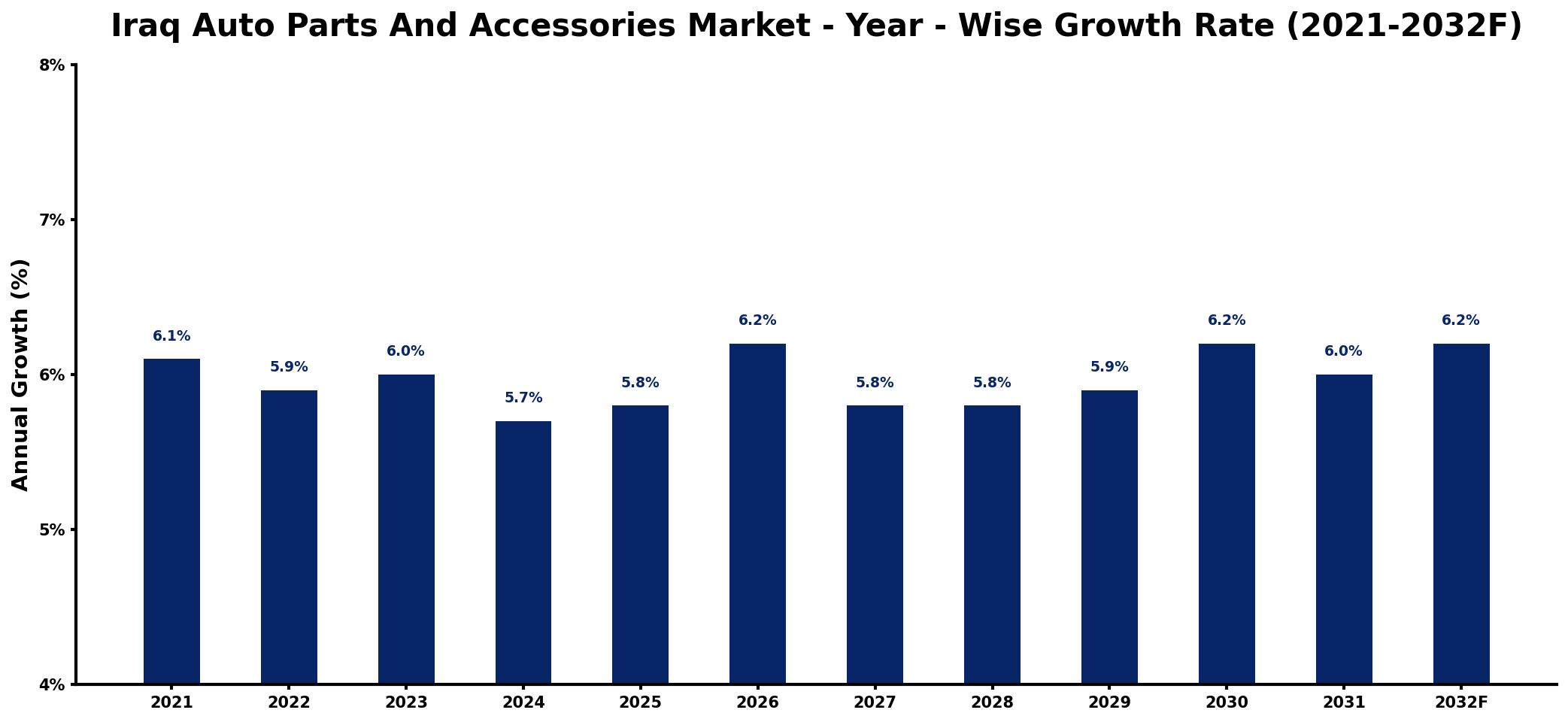
The table below presents the year‑wise growth rates along with the key drivers influencing the market
| Year | Growth Rate | Major Drivers |
| 2021 | 6.1% | Rising consumer vehicle ownership rates |
| 2022 | 5.9% | Increased demand for vehicle maintenance |
| 2023 | 6.0% | Growth in transportation sector investments |
| 2024 | 5.7% | Expansion of local manufacturing capabilities |
| 2025 | 5.8% | Surge in e-commerce distribution networks |
| 2026 | 6.2% | Enhanced government infrastructure projects |
| 2027 | 5.8% | improved raw material availability |
| 2028 | 5.8% | Growing interest in electric vehicles |
| 2029 | 5.9% | Strengthening export opportunities abroad |
| 2030 | 6.2% | Increased focus on sustainability initiatives |
| 2031 | 6.0% | Rising disposable income among consumers |
| 2032 | 6.2% | Growth of urban mobility solutions |
Note: Market size estimations and growth projections presented in this report are based on 6Wresearch's proprietary forecasting methodology, utilizing the latest available industry data, government publications, and primary research inputs.
Iraq Auto Parts And Accessories Market Synopsis
The surge in vehicle ownership in Iraq is spurring a parallel increase in demand for auto parts and accessories, reflecting consumers needs for maintenance and upgrades. From brake systems to electrical components, the market showcases a diverse array of products supplied by a blend of local and international providers.
As economic conditions improve, the accessibility of disposable income is prompting consumers to invest in higher-quality, reliable auto parts. Furthermore, awareness of sustainability is driving preferences toward eco-friendly options, setting the stage for a transformative market landscape.
Iraq Auto Parts And Accessories Market Key Takeaways
- The market is projected to grow at a CAGR of 5.1% from 2026 to 2032.
- There is a significant rise in the demand for eco-friendly and energy-efficient auto parts.
- Online sales platforms are increasingly becoming a preferred choice for consumers.
- The market is characterized by competition between local suppliers and international players.
- Government initiatives aim to bolster local manufacturing and promote quality standards.
Evaluation of Restraints in Iraq Auto Parts And Accessories Market
Despite the promising growth trajectory, the Iraq Auto Parts and Accessories Market is not without its challenges. A poorly developed supply chain often results in delays and difficulties in sourcing high-quality products. Competition is fierce, with numerous small local players struggling to coexist with larger international suppliers, leading to pricing pressures. Political instability and security concerns further complicate operations, while the absence of standardized regulations leaves room for counterfeit products, undermining consumer confidence and market integrity.
Iraq Auto Parts And Accessories Market Trends
The market is witnessing a marked shift toward innovative and connected auto parts, driven by advancements in technology and the growing consumer interest in smart vehicle features. Additionally, the eco-conscious consumer is increasingly prioritizing sustainable options, prompting suppliers to innovate with greener materials and manufacturing processes. The emergence of online sales platforms is also reshaping the purchasing landscape, offering consumers convenient access to a variety of products.
Iraq Auto Parts And Accessories Market Opportunities
Investment opportunities abound within the Iraq Auto Parts and Accessories Market, particularly for those looking to supply high-quality or eco-friendly auto parts. Strategic partnerships with local manufacturers can yield substantial returns, as can ventures focusing on distribution networks to reach a growing customer base. As the government continues to bolster transportation infrastructure, there will be increased demand for aftermarket products, opening avenues for businesses that can meet evolving consumer needs.
Government Initiatives in the Iraq Auto Parts And Accessories Market
The Iraqi government has introduced various policies aimed at enhancing the auto parts and accessories sector. Initiatives include reducing import tariffs to make auto parts more affordable and providing incentives for local manufacturing. Efforts are also underway to implement quality control measures to ensure product safety and reliability. Furthermore, regulations are promoting environmentally friendly practices within the automotive industry, such as encouraging the adoption of eco-friendly materials.
Future Insights of the Iraq Auto Parts And Accessories Market
Looking ahead to the period from 2026 to 2032, the outlook for the Iraq Auto Parts and Accessories Market remains strong. With continued economic development and infrastructure improvements, the demand for both new and replacement auto parts is expected to rise steadily. As consumers increasingly focus on vehicle maintenance and upgrades, coupled with government support for the automotive sector, the market is poised to achieve sustained growth. However, vigilance regarding counterfeit products and market fluctuations will be crucial for ongoing success.
Iraq Auto Parts And Accessories Market Latest Developments (2025 - 2026)
In recent months, the Iraq Auto Parts and Accessories Market has seen a surge in initiatives aimed at enhancing product quality and consumer safety. Industry stakeholders are increasingly collaborating to establish standards that can help mitigate issues related to counterfeit parts. Additionally, there is a growing interest in online sales channels, with many suppliers investing in digital platforms to cater to the evolving purchasing habits of consumers.
Iraq Auto Parts And Accessories Market - Key Attractiveness of the Report
- 10 Years of Market Numbers
- Historical Data Starting from 2022 to 2025
- Base Year: 2025
- Forecast Data until 2032
- Key Performance Indicators Impacting the Market
- Major Upcoming Developments and Projects
Key Highlights of the Report:
- Iraq Auto Parts And Accessories Market Outlook
- Market Size of Iraq Auto Parts And Accessories Market, 2025
- Forecast of Iraq Auto Parts And Accessories Market, 2032
- Historical Data and Forecast of Iraq Auto Parts And Accessories Revenues & Volume for the Period 2022-2032F
- Iraq Auto Parts And Accessories Market Trend Evolution
- Iraq Auto Parts And Accessories Market Drivers and Challenges
- Iraq Auto Parts And Accessories Price Trends
- Iraq Auto Parts And Accessories Porter's Five Forces
- Iraq Auto Parts And Accessories Industry Life Cycle
- Historical Data and Forecast of Iraq Auto Parts And Accessories Market Revenues & Volume By Product for the Period 2022-2032F
- Historical Data and Forecast of Iraq Auto Parts And Accessories Market Revenues & Volume By Driveline & Powertrain for the Period 2022-2032F
- Historical Data and Forecast of Iraq Auto Parts And Accessories Market Revenues & Volume By Interiors & Exteriors for the Period 2022-2032F
- Historical Data and Forecast of Iraq Auto Parts And Accessories Market Revenues & Volume By Electronics for the Period 2022-2032F
- Historical Data and Forecast of Iraq Auto Parts And Accessories Market Revenues & Volume By Bodies & Chassis for the Period 2022-2032F
- Historical Data and Forecast of Iraq Auto Parts And Accessories Market Revenues & Volume By Wheel & Tires for the Period 2022-2032F
- Historical Data and Forecast of Iraq Auto Parts And Accessories Market Revenues & Volume By Others for the Period 2022-2032F
- Historical Data and Forecast of Iraq Auto Parts And Accessories Market Revenues & Volume By Application for the Period 2022-2032F
- Historical Data and Forecast of Iraq Auto Parts And Accessories Market Revenues & Volume By OEMs for the Period 2022-2032F
- Historical Data and Forecast of Iraq Auto Parts And Accessories Market Revenues & Volume By Aftermarket for the Period 2022-2032F
- Iraq Auto Parts And Accessories Import Export Trade Statistics
- Market Opportunity Assessment By Product
- Market Opportunity Assessment By Application
- Iraq Auto Parts And Accessories Top Companies Market Share
- Iraq Auto Parts And Accessories Competitive Benchmarking By Technical and Operational Parameters
- Iraq Auto Parts And Accessories Company Profiles
- Iraq Auto Parts And Accessories Key Strategic Recommendations






































