France Heavy Fuel Oil Market Top 5 Importing Countries and Market Competition (HHI) Analysis
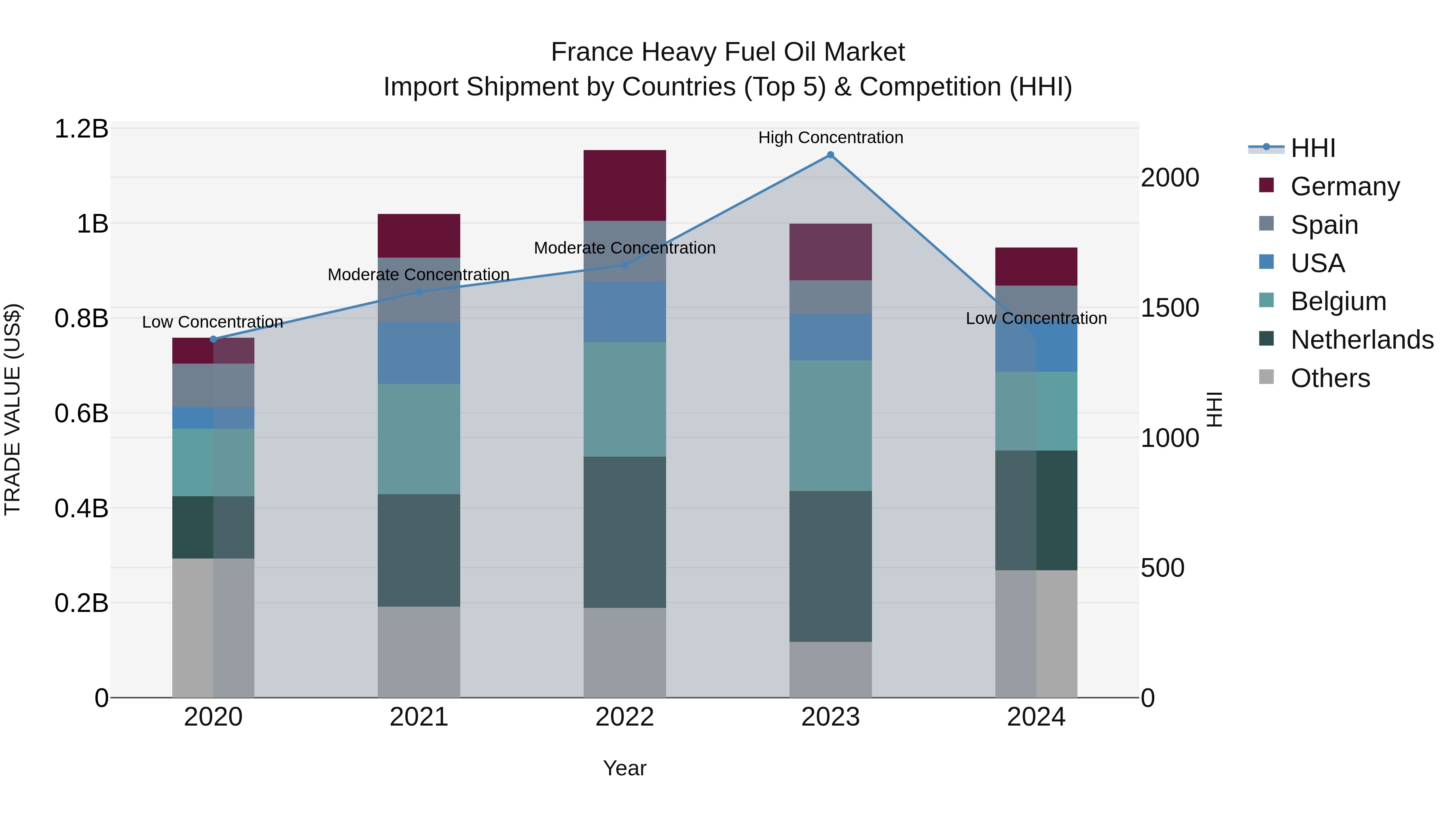
In 2024, France`s heavy fuel oil import market saw a shift in concentration from high to low, with top exporters being Netherlands, Belgium, USA, Germany, and Spain. Despite a slight decline in growth rate from 2023 to 2024, the compound annual growth rate (CAGR) over the period of 2020-2024 remained positive at 5.75%. This indicates a steady demand for heavy fuel oil in France, with diverse sources of imports contributing to the market dynamics. The changing concentration levels suggest a competitive landscape that offers opportunities for both domestic and international suppliers.
France Heavy Fuel Oil Market Overview
The France heavy fuel oil market is characterized by a strong demand from industries such as shipping, power generation, and manufacturing. Heavy fuel oil is a cost-effective option for these sectors due to its lower price compared to other fuels. However, there is a growing trend towards cleaner and more sustainable energy sources, leading to a gradual shift away from heavy fuel oil. Regulatory initiatives promoting cleaner fuels and stricter emissions standards are driving this transition. The market is also influenced by global oil prices, supply and demand dynamics, and geopolitical factors. Companies operating in the France heavy fuel oil market are increasingly investing in alternative energy solutions and technologies to adapt to the changing landscape and meet environmental targets.
France Heavy Fuel Oil Market Trends
Currently, the heavy fuel oil market in France is experiencing a shift towards cleaner and more sustainable energy sources in line with the country`s commitment to reducing carbon emissions. With the implementation of stricter environmental regulations and the increasing focus on renewable energy sources, there is a growing trend towards the gradual phase-out of heavy fuel oil for industrial and power generation purposes. Many companies are investing in alternative fuels such as natural gas, biomass, and hydrogen to meet their energy needs while reducing their environmental impact. Additionally, there is a rising interest in energy efficiency measures and technologies to optimize fuel consumption and lower emissions in the heavy fuel oil sector. Overall, the heavy fuel oil market in France is moving towards a more sustainable and eco-friendly future.
France Heavy Fuel Oil Market Challenges
In the France heavy fuel oil market, one of the main challenges faced is the increasing focus on environmental sustainability and the transition towards cleaner energy sources. Heavy fuel oil is a high-polluting fuel with significant environmental impacts, leading to regulatory pressure and public scrutiny on its usage. This has resulted in a shift towards cleaner alternatives such as natural gas, renewable energy, and electrification in various industries, including shipping, power generation, and manufacturing. As a result, companies operating in the heavy fuel oil market in France are facing the challenge of adapting to these changing market dynamics, investing in cleaner technologies, and finding ways to remain competitive while meeting stringent environmental regulations and sustainability goals.
France Heavy Fuel Oil Market Investment Opportunities
In the France heavy fuel oil market, there are various investment opportunities available for investors looking to capitalize on the sector. With the increasing regulations on emissions and the transition towards cleaner energy sources, investing in companies that are developing technologies for fuel oil optimization or transitioning to alternative fuels could be promising. Additionally, investing in companies involved in the storage and distribution of heavy fuel oil, as well as those providing environmental services related to fuel oil management, could also be lucrative. Furthermore, considering the demand for heavy fuel oil in industries like shipping and power generation, investing in companies that cater to these sectors could present attractive opportunities for growth and returns in the France heavy fuel oil market.
France Heavy Fuel Oil Market Government Policy
In France, government policies related to the heavy fuel oil market aim to transition away from this high-polluting fuel source towards cleaner alternatives in order to reduce greenhouse gas emissions and improve air quality. One key policy is the Energy Transition for Green Growth Law, which includes measures to phase out the use of heavy fuel oil for heating in buildings. Additionally, the French government offers financial incentives and support for businesses and individuals to switch to more sustainable heating options, such as natural gas, electricity, or renewable energy sources. These policies align with France`s commitment to meeting its climate targets and transitioning to a more sustainable energy system.
France Heavy Fuel Oil Market Future Outlook
The future outlook for the France heavy fuel oil market is expected to decline gradually due to ongoing global efforts to reduce carbon emissions and transition towards cleaner energy sources. The implementation of stricter environmental regulations, such as the International Maritime Organization`s sulfur cap regulations, will likely lead to a decrease in heavy fuel oil consumption in the shipping industry. Additionally, the shift towards renewable energy sources and the increasing popularity of natural gas as a cleaner alternative for heating and power generation will further contribute to the decline in demand for heavy fuel oil in France. As a result, the market is anticipated to see a gradual but steady decline in the coming years, with opportunities emerging for alternative energy sources and cleaner technologies to fill the gap.
Key Highlights of the Report:
- France Heavy Fuel Oil Market Outlook
- Market Size of France Heavy Fuel Oil Market,2024
- Forecast of France Heavy Fuel Oil Market, 2031
- Historical Data and Forecast of France Heavy Fuel Oil Revenues & Volume for the Period 2021-2031
- France Heavy Fuel Oil Market Trend Evolution
- France Heavy Fuel Oil Market Drivers and Challenges
- France Heavy Fuel Oil Price Trends
- France Heavy Fuel Oil Porter's Five Forces
- France Heavy Fuel Oil Industry Life Cycle
- Historical Data and Forecast of France Heavy Fuel Oil Market Revenues & Volume By Application for the Period 2021-2031
- Historical Data and Forecast of France Heavy Fuel Oil Market Revenues & Volume By Marine for the Period 2021-2031
- Historical Data and Forecast of France Heavy Fuel Oil Market Revenues & Volume By Power Generation for the Period 2021-2031
- Historical Data and Forecast of France Heavy Fuel Oil Market Revenues & Volume By Industrial Heating for the Period 2021-2031
- Historical Data and Forecast of France Heavy Fuel Oil Market Revenues & Volume By Manufacturing for the Period 2021-2031
- Historical Data and Forecast of France Heavy Fuel Oil Market Revenues & Volume By Residential Heating for the Period 2021 - 2029
- Historical Data and Forecast of France Heavy Fuel Oil Market Revenues & Volume By End use for the Period 2021-2031
- Historical Data and Forecast of France Heavy Fuel Oil Market Revenues & Volume By Shipping Industry for the Period 2021-2031
- Historical Data and Forecast of France Heavy Fuel Oil Market Revenues & Volume By Electricity Generation for the Period 2021-2031
- Historical Data and Forecast of France Heavy Fuel Oil Market Revenues & Volume By Manufacturing Industry for the Period 2021-2031
- Historical Data and Forecast of France Heavy Fuel Oil Market Revenues & Volume By Cement Industry for the Period 2021-2031
- Historical Data and Forecast of France Heavy Fuel Oil Market Revenues & Volume By Type for the Period 2021-2031
- Historical Data and Forecast of France Heavy Fuel Oil Market Revenues & Volume By Straight Run Fuel Oil for the Period 2021-2031
- Historical Data and Forecast of France Heavy Fuel Oil Market Revenues & Volume By Residuums for the Period 2021-2031
- Historical Data and Forecast of France Heavy Fuel Oil Market Revenues & Volume By Blend Fuels for the Period 2021-2031
- Historical Data and Forecast of France Heavy Fuel Oil Market Revenues & Volume By Geographic Supply Chain for the Period 2021-2031
- Historical Data and Forecast of France Heavy Fuel Oil Market Revenues & Volume By Production for the Period 2021-2031
- Historical Data and Forecast of France Heavy Fuel Oil Market Revenues & Volume By Refining for the Period 2021-2031
- Historical Data and Forecast of France Heavy Fuel Oil Market Revenues & Volume By Trading for the Period 2021-2031
- France Heavy Fuel Oil Import Export Trade Statistics
- Market Opportunity Assessment By Application
- Market Opportunity Assessment By End use
- Market Opportunity Assessment By Type
- Market Opportunity Assessment By Geographic Supply Chain
- France Heavy Fuel Oil Top Companies Market Share
- France Heavy Fuel Oil Competitive Benchmarking By Technical and Operational Parameters
- France Heavy Fuel Oil Company Profiles
- France Heavy Fuel Oil Key Strategic Recommendations






































