France Real Estate Market Size, Share & Growth Rate
The France Real Estate Market was estimated at USD 196 Million in 2025 and is projected to reach USD 218 Million by 2032, growing at a CAGR of 1.5% from 2026 to 2032. This growth is driven by sustained demand in urban centers, particularly in Paris, Lyon, and Marseille, where low-interest rates and stable economic conditions are compelling both local and international buyers to invest. Additionally, ongoing trends toward remote working and the rising preference for sustainable living are further enhancing the appeal of urban properties.
France Real Estate Market Year-wise Growth Rate and Key Drivers
This graph highlights how the France Real Estate Market has steadily grown over the years, supported by major growth factors.
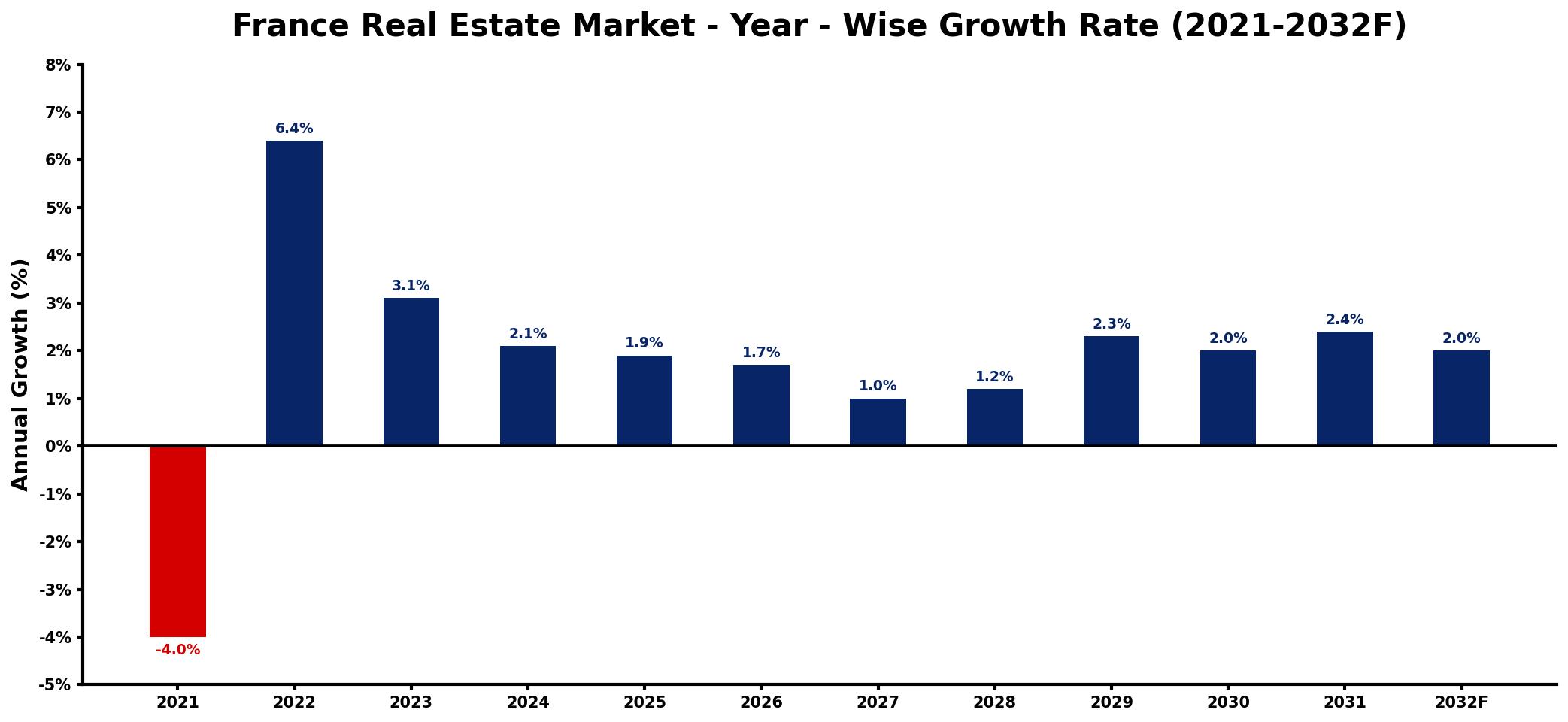
The table below presents the year‑wise growth rates along with the key drivers influencing the market
| Year | Growth Rate | Major Drivers |
| 2021 | -4.0% | decreased buyer confidence in investments |
| 2022 | 6.4% | rising demand for urban living |
| 2023 | 3.1% | increased foreign investment opportunities |
| 2024 | 2.1% | growing interest in sustainable housing |
| 2025 | 1.9% | expansion of tech-driven solutions |
| 2026 | 1.7% | increased availability of financing options |
| 2027 | 1.0% | surge in rental market activity |
| 2028 | 1.2% | growing preference for suburban areas |
| 2029 | 2.3% | increased migration to metropolitan regions |
| 2030 | 2.0% | rising construction of new developments |
| 2031 | 2.4% | strengthening international trade flows |
| 2032 | 2.0% | increased focus on eco-friendly designs |
Note: Market size estimations and growth projections presented in this report are based on 6Wresearch's proprietary forecasting methodology, utilizing the latest available industry data, government publications, and primary research inputs.
France Real Estate Market Synopsis
The most significant force shaping the France Real Estate Market right now is the high demand for urban properties. Major cities are witnessing a continuous influx of residents, which has created a competitive environment, especially in desirable neighborhoods.
Equally important is the trend toward sustainability, with energy-efficient properties gaining traction among buyers. This is reflective of a broader societal shift towards eco-conscious living, which adds another layer to the investment appeal of the real estate sector in France.
France Real Estate Market Key Takeaways
- The market is primarily driven by urban demand, with cities like Paris and Lyon at the forefront.
- Competition in key locations is leading to rising property prices, making affordability a pressing issue.
- Sustainable and energy-efficient properties are becoming increasingly popular among buyers.
- Government initiatives aim to promote construction while ensuring tenant protections.
- Overall market growth remains stable despite potential economic uncertainties.
Evaluation of Restraints in France Real Estate Market
One of the most pressing restraints in the France Real Estate Market is the high property prices prevalent in major urban centers. These elevated costs can deter first-time buyers, limiting their entry into the market. Additionally, the shortage of affordable housing exacerbates the problem, creating bidding wars that further inflate prices. Regulatory challenges, such as stringent property transaction taxes, complicate the landscape for investors and developers, necessitating thorough market knowledge to navigate successfully.
France Real Estate Market Trends
Current trends show a marked shift in buyer preferences towards properties equipped for remote working, alongside access to outdoor spaces. The focus on energy-efficient homes also indicates a growing awareness of environmental impact among consumers. Additionally, urban centers are adapting to meet these evolving demands, with many developers prioritizing sustainable designs and community-oriented spaces to attract modern buyers.
France Real Estate Market Opportunities
The France Real Estate Market offers promising investment opportunities, particularly in high-demand urban locales. Residential properties in cities like Paris and Lyon provide excellent potential for stable rental income and capital appreciation. Moreover, commercial real estate, including office and retail spaces in prime urban settings, presents additional avenues for investment. The push for sustainability further opens doors for projects focused on eco-friendly developments that align with consumer demands.
Government Initiatives in the France Real Estate Market
The French government actively promotes new housing construction and energy efficiency within the real estate sector. Policies include tax incentives and subsidies aimed at encouraging the development of affordable housing units, particularly in urban areas. Strict regulations governing energy efficiency are also in place, aimed at reducing carbon emissions and promoting sustainable urban development. These initiatives not only support the market but also aim to protect tenants' rights and ensure housing stability.
Future Insights of the France Real Estate Market
Looking ahead to 2026-2032, the France Real Estate Market is expected to maintain its growth trajectory. Continued demand for urban properties, spurred by low mortgage rates and foreign investment, will likely play a significant role in market expansion. However, challenges such as affordability and regulatory complexities may create obstacles. Despite these hurdles, the overall outlook remains positive, with opportunities for growth and innovation expected to emerge.
France Real Estate Market Latest Developments (2025 - 2026)
Recent developments in the France Real Estate Market reflect a focus on sustainability and modernization. Many urban projects are increasingly integrating eco-friendly designs, with a noticeable shift towards mixed-use developments. Additionally, government initiatives targeting affordable housing have gained momentum, resulting in new projects aimed at alleviating housing shortages. The influence of remote work continues to reshape buyer preferences, pushing the market towards properties that offer flexibility and outdoor access.
France Real Estate Market - Key Attractiveness of the Report
- 10 Years of Market Numbers
- Historical Data Starting from 2022 to 2025
- Base Year: 2025
- Forecast Data until 2032
- Key Performance Indicators Impacting the Market
- Major Upcoming Developments and Projects
Key Highlights of the Report:
- France Real Estate Market Outlook
- Market Size of France Real Estate Market, 2025
- Forecast of France Real Estate Market, 2032
- Historical Data and Forecast of France Real Estate Revenues & Volume for the Period 2022-2032F
- France Real Estate Market Trend Evolution
- France Real Estate Market Drivers and Challenges
- France Real Estate Price Trends
- France Real Estate Porter's Five Forces
- France Real Estate Industry Life Cycle
- Historical Data and Forecast of France Real Estate Market Revenues & Volume By Property for the Period 2022-2032F
- Historical Data and Forecast of France Real Estate Market Revenues & Volume By Residential for the Period 2022-2032F
- Historical Data and Forecast of France Real Estate Market Revenues & Volume By Commercial for the Period 2022-2032F
- Historical Data and Forecast of France Real Estate Market Revenues & Volume By Industrial for the Period 2022-2032F
- Historical Data and Forecast of France Real Estate Market Revenues & Volume By Land for the Period 2022-2032F
- Historical Data and Forecast of France Real Estate Market Revenues & Volume By Others for the Period 2022-2032F
- Historical Data and Forecast of France Real Estate Market Revenues & Volume By Type for the Period 2022-2032F
- Historical Data and Forecast of France Real Estate Market Revenues & Volume By Sales for the Period 2022-2032F
- Historical Data and Forecast of France Real Estate Market Revenues & Volume By Rental for the Period 2022-2032F
- Historical Data and Forecast of France Real Estate Market Revenues & Volume By Lease for the Period 2022-2032F
- France Real Estate Import Export Trade Statistics
- Market Opportunity Assessment By Property
- Market Opportunity Assessment By Type
- France Real Estate Top Companies Market Share
- France Real Estate Competitive Benchmarking By Technical and Operational Parameters
- France Real Estate Company Profiles
- France Real Estate Key Strategic Recommendations






































