France Television Market Summary
The france television market was estimated at USD 266 Million in 2025 and is projected to reach USD 338 Million by 2032, growing at a CAGR of 3.6% from 2026 to 2032.
France Television Market Year-wise Growth Rate and Key Drivers
This graph highlights how the France Television Market has steadily grown over the past five years, supported by major growth factors.
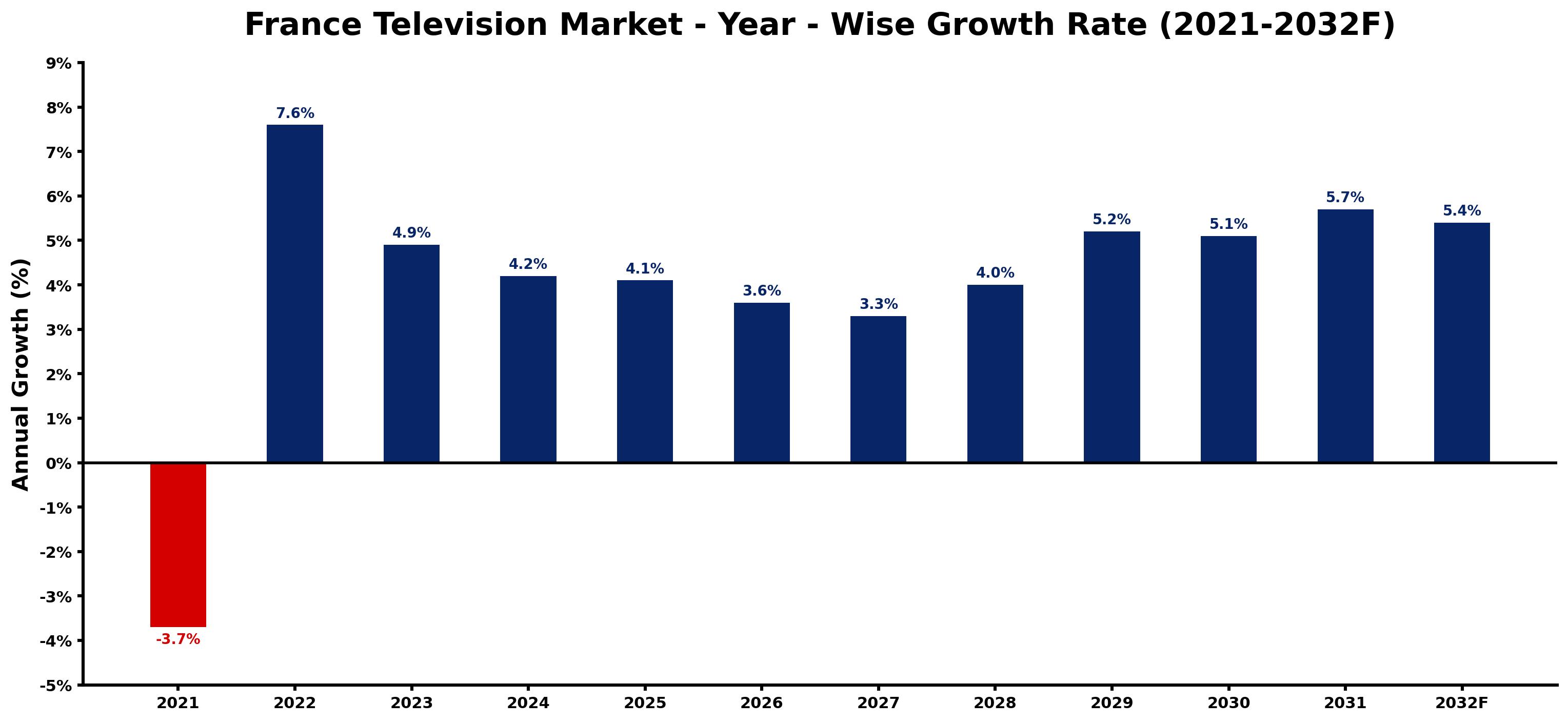
The table below presents the year wise growth rates along with the key drivers influencing the market
| Year | Growth Rate | Major Drivers |
| 2021 | -3.7% | Increased competition from streaming services diminished traditional television viewership and advertising revenues. |
| 2022 | 7.6% | Streaming platforms enhanced competition, prompting traditional broadcasters to innovate. |
| 2023 | 4.9% | Audience preferences shifted towards on-demand programming, affecting advertising strategies significantly. |
| 2024 | 4.2% | Integration of AI technology improved content personalization and viewer experience drastically. |
| 2025 | 4.1% | Emergence of 5G infrastructure enabled seamless streaming, attracting tech-savvy consumers. |
| 2026 | 3.6% | Environmental concerns began influencing content themes, aligning with social responsibility trends. |
| 2027 | 3.3% | Data analytics transformed audience targeting, optimizing advertising revenues for networks. |
| 2028 | 4.0% | Strategic partnerships between broadcasters and tech firms enriched content delivery models. |
| 2029 | 5.2% | Cultural programming initiatives fostered national pride, boosting viewership of local productions. |
| 2030 | 5.1% | Interactive content formats emerged, enhancing viewer participation and loyalty to brands. |
| 2031 | 5.7% | Global events prompted increased international content acquisitions, diversifying program offerings. |
| 2032 | 5.4% | Market consolidation reached new heights, reshaping competitive dynamics in the broadcasting landscape. |
Note - Market size estimations and growth projections presented in this report are based on 6Wresearch's advanced forecasting approach, validated with industry datasets as of June 2026.
France Television Market Synopsis
The France Television Market is projected to reach 3.6% and witness significant growth during the forecast period (2026-2032). This growth is driven by a variety of factors, including the increasing demand for diverse content and the evolution of viewing habits among the French population. The market encompasses a rich tapestry of both public and private broadcasters, engaging audiences through a plethora of channels and innovative programming strategies.
France Television Market Growth Drivers
One of the primary growth drivers within the France Television Market is the digital transformation that has catalyzed a shift in content consumption. As viewers increasingly favor on-demand and streaming services, traditional broadcasters are compelled to adapt to these new preferences. This shift has led to a greater investment in original content production.
- Public broadcasters are enhancing their offerings by including more diverse programming that appeals to younger demographics.
- Increased penetration of smart TVs and connected devices has enabled seamless access to online platforms.
- Viewers are opting for personalized viewing experiences, leading to a surge in demand for original, high-quality content.
- Advancements in internet speeds and technologies like 5G have made streaming more viable and convenient.
- Advertisers are reallocating budgets towards digital platforms, enhancing revenue potential for broadcasters.
France Television Market Trends and Opportunities
The France Television Market is witnessing notable trends that pave the way for new business opportunities. As streaming services continue to proliferate, the demand for unique and appealing content is escalating.
- There is a significant rise in subscription models, offering broadcasters the chance to generate steady revenue streams.
- French content creators are increasingly focusing on niche genres that cater to specific audience segments, thereby enhancing viewer engagement.
- Innovative partnerships between broadcasters and digital platforms are emerging to create exclusive content.
- Interactive viewing experiences are becoming more prevalent, encouraging audience participation and engagement.
- The need for bilingual or multilingual content is growing due to the country's diverse population, presenting an opportunity for localized programming.
France Television Market Challenges and Restraints
Within the France Television Market, several challenges must be navigated to ensure sustained growth. The fierce competition from streaming services poses a significant threat to traditional broadcasters.
- The rapid evolution of viewer preferences can leave broadcasters struggling to keep up with constantly changing demands.
- Fragmentation of viewership due to multiple platforms can dilute audience numbers and complicate advertising strategies.
- Regulatory constraints regarding content distribution can hinder the flexibility of broadcasters to monetize their offerings effectively.
- The increasing cost of producing high-quality original content puts financial pressure on traditional networks.
- Subscription fatigue can lead to viewer churn, making it difficult for platforms to retain subscribers in a crowded marketplace.
France Television Market Government Investment and Initiatives
Government policy plays a crucial role in shaping the France Television Market, with initiatives aimed at promoting cultural diversity and quality programming. The regulatory body, Conseil supérieur de l'audiovisuel (CSA), enforces laws that support the local content creation industry.
- The government mandates content quotas for French and European productions to safeguard the nation's cultural heritage.
- Funding mechanisms are in place to support public broadcasting services, ensuring their sustainability.
- Investment in digital infrastructure is being prioritized to enhance access to video content across the country.
- Subsidies may be available for innovative projects that focus on emerging technologies in the television sector.
- Policies are being established to encourage collaboration between public and private sectors in content production.
France Television Market Latest Developments (May 2025 - June 2026)
The period between May 2025 and June 2026 has seen several pivotal developments in the France Television Market. The competitive landscape has shifted as broadcasters actively pursue strategies to retain and attract viewership amid the continuing rise of streaming platforms.
- Innovative content delivery methods have been adopted, allowing for enhanced engagement with audiences across digital platforms.
- Collaborations between traditional media and tech companies have become more prevalent, opening new avenues for content distribution.
- The focus on producing localized content has intensified, appealing to diverse audience segments, including regional dialects.
- Market players are increasingly investing in advanced analytics to better understand viewer preferences and tailor content accordingly.
- Various initiatives aimed at training and developing talent within the industry have been launched, ensuring sustainability and growth.
France Television Market - Key Attractiveness of the Report
- 10 Years of Market Numbers
- Historical Data Starting from 2022 to 2025
- Base Year: 2025
- Forecast Data until 2032
- Key Performance Indicators Impacting the Market
- Major Upcoming Developments and Projects
Key Highlights of the Report:
- France Television Market Outlook
- Market Size of France Television Market, 2025
- Forecast of France Television Market, 2032F
- Historical Data and Forecast of France Television Revenues & Volume for the Period 2022-2032F
- France Television Market Trend Evolution
- France Television Market Drivers and Challenges
- France Television Price Trends
- France Television Porter's Five Forces
- France Television Industry Life Cycle
- Historical Data and Forecast of France Television Market Revenues & Volume By Resolution for the Period 2022-2032F
- Historical Data and Forecast of France Television Market Revenues & Volume By LCD TVs for the Period 2022-2032F
- Historical Data and Forecast of France Television Market Revenues & Volume By OLED TVs for the Period 2022-2032F
- Historical Data and Forecast of France Television Market Revenues & Volume By Types for the Period 2022-2032F
- Historical Data and Forecast of France Television Market Revenues & Volume By 2D TVs for the Period 2022-2032F
- Historical Data and Forecast of France Television Market Revenues & Volume By 3D TVs for the Period 2022-2032F
- France Television Import Export Trade Statistics
- Market Opportunity Assessment By Resolution
- Market Opportunity Assessment By Types
- France Television Top Companies Market Share
- France Television Competitive Benchmarking By Technical and Operational Parameters
- France Television Company Profiles
- France Television Key Strategic Recommendations






































