Peru Television Market Summary
The peru television market was estimated at USD 1179 Million in 2025 and is projected to reach USD 2010 Million by 2032, growing at a CAGR of 9.1% from 2026 to 2032.
Peru Television Market Year-wise Growth Rate and Key Drivers
This graph highlights how the Peru Television Market has steadily grown over the past five years, supported by major growth factors.
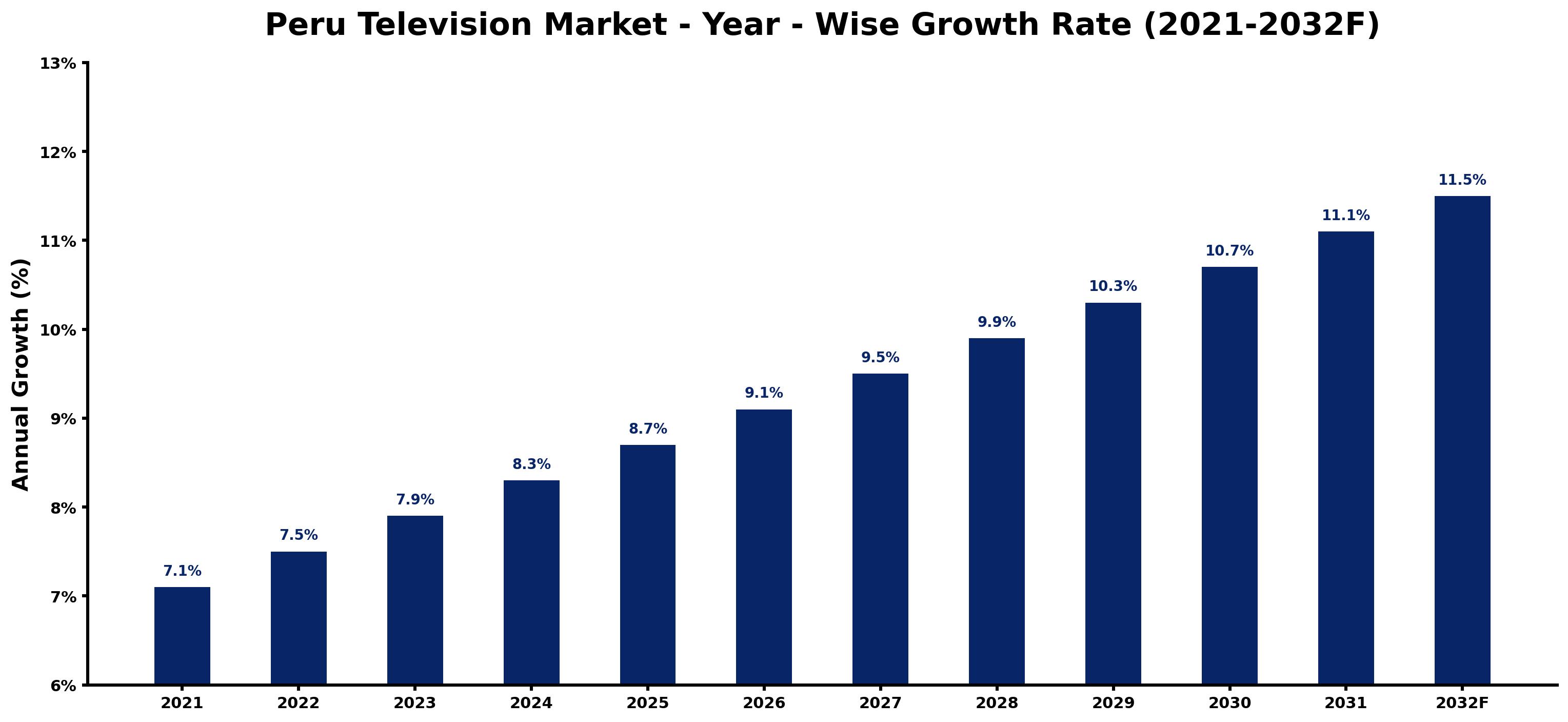
The table below presents the year wise growth rates along with the key drivers influencing the market
| Year | Growth Rate | Major Drivers |
| 2021 | 7.1% | Peru's television market showed resilience with increased audience engagement during the pandemic. |
| 2022 | 7.5% | Competition intensified as local channels improved content quality and diversified offerings. |
| 2023 | 7.9% | Digital streaming platforms began capturing significant viewership, challenging traditional broadcasting norms. |
| 2024 | 8.3% | Latin American partnerships facilitated better production standards and regional content exchange. |
| 2025 | 8.7% | Smart TV sales surged, prompting more households to access diverse streaming services. |
| 2026 | 9.1% | Advertising revenues shifted towards digital platforms, prompting TV networks to adapt strategies. |
| 2027 | 9.5% | Audience preferences began leaning towards localized content, emphasizing cultural relevance in programming. |
| 2028 | 9.9% | Technological upgrades in broadcasting infrastructure enhanced viewing experiences across urban areas. |
| 2029 | 10.3% | Consumer data analytics enabled broadcasters to tailor content effectively, increasing viewer retention. |
| 2030 | 10.7% | Interactive television formats gained traction, creating new engagement opportunities for audiences. |
| 2031 | 11.1% | Collaborations with international streaming giants reshaped content distribution and audience reach dynamics. |
| 2032 | 11.5% | Emerging technologies like VR and AR started to influence how content was delivered. |
Note - Market size estimations and growth projections presented in this report are based on 6Wresearch's advanced forecasting approach, validated with industry datasets as of June 2026.
Peru Television Market Synopsis
The Peru Television Market is projected to reach 9.1% and witness significant growth during the forecast period (2026-2032). With a vibrant ecosystem comprising both public and private broadcasters, the market serves approximately 8.5 million television households, making it a crucial segment within the broader media landscape. Free-to-air channels dominate the viewing preferences, while pay-TV services are steadily gaining traction, reflecting an evolving consumer demand for diverse content options. Amidst this competitive terrain, digital television services are increasingly popular, driven by enhanced internet connectivity and a growing appetite for on-demand programming.
Peru Television Market Trends and Opportunities
The Peru Television Market is undergoing a transformative phase characterized by several notable trends. The shift towards digital platforms is one of the primary driving forces behind this evolution:
- An increasing number of viewers are favoring on-demand content, which challenges traditional cable and satellite offerings. This trend indicates a fundamental change in consumer behavior towards more flexible viewing options.
- With the demand for original programming on the rise, there is a substantial increase in investments in local content production. This aligns with the cultural richness of Peru and its diverse audience's interests.
- The proliferation of smart TVs and connected devices has enabled audiences to access a wider array of content seamlessly. This trend signals a significant shift in how consumers engage with television.
- As internet penetration improves across the nation, providers are focusing on offering affordable streaming services, which cater to a more extensive viewer demographic.
- The cultural significance of local productions is becoming increasingly relevant, with viewers expressing a preference for content that resonates with their regional identities.
Peru Television Market Challenges and Restraints
Despite its growth trajectory, the Peru Television Market faces several challenges that stakeholders must navigate:
- Intense competition among domestic and international broadcasters leads to a crowded market, necessitating innovative strategies for audience retention.
- Rapidly evolving viewer preferences and consumption habits make it difficult for traditional broadcasters to keep pace, particularly in terms of adapting content offerings.
- Regulatory constraints can impact the production and distribution of content, affecting the ability of networks to operate freely within the market.
- The rise of digital platforms and the prevalence of on-demand consumption pose a considerable threat to conventional television models, requiring swift adaptation.
- Challenges in maintaining advertising revenue streams due to shifting ad budgets towards digital spaces create financial stress for traditional networks.
Peru Television Market Investment Opportunities
The evolving landscape of the Peru Television Market presents numerous investment avenues. As the market matures, several factors facilitate growth:
- The expanding middle class, coupled with a population exceeding 30 million, fuels demand for diverse and high-quality television content, creating space for new entrants.
- The increasing penetration of pay-TV services opens opportunities for investment in subscription-based models, enhancing revenue potential.
- Digital streaming platforms are on the rise, presenting openings for innovation in content delivery and user engagement.
- Investments in local production capabilities can cater to the unique preferences of Peruvian audiences, enhancing cultural representation.
- Acquisition of broadcasting rights for internationally popular shows can provide competitive leverage and attract diverse viewership.
Peru Television Market Government Investment and Initiatives
The Peruvian government plays a pivotal role in shaping the television market through various policies and initiatives aimed at promoting fair competition and cultural diversity. The National Institute for the Defense of Competition and Protection of Intellectual Property (INDECOPI) safeguards market integrity by regulating anti-competitive practices. The Audiovisual Communication Law establishes guidelines for media ownership and ensures content diversity, fostering a pluralistic environment. Furthermore, government initiatives support local content production through funding and incentives, which aim to enhance the representation of Peru's rich cultural narratives. These concerted efforts strive to cultivate a competitive television ecosystem while prioritizing consumer rights and promoting local industry growth.
Peru Television Market Latest Developments (May 2025 - June 2026)
Recent developments within the Peru Television Market from May 2025 to June 2026 indicate a significant shift towards embracing digital transformation. Broadcasting entities have increasingly explored partnerships with digital platforms to extend their reach and offer hybrid viewing options. The rise of mobile streaming applications has garnered attention, facilitating greater audience accessibility. Moreover, advancements in content delivery technologies have improved viewing experiences, contributing to higher engagement rates. Industry players are also focusing on enhancing their advertising offerings to keep pace with shifting consumer habits—particularly as viewers become more discerning regarding content choices. In summary, this period marks a critical evolution as the television landscape actively adapts to the digital age.
Peru Television Market - Key Attractiveness of the Report
- 10 Years of Market Numbers
- Historical Data Starting from 2022 to 2025
- Base Year: 2025
- Forecast Data until 2032
- Key Performance Indicators Impacting the Market
- Major Upcoming Developments and Projects
Key Highlights of the Report:
- Peru Television Market Outlook
- Market Size of Peru Television Market, 2025
- Forecast of Peru Television Market, 2032F
- Historical Data and Forecast of Peru Television Revenues & Volume for the Period 2022-2032F
- Peru Television Market Trend Evolution
- Peru Television Market Drivers and Challenges
- Peru Television Price Trends
- Peru Television Porter's Five Forces
- Peru Television Industry Life Cycle
- Historical Data and Forecast of Peru Television Market Revenues & Volume By Resolution for the Period 2022-2032F
- Historical Data and Forecast of Peru Television Market Revenues & Volume By LCD TVs for the Period 2022-2032F
- Historical Data and Forecast of Peru Television Market Revenues & Volume By OLED TVs for the Period 2022-2032F
- Historical Data and Forecast of Peru Television Market Revenues & Volume By Types for the Period 2022-2032F
- Historical Data and Forecast of Peru Television Market Revenues & Volume By 2D TVs for the Period 2022-2032F
- Historical Data and Forecast of Peru Television Market Revenues & Volume By 3D TVs for the Period 2022-2032F
- Peru Television Import Export Trade Statistics
- Market Opportunity Assessment By Resolution
- Market Opportunity Assessment By Types
- Peru Television Top Companies Market Share
- Peru Television Competitive Benchmarking By Technical and Operational Parameters
- Peru Television Company Profiles
- Peru Television Key Strategic Recommendations






































