United States (US) Television Market Summary
The united states (us) television market was estimated at USD 431 Million in 2025 and is projected to reach USD 576 Million by 2032, growing at a CAGR of 4.7% from 2026 to 2032.
United States (US) Television Market Year-wise Growth Rate and Key Drivers
This graph highlights how the United States (US) Television Market has steadily grown over the past five years, supported by major growth factors.
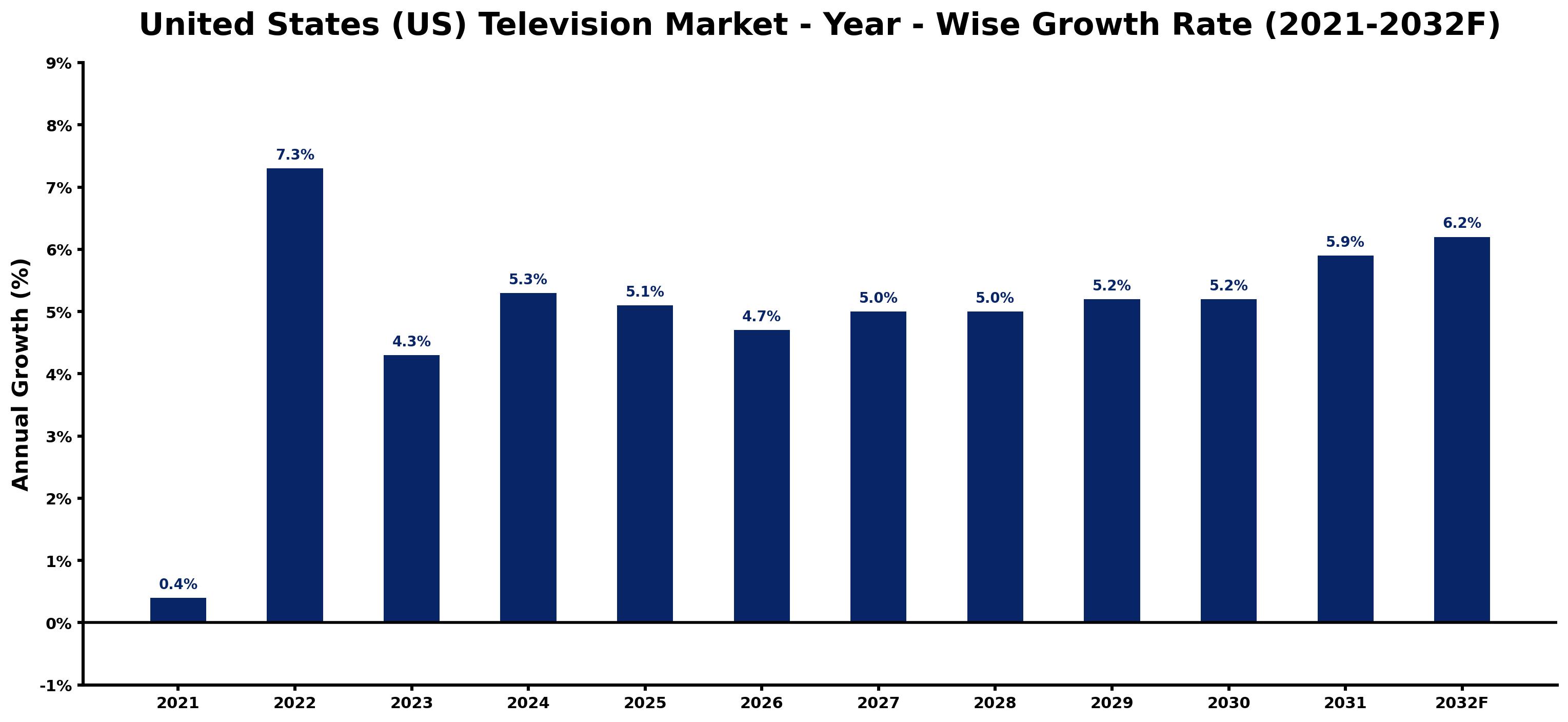
The table below presents the year wise growth rates along with the key drivers influencing the market
| Year | Growth Rate | Major Drivers |
| 2021 | 0.4% | Post-pandemic viewership trends shifted towards streaming platforms and on-demand content. |
| 2022 | 7.3% | Emerging technologies in content delivery reshaped traditional broadcasting dynamics significantly. |
| 2023 | 4.3% | Consumer preferences evolved, emphasizing personalized viewing experiences and niche programming. |
| 2024 | 5.3% | Advertisers increasingly recognized the value of targeted digital advertisement integration strategies. |
| 2025 | 5.1% | Innovative partnerships between tech firms and networks expanded distribution channels for content. |
| 2026 | 4.7% | New player entries introduced competition, driving content diversity and pricing strategy adjustments. |
| 2027 | 5.0% | Shifts in consumer behavior reflected a growing appreciation for interactive television formats. |
| 2028 | 5.0% | Enhanced broadband infrastructure facilitated smoother streaming experiences nationwide, attracting viewers. |
| 2029 | 5.2% | Original programming investments surged, enhancing brand loyalty among key demographic segments. |
| 2030 | 5.2% | Cross-platform integration became essential, blending social media with traditional television experiences. |
| 2031 | 5.9% | Sustainability initiatives influenced production decisions, appealing to environmentally conscious audiences. |
| 2032 | 6.2% | Audience fragmentation led networks to develop hyper-targeted content for diverse viewer segments. |
Note - Market size estimations and growth projections presented in this report are based on 6Wresearch's advanced forecasting approach, validated with industry datasets as of June 2026.
United States (US) Television Market Synopsis
The United States (US) Television Market is projected to reach 4.7% and witness significant growth during the forecast period (2026-2032). This market is renowned for its vast array of viewing options and its competitive landscape, where traditional cable and satellite services coexist with a surge in streaming platforms. Notably, services such as Netflix, Hulu, and Amazon Prime Video have captured increasing shares of consumer attention, further shifting viewing habits and preferences.
United States (US) Television Market Growth Drivers
Several factors are driving the growth of the United States (US) Television Market, shaping its future trajectory:
- The proliferation of streaming services is radically changing consumer behavior, with platforms offering flexible subscription models and extensive libraries of content that appeal to diverse demographics.
- Advancements in technology, particularly smart TVs and connected devices, have enhanced the way viewers consume content, making it more convenient to access platforms directly from their televisions.
- A growing trend towards on-demand content consumption reflects a shift in viewer expectations, emphasizing the need for ready availability and the ability to choose what and when to watch.
- Advertisers continue to heavily invest in television due to its capacity to reach wide audiences; with targeted advertising capabilities improving, businesses are finding new ways to engage consumers.
- The demand for high-quality original programming across platforms is fostering a competitive environment, leading to increased investment in content creation.
United States (US) Television Market Trends and Opportunities
The United States (US) Television Market is observing notable trends that present numerous opportunities for stakeholders:
- Subscription-based platforms are increasingly preferred, as cord-cutting trends hint at consumers moving away from traditional cable services in favor of more cost-effective streaming solutions.
- There is a marked increase in the production of exclusive original content, with streaming services engaging audiences through unique storytelling and high production values, which are enticing to subscribers.
- Interactive content and personalized viewing experiences are becoming significant selling points, attracting consumers who seek engagement beyond traditional viewing.
- The integration of advanced analytics is allowing content providers to better understand viewer preferences and tailor offerings accordingly, optimizing user satisfaction.
- Investment in advanced technology solutions—such as augmented reality (AR), virtual reality (VR), and Artificial Intelligence (AI) for content customization—presents opportunities for enhancing viewer engagement and experience.
United States (US) Television Market Challenges and Restraints
The United States (US) Television Market, while robust, faces several challenges that could impede growth:
- Intensifying competition from streaming platforms creates pressure on traditional providers to innovate and adapt their service offerings to retain subscribers.
- The fragmentation of viewership across various platforms complicates marketing strategies for television networks, making it harder to achieve substantial audience reach.
- As consumers favor on-demand content, traditional broadcasting faces declining viewership, which could adversely affect revenue streams from advertisements.
- The rapid evolution of technology necessitates continuous investment from companies, which can be a significant burden, especially for smaller players in the market.
- Regulatory changes or shifts in government policy could introduce additional challenges or limitations on market operations, altering competitive dynamics within the industry.
United States (US) Television Market Investment Opportunities
Investment opportunities within the United States (US) Television Market remain robust, driven by both established and emerging sectors:
- Investing in content production companies offers growth potential as demand for unique programming continues to rise, marking it as a resilient segment within the market.
- Established cable and satellite providers still hold significant market presence, representing investment avenues that may capitalize on partial shifts towards digital platforms.
- Emerging media technologies, particularly those enhancing the smart TV experience, present lucrative opportunities for investors seeking to align with current viewing trends.
- Investments in advertising technology firms can benefit from the enhanced targeting capabilities that are revolutionizing how brands connect with audiences.
- The growing emphasis on data analytics within television content delivery is giving rise to investment opportunities in firms developing these technological solutions.
United States (US) Television Market Government Investment and Initiatives
The regulatory landscape plays a crucial role in shaping the United States (US) Television Market. The Federal Communications Commission (FCC) is the primary governing body overseeing this sector, executing policies that foster competition and protect consumer rights:
- The FCC establishes content regulations that ensure inclusivity and diversity, such as the Children's Television Act, which mandates educational programming for younger audiences.
- Government initiatives encouraging technological innovation and infrastructure upgrades are aimed at enhancing the overall viewing experience for consumers.
- Public funding and incentives often support the development of broadcasting technology, assisting companies in adopting next-generation solutions.
- Ongoing consumer protection laws are designed to address issues related to pricing and content delivery, ensuring fair access across the competitive landscape.
- Government policies promoting fair competition seek to prevent monopolistic practices, aiming to maintain a healthy market environment for both traditional and emerging players.
United States (US) Television Market Latest Developments (May 2025 - June 2026)
In the period spanning May 2025 to June 2026, the United States (US) Television Market has experienced transformative developments:
- Streaming service subscriptions have continued to soar, with traditional cable networks launching complementary streaming platforms to adapt to the changing demands of consumers.
- Increased competition among content providers has resulted in innovative storytelling approaches, aiming to capture and retain viewer attention.
- Enhanced audience engagement strategies, including interactive content and personalized recommendations, have been increasingly adopted by various platforms.
- Investment in production technologies has surged as companies seek to create high-quality original content to compete effectively in a saturated market.
- Regulatory developments have introduced updates to advertising standards, reflecting the ongoing shifts in how advertisements are delivered and consumed, further influencing strategic decisions in the industry.
United States (US) Television Market - Key Attractiveness of the Report
- 10 Years of Market Numbers
- Historical Data Starting from 2022 to 2025
- Base Year: 2025
- Forecast Data until 2032
- Key Performance Indicators Impacting the Market
- Major Upcoming Developments and Projects
Key Highlights of the Report:
- United States (US) Television Market Outlook
- Market Size of United States (US) Television Market, 2025
- Forecast of United States (US) Television Market, 2032F
- Historical Data and Forecast of United States (US) Television Revenues & Volume for the Period 2022-2032F
- United States (US) Television Market Trend Evolution
- United States (US) Television Market Drivers and Challenges
- United States (US) Television Price Trends
- United States (US) Television Porter's Five Forces
- United States (US) Television Industry Life Cycle
- Historical Data and Forecast of United States (US) Television Market Revenues & Volume By Resolution for the Period 2022-2032F
- Historical Data and Forecast of United States (US) Television Market Revenues & Volume By LCD TVs for the Period 2022-2032F
- Historical Data and Forecast of United States (US) Television Market Revenues & Volume By OLED TVs for the Period 2022-2032F
- Historical Data and Forecast of United States (US) Television Market Revenues & Volume By Types for the Period 2022-2032F
- Historical Data and Forecast of United States (US) Television Market Revenues & Volume By 2D TVs for the Period 2022-2032F
- Historical Data and Forecast of United States (US) Television Market Revenues & Volume By 3D TVs for the Period 2022-2032F
- United States (US) Television Import Export Trade Statistics
- Market Opportunity Assessment By Resolution
- Market Opportunity Assessment By Types
- United States (US) Television Top Companies Market Share
- United States (US) Television Competitive Benchmarking By Technical and Operational Parameters
- United States (US) Television Company Profiles
- United States (US) Television Key Strategic Recommendations






































