Georgia Automotive Aftermarket Market Size, Share & Growth Rate
The Georgia Automotive Aftermarket Market was estimated at USD 445 Million in 2025 and is projected to reach USD 610 Million by 2032, growing at a CAGR of 4.6% from 2026 to 2032. This robust growth trajectory is primarily driven by the increasing vehicle ownership in the state, coupled with a surging demand for customized parts and performance upgrades. Furthermore, the aging vehicle fleet, which necessitates regular maintenance and repair, significantly contributes to the sustained demand for aftermarket products and services.
Georgia Automotive Aftermarket Market Year-wise Growth Rate and Key Drivers
This graph highlights how the Georgia Automotive Aftermarket Market has steadily grown over the years, supported by major growth factors.
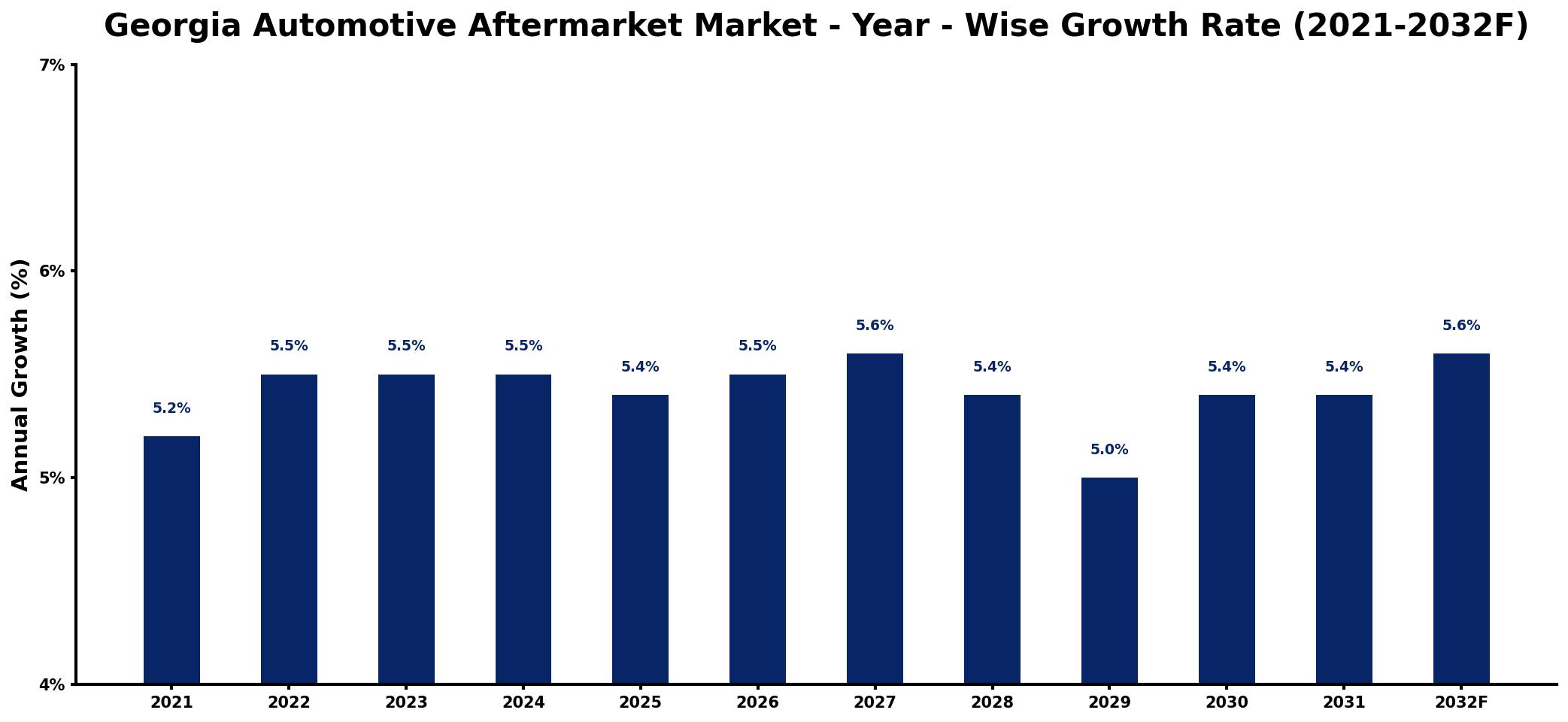
The table below presents the year‑wise growth rates along with the key drivers influencing the market
| Year | Growth Rate | Major Drivers |
| 2021 | 5.2% | Rising consumer spending on repairs |
| 2022 | 5.5% | Increased vehicle ownership rates |
| 2023 | 5.5% | Expansion of e-commerce platforms |
| 2024 | 5.5% | Growth in electric vehicle services |
| 2025 | 5.4% | Investments in local service centers |
| 2026 | 5.5% | Surge in DIY repair interest |
| 2027 | 5.6% | Emergence of new service technologies |
| 2028 | 5.4% | Higher demand for quality parts |
| 2029 | 5.0% | Strengthening of local supply chains |
| 2030 | 5.4% | Increasing popularity of maintenance packages |
| 2031 | 5.4% | Enhanced customer loyalty programs |
| 2032 | 5.6% | Development of sustainable repair solutions |
Note: Market size estimations and growth projections presented in this report are based on 6Wresearch's proprietary forecasting methodology, utilizing the latest available industry data, government publications, and primary research inputs.
Georgia Automotive Aftermarket Market Synopsis
The Georgia Automotive Aftermarket is witnessing a transformative period, characterized by an expanding range of products and services tailored to meet the diverse preferences of vehicle owners. This market encompasses everything from essential automotive parts to luxury accessories and cutting-edge maintenance solutions, providing an extensive array of choices for consumers.
Recent observations highlight the strong presence of both local businesses and national chains, creating a highly competitive environment. This dynamic marketplace not only caters to everyday vehicle maintenance needs but also fosters innovation and customization, aligning with the evolving demands of modern consumers.
Georgia Automotive Aftermarket Market Key Takeaways
- The market's growth is supported by increasing vehicle ownership rates across Georgia.
- Customization trends are driving sales of aftermarket accessories, appealing to a wide array of consumers.
- Investment opportunities are emerging in eco-friendly and energy-efficient automotive products.
- Collaborations between aftermarket and OEMs are enhancing product offerings and customer experiences.
- Technological advancements are paving the way for innovative solutions in the aftermarket sector.
Evaluation of Restraints in Georgia Automotive Aftermarket Market
The Georgia Automotive Aftermarket faces several constraints that could hinder its potential growth. Heightened competition from online retailers poses a significant challenge for traditional brick-and-mortar businesses. Consumers are increasingly drawn to the convenience of online shopping, which may impact foot traffic and sales in physical stores. Moreover, fluctuating raw material costs can pressure profitability, potentially leading to increased prices for consumers. The industry's adaptation to the evolving automotive landscape, especially with the rise of electric vehicles, necessitates strategic planning and investment in new product lines that meet the needs of this emerging market segment.
Georgia Automotive Aftermarket Market Trends
Several trends are shaping the Georgia Automotive Aftermarket, reflecting changing consumer preferences and technological advancements. There is a notable shift towards sustainability, with a growing demand for eco-friendly products, including electric vehicle charging stations and energy-efficient aftermarket parts. Additionally, consumers are increasingly favoring online purchasing, valuing the convenience and extensive information available at their fingertips.
Furthermore, customization continues to gain traction, as vehicle owners seek to express their individuality through personalized modifications. As collaborations between aftermarket manufacturers and original equipment manufacturers become more prevalent, innovative offerings are likely to enhance the customer experience, catering to a more discerning consumer base.
Georgia Automotive Aftermarket Market Opportunities
The Georgia Automotive Aftermarket presents a wealth of investment opportunities, especially in segments that align with current trends. As vehicle ownership continues to rise, there is a pressing need for high-quality aftermarket parts, including performance enhancements and aesthetic accessories. The increasing popularity of customization opens avenues for businesses to introduce unique offerings that cater to consumer preferences.
Moreover, with the automotive industry moving towards electrification, opportunities are emerging in the development of specialized products and services that support electric vehicles. Investors can leverage this growth potential by focusing on innovative solutions that not only meet existing market demands but also anticipate future needs.
Government Initiatives in the Georgia Automotive Aftermarket Market
Government policies in Georgia play a pivotal role in shaping the automotive aftermarket landscape. Regulatory frameworks are designed to ensure consumer protection, promote environmental sustainability, and foster fair competition among businesses. The Georgia Department of Revenue monitors sales tax on aftermarket parts and services, while the Environmental Protection Division enforces emissions standards and waste disposal regulations.
Additionally, the Georgia Automotive Aftermarket Association collaborates with state policymakers to advocate for regulations that support industry growth. These initiatives aim to balance the interests of consumers, businesses, and the environment, creating a conducive environment for the aftermarket sector's expansion.
Future Insights of the Georgia Automotive Aftermarket Market
Looking ahead to 2026-2032, the Georgia Automotive Aftermarket is set to experience sustained growth, driven by a robust economy and an increasing rate of vehicle ownership. As consumers prioritize vehicle personalization and performance upgrades, the demand for aftermarket products is expected to rise. Additionally, advancements in technology and the shift towards electric and autonomous vehicles will open new avenues for innovation within the sector.
Georgias strategic location as a transportation hub and its strong automotive manufacturing presence further position the state as a critical player in the aftermarket industry. By embracing the evolving landscape and adapting to new consumer demands, businesses can capitalize on the emerging opportunities, ensuring their place in this thriving market.
Georgia Automotive Aftermarket Market Latest Developments (2025 - 2026)
Recent developments within the Georgia Automotive Aftermarket indicate a growing focus on sustainability and the incorporation of advanced technologies. Industry stakeholders are increasingly investing in the development of eco-friendly products and services, responding to consumer demands for greener alternatives. Concurrently, businesses are enhancing their digital platforms to facilitate online purchasing and improve customer engagement, reflecting a broader trend towards digital transformation in retail.
Georgia Automotive Aftermarket Market - Key Attractiveness of the Report
- 10 Years of Market Numbers
- Historical Data Starting from 2022 to 2025
- Base Year: 2025
- Forecast Data until 2032
- Key Performance Indicators Impacting the Market
- Major Upcoming Developments and Projects
Key Highlights of the Report:
- Georgia Automotive Aftermarket Market Outlook
- Market Size of Georgia Automotive Aftermarket Market, 2025
- Forecast of Georgia Automotive Aftermarket Market, 2032
- Historical Data and Forecast of Georgia Automotive Aftermarket Revenues & Volume for the Period 2022-2032F
- Georgia Automotive Aftermarket Market Trend Evolution
- Georgia Automotive Aftermarket Market Drivers and Challenges
- Georgia Automotive Aftermarket Price Trends
- Georgia Automotive Aftermarket Porter's Five Forces
- Georgia Automotive Aftermarket Industry Life Cycle
- Historical Data and Forecast of Georgia Automotive Aftermarket Market Revenues & Volume By Replacement Parts for the Period 2022-2032F
- Historical Data and Forecast of Georgia Automotive Aftermarket Market Revenues & Volume By Tire for the Period 2022-2032F
- Historical Data and Forecast of Georgia Automotive Aftermarket Market Revenues & Volume By Battery for the Period 2022-2032F
- Historical Data and Forecast of Georgia Automotive Aftermarket Market Revenues & Volume By Brake Parts for the Period 2022-2032F
- Historical Data and Forecast of Georgia Automotive Aftermarket Market Revenues & Volume By Filters for the Period 2022-2032F
- Historical Data and Forecast of Georgia Automotive Aftermarket Market Revenues & Volume By Body parts for the Period 2022-2032F
- Historical Data and Forecast of Georgia Automotive Aftermarket Market Revenues & Volume By Lighting & Electronic Components for the Period 2022-2032F
- Historical Data and Forecast of Georgia Automotive Aftermarket Market Revenues & Volume By Wheels for the Period 2022-2032F
- Historical Data and Forecast of Georgia Tire Automotive Aftermarket Market Revenues & Volume By Exhaust components for the Period 2022-2032F
- Historical Data and Forecast of Georgia Automotive Aftermarket Market Revenues & Volume By Distribution Channel for the Period 2022-2032F
- Historical Data and Forecast of Georgia Automotive Aftermarket Market Revenues & Volume By Retailers for the Period 2022-2032F
- Historical Data and Forecast of Georgia Automotive Aftermarket Market Revenues & Volume By Wholesalers & Distributors for the Period 2022-2032F
- Historical Data and Forecast of Georgia Automotive Aftermarket Market Revenues & Volume By Service Channel for the Period 2022-2032F
- Historical Data and Forecast of Georgia Automotive Aftermarket Market Revenues & Volume By DIY (Do it Yourself) for the Period 2022-2032F
- Historical Data and Forecast of Georgia Automotive Aftermarket Market Revenues & Volume By DIFM (Do it for Me) for the Period 2022-2032F
- Historical Data and Forecast of Georgia Automotive Aftermarket Market Revenues & Volume By OE (Delegating to OEM??s) for the Period 2022-2032F
- Historical Data and Forecast of Georgia Automotive Aftermarket Market Revenues & Volume By Certification for the Period 2022-2032F
- Historical Data and Forecast of Georgia Automotive Aftermarket Market Revenues & Volume By Genuine Parts for the Period 2022-2032F
- Historical Data and Forecast of Georgia Automotive Aftermarket Market Revenues & Volume By Certified Parts for the Period 2022-2032F
- Historical Data and Forecast of Georgia Automotive Aftermarket Market Revenues & Volume By Uncertified Parts for the Period 2022-2032F
- Georgia Automotive Aftermarket Import Export Trade Statistics
- Market Opportunity Assessment By Replacement Parts
- Market Opportunity Assessment By Distribution Channel
- Market Opportunity Assessment By Service Channel
- Market Opportunity Assessment By Certification
- Georgia Automotive Aftermarket Top Companies Market Share
- Georgia Automotive Aftermarket Competitive Benchmarking By Technical and Operational Parameters
- Georgia Automotive Aftermarket Company Profiles
- Georgia Automotive Aftermarket Key Strategic Recommendations






































