Germany Air Purifier Market: Import Trend Analysis
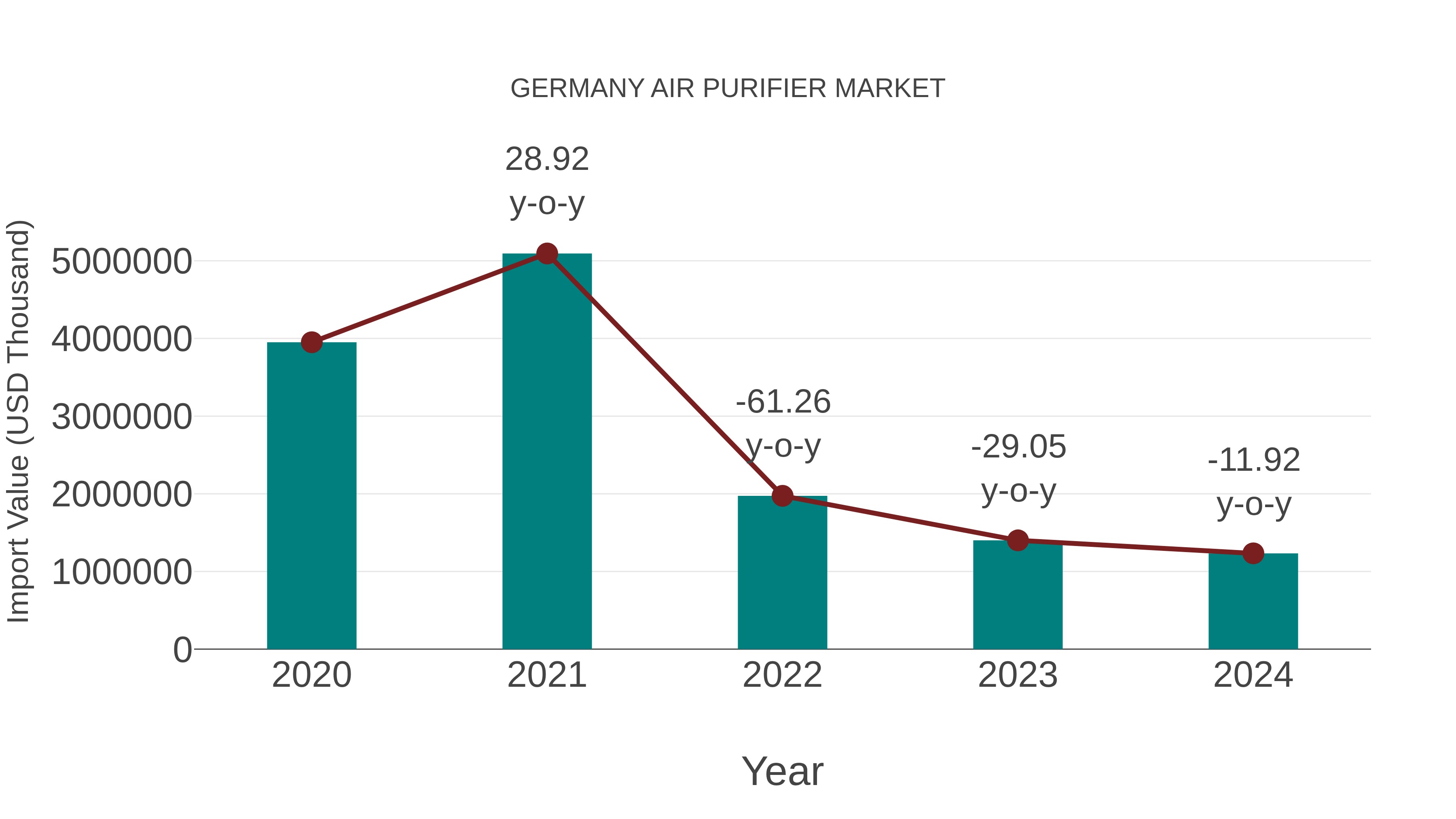
In the Germany air purifier market, the import trend experienced a decline from 2023 to 2024, with a growth rate of -11.92%. The compound annual growth rate (CAGR) for imports between 2020 and 2024 stood at -25.25%. This negative import momentum could be attributed to shifting consumer preferences towards domestic products or changes in environmental regulations impacting trade dynamics.
Germany Air Purifier Market report comprehensively covers the Germany Air Purifier Market by technology, applications, and CADR values. Germany air purifier market report provides an unbiased and detailed analysis of the Germany air purifier market trends, opportunities/high growth areas, and market drivers which would help the stakeholders device and align their market strategies according to the current and future market dynamics.
Latest (2024) Development of the Germany Air Purifier Market
Germany Air Purifier Market has been characterized by a strong emphasis on sustainability and energy efficiency. The latest models focus on reducing energy consumption while maintaining high purification standards, leveraging advanced filtration technologies such as ULPA filters and ionizers. The German market is also seeing a surge in demand for air purifiers with smart features, including app-based controls and real-time air quality notifications.
The rise in awareness about indoor air pollution and its impact on health, particularly in urban areas, has further spurred the adoption of these improved air quality solutions. Additionally, regulatory measures and governmental incentives promoting clean air initiatives continue to support market growth.
Germany Air Purifier Market Synopsis
Germany Air Purifier Market demand would continue to accelerate due to increasing pollution caused by factors such as increasing construction activities in urban areas, industrial carbon emission, fossil fuel burning, and vehicle emissions. The aforementioned factors would deteriorate the air quality and densify the air by increasing the particulate matter concentration. Further, owing to the increasing incidences of air-borne diseases and other health hazards, people would become more inclined toward using air purifiers during the forecast period. However, in 2020, the sales of air purifiers are expected to drop in the first half in Germany, owing to the coronavirus pandemic. This case could be attributed to the disruption in the supply chain and people’s reluctance to buy luxury products such as air purifiers as they are expected to lean more towards buying first-priority products such as food and groceries amid a lockdown.
According to 6Wresearch, Germany Air Purifier Market size is projected to grow at a CAGR of 7.8% during 2020-2026. Due to the large-scale industrialization, the air quality in Germany varies from 50-150, mostly staying close to 80-110. Additionally, ambient air pollution is an existing issue on account of increasing construction activity and rising industrial emissions. Surging disposable income coupled with increasing awareness among people regarding the benefits of air purifiers is driving the Germany Air Purifier Market share. Increasing respiratory diseases due to increasing levels of pollution are adding to the development of the market. Moreover, consumer in urban areas is also becoming conscious of the detrimental effects of pollution in the country, which would drive the demand for air purifiers during the coming years. However, the COVID-19 outbreak would slow down the market in terms of the supply of the product in the first few months of 2020. While on the other hand, the demand side would also fall victim to the slowdown due to the market being closed during the lockdown period and slowing down the market growth of Air Purifiers in Germany.

Market Analysis by Technology
In 2019, Type-I dominated the technology segment in terms of revenue and volume on account of a better cost/efficiency ratio. Further, consumers are also inclined towards entry-level products, such as Type-I and Type-II, in a relatively new market. Moreover, Type-I is also expected to have the highest growth rate in the Germany air purifier market during the forecast period.
Market Analysis by Application
On the basis of applications, the residential sector air purifiers have accumulated a decent market share in the overall market revenues in 2019. The increasing construction activities in the urban areas and their respective densification is leading to the rise in the inclination of families towards adopting healthcare products in order to reduce the harmful effects of pollution emission and stagnant airflow. This factor would boost the sales of air purifiers in the residential sector over the coming years.
Key Attractiveness of the Report
- COVID-19 Impact on the Market.
- 10 Years Market Numbers.
- Historical Data Starting from 2016 to 2020.
- Base Year: 2019
- Forecast Data until 2026.
- Key Performance Indicators Impacting the Market.
- Major Upcoming Developments and Projects.
Key Highlights of the Report:
- Germany Air Purifier Market Overview
- Germany Air Purifier Market Outlook
- Germany Air Purifier Market Forecast
- Germany Air Purifier Market Size
- Historical Data of the Germany Air Purifier Market Revenues and Volume for the period 2016-2019 & Germany Air Purifier Market Forecast of the Revenues and Volume for the period 2020F- 2026F
- Historical Data of the Germany Room Air Purifier Market Revenues and Volume for the period 2016-2019 & Germany Room Air Purifier Market Forecast of the Revenues and Volume for the period 2020F- 2026F
- Historical Data of the Germany Car Air Purifier Market Revenues and Volume for the Period 2016-2019 & Germany Car Air Purifier Market Forecast of the Revenues and Volume for the period 2020F- 2026F
- Historical Data of the Germany Commercial Air Purifier Market Revenues and Volume for the Period 2016-2019 & Germany Commercial Air Purifier Market Forecast of the Revenues and Volume for the Period 2020F- 2026F
- Historical Data of Germany Room Air Purifier Market Revenues and Volume & Germany room Air Purifier Market Forecast of the Revenues and Volume, By Technology for the period 2016-2026F
- Historical Data of Germany room air purifier market Revenues & Germany room air purifier market Forecast of the Revenues and Volume, By Regions for the period 2016-2026F
- Historical Data of Germany room air purifier market Volume & Germany room air purifier market Forecast of the Revenues and Volume, By Noise Level for the period 2016-2026F
- Historical Data of Germany room air purifier market Volume & Germany room air purifier market Forecast of the Revenues and Volume, By Area Applicability for the period 2016-2026F
- Historical Data of Germany room air purifier market Volume & Germany room air purifier market Forecast of the Revenues and Volume, By Weight for the period 2016-2026F
- Historical Data of Germany room air purifier market Volume & Germany room air purifier market Forecast of the Revenues and Volume, By Air Flow for the period 2016-2026F
- Historical Data of Germany room air purifier market Volume & Germany room air purifier market Forecast of the Revenues and Volume, By Height for the period 2016-2026F
- Historical Data of Germany room air purifier market Revenues & Germany room air purifier market Forecast of the Revenues and Volume, By Applications for the period 2016-2026F
- Historical Data of Germany room air purifier market Revenues & Germany room air purifier market Forecast of the Revenues and Volume, By Sales Channels for the period 2016-2026F
- Germany Air Purifier Market Drivers
- Germany Air Purifier Market Restraints
- Germany Air Purifier Market Trends and Industry Life Cycle
- Porter’s Five Force Analysis
- Market Opportunity Assessment
- Germany Air Purifier Market Share of Room, By Volume
- Germany Air Purifier Market Share of Car, By Volume
- Germany Air Purifier Market Overview on Competitive Benchmarking
- Company Profiles
- Key Strategic Recommendations
Market Scope and Segmentation
The report provides a detailed analysis of the following market segments:
By Technology:
- Type-I (HEPA + Carbon)
- Type-II (HEPA + Carbon + Ionizer)
- Type-III (HEPA + Carbon+ UV)
- Type-IV (HEPA + Carbon + Electrostatic)
- Type-V (HEPA + Carbon + Ionizer + UV + Electrostatic)
- Other Technologies
By Applications:
- Residential
- Commercial
- Industrial
By CADR Values:
- Low (Up to 250 m3/h)
- Medium (251 to 500 m3/h)
- High (Above 500 m3/h)































