Germany Benzoic Acid Market: Import Trend Analysis
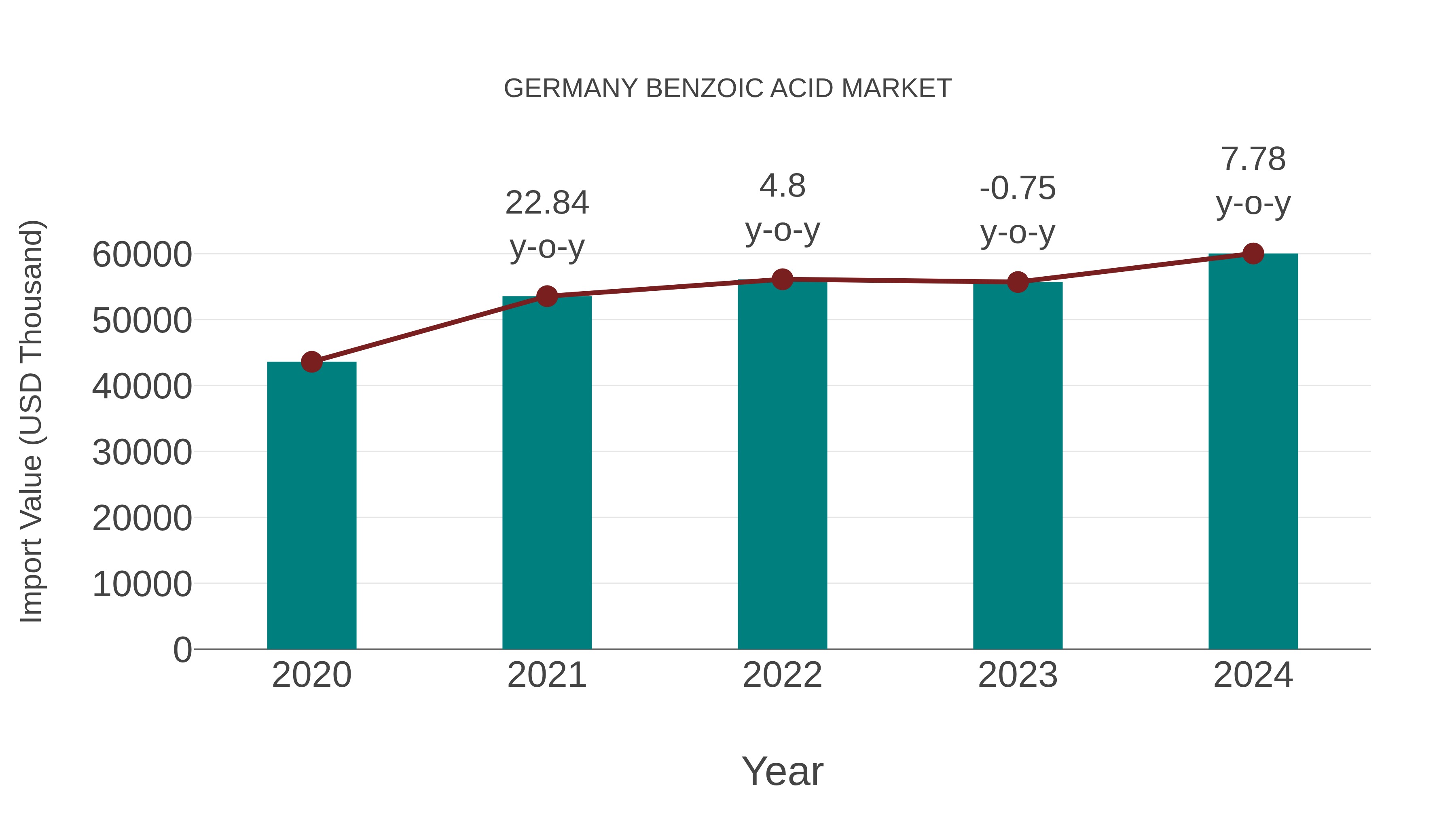
Germany`s import trend for benzoic acid in 2024 showed a growth rate of 7.78% from the previous year, with a compound annual growth rate (CAGR) of 8.33% from 2020 to 2024. This positive import momentum can be attributed to the steady demand for benzoic acid in various industries, indicating market stability and sustained interest in the product.
Germany Benzoic Acid Market Overview
The Germany Benzoic Acid market is a mature and stable segment within the chemical industry, primarily driven by its widespread applications in food preservatives, pharmaceuticals, and industrial processes. The market is characterized by a strong demand for high-quality benzoic acid products, with key players focusing on product innovation and sustainability to maintain their market positions. Germany`s stringent regulations on food safety and quality control further drive the market for benzoic acid as a preservative. The market is also influenced by factors such as technological advancements in production processes and increasing consumer awareness towards clean label products. Overall, the Germany Benzoic Acid market is expected to witness steady growth in the coming years, supported by the diverse applications of benzoic acid across various industries.
Germany Benzoic Acid Market Trends
Currently, the Germany Benzoic Acid Market is experiencing a steady growth trend driven by the increasing demand for benzoic acid as a key ingredient in various industries such as food and beverages, pharmaceuticals, and personal care products. The growing awareness among consumers regarding the benefits of benzoic acid, such as its antimicrobial and preservative properties, is also contributing to the market growth. Additionally, the rising focus on organic and natural ingredients in consumer products is leading to the adoption of benzoic acid as a safer alternative to synthetic preservatives. Manufacturers in the Germany Benzoic Acid Market are investing in research and development to innovate new applications and formulations, further fueling the market expansion. Overall, the market is projected to continue its upward trajectory in the coming years.
Germany Benzoic Acid Market Challenges
In the Germany Benzoic Acid Market, some key challenges include increasing competition from alternative preservatives, such as parabens and sorbic acid, which offer similar antimicrobial properties. Additionally, regulatory restrictions on the use of certain preservatives in cosmetic and food products can impact the demand for benzoic acid. Price fluctuations in raw materials, such as benzene and toluene, can also pose challenges for manufacturers in maintaining stable pricing for benzoic acid products. Furthermore, the growing demand for natural and organic products has led to a shift towards plant-based preservatives, creating a need for innovation and product development within the benzoic acid market to stay competitive. Overall, companies operating in the Germany Benzoic Acid Market need to adapt to changing market trends and consumer preferences to sustain their growth and profitability.
Germany Benzoic Acid Market Investment Opportunities
In the Germany Benzoic Acid Market, there are several investment opportunities worth considering. One potential opportunity lies in the increasing demand for benzoic acid as a preservative in the food and beverage industry, driven by changing consumer preferences towards natural and clean label products. Another opportunity stems from the growing application of benzoic acid in the pharmaceutical sector for its antifungal and antibacterial properties. Additionally, the rising adoption of benzoic acid in various industrial applications such as plastics, paints, and personal care products presents a promising investment avenue. Investing in research and development for innovative benzoic acid derivatives or exploring sustainable production methods could also offer long-term growth prospects in the market. Overall, the Germany Benzoic Acid Market presents diverse investment opportunities across multiple sectors, making it an attractive option for potential investors.
Germany Benzoic Acid Market Government Policy
In Germany, the regulation of benzoic acid in the market is primarily overseen by the Federal Institute for Risk Assessment (BfR) and the European Chemicals Agency (ECHA). Benzoic acid is classified as a food additive and is subject to stringent safety assessments and maximum allowable limits in food products, as set by the European Food Safety Authority (EFSA). Additionally, the use of benzoic acid in industrial applications is regulated under the European Union`s REACH regulation, which aims to ensure the safe use of chemicals and protect human health and the environment. Manufacturers and importers of benzoic acid in Germany must comply with these regulations to ensure the safe production, handling, and use of the substance in the market.
Germany Benzoic Acid Market Future Outlook
The future outlook for the Germany Benzoic Acid Market appears positive, with steady growth expected in the coming years. Factors such as increasing demand for benzoic acid in the food and beverage industry as a preservative, as well as its growing applications in pharmaceuticals and personal care products, are likely to drive market expansion. Additionally, the rising trend towards clean label and natural ingredients in consumer products is anticipated to further boost demand for benzoic acid as a safe and effective preservative. Technological advancements in production processes and increasing investments in research and development for innovative applications are also expected to contribute to the market`s growth. Overall, the Germany Benzoic Acid Market is poised for continued development and opportunities for market players in the foreseeable future.
Key Highlights of the Report:
- Germany Benzoic Acid Market Outlook
- Market Size of Germany Benzoic Acid Market, 2021
- Forecast of Germany Benzoic Acid Market, 2027
- Historical Data and Forecast of Germany Benzoic Acid Revenues & Volume for the Period 2018 - 2027
- Germany Benzoic Acid Market Trend Evolution
- Germany Benzoic Acid Market Drivers and Challenges
- Germany Benzoic Acid Price Trends
- Germany Benzoic Acid Porter's Five Forces
- Germany Benzoic Acid Industry Life Cycle
- Historical Data and Forecast of Germany Benzoic Acid Market Revenues & Volume By End-use Industry for the Period 2018 - 2027
- Historical Data and Forecast of Germany Benzoic Acid Market Revenues & Volume By Food & Beverages for the Period 2018 - 2027
- Historical Data and Forecast of Germany Benzoic Acid Market Revenues & Volume By Chemical for the Period 2018 - 2027
- Historical Data and Forecast of Germany Benzoic Acid Market Revenues & Volume By Pharmaceutical for the Period 2018 - 2027
- Historical Data and Forecast of Germany Benzoic Acid Market Revenues & Volume By Application for the Period 2018 - 2027
- Historical Data and Forecast of Germany Benzoic Acid Market Revenues & Volume By Benzoates for the Period 2018 - 2027
- Historical Data and Forecast of Germany Benzoic Acid Market Revenues & Volume By Benzoate plasticizers for the Period 2018 - 2027
- Historical Data and Forecast of Germany Benzoic Acid Market Revenues & Volume By Benzoyl Chloride for the Period 2018 - 2027
- Historical Data and Forecast of Germany Benzoic Acid Market Revenues & Volume By Alkyd Resins for the Period 2018 - 2027
- Historical Data and Forecast of Germany Benzoic Acid Market Revenues & Volume By Animal Feed Additive for the Period 2018 - 2027
- Germany Benzoic Acid Import Export Trade Statistics
- Market Opportunity Assessment By End-use Industry
- Market Opportunity Assessment By Application
- Germany Benzoic Acid Top Companies Market Share
- Germany Benzoic Acid Competitive Benchmarking By Technical and Operational Parameters
- Germany Benzoic Acid Company Profiles
- Germany Benzoic Acid Key Strategic Recommendations






































