Germany LED Professional Lighting Market Summary
The germany led professional lighting market was estimated at USD 188 Million in 2025 and is projected to reach USD 204 Million by 2032, growing at a CAGR of 0.9% from 2026 to 2032.
Germany LED Professional Lighting Market Year-wise Growth Rate and Key Drivers
This graph highlights how the Germany LED Professional Lighting Market has steadily grown over the past five years, supported by major growth factors.
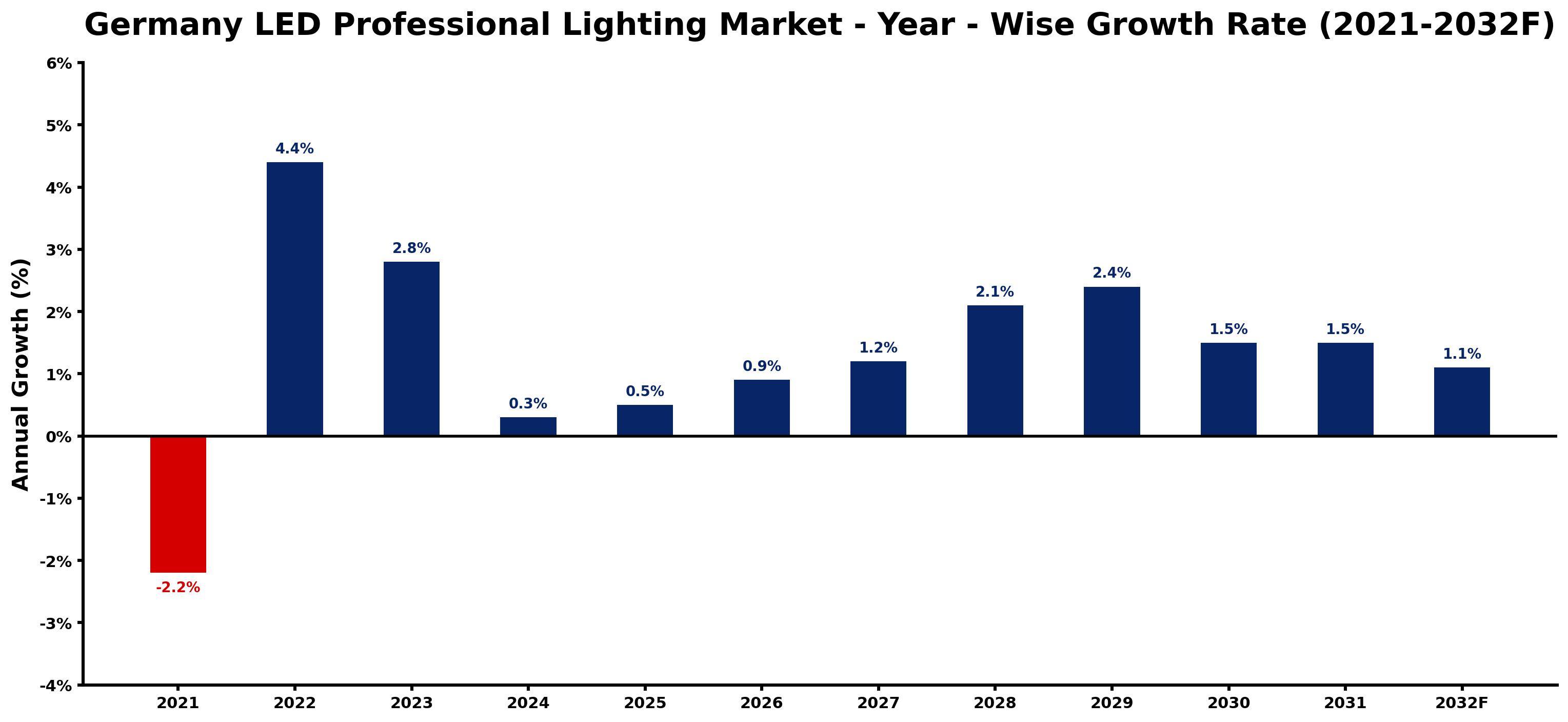
The table below presents the year wise growth rates along with the key drivers influencing the market
| Year | Growth Rate | Major Drivers |
| 2021 | -2.2% | Diminished corporate investment in infrastructure projects curtailed demand for professional LED lighting solutions. |
| 2022 | 4.4% | Corporate sustainability goals emphasized the need for innovative LED technologies. |
| 2023 | 2.8% | Industrial automation trends increased reliance on smart lighting systems for efficiency. |
| 2024 | 0.3% | Legacy copper grid failures prompted shifts towards LED installations in urban infrastructures. |
| 2025 | 0.5% | Green building certifications encouraged market players to adopt advanced LED solutions. |
| 2026 | 0.9% | Technological breakthroughs in LED efficiency attracted significant venture capital funding. |
| 2027 | 1.2% | Rising energy prices heightened awareness around operational cost reduction strategies. |
| 2028 | 2.1% | Consumer preferences shifted, favoring brands committed to sustainable lighting practices. |
| 2029 | 2.4% | Integration of IoT in lighting systems provided additional layers of convenience and control. |
| 2030 | 1.5% | Increased emphasis on workplace wellness drove demand for adaptive lighting environments. |
| 2031 | 1.5% | Construction pipelines for smart cities required reliable and efficient lighting infrastructures. |
| 2032 | 1.1% | Market consolidation led to enhanced innovation and competitive pricing among key players. |
Note - Market size estimations and growth projections presented in this report are based on 6Wresearch's advanced forecasting approach, validated with industry datasets as of June 2026.
Germany LED Professional Lighting Market Synopsis
The Germany LED Professional Lighting Market is projected to reach 0.9% and witness significant growth during the forecast period (2026-2032). This market expansion is largely driven by Germany's commitment to enhancing energy efficiency and sustainability across various sectors. With increasing modernization of commercial facilities and rapid industrial growth, the demand for advanced LED lighting solutions is on the rise, particularly in applications such as offices, retail environments, hospitality venues, and public infrastructure.
Germany LED Professional Lighting Market Growth Drivers
The Germany LED Professional Lighting Market is influenced by several key growth drivers that are transforming the landscape of professional lighting. Firstly, stringent government regulations concerning energy consumption are propelling the demand for energy-efficient solutions. These regulations incentivize organizations to invest in LED lighting technology to comply with sustainability standards. Secondly, the increasing modernization of commercial buildings necessitates the adoption of superior lighting systems. As businesses strive to create appealing environments, the demand for architecturally advanced LED products is surging.
- The rapid advancement of smart lighting technologies enables the integration of connectivity features that enhance user experience and energy savings.
- Growing consumer awareness regarding environmental sustainability is influencing purchasing decisions across various industries, favoring LED solutions.
- Continuous innovation from manufacturers in the realm of dimming capabilities and motion sensors is creating more versatile lighting options that meet diverse needs.
- Rising investments in public infrastructure projects highlight the importance of energy-efficient lighting solutions, thereby accelerating market growth.
- Increased competition among vendors is driving innovation and improving product offerings, which is beneficial to end-users seeking advanced features.
Germany LED Professional Lighting Market Trends and Opportunities
Trends within the Germany LED Professional Lighting Market indicate a significant opportunity for further development and innovation. The mounting demand for smart and connected lighting systems is reshaping how lighting is utilized in various sectors. Office environments are increasingly adopting systems that synchronize with occupancy and natural light levels, significantly enhancing energy efficiency.
- Real-time data analytics in lighting systems are emerging, allowing businesses to optimize energy usage and operational costs.
- The integration of IoT in lighting systems is gaining momentum, paving the way for a more connected, responsive lighting environment.
- Architectural and decorative LED lighting solutions are on the rise as aesthetics become a critical factor in commercial spaces.
- Emerging technologies such as human-centric lighting are gaining traction, focusing on the impact of light on well-being and productivity.
- Opportunities are expanding in the hospitality sector, where the ambiance created by professional lighting is vital in enhancing guest experiences.
Germany LED Professional Lighting Market Challenges and Restraints
Despite its growth prospects, the Germany LED Professional Lighting Market faces several challenges that may affect its trajectory. The high initial investment for advanced LED systems can deter some businesses, particularly small and medium-sized enterprises, from adopting these technologies. Additionally, while LED lighting offers long-term savings, the upfront costs may not be perceived favorably in the short term.
- Competition from traditional lighting solutions which may appear more cost-effective despite their long-term inefficiencies.
- Market saturation in urban areas may limit growth potentials as primary markets become increasingly competitive.
- Resistance to change among consumers and businesses accustomed to conventional lighting systems can slow adoption rates.
- Technological complexities associated with smart lighting systems can pose barriers to understanding and implementation.
- Economic fluctuations or downturns can impact overall investment in infrastructure and lighting projects.
Germany LED Professional Lighting Market Government Investment and Initiatives
The German government has implemented several initiatives to promote the growth of the LED professional lighting market. Policies emphasizing energy efficiency are pivotal; they support funding for energy-efficient projects and facilitate the transition to modern lighting technologies. Public spending on infrastructure projects increasingly focuses on integrating LED solutions, ensuring compliance with environmental standards.
- Government grants and subsidies are available for businesses that invest in energy-efficient LED systems, reducing the financial burden of transition.
- National campaigns aimed at increasing public awareness of energy-efficient technologies promote broader adoption across multiple sectors.
- Partnerships between government bodies and private enterprises foster innovation and development of advanced lighting technologies.
- Public sector projects are increasingly prioritizing sustainable lighting solutions, creating a ripple effect in the commercial sector.
- Support for research and development in lighting technologies is bolstered by government policy, further enhancing market opportunities.
Germany LED Professional Lighting Market Latest Developments (May 2025 - June 2026)
Recent developments in the Germany LED Professional Lighting Market highlight the dynamic changes occurring in this sector. During this period, there has been a notable increase in the adoption of smart lighting technologies across commercial and industrial sectors. Many organizations are increasingly exploring automated lighting solutions that adjust to environmental changes, enhancing energy efficiency and user comfort.
- Innovations in wireless control systems and IoT integration have made smart lighting more accessible and appealing to businesses.
- Emerging trends indicate a growing preference for sustainable materials in the manufacturing of LED lights, aligning with broader environmental objectives.
- Collaborations between technology firms and lighting manufacturers have been intensifying, leading to the development of next-generation lighting solutions.
- Increased emphasis on human-centric lighting in workplaces aims to enhance productivity and employee well-being, creating new market opportunities.
- Customer demand for customizable lighting experiences has driven manufacturers to develop solutions that meet specific aesthetic and functional requirements.
Germany LED Professional Lighting Market - Key Attractiveness of the Report
- 10 Years of Market Numbers
- Historical Data Starting from 2022 to 2025
- Base Year: 2025
- Forecast Data until 2032
- Key Performance Indicators Impacting the Market
- Major Upcoming Developments and Projects
Key Highlights of the Report:
- Germany LED Professional Lighting Market Outlook
- Market Size of Germany LED Professional Lighting Market, 2025
- Forecast of Germany LED Professional Lighting Market, 2032
- Historical Data and Forecast of Germany LED Professional Lighting Revenues & Volume for the Period 2022-2032
- Germany LED Professional Lighting Market Trend Evolution
- Germany LED Professional Lighting Market Drivers and Challenges
- Germany LED Professional Lighting Price Trends
- Germany LED Professional Lighting Porter's Five Forces
- Germany LED Professional Lighting Industry Life Cycle
- Historical Data and Forecast of Germany LED Professional Lighting Market Revenues & Volume By Product Type for the Period 2022-2032
- Historical Data and Forecast of Germany LED Professional Lighting Market Revenues & Volume By LED Bulbs for the Period 2022-2032
- Historical Data and Forecast of Germany LED Professional Lighting Market Revenues & Volume By LED Fixtures for the Period 2022-2032
- Historical Data and Forecast of Germany LED Professional Lighting Market Revenues & Volume By Bare LED Tubes for the Period 2022-2032
- Historical Data and Forecast of Germany LED Professional Lighting Market Revenues & Volume By LED Down lights for the Period 2022-2032
- Historical Data and Forecast of Germany LED Professional Lighting Market Revenues & Volume By Applications for the Period 2022-2032
- Historical Data and Forecast of Germany LED Professional Lighting Market Revenues & Volume By Indoor for the Period 2022-2032
- Historical Data and Forecast of Germany LED Professional Lighting Market Revenues & Volume By Outdoor for the Period 2022-2032
- Historical Data and Forecast of Germany LED Professional Lighting Market Revenues & Volume By Automotive for the Period 2022-2032
- Historical Data and Forecast of Germany LED Professional Lighting Market Revenues & Volume By Backlighting for the Period 2022-2032
- Germany LED Professional Lighting Import Export Trade Statistics
- Market Opportunity Assessment By Product Type
- Market Opportunity Assessment By Applications
- Germany LED Professional Lighting Top Companies Market Share
- Germany LED Professional Lighting Competitive Benchmarking By Technical and Operational Parameters
- Germany LED Professional Lighting Company Profiles
- Germany LED Professional Lighting Key Strategic Recommendations
Market Covered
This report offers a comprehensive study of the subsequent market segments:
By Product Type
- LED Bulbs
- LED Fixtures
- Bare LED Tubes
- LED Down lights
By Applications
- Indoor, Outdoor
- Automotive
- Backlighting
- Competitive Landscape






































