Germany Telehealth Market Summary
The germany telehealth market was estimated at USD 141 Million in 2025 and is projected to reach USD 153 Million by 2032, growing at a CAGR of 1.1% from 2026 to 2032.
Germany Telehealth Market Year-wise Growth Rate and Key Drivers
This graph highlights how the Germany Telehealth Market has steadily grown over the past five years, supported by major growth factors.
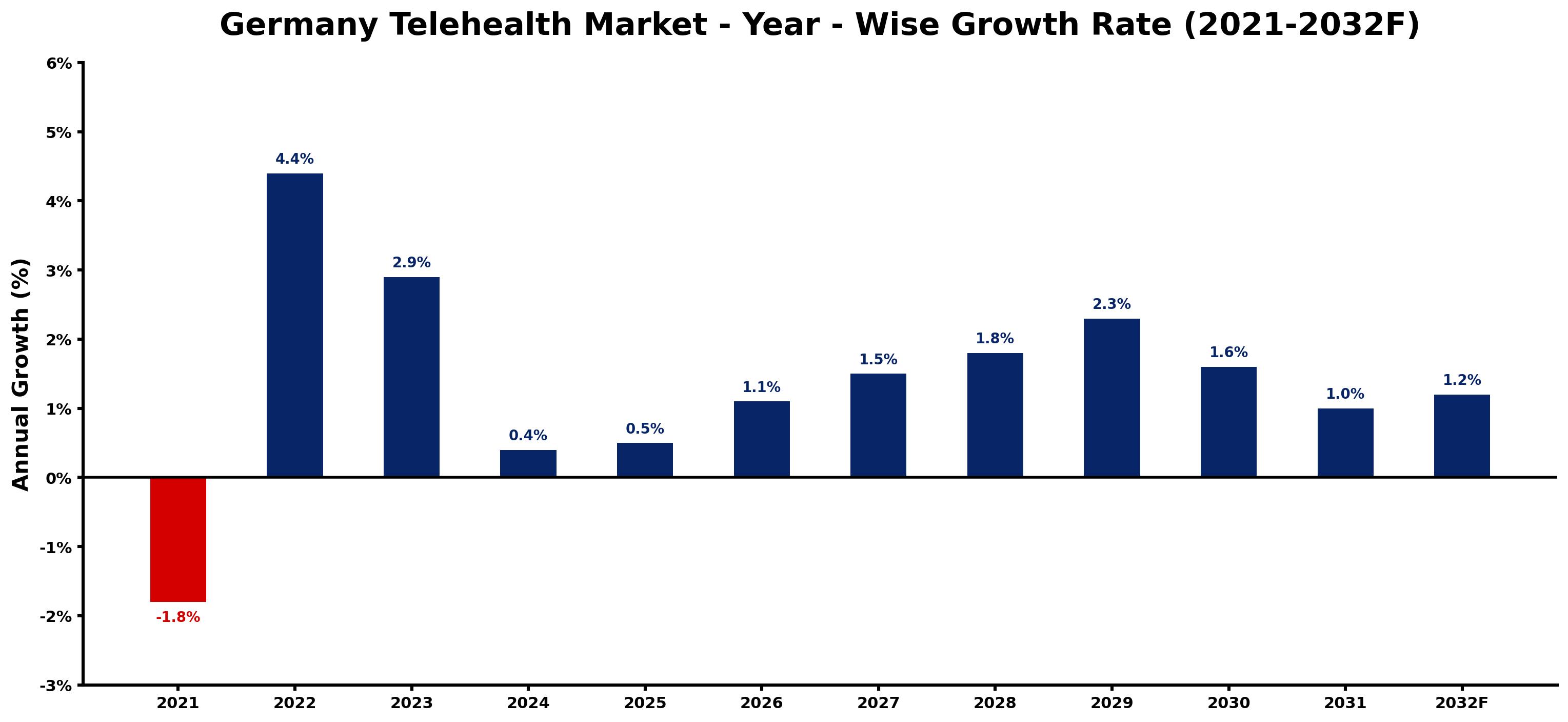
The table below presents the year wise growth rates along with the key drivers influencing the market
| Year | Growth Rate | Major Drivers |
| 2021 | -1.8% | Heightened cybersecurity concerns deterred patients from utilizing telehealth services amid increasing data breach incidents. |
| 2022 | 4.4% | Technological integration improved, facilitating smoother virtual consultations and remote patient monitoring. |
| 2023 | 2.9% | Consumer preferences shifted, as patients began valuing convenience and accessibility in healthcare. |
| 2024 | 0.4% | Investment in digital health startups increased, fostering innovation within the telehealth landscape. |
| 2025 | 0.5% | Partnerships between tech firms and healthcare providers flourished, enhancing service offerings across platforms. |
| 2026 | 1.1% | Enhanced cybersecurity measures became paramount, building trust in virtual healthcare solutions. |
| 2027 | 1.5% | Insurance coverage for telehealth expanded, promoting wider acceptance among traditional healthcare consumers. |
| 2028 | 1.8% | Patient education initiatives increased, driving awareness and utilization of telehealth services. |
| 2029 | 2.3% | Elderly populations embraced remote healthcare, reducing barriers to access for senior citizens. |
| 2030 | 1.6% | Corporate wellness programs increasingly incorporated telehealth, benefiting employee health management strategies. |
| 2031 | 1.0% | Integration with wearable technology enabled real-time health monitoring, elevating telehealth's efficacy. |
| 2032 | 1.2% | Interoperability standards evolved, allowing seamless data exchange between telehealth and traditional healthcare systems. |
Note - Market size estimations and growth projections presented in this report are based on 6Wresearch's advanced forecasting approach, validated with industry datasets as of June 2026.
Germany Telehealth Market Synopsis
The Germany Telehealth Market is projected to reach 1.1% and witness significant growth during the forecast period (2026-2032). This anticipated expansion is primarily attributed to the increasing demand for digitized healthcare solutions, a shift towards remote care facilitated by technological advancements, and an escalating prevalence of chronic diseases. The market is set to achieve a remarkable triple-digit revenue value, driven by a combination of factors that include rising healthcare costs, government policies encouraging digital health, and the long-lasting impact of the COVID-19 pandemic on healthcare delivery methods.
Germany Telehealth Market Growth Drivers
The growth trajectory of the Germany Telehealth Market is supported by several key drivers:
- Increased Adoption of Digital Health Solutions: The accelerating digitization in healthcare has led to a higher adoption rate of telehealth services, making them more accessible for patients.
- Rising Prevalence of Chronic Diseases: With chronic diseases becoming prevalent among the population, telehealth services are increasingly being utilized for remote consultations and ongoing patient management.
- Cost Efficiency: Telehealth solutions offer significant cost savings by reducing the need for travel and allowing for more efficient healthcare delivery, which is becoming crucial amid rising healthcare expenses.
- Enhanced Accessibility: Telehealth provides crucial access to healthcare services for individuals in remote or underserved areas, addressing longstanding accessibility issues.
- Technological Advancements: Continuous innovations in telehealth platforms are improving the quality of care, user experience, and health outcomes, further driving market growth.
Germany Telehealth Market Challenges and Restraints
While the Germany Telehealth Market is poised for growth, it faces several challenges:
- Regulatory Compliance: Navigating the complex regulatory landscape can pose challenges for service providers aiming to operate within the legal frameworks.
- Limited Reimbursement Models: The prevailing low reimbursement rates by the government have shifted costs to private payers, placing additional financial burdens on healthcare providers.
- Technology Adoption: Despite the rise in digitization, barriers related to technology adoption among certain segments of the population can hinder widespread acceptance of telehealth services.
- Data Privacy Concerns: The handling of sensitive health information raises concerns about data privacy and security, which must be addressed to foster trust.
- Infrastructure Limitations: In some areas, inadequate technological infrastructure can limit the effectiveness and accessibility of telehealth solutions.
Germany Telehealth Market Government Investment and Initiatives
The German government has been proactive in promoting telehealth through various policies and initiatives. Investments have been directed toward the digital transformation of healthcare systems, aiming to improve access and quality of care. Government funding has supported telehealth implementation projects, particularly in rural and underserved areas, ensuring that technological advancements reach all segments of the population. Initiatives designed to streamline reimbursement processes for telehealth services are also being developed, encouraging healthcare providers to adopt these digital solutions. Additionally, public spending on health IT infrastructure is expected to grow, enhancing the capability for remote consultations and connected care.
Germany Telehealth Market Latest Developments (May 2025 - June 2026)
During the period from May 2025 to June 2026, the Germany Telehealth Market has experienced notable developments. The rising demand for remote healthcare services has prompted initiatives from healthcare providers to expand their telehealth offerings. Innovations in artificial intelligence and machine learning are being integrated into telehealth platforms, enhancing diagnostic accuracy and patient engagement. Furthermore, healthcare systems are increasingly employing hybrid models that combine telehealth with traditional face-to-face consultations, providing a more comprehensive approach to patient care. Public health campaigns aimed at educating patients about telehealth services have seen significant uptake, contributing to a growing acceptance of remote healthcare solutions in mainstream medical practice.
Germany Telehealth Market - Key Attractiveness of the Report
- 10 Years of Market Numbers
- Historical Data Starting from 2022 to 2025
- Base Year: 2025
- Forecast Data until 2032
- Key Performance Indicators Impacting the Market
- Major Upcoming Developments and Projects
Key Highlights of the Report:
- Germany Telehealth Market Overview
- Germany Telehealth Market Outlook
- Germany Telehealth Market Forecast
- Historical Data of Germany Telehealth Market Revenues & Volume for the Period 2022-2032F
- Germany Telehealth Market Size and Germany Telehealth Market Forecast of Revenues & Volume, Until 2032F
- Historical Data of Germany Telehealth Market Revenues & Volume, by Types, for the Period 2022-2032F
- Market Size & Forecast of Germany Telehealth Market Revenues & Volume, by Types, Until 2032F
- Historical Data of Germany Telehealth Market Revenues, by Component, for the Period 2022-2032F
- Market Size & Forecast of Germany Telehealth Market Revenues, by Component, Until 2032F
- Historical Data of Central Region Telehealth Market Revenues, for the Period 2022-2032F
- Market Size & Forecast of Central Region Telehealth Market Revenues, Until 2032F
- Historical Data of Western Region Telehealth Market Revenues, for the Period 2022-2032F
- Market Size & Forecast of Western Region Telehealth Market Revenues, Until 2032F
- Historical Data of Southern Region Telehealth Market Revenues, for the Period 2022-2032F
- Market Size & Forecast of Southern Region Telehealth Market Revenues, Until 2032F
- Historical Data of Eastern Region Telehealth Market Revenues, for the Period 2022-2032F
- Market Size & Forecast of Eastern Region Telehealth Market Revenues, Until 2032F
- Market Drivers and Restraints
- Germany Telehealth Market Trends and Industry Life Cycle
- Porter’s Five Force Analysis
- Market Opportunity Assessment
- Germany Telehealth Market Share, By Players
- Germany Telehealth Market Share, By Regions
- Germany Telehealth Market Overview on Competitive Benchmarking
- Company Profiles
- Key Strategic Recommendations
Markets Covered
The Germany Telehealth Market report provides a detailed analysis of the following market segments:
- By Types:
- Tele Hospitals
- Tele Homes
- mHealth (Mobile Health)
- By Component:
- Product
- Hardware
- Software
- Other Types
- Services
- Teleradiology
- Telecardiology
- Teledermatology
- Telepsychiatry
- Other Services
- Product






































