Ghana Aircraft Engine Market Size, Share & Growth Rate
The Ghana Aircraft Engine Market was estimated at USD 1064 Million in 2025 and is projected to reach USD 1947 Million by 2032, growing at a CAGR of 9.0% from 2026 to 2032. This growth trajectory is primarily driven by the increasing demand for air travel and the modernization of the national fleet, pushing airlines to invest in advanced and fuel-efficient engine technologies. Coupled with governmental support and rising tourism, these factors create a conducive environment for robust market expansion.
Ghana Aircraft Engine Market Year-wise Growth Rate and Key Drivers
This graph highlights how the Ghana Aircraft Engine Market has steadily grown over the years, supported by major growth factors.
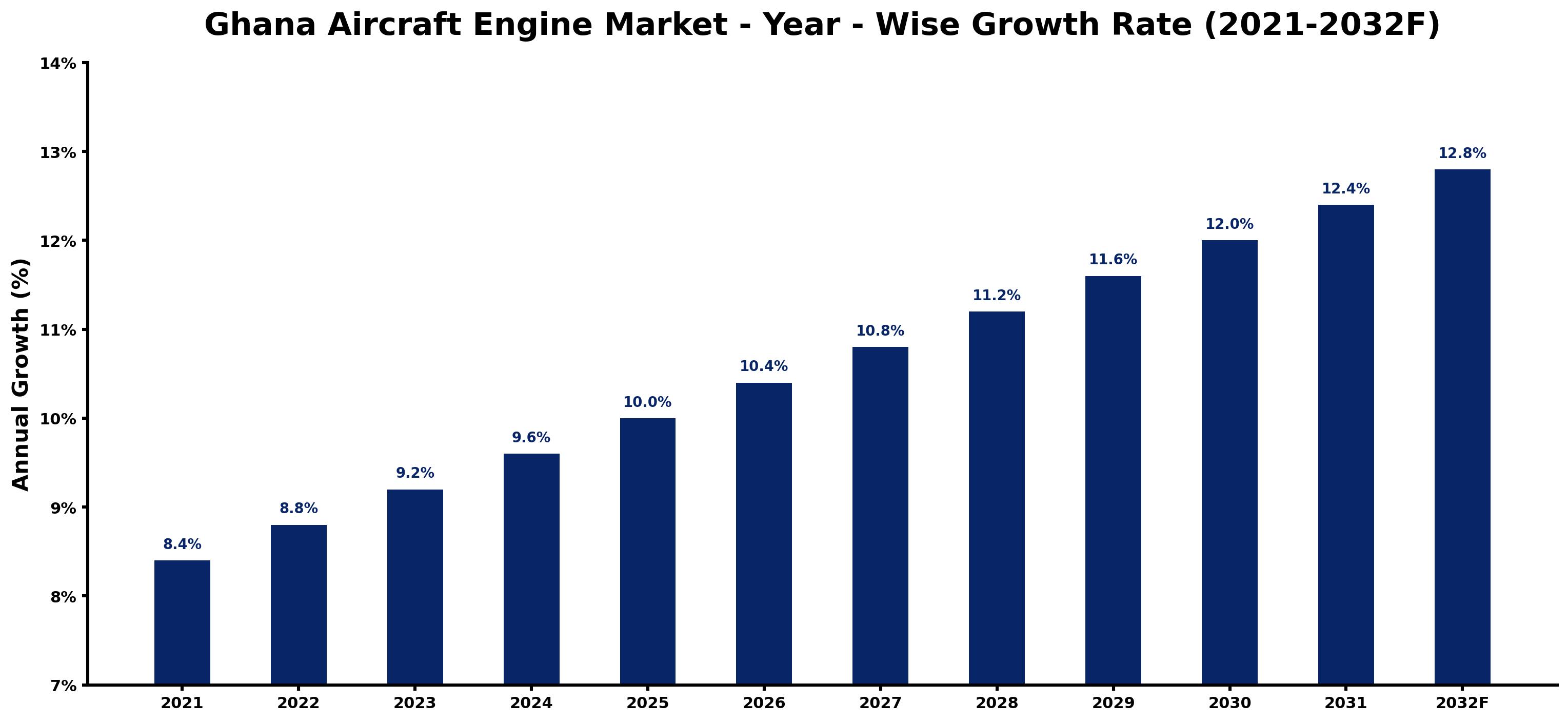
The table below presents the year‑wise growth rates along with the key drivers influencing the market
| Year | Growth Rate | Major Drivers |
| 2021 | 8.4% | Rising electricity demand across industries |
| 2022 | 8.8% | Growing renewable energy integration projects |
| 2023 | 9.2% | Increasing adoption of advanced technologies |
| 2024 | 9.6% | Increasing adoption of advanced technologies |
| 2025 | 10.0% | Expansion of transportation and logistics networks |
| 2026 | 10.4% | Increasing industrial automation investments |
| 2027 | 10.8% | Increasing industrial automation investments |
| 2028 | 11.2% | Rapid growth in telecom and data center sectors |
| 2029 | 11.6% | Rising electricity demand across industries |
| 2030 | 12.0% | Expansion of commercial construction activities |
| 2031 | 12.4% | Growing urbanization and commercial development |
| 2032 | 12.8% | Expansion of commercial construction activities |
Note - Market size estimations and growth projections presented in this report are based on 6Wresearch’s advanced forecasting approach, validated with industry datasets as of June 2026.
Ghana Aircraft Engine Market Synopsis
The Ghana Aircraft Engine Market has recently gained significant momentum, propelled by heightened demand for air travel and an expanding aviation sector. However, as the industry evolves, it is gradually transitioning towards more innovative and environmentally friendly technologies, emphasizing sustainability.
As airlines in Ghana seek to enhance operational efficiency and reduce costs, the focus is shifting towards advanced aircraft engines with lower emissions and higher reliability. This evolution signals an exciting phase for the market as it prepares for accelerated growth and transformation.
Ghana Aircraft Engine Market Key Takeaways
- The market is anticipated to grow significantly due to rising air travel demand and fleet modernization.
- Investment in sustainable and fuel-efficient engine technologies is a key driver of growth.
- Government initiatives support infrastructure development and attract foreign investments.
- Opportunities for local partnerships with international manufacturers are expanding.
- Challenges include high acquisition costs and a shortage of skilled technicians.
Evaluation of Restraints in Ghana Aircraft Engine Market
Despite the promising growth prospects, the Ghana Aircraft Engine Market faces significant restraints. The high costs associated with acquiring and maintaining aircraft engines, including purchase prices and ongoing maintenance expenses, can deter investment. Moreover, a limited pool of skilled technicians, compounded by inadequate training facilities, hampers effective engine servicing and repair. Additionally, reliance on international suppliers for parts creates vulnerabilities in supply chain efficiency, particularly amid fluctuations in foreign exchange rates. Addressing these issues will be crucial for market stakeholders aiming to capitalize on the potential growth.
Ghana Aircraft Engine Market Trends
Currently, the Ghana Aircraft Engine Market is witnessing a clear trend towards the adoption of fuel-efficient and environmentally friendly engines. Airlines are prioritizing investments in advanced engine technologies that offer reduced carbon footprints and comply with stringent environmental regulations. Furthermore, innovative propulsion systems, including electric and hybrid options, are gaining traction as the industry pushes for enhanced sustainability.
The emphasis on research and development is also growing, as local stakeholders strive to cultivate innovative designs that promise higher efficiency and lower maintenance requirements. This trend indicates a vibrant market responding adaptively to both regulatory and consumer demands.
Ghana Aircraft Engine Market Opportunities
The Ghana Aircraft Engine Market offers a myriad of investment opportunities. As the aviation sector expands, there is a notable need for maintenance, repair, and overhaul (MRO) services tailored to aircraft engines. Additionally, establishing distribution channels for engine parts and components could yield significant returns. Training programs and facilities aimed at educating aviation engineers and technicians are also in demand, supporting the local workforce while ensuring expertise in engine technologies. Forming strategic partnerships with international manufacturers for local production could further enhance competitive advantages within the market.
Government Initiatives in the Ghana Aircraft Engine Market
The Ghanaian government is actively promoting the aircraft engine market through various initiatives aimed at enhancing growth and attracting investments. Policies include tax incentives for companies engaged in engine manufacturing and maintenance, thereby encouraging local enterprise development. Furthermore, government efforts to upgrade aviation infrastructure, including airports and maintenance facilities, are pivotal in supporting industry expansion. Regulatory frameworks are also being established to uphold safety and quality standards, ensuring that the Ghana Aircraft Engine Market operates at optimal levels.
Future Insights of the Ghana Aircraft Engine Market
Looking ahead to 2026-2032, the Ghana Aircraft Engine Market is set to flourish, supported by a continuous rise in air travel demand and ongoing expansion within the aviation sector. Airlines are expected to modernize their fleets further, opting for engines that not only improve fuel efficiency but also align with global sustainability goals. The trend towards local partnerships with international manufacturers is likely to facilitate technology transfer, thereby fostering domestic production capabilities. Overall, the market's future appears bright, underpinned by robust demand and supportive government policies.
Ghana Aircraft Engine Market Latest Developments (May 2025 - June 2026)
Recent developments in the Ghana Aircraft Engine Market indicate a growing commitment to sustainability and technological innovation. Enhanced focus on eco-friendly propulsion systems and strategic investments in local infrastructure signify a proactive shift within the industry. Companies are also exploring collaborations to leverage advancements in engine technology, aiming to streamline maintenance processes and elevate operational efficiencies across the sector.
Ghana Aircraft Engine Market - Key Attractiveness of the Report
- 10 Years of Market Numbers
- Historical Data Starting from 2022 to 2025
- Base Year: 2025
- Forecast Data until 2032
- Key Performance Indicators Impacting the Market
- Major Upcoming Developments and Projects
Key Highlights of the Report:
- Ghana Aircraft Engine Market Outlook
- Market Size of Ghana Aircraft Engine Market, 2025
- Forecast of Ghana Aircraft Engine Market, 2032
- Historical Data and Forecast of Ghana Aircraft Engine Revenues & Volume for the Period 2022-2032F
- Ghana Aircraft Engine Market Trend Evolution
- Ghana Aircraft Engine Market Drivers and Challenges
- Ghana Aircraft Engine Price Trends
- Ghana Aircraft Engine Porter's Five Forces
- Ghana Aircraft Engine Industry Life Cycle
- Historical Data and Forecast of Ghana Aircraft Engine Market Revenues & Volume By Type for the Period 2022-2032F
- Historical Data and Forecast of Ghana Aircraft Engine Market Revenues & Volume By Turboprop for the Period 2022-2032F
- Historical Data and Forecast of Ghana Aircraft Engine Market Revenues & Volume By Turbofan for the Period 2022-2032F
- Historical Data and Forecast of Ghana Aircraft Engine Market Revenues & Volume By Turboshaft for the Period 2022-2032F
- Historical Data and Forecast of Ghana Aircraft Engine Market Revenues & Volume By Piston Engine for the Period 2022-2032F
- Historical Data and Forecast of Ghana Aircraft Engine Market Revenues & Volume By Application for the Period 2022-2032F
- Historical Data and Forecast of Ghana Aircraft Engine Market Revenues & Volume By Military Aviation for the Period 2022-2032F
- Historical Data and Forecast of Ghana Aircraft Engine Market Revenues & Volume By Commercial Aviation for the Period 2022-2032F
- Historical Data and Forecast of Ghana Aircraft Engine Market Revenues & Volume By General Aviation for the Period 2022-2032F
- Historical Data and Forecast of Ghana Aircraft Engine Market Revenues & Volume By Platform for the Period 2022-2032F
- Historical Data and Forecast of Ghana Aircraft Engine Market Revenues & Volume By Fixed Wing for the Period 2022-2032F
- Historical Data and Forecast of Ghana Aircraft Engine Market Revenues & Volume By Rotary Wing for the Period 2022-2032F
- Ghana Aircraft Engine Import Export Trade Statistics
- Market Opportunity Assessment By Type
- Market Opportunity Assessment By Application
- Market Opportunity Assessment By Platform
- Ghana Aircraft Engine Top Companies Market Share
- Ghana Aircraft Engine Competitive Benchmarking By Technical and Operational Parameters
- Ghana Aircraft Engine Company Profiles
- Ghana Aircraft Engine Key Strategic Recommendations






































