Ghana Art and Sculpture Market Size, Share & Growth Rate
The Ghana Art and Sculpture Market was estimated at USD 488 Million in 2025 and is projected to reach USD 652 Million by 2032, growing at a CAGR of 4.2% from 2026 to 2032. This upward trajectory is being driven by an increasing appreciation for Ghana's unique blend of traditional artistry and contemporary expression, capturing the interest of both local and global buyers. Additionally, the rise of digital platforms facilitating access to this vibrant market is enabling artists to connect with a broader audience, further stimulating growth.
Ghana Art and Sculpture Market Year-wise Growth Rate and Key Drivers
This graph highlights how the Ghana Art and Sculpture Market has steadily grown over the years, supported by major growth factors.
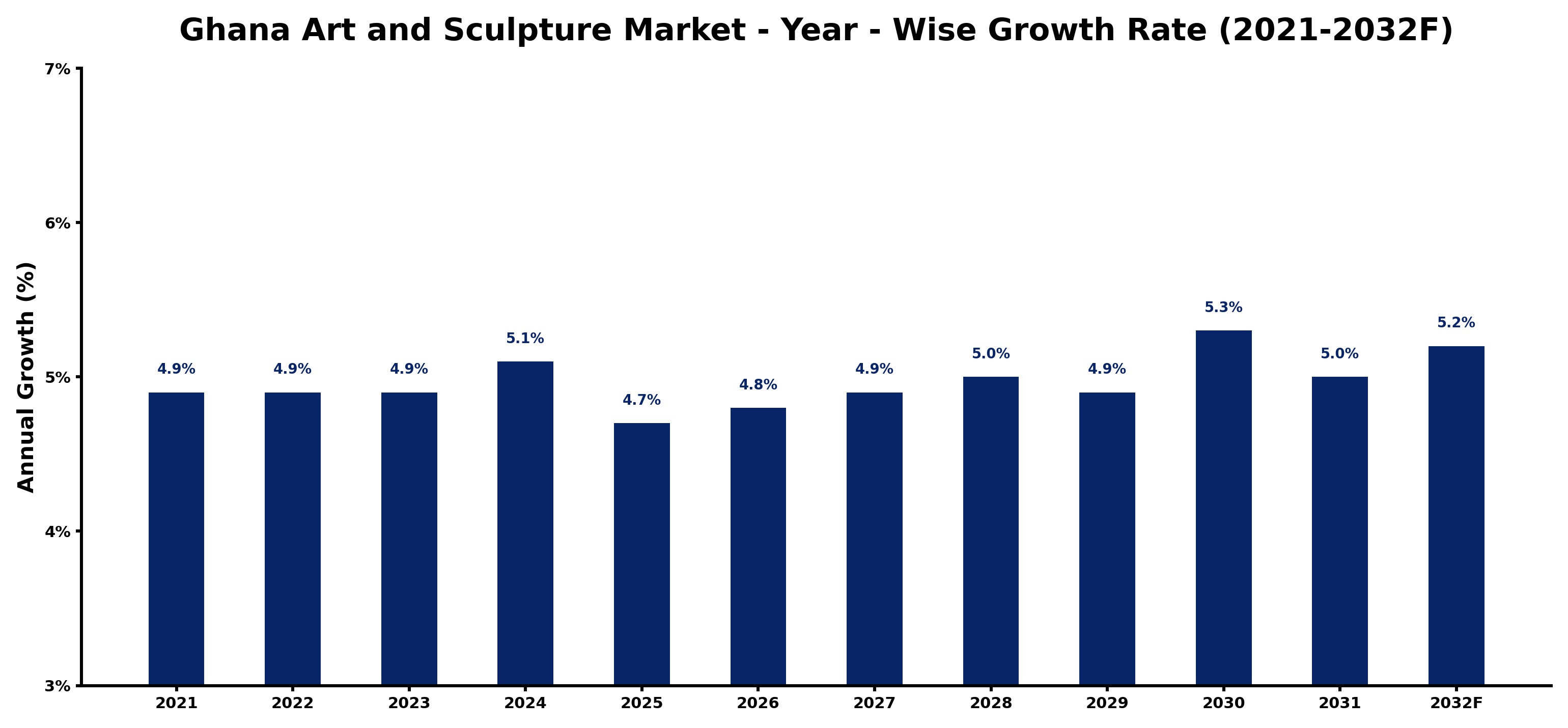
The table below presents the year‑wise growth rates along with the key drivers influencing the market
| Year | Growth Rate | Major Drivers |
| 2021 | 4.9% | Increasing industrial automation investments |
| 2022 | 4.9% | Increasing smart city development projects |
| 2023 | 4.9% | Increasing industrial infrastructure investments |
| 2024 | 5.1% | Increasing industrial automation investments |
| 2025 | 4.7% | Rapid growth in telecom and data center sectors |
| 2026 | 4.8% | Expansion of transportation and logistics networks |
| 2027 | 4.9% | Expansion of commercial construction activities |
| 2028 | 5.0% | Expansion of commercial construction activities |
| 2029 | 4.9% | Expansion of manufacturing activities |
| 2030 | 5.3% | Growing renewable energy integration projects |
| 2031 | 5.0% | Expansion of manufacturing activities |
| 2032 | 5.2% | Increasing adoption of advanced technologies |
Note - Market size estimations and growth projections presented in this report are based on 6Wresearch’s advanced forecasting approach, validated with industry datasets as of June 2026.
Ghana Art and Sculpture Market Synopsis
A transformative force in the Ghana Art and Sculpture Market is the growing recognition of local artists, whose work embodies a rich cultural narrative that resonates with audiences worldwide. This increased visibility has resulted in an uptick in demand for authentic pieces that reflect Ghana's heritage, making the market an exciting landscape for collectors and investors alike.
Furthermore, the convergence of traditional craftsmanship with contemporary art forms is redefining the artistic landscape in Ghana. This blending not only showcases the versatility of artists but also attracts a diverse clientele that appreciates originality and cultural storytelling, fueling a dynamic art scene.
Ghana Art and Sculpture Market Key Takeaways
- The market reflects a diverse artistic landscape, merging traditional and modern art forms.
- Growing international interest in Ghanaian art is enhancing local artists' visibility.
- There is a marked shift towards sustainable and ethically sourced materials in art creation.
- Digital platforms are facilitating easier access to Ghanaian art, expanding the market reach.
- Government initiatives are actively promoting the cultural heritage and supporting local artisans.
Evaluation of Restraints in Ghana Art and Sculpture Market
Despite the optimistic outlook, the Ghana Art and Sculpture Market faces notable limitations that hinder its growth. Many local artists struggle with inadequate marketing and distribution channels, limiting their ability to reach wider audiences. This issue is compounded by a lack of supportive infrastructure, which restricts artists' production capabilities and hampers their income generation potential. Furthermore, competition from low-priced imported art poses an additional challenge, forcing local artisans to compete with mass-produced items rather than their unique creations.
Ghana Art and Sculpture Market Trends
Currently, one of the most significant trends is the movement towards using sustainable and ethically sourced materials in art production. As consumers become more environmentally conscious, they seek out artworks that reflect their values. Additionally, the market is increasingly embracing digital transformation, with online platforms and social media providing new avenues for artists to showcase their work. This accessibility not only enhances market visibility but also fosters connections between creators and audiences around the globe.
Ghana Art and Sculpture Market Opportunities
The landscape is ripe with opportunities for investment and growth within the Ghana Art and Sculpture Market. As interest in Ghanaian art expands internationally, art collectors and investors have the potential to see substantial returns on their investments. Supporting emerging artists, particularly those who successfully meld traditional and contemporary styles, offers a unique chance for investors to tap into the next wave of artistic innovation. Collaborating with local galleries and participating in cultural events can yield valuable insights and partnerships within this thriving market.
Government Initiatives in the Ghana Art and Sculpture Market
The Ghanaian government has taken proactive steps to bolster the art and sculpture market through various initiatives. Funding and grants are available to support artistic endeavors, while exhibitions and cultural festivals provide platforms for artists to showcase their work. Tax incentives are also offered to encourage private investment in the sector. Furthermore, the establishment of the National Commission on Culture ensures that traditional art forms are preserved and promoted, fostering an environment where creativity and cultural heritage can flourish.
Future Insights of the Ghana Art and Sculpture Market
Looking ahead to the period from 2026 to 2032, the Ghana Art and Sculpture Market is expected to experience robust growth driven by heightened global interest in African art. As Ghanaian artists continue to gain recognition, the unique narratives and rich heritage encapsulated in their works will attract an increasingly diverse audience. The fusion of traditional techniques with contemporary expressions promises to keep the market dynamic and appealing, while governmental support and infrastructure development will further facilitate this growth. Overall, the future of Ghana's art market is bright, as it steadily carves out a prominent space on the global stage.
Ghana Art and Sculpture Market Latest Developments (May 2025 - June 2026)
Recent months have seen a wave of enthusiasm in the Ghana Art and Sculpture Market, as local art fairs gain traction and online exhibitions provide new avenues for artists. Initiatives promoting sustainable art practices have been a focal point, resonating well with environmentally conscious consumers. Collaborative projects between artists and cultural institutions are beginning to emerge, further enhancing the visibility of Ghanaian art both locally and internationally. These developments are indicative of a market that is not only responding to current trends but also actively shaping its future.
Ghana Art and Sculpture Market - Key Attractiveness of the Report
- 10 Years of Market Numbers
- Historical Data Starting from 2022 to 2025
- Base Year: 2025
- Forecast Data until 2032
- Key Performance Indicators Impacting the Market
- Major Upcoming Developments and Projects
Key Highlights of the Report:
- Ghana Art and Sculpture Market Outlook
- Market Size of Ghana Art and Sculpture Market, 2025
- Forecast of Ghana Art and Sculpture Market, 2032
- Historical Data and Forecast of Ghana Art and Sculpture Revenues & Volume for the Period 2022-2032F
- Ghana Art and Sculpture Market Trend Evolution
- Ghana Art and Sculpture Market Drivers and Challenges
- Ghana Art and Sculpture Price Trends
- Ghana Art and Sculpture Porter's Five Forces
- Ghana Art and Sculpture Industry Life Cycle
- Historical Data and Forecast of Ghana Art and Sculpture Market Revenues & Volume By Types for the Period 2022-2032F
- Historical Data and Forecast of Ghana Art and Sculpture Market Revenues & Volume By Artifacts for the Period 2022-2032F
- Historical Data and Forecast of Ghana Art and Sculpture Market Revenues & Volume By Sculpture for the Period 2022-2032F
- Historical Data and Forecast of Ghana Art and Sculpture Market Revenues & Volume By Sales Channel for the Period 2022-2032F
- Historical Data and Forecast of Ghana Art and Sculpture Market Revenues & Volume By Auction Houses for the Period 2022-2032F
- Historical Data and Forecast of Ghana Art and Sculpture Market Revenues & Volume By Dealers for the Period 2022-2032F
- Historical Data and Forecast of Ghana Art and Sculpture Market Revenues & Volume By Galleries for the Period 2022-2032F
- Historical Data and Forecast of Ghana Art and Sculpture Market Revenues & Volume By Art Fairs for the Period 2022-2032F
- Historical Data and Forecast of Ghana Art and Sculpture Market Revenues & Volume By Online Sales for the Period 2022-2032F
- Historical Data and Forecast of Ghana Art and Sculpture Market Revenues & Volume By Retail Outlets for the Period 2022-2032F
- Historical Data and Forecast of Ghana Art and Sculpture Market Revenues & Volume By Artists Studios for the Period 2022-2032F
- Historical Data and Forecast of Ghana Art and Sculpture Market Revenues & Volume By Others for the Period 2022-2032F
- Historical Data and Forecast of Ghana Art and Sculpture Market Revenues & Volume By End-user for the Period 2022-2032F
- Historical Data and Forecast of Ghana Art and Sculpture Market Revenues & Volume By Private Collectors for the Period 2022-2032F
- Historical Data and Forecast of Ghana Art and Sculpture Market Revenues & Volume By Museums for the Period 2022-2032F
- Historical Data and Forecast of Ghana Art and Sculpture Market Revenues & Volume By Real Estate Developers for the Period 2022-2032F
- Historical Data and Forecast of Ghana Art and Sculpture Market Revenues & Volume By Interior Designers for the Period 2022-2032F
- Historical Data and Forecast of Ghana Art and Sculpture Market Revenues & Volume By Residential Individual Buyers for the Period 2022-2032F
- Historical Data and Forecast of Ghana Art and Sculpture Market Revenues & Volume By Other Professionals for the Period 2022-2032F
- Ghana Art and Sculpture Import Export Trade Statistics
- Market Opportunity Assessment By Types
- Market Opportunity Assessment By Sales Channel
- Market Opportunity Assessment By End-user
- Ghana Art and Sculpture Top Companies Market Share
- Ghana Art and Sculpture Competitive Benchmarking By Technical and Operational Parameters
- Ghana Art and Sculpture Company Profiles
- Ghana Art and Sculpture Key Strategic Recommendations






































