Ghana Commercial vehicles Market Summary
The ghana commercial vehicles market was estimated at USD 262 Million in 2025 and is projected to reach USD 366 Million by 2032, growing at a CAGR of 6.0% from 2026 to 2032.
Ghana Commercial vehicles Market Year-wise Growth Rate and Key Drivers
This graph highlights how the Ghana Commercial vehicles Market has steadily grown over the past five years, supported by major growth factors.
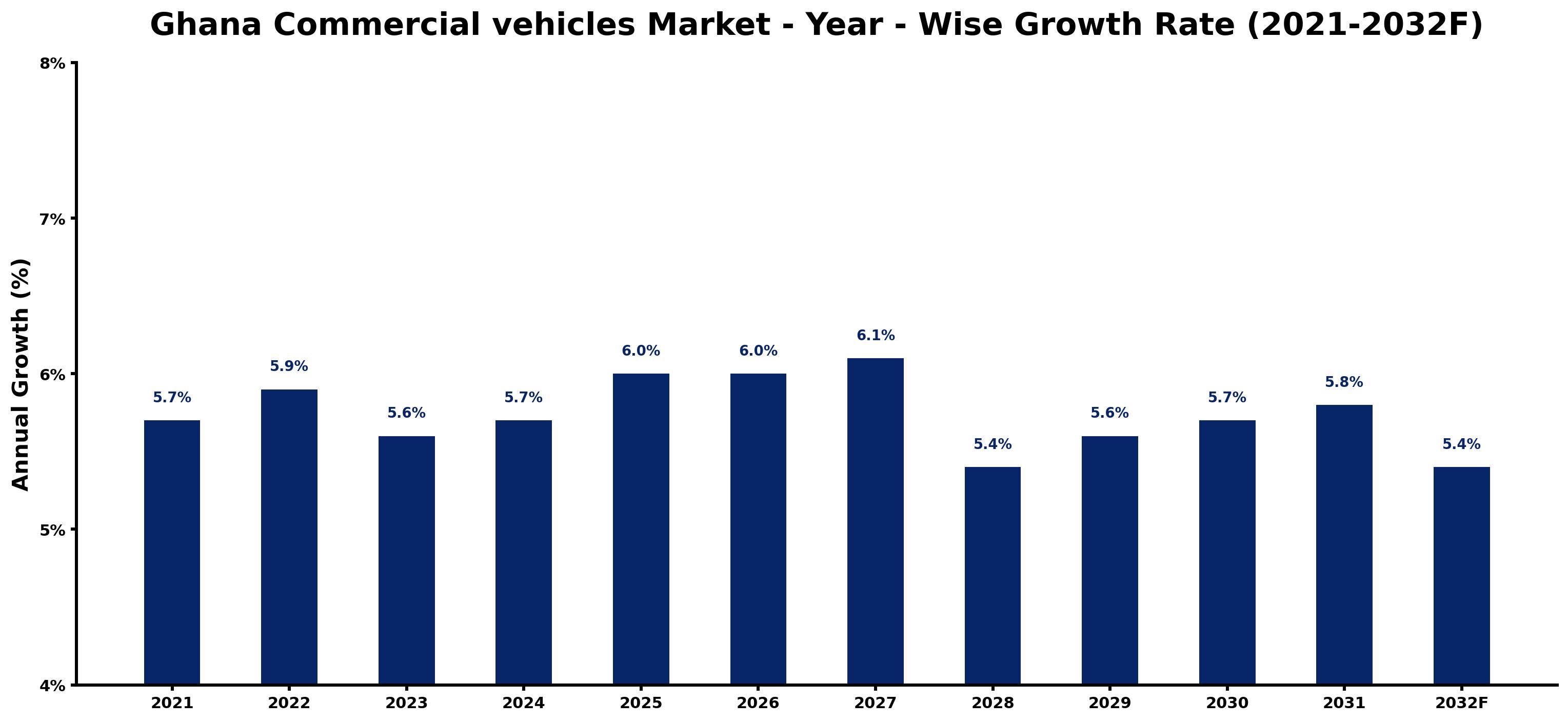
The table below presents the year wise growth rates along with the key drivers influencing the market
| Year | Growth Rate | Major Drivers |
| 2021 | 5.7% | Electric vehicle options began to enter the Ghanaian commercial market steadily. |
| 2022 | 5.9% | Infrastructure projects expanded, leading to increased transport needs across various sectors. |
| 2023 | 5.6% | Local manufacturing initiatives gained momentum, enhancing the supply chain for commercial vehicles. |
| 2024 | 5.7% | Urbanization trends fueled demand for reliable public transportation solutions and freight services. |
| 2025 | 6.0% | Increased fuel prices motivated businesses to seek more fuel-efficient vehicle alternatives. |
| 2026 | 6.0% | Partnerships with international auto manufacturers brought advanced technologies to local markets. |
| 2027 | 6.1% | E-commerce growth led to higher demand for logistics and delivery vehicles nationwide. |
| 2028 | 5.4% | Financing options improved, making commercial vehicles more accessible for small businesses. |
| 2029 | 5.6% | Technological advancements in telematics began optimizing fleet management for operators. |
| 2030 | 5.7% | Sustainability considerations pushed companies to invest in greener commercial transportation solutions. |
| 2031 | 5.8% | Rural development strategies enhanced road networks, boosting efficiency for commercial vehicle operations. |
| 2032 | 5.4% | Emerging startups in logistics introduced innovative solutions, reshaping the commercial vehicle landscape. |
Note - Market size estimations and growth projections presented in this report are based on 6Wresearch's advanced forecasting approach, validated with industry datasets as of June 2026.
Ghana Commercial vehicles Market Synopsis
The Ghana Commercial vehicles Market is projected to reach 6.0% and witness significant growth during the forecast period (2026-2032). This market is poised to expand at a compound annual growth rate (CAGR) of 4.1%, driven primarily by government initiatives and infrastructural investments aimed at enhancing transportation networks across the country. Such developments are expected to significantly boost demand for various commercial vehicles, including trucks and buses, essential for supporting the increasing freight transportation activities seen in recent years.
Ghana Commercial vehicles Market Growth Drivers
The growth of the Ghana Commercial vehicles Market can be attributed to several key factors. Among these, the following drivers stand out:
- Government initiatives are playing a central role in boosting the commercial vehicles sector. Strategic policies aimed at improving transportation efficiency and accessibility are drawing investments into the market.
- Infrastructural development is another significant factor. Roads and ports are being upgraded nationwide, directly impacting the logistics and transportation landscape and increasing the demand for commercial vehicles.
- The rise of exports from Ghana, especially following free trade agreements with several countries, particularly in the European Union, is contributing positively to the demand for commercial vehicles.
- Additionally, the growth of e-commerce across Africa is leading to increased cargo shipments, particularly by road, thereby enhancing the demand for trucks to facilitate this growth.
- The resurgence of freight transportation activities is also driving demand for commercial vehicles such as buses and trucks, as businesses seek to optimize their transport capabilities.
Ghana Commercial vehicles Market Challenges and Restraints
While the Ghana Commercial vehicles Market presents numerous growth opportunities, it also faces several challenges that could hinder its expansion. Key restraints include:
- The availability of low-cost used vehicles creates significant competition for new models, potentially deterring businesses from investing in advanced commercial vehicles.
- Economic fluctuations and uncertainty can affect consumer confidence, leading to reduced spending on new commercial vehicles as businesses evaluate their financial priorities.
- Supply chain disruptions, particularly related to global material shortages, can impede production timelines for new vehicle models, affecting market availability.
- Regulatory challenges, including compliance with environmental standards and vehicle safety regulations, can impose additional costs on manufacturers and increase market entry barriers.
- The uneven distribution of infrastructure development across regions may result in disparities in vehicle demand, posing challenges for manufacturers targeting specific geographic areas.
Ghana Commercial vehicles Market Government Investment and Initiatives
The Ghanaian government has established several initiatives aimed at enhancing its commercial vehicles market. High-profile public spending on infrastructure development is a priority, with investments focused on improving road networks, transit systems, and port facilities. These initiatives are designed to facilitate trade and transport efficiency, thereby stimulating the demand for commercial vehicles across the country.
Moreover, the government has set forth policies that encourage local manufacturing of commercial vehicles, aiming to reduce reliance on imports. Incentives, such as tax breaks and tariffs on vehicle components, are designed to support domestic production and make new models more accessible to businesses. This strategic focus is expected to further propel the market, fostering a more competitive environment that can attract both local and foreign investment.
Ghana Commercial vehicles Market Latest Developments (May 2025 - June 2026)
Recent developments in the Ghana Commercial vehicles Market from May 2025 to June 2026 indicate a profound shift towards modernization and sustainability. Industry stakeholders are increasingly investing in the research and development of electric and hybrid commercial vehicles, reflecting a global trend towards greener technologies. This shift is likely to impact future sales as businesses seek eco-friendly alternatives to traditional fuel-based vehicles.
Additionally, there has been a noticeable increase in partnerships between governmental bodies and private sector organizations aimed at enhancing logistics capabilities. These collaborations are expected to address various bottlenecks in transportation and supply chain management, further stimulating the demand for robust commercial vehicles.
The expansion of e-commerce platforms is also influencing the market dynamics, leading to a surge in last-mile delivery services that require specialized commercial vehicles. As consumer preferences continue to shift towards online shopping, logistics companies are adapting to meet this growing demand, resulting in increased orders for light-duty trucks and vans.
Ghana Commercial vehicles Market - Key Attractiveness of the Report
- 10 Years of Market Numbers
- Historical Data Starting from 2022 to 2025
- Base Year: 2025
- Forecast Data until 2032
- Key Performance Indicators Impacting the Market
- Major Upcoming Developments and Projects
Key Highlights of the Report:
- Ghana Commercial vehicles Market Outlook
- Market Size of Ghana Commercial vehicles Market, 2025
- Forecast of Ghana Commercial vehicles Market, 2032F
- Historical Data and Forecast of Ghana Commercial vehicles Revenues & Volume for the Period 2022-2032F
- Ghana Commercial vehicles Market Trend Evolution
- Ghana Commercial vehicles Market Drivers and Challenges
- Ghana Commercial vehicles Price Trends
- Ghana Commercial vehicles Porter's Five Forces
- Ghana Commercial vehicles Industry Life Cycle
- Historical Data and Forecast of Ghana Commercial vehicles Market Revenues & Volume By Product for the Period 2022-2032F
- Historical Data and Forecast of Ghana Commercial vehicles Market Revenues & Volume By Light Commercial Vehicles (LCVs) for the Period 2022-2032F
- Historical Data and Forecast of Ghana Commercial vehicles Market Revenues & Volume By Heavy Trucks for the Period 2022-2032F
- Historical Data and Forecast of Ghana Commercial vehicles Market Revenues & Volume By Buses & Coaches for the Period 2022-2032F
- Historical Data and Forecast of Ghana Commercial vehicles Market Revenues & Volume By End-Users for the Period 2022-2032F
- Historical Data and Forecast of Ghana Commercial vehicles Market Revenues & Volume By Industrial for the Period 2022-2032F
- Historical Data and Forecast of Ghana Commercial vehicles Market Revenues & Volume By Mining & Construction for the Period 2022-2032F
- Historical Data and Forecast of Ghana Commercial vehicles Market Revenues & Volume By Logistics for the Period 2022-2032F
- Historical Data and Forecast of Ghana Commercial vehicles Market Revenues & Volume By Passenger Transportation for the Period 2022-2032F
- Historical Data and Forecast of Ghana Commercial vehicles Market Revenues & Volume By Others for the Period 2022-2032F
- Ghana Commercial vehicles Import Export Trade Statistics
- Market Opportunity Assessment By Product
- Market Opportunity Assessment By End-Users
- Ghana Commercial vehicles Top Companies Market Share
- Ghana Commercial vehicles Competitive Benchmarking By Technical and Operational Parameters
- Ghana Commercial vehicles Company Profiles
- Ghana Commercial vehicles Key Strategic Recommendations






































