Ghana Winding Wire Market Size, Share & Growth Rate
The Ghana Winding Wire Market was estimated at USD 247 Million in 2025 and is projected to reach USD 339 Million by 2032, growing at a CAGR of 4.6% from 2026 to 2032. This robust growth trajectory is largely fueled by increasing industrialization and infrastructure development within the country, which is driving the demand for high-quality electrical components. In particular, the rising focus on renewable energy projects and government initiatives to expand electricity access create a fertile landscape for the winding wire sector.
Ghana Winding Wire Market Year-wise Growth Rate and Key Drivers
This graph highlights how the Ghana Winding Wire Market has steadily grown over the years, supported by major growth factors.
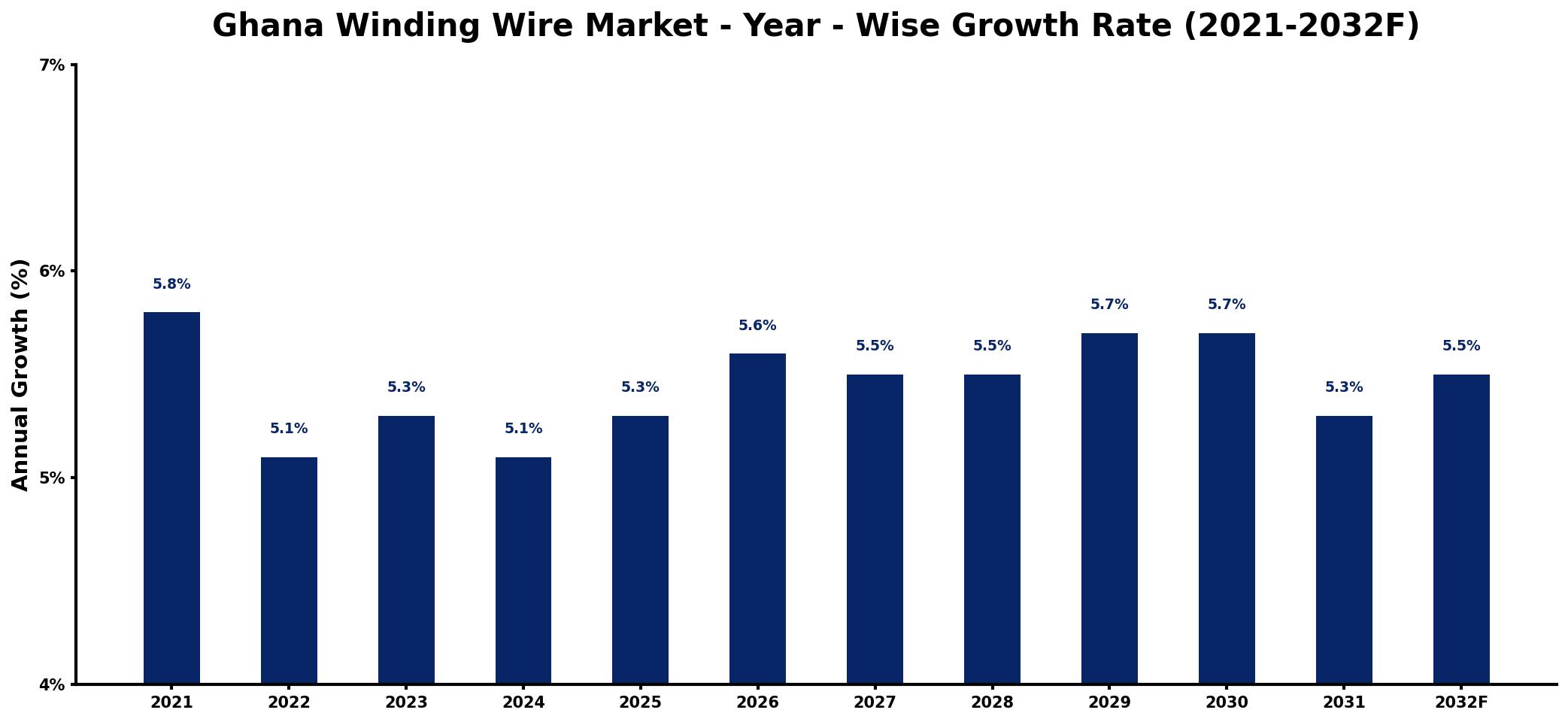
The table below presents the year‑wise growth rates along with the key drivers influencing the market
| Year | Growth Rate | Major Drivers |
| 2021 | 5.8% | Rising demand for renewable energy |
| 2022 | 5.1% | Increased construction and infrastructure projects |
| 2023 | 5.3% | Growth in electrical vehicle market |
| 2024 | 5.1% | Expansion of telecommunications networks |
| 2025 | 5.3% | Surge in industrial automation adoption |
| 2026 | 5.6% | Investment in smart grid technology |
| 2027 | 5.5% | Higher consumer electronics production |
| 2028 | 5.5% | Boost in manufacturing sector output |
| 2029 | 5.7% | Increased focus on energy efficiency |
| 2030 | 5.7% | improved processing technologies adoption |
| 2031 | 5.3% | strengthening international trade flows |
| 2032 | 5.5% | growing automotive sector requirements |
Note: Market size estimations and growth projections presented in this report are based on 6Wresearch's proprietary forecasting methodology, utilizing the latest available industry data, government publications, and primary research inputs.
Ghana Winding Wire Market Synopsis
Currently, the Ghana Winding Wire Market is experiencing a notable shift as manufacturers adapt to evolving industry demands. The market is predominantly characterized by copper winding wires, known for their high conductivity, while aluminum winding wires are gaining traction due to their cost-effectiveness and lighter weight.
This dynamic environment presents numerous challenges and opportunities. Local producers are striving to meet the increasing expectations for quality and performance, particularly in sectors such as automotive and electronics, which are becoming increasingly integral to Ghanas economy.
Ghana Winding Wire Market Key Takeaways
- The market is primarily driven by increasing industrialization and infrastructure investments.
- Growing demand for energy-efficient solutions is propelling the preference for copper over aluminum wires.
- Customization and innovation in winding wire solutions are on the rise.
- The government is implementing supportive policies to promote local manufacturing.
- Strategic investments in technology can enhance competitiveness in the sector.
Evaluation of Restraints in Ghana Winding Wire Market
Despite the promising outlook, the Ghana Winding Wire Market faces several significant restraints. One of the foremost challenges is the inconsistent availability and quality of raw materials, which creates volatility in production costs and affects overall product quality. Additionally, many local manufacturers contend with outdated machinery that limits their capacity for innovation. The presence of imported winding wire products, often of superior quality and lower cost, also poses a formidable challenge. Moreover, infrastructural inadequacies, particularly in transportation and power supply, can disrupt production schedules, resulting in increased operational costs.
Ghana Winding Wire Market Trends
A significant trend in the Ghana Winding Wire Market is the escalating demand for high-quality and energy-efficient wires, largely driven by the adoption of renewable energy sources. This is complemented by advancements in manufacturing technologies that enhance wire performance and reliability, particularly in applications like transformers and motors. Furthermore, customization of winding wire solutions is gaining traction as manufacturers seek to cater to specific industry requirements, reflecting a broader trend toward tailored solutions in the electrical components sector.
Ghana Winding Wire Market Opportunities
The Ghana Winding Wire Market is ripe with investment opportunities, especially in the realms of manufacturing high-quality winding wires and expanding distribution networks. The growing industrial sector and rising electrical product demand underscore the potential for new entrants and established players alike. Additionally, the government's ongoing initiatives to bolster infrastructure and expand electricity access provide an auspicious environment for investment. Partnering with local distributors can further enhance market penetration and drive profitability.
Government Initiatives in the Ghana Winding Wire Market
The Ghanaian government has instituted various policies aimed at fostering the growth of the winding wire market. These initiatives are focused on promoting local production, ensuring compliance with quality standards, and bolstering the overall industry landscape. The Ghana Standards Authority plays a pivotal role in quality control, ensuring that winding wires meet international standards while providing protections for consumers. Incentives, such as tax breaks and subsidies, are offered to encourage domestic manufacturing, thereby reducing reliance on imports and stimulating local economic growth.
Future Insights of the Ghana Winding Wire Market
Looking ahead to the period from 2026 to 2032, the Ghana Winding Wire Market is set to flourish due to ongoing investments in infrastructure, renewable energy initiatives, and the expansion of the industrial sector. The increasing need for effective electricity transmission and distribution systems will drive demand across various sectors, including automotive and consumer electronics. Additionally, government efforts to enhance electricity access in rural areas and promote local manufacturing are expected to further bolster market growth. The sector is poised for steady expansion, offering ample opportunities for market players to grow their presence and product offerings.
Ghana Winding Wire Market Latest Developments (2025 - 2026)
In recent months, the Ghana Winding Wire Market has seen a number of noteworthy developments. Manufacturers are increasingly investing in advanced technologies to improve production efficiency and product quality. There is a marked shift towards energy-efficient winding wire solutions, aligning with global sustainability trends. Concurrently, local firms are ramping up efforts to enhance their competitive edge against imported products, focusing on quality and innovation. These trends indicate a market that is rapidly evolving to meet both domestic and international demands.
Ghana Winding Wire Market - Key Attractiveness of the Report
- 10 Years of Market Numbers
- Historical Data Starting from 2022 to 2025
- Base Year: 2025
- Forecast Data until 2032
- Key Performance Indicators Impacting the Market
- Major Upcoming Developments and Projects
Key Highlights of the Report:
- Ghana Winding Wire Market Outlook
- Market Size of Ghana Winding Wire Market, 2025
- Forecast of Ghana Winding Wire Market, 2032
- Historical Data and Forecast of Ghana Winding Wire Revenues & Volume for the Period 2022-2032F
- Ghana Winding Wire Market Trend Evolution
- Ghana Winding Wire Market Drivers and Challenges
- Ghana Winding Wire Price Trends
- Ghana Winding Wire Porter's Five Forces
- Ghana Winding Wire Industry Life Cycle
- Historical Data and Forecast of Ghana Winding Wire Market Revenues & Volume By Product for the Period 2022-2032F
- Historical Data and Forecast of Ghana Winding Wire Market Revenues & Volume By Copper Winding Wire for the Period 2022-2032F
- Historical Data and Forecast of Ghana Winding Wire Market Revenues & Volume By Aluminum Winding Wire for the Period 2022-2032F
- Ghana Winding Wire Import Export Trade Statistics
- Market Opportunity Assessment By Product
- Ghana Winding Wire Top Companies Market Share
- Ghana Winding Wire Competitive Benchmarking By Technical and Operational Parameters
- Ghana Winding Wire Company Profiles
- Ghana Winding Wire Key Strategic Recommendations






































