Global Language Translation Device Market Highlights
| Market Size (2025) | USD 2.1 Billion |
| Forecast Size (2032) | USD 3.6 Billion |
| CAGR | 7.00% |
| Base Year | 2025 |
| Forecast Period | 2026-2032 |
| Largest Region | North America |
| Fastest Growing Region | Asia |
| Largest Segment | Handheld |
| Fastest Growing Segment | Wearable |
| Leading Companies | Google, Microsoft, Amazon, iTranslate, Pocketalk |
Global Language Translation Device Market Size & Growth Rate (2026-2032)
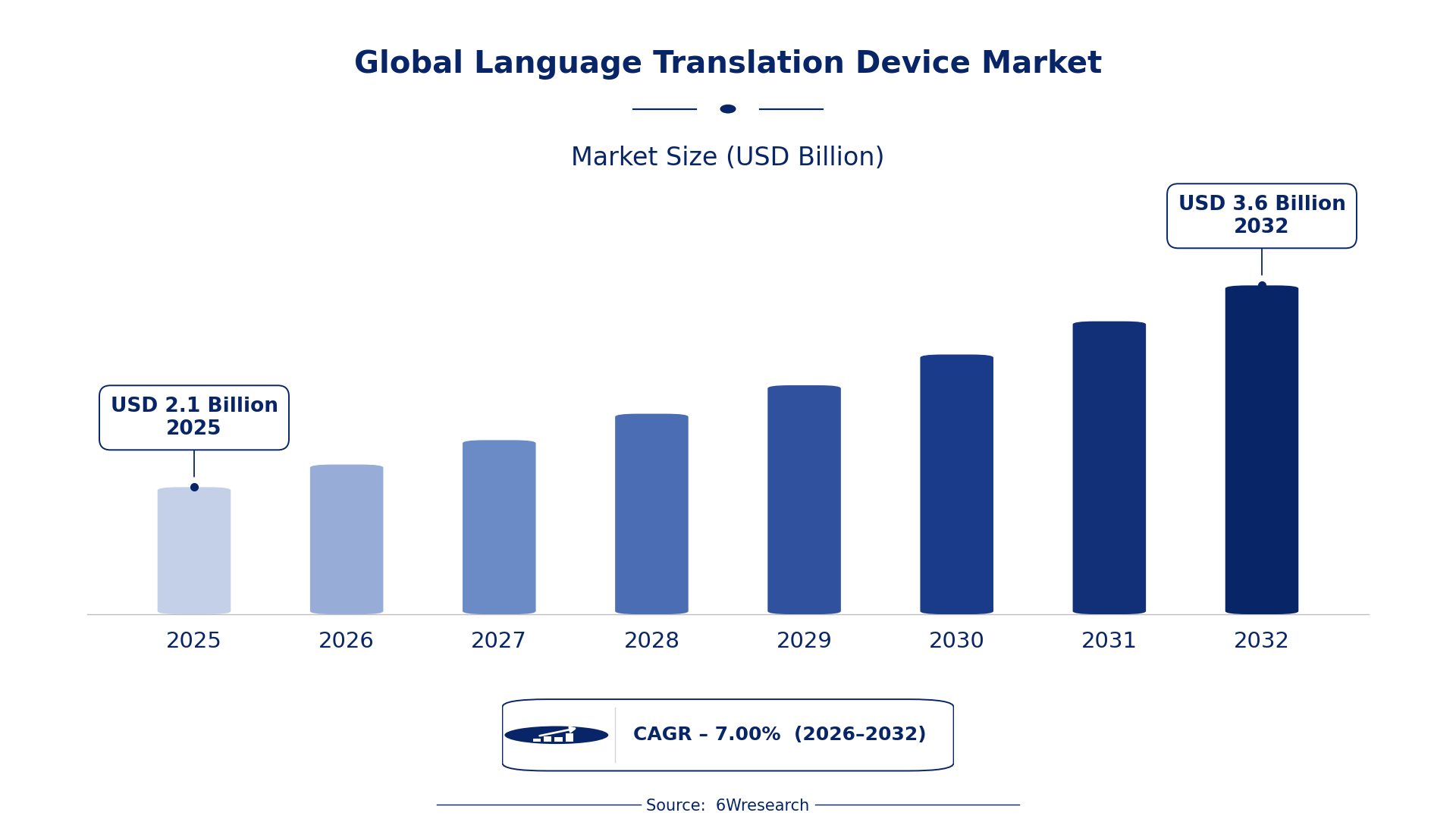
The Global Language Translation Device Market was estimated at USD 2.1 Billion in 2025 and is projected to reach USD 3.6 Billion by 2032, growing at a CAGR of 7.00% from 2026 to 2032.
Global Language Translation Device Market Synopsis
The dynamics within the Global Language Translation Device Market are shifting significantly, propelled by heightened globalization and an increase in cross-border interactions. This change underscores the essential role of language translation devices in both personal and professional contexts. Emerging technology is not just facilitating communication; it's creating seamless experiences where language barriers are minimized.
Many sectors, such as travel, healthcare, and e-commerce, are redefining their operational strategies to leverage language translation devices. This evolution differentiates the market from adjacent sectors, emphasizing a reliance on real-time communication tools and suggesting an exciting trajectory for future growth aligned with advancements in AI and machine learning.
Global Language Translation Device Market Year-wise Growth Rate and Key Drivers
This graph illustrates the annual growth rates of the Global Language Translation Device Market from 2022 to 2032, highlighting a steady upward trajectory and projected expansion over the forecast period.
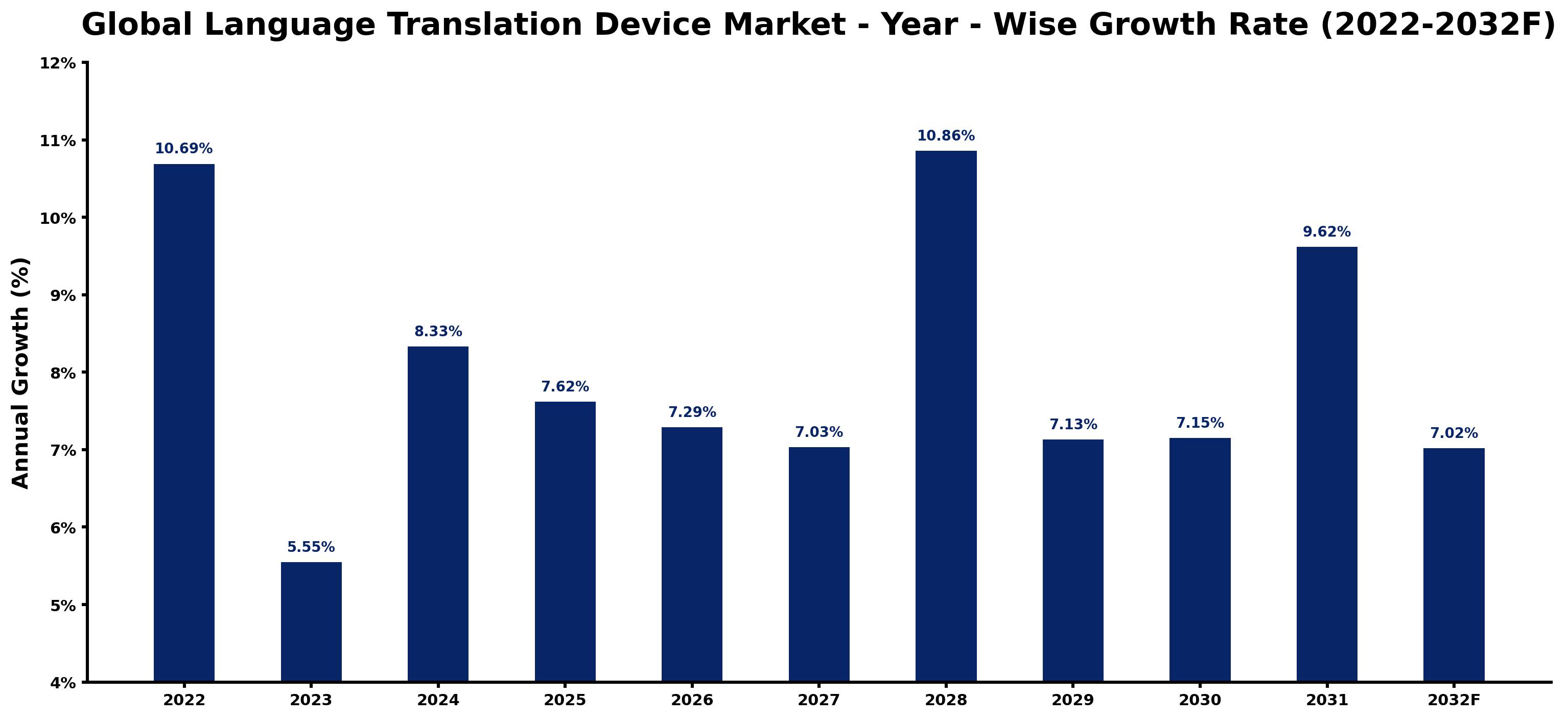
The table below presents the year‑wise growth rates along with the key drivers influencing the market
| Year | Growth Rate (%) | Major Drivers |
| 2022 | 10.69 | Language service providers increased investment in translation devices to enhance connectivity. |
| 2023 | 5.55 | In North America, rising input costs for translation device components pressured pricing strategies. |
| 2024 | 8.33 | Growing interest in real-time translation applications among travelers is driving device sales. |
| 2025 | 7.62 | Expanding cloud migration improves capabilities and user experience for translation devices. |
| 2026 | 7.29 | While consumers increasingly demand instant communication, translation devices enhance multilingual interactions. |
| 2027 | 7.03 | AI-powered translation devices promote sustainability by reducing language barriers and resource waste. |
| 2028 | 10.86 | Telecom companies are prioritizing translation device solutions to streamline global operations. |
| 2029 | 7.13 | A shift toward competitive pricing and features is reshaping the translation device sector. |
| 2030 | 7.15 | Regulators are imposing new standards on translation devices to ensure data security compliance. |
| 2031 | 9.62 | Enhanced global partnerships among tech firms accelerate the regional adoption of translation devices. |
| 2032 | 7.02 | A mature workforce increasingly requires proficiency in translation device technology for effective communication. |
Note - Market size estimations and growth projections presented in this report are based on 6Wresearch's proprietary research methodology, combining internal industry data, secondary research, and primary validation, updated periodically to reflect current market conditions. As markets evolve rapidly, figures for certain industries may vary slightly and are intended as informed estimates rather than absolute figures. For the most current market sizing, we recommend validating figures with a 6Wresearch analyst.
Global Language Translation Device Market Key Takeaways
Below are some of the specific key takeaways from the market, including:
- The handheld segment is estimated to hold approximately 55% share in 2025, showcasing robust consumer demand for portable solutions.
- Asia is projected as the fastest-growing region, with a CAGR of 8.5% from 2026 to 2032, reflecting a surge in travel and cross-cultural exchanges.
- Google continues to innovate in this space; in 2023, it launched enhanced features in Google Translate that integrate voice recognition technology.
- Pocketalk, recognized for its sleek, user-friendly interface, has increased its market share by launching new models that support over 80 languages in 2022.
- The anticipated growth in e-commerce transactions, estimated at USD 6 trillion worldwide by 2024, is driving demand for translation devices.
Evaluation of Restraints in Global Language Translation Device Market
A significant challenge facing the Global Language Translation Device Market is the accuracy of translations, which is crucial for effective communication. This market typically confronts dialect variations that can complicate translation efforts. For instance, industry analyst estimates suggest that errors in translating sensitive healthcare information can account for losses exceeding USD 5 billion annually. This accuracy challenge is compounded by regulatory hurdles; certification requirements for medical translation devices can lengthen market entry timelines, emphasizing the need for rigorous compliance strategies.
Global Language Translation Device Market Trends
A notable trend in the Global Language Translation Device Market is the integration of AI capabilities. Companies such as Microsoft are embedding advanced neural network technology into their translation algorithms, significantly improving accuracy and context handling. For example, in 2022, Microsoft reported a 30% enhancement in translation quality due to these advances, making its devices more appealing to global users who require precision. Another trend is the increasing preference for portable devices; with the rise of remote work, many individuals now value wearable translation devices that provide hands-free operation. The demand for such solutions mirrors the expectations of a workforce that is increasingly mobile and ethnically diverse, requiring quick communication tools that adapt to various languages.
Global Language Translation Device Market Opportunities
The future revenue landscape for the Global Language Translation Device Market is rich with opportunities. One promising avenue lies in healthcare, where personalized patient services are becoming paramount. Companies like iTranslate are developing devices specifically tailored for medical professionals, facilitating seamless communication between providers and patients. This segment could see significant growth, especially as telemedicine expands; reports project the telehealth market to surpass USD 459 billion by 2030. Additionally, there's an opportunity in educational tools, where language translation devices can support language learners by providing real-time feedback and context, further enriching the learning experience.
Global Language Translation Device Market by Product Type
In the product type segment of the Global Language Translation Device Market, handheld devices lead the market, commanding a substantial share of approximately 55% in 2025. On the other hand, wearable translation devices are emerging as the fastest-growing segment, projected to achieve a CAGR of 9.2% from 2026 to 2032. This growth can be attributed to their convenience and increasing popularity among travelers and professionals who prioritize mobility and ease of use, further enhancing communication on the go.
Global Language Translation Device Market by Region
North America presently stands as the largest region in the Global Language Translation Device Market, estimated to hold a share of around 40% in 2025. However, Asia is posited to be the fastest-growing region, projected to exhibit a CAGR of 8.5% from 2026 to 2032. This increase is driven by rising international business activities and cultural exchanges, supported by governmental initiatives that promote language diversity and accessibility in communication.
Government Initiatives in the Global Language Translation Device Market
The regulatory landscape surrounding the Global Language Translation Device Market is defined by multiple initiatives aimed at enhancing communication technologies and accessibility. Government bodies are increasingly recognizing the role of translation devices in bridging communication gaps, that facilitate trade and cultural exchange. Below are key initiatives relevant to this sector:
- Department of Education, "Multilingual Education Policy," 2021 — Aims to enhance language teaching resources, benefiting translation technology users in educational settings.
- Federal Communications Commission (FCC), "Digital Equity Act," 2023 — Promotes universal access to communication devices, fostering demand for translation solutions across underserved communities.
- Ministry of Culture, "Language Preservation Initiative," 2022 — Allocates funding to preserve and promote indigenous languages, creating a market for devices that support diverse linguistic needs.
- European Commission, "Cross-Border Cooperation Regulations," 2023 — These regulations make it mandatory for businesses involved in cross-border operations to provide translation services, boosting device adoption rates.
Future Insights of the Global Language Translation Device Market
The Global Language Translation Device Market is expected to undergo transformative changes driven by technological advancements and evolving consumer needs. The adoption of AI-driven real-time translation is projected to shape future offerings, with companies such as Microsoft focusing on neural networks to enhance context accuracy. Projects like iTranslate's customized solutions for healthcare signify a shift toward specialized applications, while a burgeoning remote workforce will continue fueling demand for portable and user-friendly devices through 2032.
Global Language Translation Device Market Latest Developments
Recent advancements in the Global Language Translation Device Market have underscored the competitive landscape, as key players expand their offerings and capabilities to capture a growing customer base.
- In July 2023, Google introduced an upgrade to its Google Translate app, enhancing voice recognition features. This improvement enables more accurate translations, significantly enhancing user experience in real-time communication.
- Pocketalk has recently expanded its product line with devices now supporting over 80 languages, launched in September 2023. This addresses the diverse linguistic needs of international travelers and professionals.
- Microsoft is currently piloting a new wearable translation device expected to launch in early 2024. This initiative aims to blend AI and AR technologies to provide immediate translations in immersive environments.
- In November 2023, iTranslate announced a strategic partnership with a leading telehealth provider to develop specialized translation devices aimed at facilitating communication between healthcare professionals and patients.
Global Language Translation Device Market Key Players and Industry Positioning
The competitive structure of the Global Language Translation Device Market is fairly fragmented, with several key players dominating various segments. Each company distinguishes itself through unique strengths and strategies, responding dynamically to consumer trends and technological advancements.
| Leading Company | Core Strength | Strategic Focus |
|---|---|---|
| Advanced AI and extensive language database | Continuous improvements in translation accuracy | |
| Microsoft | Integration of neural network technology | Development of AI-enhanced translations for business applications |
| Amazon | Robust cloud infrastructure | Expanding cloud-based translation solutions |
| iTranslate | Customized translation solutions for niche markets | Focus on healthcare and educational applications |
| Pocketalk | User-friendly design with extensive language support | Enhancing accessibility for travelers and business professionals |
The unique capabilities and strategies of these key players illustrate a competitive market where companies must continually evolve to harness emerging opportunities and address user needs effectively.
Key Attractiveness of the Report
- 10 Years of Market Numbers
- Historical Data Starting from 2022 to 2025
- Base Year: 2025
- Forecast Data until 2032
- Key Performance Indicators Impacting the Market
- Major Upcoming Developments and Projects
Key Highlights of the Report:
- Global Language Translation Device Market Outlook
- Market Size of Global Language Translation Device Market, 2025
- Forecast of Global Language Translation Device Market, 2032
- Historical Data and Forecast of Global Language Translation Device Revenues & Volume for the Period 2022-2032
- Global Language Translation Device Market Trend Evolution
- Global Language Translation Device Market Drivers and Challenges
- Global Language Translation Device Price Trends
- Global Language Translation Device Porter's Five Forces
- Global Language Translation Device Industry Life Cycle
- Historical Data and Forecast of Global Language Translation Device Market Revenues & Volume
- Historical Data and Forecast of Global Language Translation Device Market Revenues & Volume By Product Type for the Period 2022-2032
- Historical Data and Forecast of Global Language Translation Device Market Revenues & Volume By Handheld for the Period 2022-2032
- Historical Data and Forecast of Global Language Translation Device Market Revenues & Volume By Wearable for the Period 2022-2032
- Historical Data and Forecast of North America Language Translation Device Market Revenues & Volume By Product Type for the Period 2022-2032
- Historical Data and Forecast of North America Language Translation Device Market Revenues & Volume By Handheld for the Period 2022-2032
- Historical Data and Forecast of North America Language Translation Device Market Revenues & Volume By Wearable for the Period 2022-2032
- Historical Data and Forecast of United States of America Language Translation Device Market Revenues & Volume for the Period 2022-2032
- Historical Data and Forecast of Canada Language Translation Device Market Revenues & Volume for the Period 2022-2032
- Historical Data and Forecast of Rest of North America Language Translation Device Market Revenues & Volume for the Period 2022-2032
- Historical Data and Forecast of Latin America (LATAM) Language Translation Device Market Revenues & Volume By Product Type for the Period 2022-2032
- Historical Data and Forecast of Latin America (LATAM) Language Translation Device Market Revenues & Volume By Handheld for the Period 2022-2032
- Historical Data and Forecast of Latin America (LATAM) Language Translation Device Market Revenues & Volume By Wearable for the Period 2022-2032
- Historical Data and Forecast of Brazil Language Translation Device Market Revenues & Volume for the Period 2022-2032
- Historical Data and Forecast of Mexico Language Translation Device Market Revenues & Volume for the Period 2022-2032
- Historical Data and Forecast of Argentina Language Translation Device Market Revenues & Volume for the Period 2022-2032
- Historical Data and Forecast of Rest of LATAM Language Translation Device Market Revenues & Volume for the Period 2022-2032
- Historical Data and Forecast of Asia Language Translation Device Market Revenues & Volume By Product Type for the Period 2022-2032
- Historical Data and Forecast of Asia Language Translation Device Market Revenues & Volume By Handheld for the Period 2022-2032
- Historical Data and Forecast of Asia Language Translation Device Market Revenues & Volume By Wearable for the Period 2022-2032
- Historical Data and Forecast of China Language Translation Device Market Revenues & Volume for the Period 2022-2032
- Historical Data and Forecast of India Language Translation Device Market Revenues & Volume for the Period 2022-2032
- Historical Data and Forecast of Japan Language Translation Device Market Revenues & Volume for the Period 2022-2032
- Historical Data and Forecast of Rest of Asia Language Translation Device Market Revenues & Volume for the Period 2022-2032
- Historical Data and Forecast of Africa Language Translation Device Market Revenues & Volume By Product Type for the Period 2022-2032
- Historical Data and Forecast of Africa Language Translation Device Market Revenues & Volume By Handheld for the Period 2022-2032
- Historical Data and Forecast of Africa Language Translation Device Market Revenues & Volume By Wearable for the Period 2022-2032
- Historical Data and Forecast of South Africa Language Translation Device Market Revenues & Volume for the Period 2022-2032
- Historical Data and Forecast of Nigeria Language Translation Device Market Revenues & Volume for the Period 2022-2032
- Historical Data and Forecast of Egypt Language Translation Device Market Revenues & Volume for the Period 2022-2032
- Historical Data and Forecast of Rest of Africa Language Translation Device Market Revenues & Volume for the Period 2022-2032
- Historical Data and Forecast of Europe Language Translation Device Market Revenues & Volume By Product Type for the Period 2022-2032
- Historical Data and Forecast of Europe Language Translation Device Market Revenues & Volume By Handheld for the Period 2022-2032
- Historical Data and Forecast of Europe Language Translation Device Market Revenues & Volume By Wearable for the Period 2022-2032
- Historical Data and Forecast of United Kingdom Language Translation Device Market Revenues & Volume for the Period 2022-2032
- Historical Data and Forecast of France Language Translation Device Market Revenues & Volume for the Period 2022-2032
- Historical Data and Forecast of Germany Language Translation Device Market Revenues & Volume for the Period 2022-2032
- Historical Data and Forecast of Rest of Europe Language Translation Device Market Revenues & Volume for the Period 2022-2032
- Historical Data and Forecast of Middle East Language Translation Device Market Revenues & Volume By Product Type for the Period 2022-2032
- Historical Data and Forecast of Middle East Language Translation Device Market Revenues & Volume By Handheld for the Period 2022-2032
- Historical Data and Forecast of Middle East Language Translation Device Market Revenues & Volume By Wearable for the Period 2022-2032
- Historical Data and Forecast of Saudi Arabia Language Translation Device Market Revenues & Volume for the Period 2022-2032
- Historical Data and Forecast of UAE Language Translation Device Market Revenues & Volume for the Period 2022-2032
- Historical Data and Forecast of Turkey Language Translation Device Market Revenues & Volume for the Period 2022-2032
- Historical Data and Forecast of Rest of Middle East Language Translation Device Market Revenues & Volume for the Period 2022-2032
- Global Language Translation Device Market - Key Performance Indicators
- Global Language Translation Device Market - Import Export Trade Statistics
- Global Language Translation Device Market - Opportunity Assessment By Countries
- Global Language Translation Device Market - Opportunity Assessment By Product Type
- 0
- Global Language Translation Device Market - Top Companies Market Share
- Global Language Translation Device Market - Top Companies Profiles
- Global Language Translation Device Market - Comparison of Players in Technical and Operating Parameters
- Global Language Translation Device Market - Strategic Recommendations
Markets Covered
The Global Language Translation Device Market report provides a detailed analysis of the following market segments:
By Regions and Countries:
- North America
- Europe
- LATAM
- Middle East
- Asia
- Africa
By Product Type:
- Handheld
- Wearable






































