Hong Kong Propane Market Top 5 Importing Countries and Market Competition (HHI) Analysis
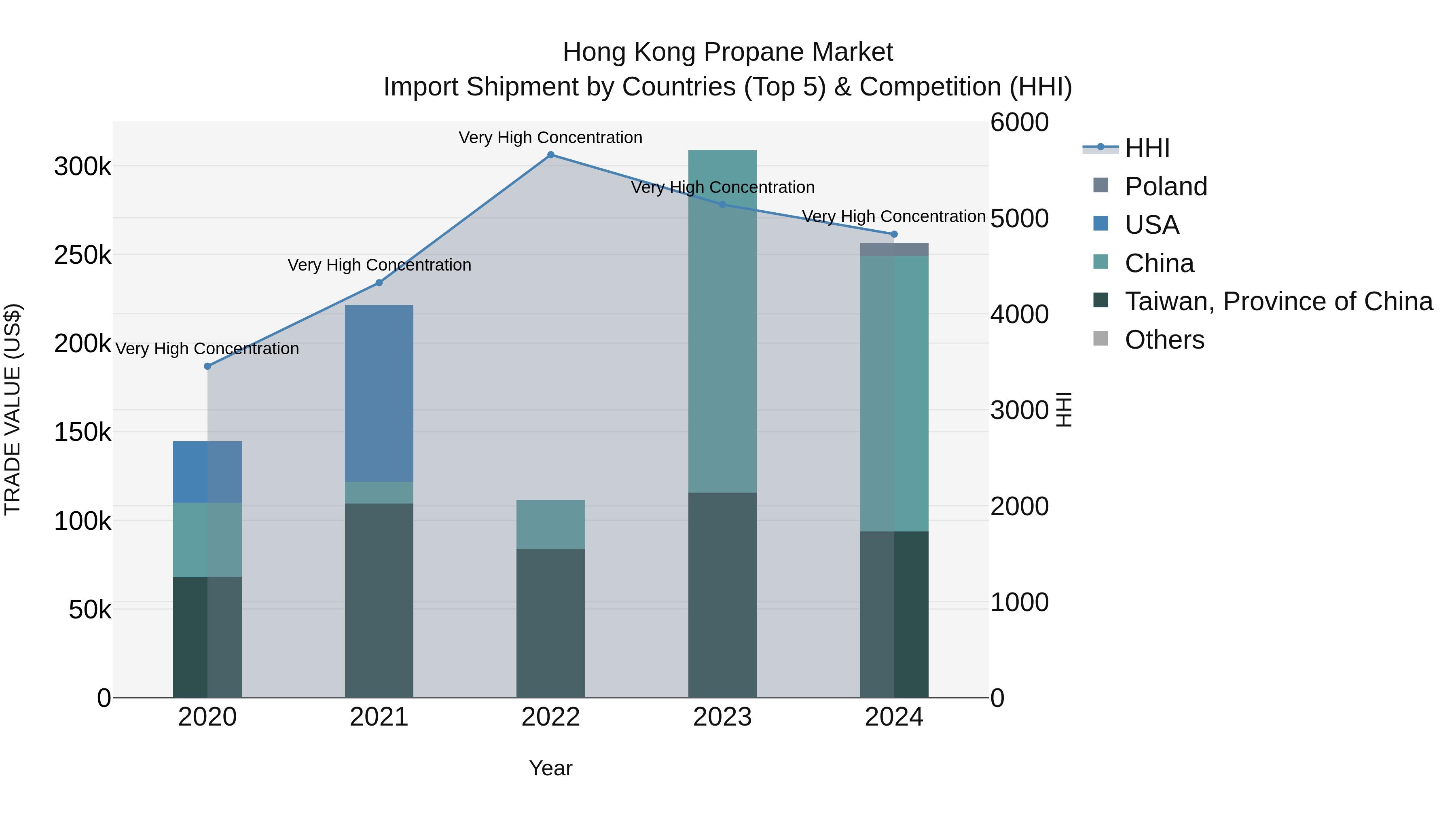
In 2024, Hong Kong continued to receive significant propane import shipments primarily from China, Taiwan, Poland, and the USA, with a high Herfindahl-Hirschman Index indicating market concentration. Despite a strong compound annual growth rate of 15.37% from 2020 to 2024, there was a notable decline in growth from 2023 to 2024 at -16.99%. This data suggests a shifting landscape in propane imports to Hong Kong, which may be influenced by various factors such as market dynamics, trade policies, and global economic conditions.
Hong Kong Propane Market Synopsis
The Hong Kong Propane Market is expanding as propane is widely used for heating, cooking, and industrial applications. The market`s growth is linked to the increasing demand for clean and efficient energy sources in residential, commercial, and industrial sectors.
Drivers of the market
The propane market in Hong Kong is driven by demand from the residential, commercial, and industrial sectors for heating, cooking, and energy generation. Propane`s versatility, efficiency, and lower environmental impact compared to other fossil fuels contribute to its growing adoption.
Challenges of the market
The propane market in Hong Kong faces challenges related to fluctuating global propane prices and supply chain disruptions. Companies must navigate regulatory requirements regarding safety and environmental impact, which can complicate market operations. Additionally, increasing competition from alternative energy sources, such as electricity and natural gas, pressures market participants to differentiate their offerings. Ensuring consistent supply and quality while adapting to evolving customer demands is crucial for maintaining competitiveness in this market.
Government Policy of the market
Hong Kong propane market is regulated by government policies that focus on energy security, safety, and environmental protection. The government enforces strict safety standards for the storage, distribution, and use of propane, promoting the use of propane as a clean energy source in industries such as residential heating and transportation.
Key Highlights of the Report:
- Hong Kong Propane Market Outlook
- Market Size of Hong Kong Propane Market, 2024
- Forecast of Hong Kong Propane Market, 2031
- Historical Data and Forecast of Hong Kong Propane Revenues & Volume for the Period 2021-2031
- Hong Kong Propane Market Trend Evolution
- Hong Kong Propane Market Drivers and Challenges
- Hong Kong Propane Price Trends
- Hong Kong Propane Porter`s Five Forces
- Hong Kong Propane Industry Life Cycle
- Historical Data and Forecast of Hong Kong Propane Market Revenues & Volume By Applications for the Period 2021-2031
- Historical Data and Forecast of Hong Kong Propane Market Revenues & Volume By Industrial for the Period 2021-2031
- Historical Data and Forecast of Hong Kong Propane Market Revenues & Volume By Commercial for the Period 2021-2031
- Historical Data and Forecast of Hong Kong Propane Market Revenues & Volume By Residential for the Period 2021-2031
- Historical Data and Forecast of Hong Kong Propane Market Revenues & Volume By Transportation for the Period 2021-2031
- Historical Data and Forecast of Hong Kong Propane Market Revenues & Volume By Agriculture for the Period 2021-2031
- Historical Data and Forecast of Hong Kong Propane Market Revenues & Volume By Chemicals and Refineries for the Period 2021-2031
- Hong Kong Propane Import Export Trade Statistics
- Market Opportunity Assessment By Applications
- Hong Kong Propane Top Companies Market Share
- Hong Kong Propane Competitive Benchmarking By Technical and Operational Parameters
- Hong Kong Propane Company Profiles
- Hong Kong Propane Key Strategic Recommendations






































