Hong Kong Table Olives Market Top 5 Importing Countries and Market Competition (HHI) Analysis
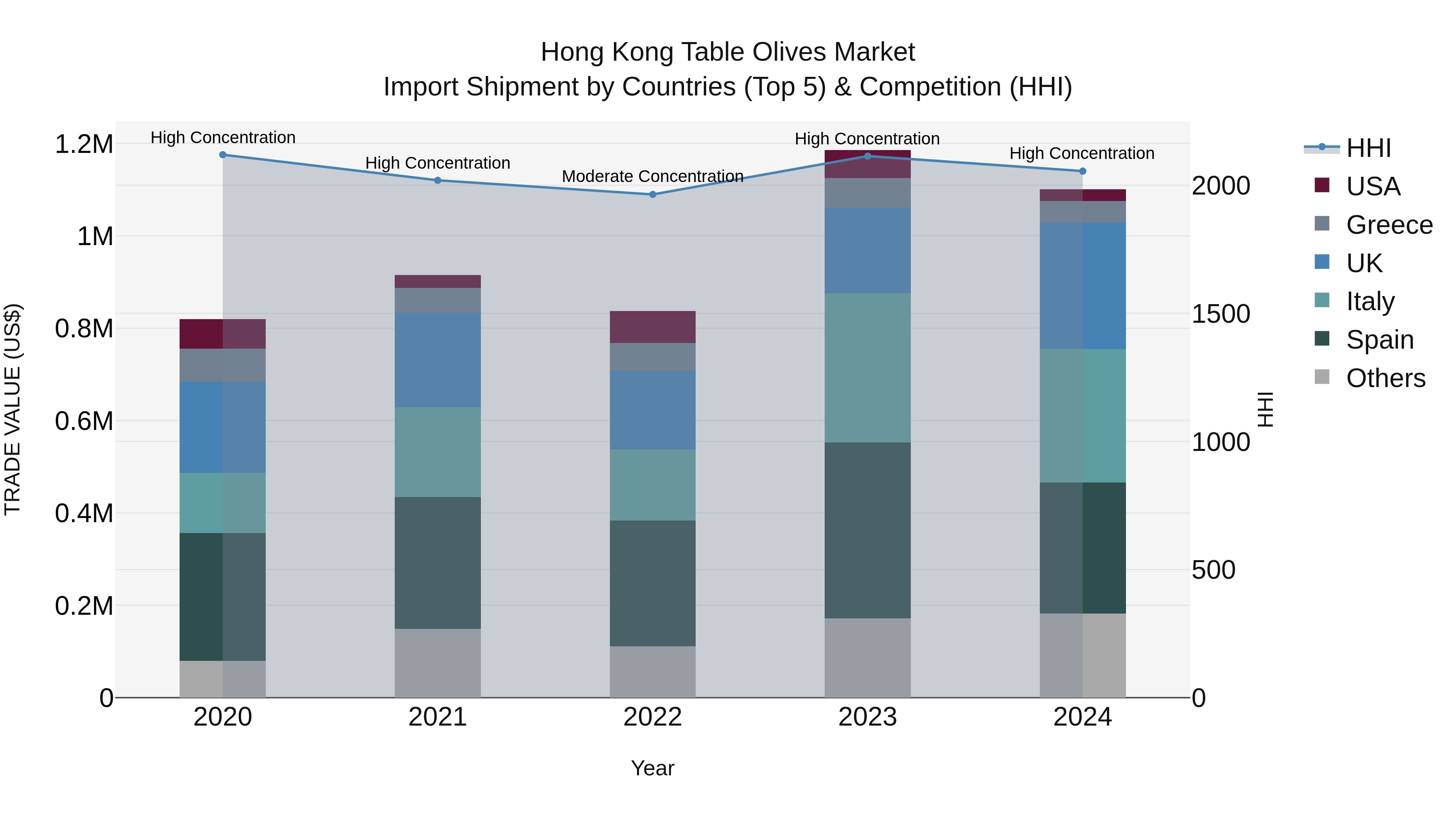
In 2024, Hong Kong continued to see a high concentration of table olive imports from top exporting countries such as Italy, Spain, UK, Singapore, and Australia. Despite a slight decline in growth rate from 2023 to 2024, the industry maintained a strong compound annual growth rate (CAGR) of 7.67% from 2020 to 2024. This data suggests that the market for table olives in Hong Kong remains robust, with key players consistently supplying quality products to meet consumer demand.
Hong Kong Table Olives Market Synopsis
The Hong Kong Table Olives Market is witnessing steady growth driven by the increasing consumer awareness of the health benefits associated with olives. The market is primarily dominated by imported olives, with Spain, Italy, and Greece being the key supplying countries. Hong Kong`s rapidly growing food and beverage industry, coupled with the rising demand for Mediterranean cuisine, is further fueling the demand for table olives in the region. The market offers a wide variety of olive products, including green and black olives, stuffed olives, and olive spreads, catering to the diverse preferences of consumers. Additionally, the growing trend of healthy snacking and the rising popularity of Mediterranean diets are expected to continue driving the growth of the table olives market in Hong Kong.
Hong Kong Table Olives Market Trends
The Hong Kong Table Olives Market is experiencing a growing demand for diverse and high-quality olive products due to an increasing interest in Mediterranean cuisine and healthy eating habits. There is a trend towards premium and organic table olives, as consumers are becoming more health-conscious and willing to pay a premium for superior quality. Opportunities lie in offering a wide variety of flavored and marinated olives to cater to the evolving taste preferences of consumers. Additionally, there is potential for market expansion through online retail channels and collaborations with local restaurants and gourmet food stores to increase product visibility and accessibility. Overall, the Hong Kong Table Olives Market presents opportunities for producers to capitalize on the growing demand for premium and healthy food options in the region.
Hong Kong Table Olives Market Challenges
In the Hong Kong Table Olives Market, some challenges include limited local production leading to heavy reliance on imported products, fluctuating exchange rates affecting pricing and profitability, and increasing consumer preferences for healthier and more diverse snack options impacting traditional olive consumption patterns. Additionally, stringent regulations on food imports and labeling requirements can create barriers to entry for new players. Competition from other snack products and the need for effective marketing strategies to educate consumers about the health benefits and culinary versatility of table olives also pose challenges for market growth. Overall, navigating these obstacles requires industry players to innovate, adapt to changing consumer preferences, and establish strong distribution channels to remain competitive in the Hong Kong market.
Hong Kong Table Olives Market Investment Opportunities
The Hong Kong Table Olives Market is primarily driven by the increasing consumer awareness of the health benefits associated with olives, such as their high antioxidant content and heart-healthy monounsaturated fats. The growing trend of healthy eating and the rising demand for Mediterranean cuisine in Hong Kong have also contributed to the market growth. Additionally, the expanding retail sector and the availability of a wide variety of flavored olives have attracted consumers looking for convenient and flavorful snack options. Moreover, the influence of global food trends and the increasing popularity of international cuisines among Hong Kong consumers have further boosted the demand for table olives in the market.
Hong Kong Table Olives Market Government Polices
The Hong Kong government does not impose specific policies directly targeted at the table olives market. However, the industry is subject to general regulations and standards related to food safety, labeling, and import/export requirements. The Food and Environmental Hygiene Department oversees the safety and quality of food products in Hong Kong, including olives, ensuring compliance with international standards. Importers and exporters of table olives must adhere to customs regulations and tariffs set by the Customs and Excise Department. Additionally, the Agriculture, Fisheries and Conservation Department may provide support and guidance to local farmers or producers in enhancing the quality and competitiveness of their table olives. Overall, the government`s policies indirectly impact the table olives market by ensuring consumer protection and maintaining industry standards.
Hong Kong Table Olives Market Future Outlook
The future outlook for the Hong Kong Table Olives Market appears promising, with a projected steady growth trajectory driven by increasing consumer awareness about the health benefits of olives, changing dietary preferences towards more Mediterranean-style cuisine, and a growing appreciation for gourmet food products. Additionally, the rising demand for organic and premium table olives is expected to further fuel market growth. The market is likely to witness an influx of innovative product offerings, such as flavored and ready-to-eat olives, as manufacturers strive to cater to evolving consumer preferences. However, challenges such as fluctuating raw material costs and intense competition from other snack options could impact market dynamics. Overall, the Hong Kong Table Olives Market is anticipated to experience moderate to strong growth in the coming years.
Key Highlights of the Report:
- Hong Kong Table Olives Market Outlook
- Market Size of Hong Kong Table Olives Market, 2024
- Forecast of Hong Kong Table Olives Market, 2031
- Historical Data and Forecast of Hong Kong Table Olives Revenues & Volume for the Period 2021- 2031
- Hong Kong Table Olives Market Trend Evolution
- Hong Kong Table Olives Market Drivers and Challenges
- Hong Kong Table Olives Price Trends
- Hong Kong Table Olives Porter's Five Forces
- Hong Kong Table Olives Industry Life Cycle
- Historical Data and Forecast of Hong Kong Table Olives Market Revenues & Volume By Type for the Period 2021- 2031
- Historical Data and Forecast of Hong Kong Table Olives Market Revenues & Volume By Black Olive for the Period 2021- 2031
- Historical Data and Forecast of Hong Kong Table Olives Market Revenues & Volume By Green Olive for the Period 2021- 2031
- Historical Data and Forecast of Hong Kong Table Olives Market Revenues & Volume By Application for the Period 2021- 2031
- Historical Data and Forecast of Hong Kong Table Olives Market Revenues & Volume By Online Store for the Period 2021- 2031
- Historical Data and Forecast of Hong Kong Table Olives Market Revenues & Volume By Supermarket for the Period 2021- 2031
- Historical Data and Forecast of Hong Kong Table Olives Market Revenues & Volume By Convenience Store for the Period 2021- 2031
- Historical Data and Forecast of Hong Kong Table Olives Market Revenues & Volume By Other for the Period 2021- 2031
- Hong Kong Table Olives Import Export Trade Statistics
- Market Opportunity Assessment By Type
- Market Opportunity Assessment By Application
- Hong Kong Table Olives Top Companies Market Share
- Hong Kong Table Olives Competitive Benchmarking By Technical and Operational Parameters
- Hong Kong Table Olives Company Profiles
- Hong Kong Table Olives Key Strategic Recommendations






































