Hungary Secondary Battery Market: Import Trend Analysis
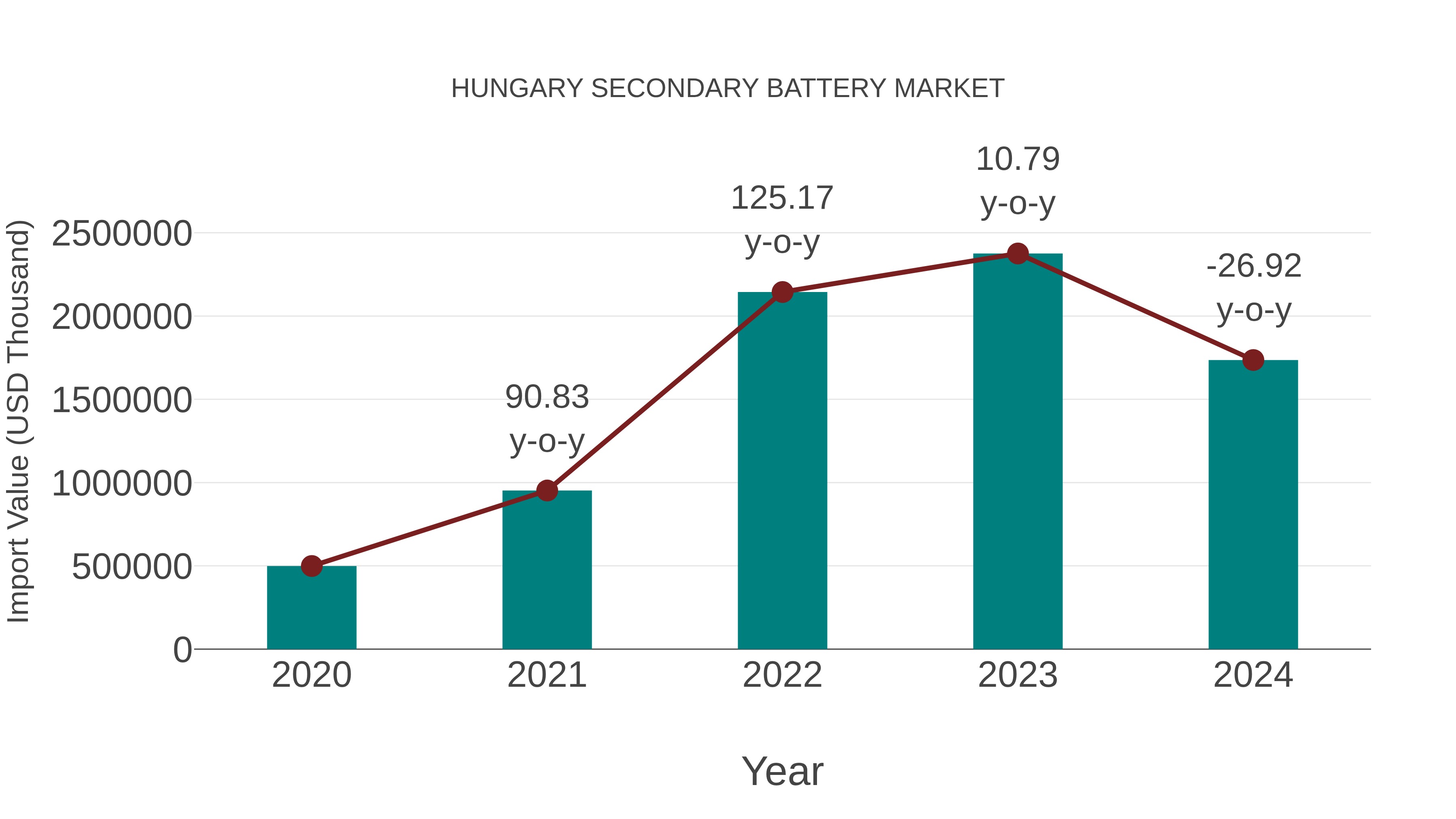
In the Hungary secondary battery market, the import trend experienced a notable decline from 2023 to 2024, with a growth rate of -26.92%. However, the compound annual growth rate (CAGR) for 2020-2024 stood at 36.57%. This shift could be attributed to changes in demand patterns or market dynamics, impacting import momentum and market stability during the period.
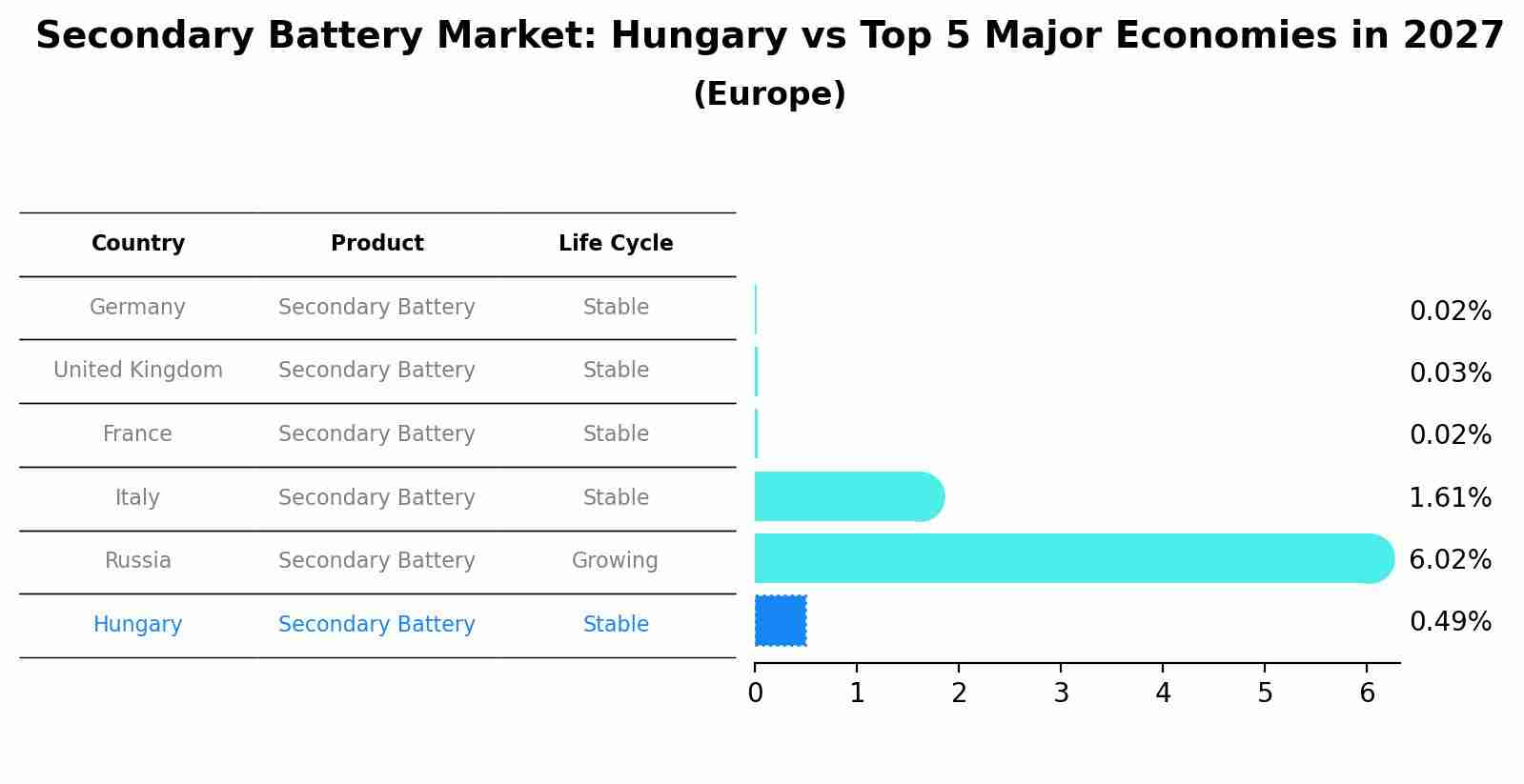
Secondary Battery Market: Hungary vs Top 5 Major Economies in 2027 (Europe)
By 2027, the Secondary Battery market in Hungary is anticipated to reach a growth rate of 0.49%, as part of an increasingly competitive Europe region, where Germany remains at the forefront, supported by United Kingdom, France, Italy and Russia, driving innovations and market adoption across sectors.
Hungary Secondary Battery Market Overview
The Hungary secondary battery market is experiencing steady growth driven by increasing adoption of electric vehicles, renewable energy storage systems, and portable electronic devices. The demand for lithium-ion batteries is particularly high due to their superior energy density and longer lifespan compared to traditional lead-acid batteries. Government incentives promoting the use of electric vehicles and renewable energy sources are further fueling market growth. Key players in the Hungary secondary battery market include Samsung SDI Co., Ltd., LG Chem Ltd., and Panasonic Corporation. The market is also witnessing advancements in battery technology to improve efficiency and sustainability. Overall, the Hungary secondary battery market is poised for continued expansion in the coming years as the country transitions towards a more sustainable and environmentally friendly energy landscape.
Hungary Secondary Battery Market Trends
The Hungary Secondary Battery Market is experiencing significant growth driven by the increasing adoption of electric vehicles, consumer electronics, and energy storage systems. Lithium-ion batteries dominate the market due to their high energy density and long lifespan, with a focus on developing more efficient and sustainable battery technologies. The demand for secondary batteries is also being fueled by government initiatives promoting renewable energy sources and electric mobility. Key players in the market are investing in research and development to enhance the performance and safety of secondary batteries, while also exploring opportunities for recycling and repurposing used batteries to minimize environmental impact. Overall, the Hungary Secondary Battery Market is poised for continued expansion as industries and consumers increasingly prioritize sustainability and energy efficiency.
Hungary Secondary Battery Market Challenges
In the Hungary Secondary Battery Market, there are several challenges that companies face. One major challenge is the increasing competition from global players, which puts pressure on local companies to innovate and differentiate their products. Additionally, fluctuating raw material prices and supply chain disruptions can impact the production costs and overall profitability of secondary battery manufacturers. Regulatory uncertainties and evolving environmental policies also pose challenges in terms of compliance and adapting to new regulations. Furthermore, the demand for more efficient and sustainable battery technologies requires continuous research and development investments, which can strain the financial resources of companies operating in the secondary battery market in Hungary. Overall, navigating these challenges while meeting the evolving market demands remains a key concern for players in the Hungary Secondary Battery Market.
Hungary Secondary Battery Market Investment Opportunities
The Hungary secondary battery market presents promising investment opportunities driven by the increasing adoption of electric vehicles and renewable energy storage solutions. Lithium-ion batteries are the dominant technology in this market, with a growing demand for high-performance and longer-lasting batteries. Investors can consider opportunities in battery manufacturing, research and development of advanced battery technologies, and battery recycling facilities to capitalize on the market growth. Additionally, partnerships with automotive companies and energy storage providers can provide avenues for expansion and diversification within the Hungarian secondary battery market. Overall, investing in the Hungary secondary battery market offers potential for long-term growth and profitability as the country continues to transition towards a more sustainable energy landscape.
Hungary Secondary Battery Market Government Policy
In Hungary, government policies related to the secondary battery market primarily focus on promoting the adoption of sustainable energy solutions and reducing greenhouse gas emissions. The government has implemented various incentives and subsidies to encourage the use of secondary batteries in energy storage systems for renewable energy sources such as solar and wind power. Additionally, there are regulations in place to ensure the safe disposal and recycling of used batteries to minimize environmental impact. The Hungarian government aims to support the development of a robust secondary battery market to enhance energy efficiency, reduce reliance on fossil fuels, and contribute to the country`s overall environmental goals.
Hungary Secondary Battery Market Future Outlook
The Hungary Secondary Battery Market is poised for steady growth in the coming years, driven by increasing demand for electric vehicles, renewable energy storage solutions, and portable electronic devices. The government`s focus on promoting sustainable energy sources and reducing carbon emissions is expected to further boost the adoption of secondary batteries in the country. Technological advancements leading to improved battery efficiency and performance are likely to attract investments in research and development within the industry. With the growing awareness of environmental sustainability and the shift towards clean energy solutions, the Hungary Secondary Battery Market is projected to expand significantly, presenting opportunities for key players to innovate and capture a larger market share.
Key Highlights of the Report:
- Hungary Secondary Battery Market Outlook
- Market Size of Hungary Secondary Battery Market, 2021
- Forecast of Hungary Secondary Battery Market, 2031
- Historical Data and Forecast of Hungary Secondary Battery Revenues & Volume for the Period 2018 - 2031
- Hungary Secondary Battery Market Trend Evolution
- Hungary Secondary Battery Market Drivers and Challenges
- Hungary Secondary Battery Price Trends
- Hungary Secondary Battery Porter's Five Forces
- Hungary Secondary Battery Industry Life Cycle
- Historical Data and Forecast of Hungary Secondary Battery Market Revenues & Volume By Technology for the Period 2018 - 2031
- Historical Data and Forecast of Hungary Secondary Battery Market Revenues & Volume By Lead-acid Battery for the Period 2018 - 2031
- Historical Data and Forecast of Hungary Secondary Battery Market Revenues & Volume By Lithium-ion Battery for the Period 2018 - 2031
- Historical Data and Forecast of Hungary Secondary Battery Market Revenues & Volume By Other Technologies (NiMh, NiCD, etc.) for the Period 2018 - 2031
- Historical Data and Forecast of Hungary Secondary Battery Market Revenues & Volume By Application for the Period 2018 - 2031
- Historical Data and Forecast of Hungary Secondary Battery Market Revenues & Volume By Automotive Batteries (HEV, PHEV, and EV) for the Period 2018 - 2031
- Historical Data and Forecast of Hungary Secondary Battery Market Revenues & Volume By Industrial Batteries (Motive, Stationary (Telecom, UPS, Energy Storage Systems (ESS), etc.) for the Period 2018 - 2031
- Historical Data and Forecast of Hungary Secondary Battery Market Revenues & Volume By Portable Batteries (Consumer Electronics, etc.) for the Period 2018 - 2031
- Historical Data and Forecast of Hungary Secondary Battery Market Revenues & Volume By Other Applications for the Period 2018 - 2031
- Hungary Secondary Battery Import Export Trade Statistics
- Market Opportunity Assessment By Technology
- Market Opportunity Assessment By Application
- Hungary Secondary Battery Top Companies Market Share
- Hungary Secondary Battery Competitive Benchmarking By Technical and Operational Parameters
- Hungary Secondary Battery Company Profiles
- Hungary Secondary Battery Key Strategic Recommendations






































