India Acute Care Telemedicine Market (2026-2032) | Growth, Segmentation, Size & Revenue, Companies, Share, Forecast, Analysis, Industry, Competitive Landscape, Trends, Outlook, Value
Market Forecast By Delivery Outlook (Clinician-to-patient, Clinician-to-clinician), By Application (Teleradiology, Telepsychiatry, TeleICU, Teleneurology, Telenephrology, Others), By End-use (Hospitals & Clinics, Others) And Competitive Landscape
| Product Code: ETC7535994 | Publication Date: Sep 2024 | Updated Date: Jul 2026 | Product Type: Market Research Report | |
| Publisher: 6Wresearch | Author: Sumit Sagar | No. of Pages: 70 | No. of Figures: 35 | No. of Tables: 5 |
India Acute Care Telemedicine Market Growth Rate
According to 6Wresearch internal database and industry insights, the India Acute Care Telemedicine Market is expected to grow at a compound annual growth rate (CAGR) of 17.6% during the forecast period (2026–2032).
India Acute Care Telemedicine Market Year-wise Growth Rate and Key Drivers (2022–2032)
This graph illustrates the annual growth rates of the India Acute Care Telemedicine Market from 2022 to 2032, highlighting a steady upward trajectory and projected market expansion over the forecast period.
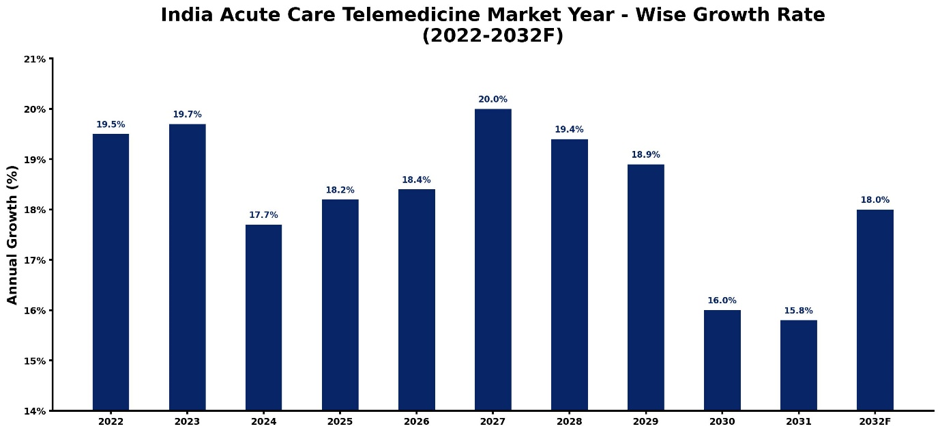
The following table summarizes the historical and forecasted growth rates of the India Acute Care Telemedicine Market, along with the rationale behind each year’s performance.
| Year | Estimated Growth (%) | Market Rationale |
| 2022 | 19.5% | Surge in telemedicine adoption, and emergency virtual care demand. |
| 2023 | 19.7% | Expansion of tele-ICU pilots, and integration of digital health platforms. |
| 2024 | 17.7% | Increased AI adoption in triage systems, and hospital digital transformation. |
| 2025 | 18.2% | Rise in penetration of telemedicine in tier-2 cities, and scaling of the acute virtual care services. |
| 2026 | 18.4% | Government-backed digital health initiatives, and 5G-enabled emergency care expansion. |
| 2027 | 20% | Strong investment inflow into tele-ICU infrastructure, and remote monitoring solutions. |
| 2028 | 19.4% | Wide interoperability of healthcare systems, and improvement in the hospital integration. |
| 2029 | 18.9% | Rising rural healthcare access, and expansion of the real-time emergency teleconsultation. |
| 2030 | 16% | Growth in IoT-enabled patient monitoring, and predictive acute care systems. |
| 2031 | 15.8% | Market will mature with consolidation of telemedicine providers, and platforms. |
| 2032 | 18% | Peak adoption phase with full integration of acute telemedicine into healthcare delivery systems. |
Topics Covered in the India Acute Care Telemedicine Market Report
The India Acute Care Telemedicine Market report covers the market by delivery outlook, application, and end-use. The report provides an in-depth analysis of ongoing market trends, opportunities, and growth drivers, enabling stakeholders to align strategies with current and future market dynamics.
India Acute Care Telemedicine Market Highlights
| Report Name | India Acute Care Telemedicine Market |
| Forecast period | 2026–2032 |
| CAGR | 17.6% |
| Growing Sector | Healthcare |
India Acute Care Telemedicine Market Synopsis
The India Acute Care Telemedicine Industry is anticipated to witness strong growth during the forecast period on account of rise in demand for instant medical intervention, and rapid digital transformation in the healthcare delivery systems. The growth in smartphone usage, and the expansion of digital health ecosystems are significantly improving the access to acute care services across regions. The integration of AI-based clinical decision support systems, and remote patient monitoring devices is enhancing the real-time diagnosis. Additionally, increase in adoption of tele-ICU services, and virtual emergency consultations are improving the patient outcomes.
Evaluation of Growth Drivers in India Acute Care Telemedicine Market (2026–2032)
Below are some major drivers and their influence on the market dynamics:
| Drivers | Primary Segment Affected | Why It Matters (Evidence) |
| Demand for Emergency Healthcare Services | Hospitals & Emergency Care Units | Emergency healthcare services enables the faster access to critical care specialists, improving the survival rates in emergencies. |
| Digital Health Ecosystem | Healthcare Providers & Patients | Digital ecosystem expands the access to virtual consultations, and reduces the dependency on physical hospitals. |
| AI & Remote Patient Monitoring | ICU & Critical Care Management | AI monitoring supports the real-time monitoring, and fast clinical decision-making. |
| Government Digital Health Initiatives | Public Healthcare System | Programs like digital health infrastructure boost the telemedicine penetration nationwide. |
| Expansion of Healthcare Access in Tier-2 Cities | Regional Healthcare Delivery | Telemedicine improves the availability of acute care services in underserved regions. |
The India Acute Care Telemedicine Market is projected to grow steadily at a CAGR of 17.6% during 2026–2032 on account of rapid healthcare digitization, demand for emergency care accessibility, and adoption of telemedicine platforms. The integration of advanced technologies such as AI-enabled medical devices, and cloud-based healthcare systems are expected to significantly improve the efficiency, and patient outcomes. The expansion of healthcare infrastructure in tier-2 cities, along with the government-led digital health initiatives, is further accelerating the adoption of acute care telemedicine solutions across India.
Evaluation of Restraints in India Acute Care Telemedicine Market
Below is the tabular representation of some major restraints and their influence on market dynamics:
| Restraints | Primary Segment Affected | What This Means (Evidence) |
| Limited Healthcare Infrastructure in Rural Areas | Rural Healthcare Systems | Poor connectivity, and facility gaps restrict the telemedicine adoption. |
| Data Privacy and Security Concerns | Digital Health Platforms | Sensitive patient data increases the need for the strong cybersecurity frameworks. |
| Regulatory Barriers | Telemedicine Providers | Complex healthcare regulations may slow down the service deployment. |
| Low Awareness Among Patients | Rural & Semi-Urban Population | Limited understanding of telemedicine reduces the adoption rates. |
| High Dependence on Technology Infrastructure | Healthcare Providers | System downtime or failures can impact the critical care delivery. |
India Acute Care Telemedicine Market Challenges
Despite strong growth prospects, India Acute Care Telemedicine Market is facing challenges such as uneven digital infrastructure, regulatory complexities, data privacy concerns, limited awareness among rural populations, and shortage of skilled healthcare professionals. However, increasing the investments in digital health infrastructure, and expansion of 5G connectivity are expected to significantly support the market growth. The continuous advancements in AI-enabled diagnostics, and tele-ICU systems will play a crucial role in strengthening India’s acute care telemedicine ecosystem.
India Acute Care Telemedicine Market Trends
Listed below are the major trends responsible for India Acute Care Telemedicine Market Growth:
- AI-Driven Emergency Triage Systems: AI tools are used to quickly assess the patient severity in acute cases, enabling fast prioritization, and reducing the delays in emergency care decision-making.
- Growth of Tele-ICU and Remote Critical Care: Hospitals are adopting tele-ICU setups where specialists remotely monitor the ICU patients in real time, improving the outcomes in critical, and time-sensitive conditions.
- 5G-Enabled Telemedicine Services: 5G connectivity is enhancing the video consultation quality, and enabling low-latency communication, which is crucial for the real-time acute care, and emergency response.
Investment Opportunities in the India Acute Care Telemedicine Market
Given below are the investment opportunities available in India Acute Care Telemedicine Market:
- Tele-ICU Infrastructure Development: Investment made in tele-ICU networks, remote monitoring centers, and ICU connectivity solutions offers strong potential as hospitals expand critical care access beyond the metro cities.
- AI-Based Clinical Decision Support Tools: Investment opportunities are available in developing the AI platforms for emergency diagnosis, and predictive analytics to improve the speed, and accuracy of acute care decisions.
- Remote Patient Monitoring Solutions: Investment made in wearable devices, IoT-enabled health trackers, and cloud platforms can support the continuous monitoring of high-risk patients, and early emergency detection.
Top Players in India Acute Care Telemedicine Market
Stated below are some of the leading companies holding majority of India Acute Care Telemedicine Market Share:
1. Apollo TeleHealth
| Company Name | Apollo TeleHealth |
|---|---|
| Established Year | 1999 |
| Headquarters | Hyderabad, Telangana, India |
| Official Website | Click Here |
Apollo TeleHealth is a market leader in India’s acute care, and telemedicine ecosystem, offering tele-ICU, tele-emergency, and remote critical care services. It plays a pivotal role in hospital-integrated acute care delivery, and rural healthcare expansion.
2. Practo Technologies
| Company Name | Practo Technologies |
|---|---|
| Established Year | 2008 |
| Headquarters | Bengaluru, Karnataka, India |
| Official Website | Click Here |
Practo is a major digital-first healthcare platform enabling online consultations, including urgent care support. It contributes significantly to primary acute consultation access, and digital triage services.
3. Tata 1mg
| Company Name | Tata 1mg |
|---|---|
| Established Year | 2015 |
| Headquarters | Gurugram, Haryana, India |
| Official Website | Click Here |
Tata 1mg is a leading integrated digital healthcare platform offering e-consultations, diagnostics, and pharmacy services. It supports the initial acute symptom consultation, and early-stage care navigation, especially in the urban markets.
4. MediBuddy
| Company Name | MediBuddy |
|---|---|
| Established Year | 2015 |
| Headquarters | Bengaluru, Karnataka, India |
| Official Website | Click Here |
MediBuddy is a fast-growing digital healthcare aggregator providing teleconsultations, and digital health services. It supports on-demand doctor access for non-critical acute conditions, and primary care escalation pathways.
5. Cloudphysician Healthcare
| Company Name | Cloudphysician Healthcare |
|---|---|
| Established Year | 2017 |
| Headquarters | Bengaluru, Karnataka, India |
| Official Website | Click Here |
Cloudphysician is a specialized tele-ICU, and critical care technology company. It is highly relevant to acute care telemedicine through its remote ICU monitoring platform, enabling real-time intensive care support for hospitals.
Government Initiatives being implemented in the India Acute Care Telemedicine Market
According to Indian government data, the authorities have strengthened the acute care telemedicine through digital health, and infrastructure initiatives. The key policies include Ayushman Bharat Digital Mission, which creates a unified digital health ecosystem, Telemedicine Practice Guidelines 2020, which regulate safe virtual consultations, and eSanjeevani, a national telemedicine service enabling the doctor-to-patient, and doctor-to-doctor consultations. Additionally, the National Digital Health Blueprint supports the interoperable health data systems to improve the emergency care delivery efficiency.
Future Insights of the India Acute Care Telemedicine Market
The India Acute Care Telemedicine Market is expected to experience strong growth on account of rapid digital healthcare adoption, and increase in demand for the instant emergency care services. The integration of AI, IoT-enabled devices, and tele-ICU systems will significantly enhance the real-time diagnosis. The rise in healthcare investments, and government digital health initiatives will further expand the access in rural, and semi-urban regions, making the acute telemedicine a core component of the India’s future healthcare infrastructure.
Market Segmentation Analysis
The report offers a comprehensive study of the following market segments and their leading categories in India Acute Care Telemedicine Market:
By Delivery Outlook - Clinician-to-Patient will Dominate the Market
According to Sachin, Senior Research Analyst, 6Wresearch, clinician-to-patient segment dominated the market till 2025, accounting for approximately 65% market share, driven by rising demand for direct emergency consultations, adoption of virtual OPD models, and digital health access across urban, and semi-urban regions. This segment is expected to maintain its dominance during 2026–2032, growing at a CAGR of around 18.2%, supported by increasing penetration of smartphone-based healthcare apps, government telemedicine initiatives, and the growing preference for instant medical support in acute conditions.
By Application - TeleICU will lead the Market
The TeleICU segment dominated the India Acute Care Telemedicine Market till 2025, capturing nearly 31% market share, owing to rising demand for remote critical care monitoring, and increasing adoption of hospital-based tele-ICU systems. During 2026–2032, TeleICU is projected to remain the leading application segment, expanding at a CAGR of around 21.1%, driven by hospital digitization, integration of AI-enabled patient monitoring systems, and growing need for continuous real-time critical care support in tier-2 cities.
By End-Use - Hospitals & Clinics will Dominate the Market
The hospitals & clinics segment dominated the market till 2025, holding approximately 76% market share, due to strong infrastructure readiness, high patient inflow for emergency care, and adoption of telemedicine platforms within established healthcare systems. This segment is expected to continue dominating the market during 2026–2032, growing at a CAGR of about 19.4%, supported by hospital network expansion, increased investment in digital health infrastructure, and integration of telemedicine into routine acute care workflows.
Note: Market size estimations and growth projections presented in this report are based on 6Wresearch’s advanced forecasting approach, validated with industry datasets as of June 2026.
Key Attractiveness of the Report:
- 10 Years of Market Numbers
- Historical Data Starting from 2022 to 2025
- Base Year: 2025
- Forecast Data until 2032
- Key Performance Indicators Impacting the Market
- Major Upcoming Developments and Projects
Key Highlights of the Report:
- India Acute Care Telemedicine Market Outlook
- Market Size of India Acute Care Telemedicine Market, 2025
- Forecast of India Acute Care Telemedicine Market, 2032
- Historical Data and Forecast of India Acute Care Telemedicine Revenues & Volume for the Period 2022- 2032
- India Acute Care Telemedicine Market Trend Evolution
- India Acute Care Telemedicine Market Drivers and Challenges
- India Acute Care Telemedicine Price Trends
- India Acute Care Telemedicine Porter's Five Forces
- India Acute Care Telemedicine Industry Life Cycle
- Historical Data and Forecast of India Acute Care Telemedicine Market Revenues & Volume By Delivery Outlook for the Period 2022- 2032
- Historical Data and Forecast of India Acute Care Telemedicine Market Revenues & Volume By Clinician-to-patient for the Period 2022- 2032
- Historical Data and Forecast of India Acute Care Telemedicine Market Revenues & Volume By Clinician-to-clinician for the Period 2022- 2032
- Historical Data and Forecast of India Acute Care Telemedicine Market Revenues & Volume By Application for the Period 2022- 2032
- Historical Data and Forecast of India Acute Care Telemedicine Market Revenues & Volume By Teleradiology for the Period 2022- 2032
- Historical Data and Forecast of India Acute Care Telemedicine Market Revenues & Volume By Telepsychiatry for the Period 2022- 2032
- Historical Data and Forecast of India Acute Care Telemedicine Market Revenues & Volume By TeleICU for the Period 2022- 2032
- Historical Data and Forecast of India Acute Care Telemedicine Market Revenues & Volume By Teleneurology for the Period 2022- 2032
- Historical Data and Forecast of India Acute Care Telemedicine Market Revenues & Volume By Telenephrology for the Period 2022- 2032
- Historical Data and Forecast of India Acute Care Telemedicine Market Revenues & Volume By Others for the Period 2022- 2032
- Historical Data and Forecast of India Acute Care Telemedicine Market Revenues & Volume By End-use for the Period 2022- 2032
- Historical Data and Forecast of India Acute Care Telemedicine Market Revenues & Volume By Hospitals & Clinics for the Period 2022- 2032
- Historical Data and Forecast of India Acute Care Telemedicine Market Revenues & Volume By Others for the Period 2022- 2032
- India Acute Care Telemedicine Import Export Trade Statistics
- Market Opportunity Assessment By Delivery Outlook
- Market Opportunity Assessment By Application
- Market Opportunity Assessment By End-use
- India Acute Care Telemedicine Top Companies Market Share
- India Acute Care Telemedicine Competitive Benchmarking By Technical and Operational Parameters
- India Acute Care Telemedicine Company Profiles
- India Acute Care Telemedicine Key Strategic Recommendations
Market Covered
The report offers an extensive study of the following market segments:
By Delivery Outlook
- Clinician-to-Patient
- Clinician-to-Clinician
By Application
- Teleradiology
- Telepsychiatry
- TeleICU
- Teleneurology
- Telenephrology
- Others
By End-Use
- Hospitals & Clinics
- Others
India Acute Care Telemedicine Market (2026-2032): FAQs
India Acute Care Telemedicine Market is anticipated to grow at the compound annual growth rate (CAGR) of 17.6% during the forecast period (2026-2032).
India Acute Care Telemedicine Market is facing challenges in the form of weak digital infrastructure, data security issues, low rural awareness, and a shortage of skilled healthcare professionals.
India Acute Care Telemedicine Market is set for strong growth on account of digital healthcare adoption, AI/IoT-enabled care, tele-ICU systems, and supportive government initiatives.
Some of the leading players dominating the India Acute Care Telemedicine Market are Apollo TeleHealth, Tata 1mg, MediBuddy, Practo Technologies, and Cloudphysician Healthcare.
6Wresearch actively monitors the India Acute Care Telemedicine Market and publishes its comprehensive annual report, highlighting emerging trends, growth drivers, revenue analysis, and forecast outlook. Our insights help businesses to make data-backed strategic decisions with ongoing market dynamics. Our analysts track relevent industries related to the India Acute Care Telemedicine Market, allowing our clients with actionable intelligence and reliable forecasts tailored to emerging regional needs.
Yes, we provide customisation as per your requirements. To learn more, feel free to contact us on sales@6wresearch.com
| 1 Executive Summary |
| 2 Introduction |
| 2.1 Key Highlights of the Report |
| 2.2 Report Description |
| 2.3 Market Scope & Segmentation |
| 2.4 Research Methodology |
| 2.5 Assumptions |
| 3 India Acute Care Telemedicine Market Overview |
| 3.1 India Country Macro Economic Indicators |
| 3.2 India Acute Care Telemedicine Market Revenues & Volume, 2022 & 2032F |
| 3.3 India Acute Care Telemedicine Market - Industry Life Cycle |
| 3.4 India Acute Care Telemedicine Market - Porter's Five Forces |
| 3.5 India Acute Care Telemedicine Market Revenues & Volume Share, By Delivery Outlook, 2022 & 2032F |
| 3.6 India Acute Care Telemedicine Market Revenues & Volume Share, By Application, 2022 & 2032F |
| 3.7 India Acute Care Telemedicine Market Revenues & Volume Share, By End-use, 2022 & 2032F |
| 4 India Acute Care Telemedicine Market Dynamics |
| 4.1 Impact Analysis |
| 4.2 Market Drivers |
| 4.2.1 Increasing adoption of telemedicine in India due to improved internet connectivity and smartphone penetration. |
| 4.2.2 Rising demand for remote healthcare services, especially in rural areas with limited access to healthcare facilities. |
| 4.2.3 Government initiatives and policies promoting telemedicine to enhance healthcare accessibility and affordability. |
| 4.3 Market Restraints |
| 4.3.1 Limited awareness and trust among the population regarding telemedicine services. |
| 4.3.2 Challenges related to data privacy and security concerns hindering the widespread adoption of telemedicine. |
| 4.3.3 Regulatory complexities and varying state-wise regulations impacting the uniform growth of telemedicine services in India. |
| 5 India Acute Care Telemedicine Market Trends |
| 6 India Acute Care Telemedicine Market, By Types |
| 6.1 India Acute Care Telemedicine Market, By Delivery Outlook |
| 6.1.1 Overview and Analysis |
| 6.1.2 India Acute Care Telemedicine Market Revenues & Volume, By Delivery Outlook, 2022-2032F |
| 6.1.3 India Acute Care Telemedicine Market Revenues & Volume, By Clinician-to-patient, 2022-2032F |
| 6.1.4 India Acute Care Telemedicine Market Revenues & Volume, By Clinician-to-clinician, 2022-2032F |
| 6.2 India Acute Care Telemedicine Market, By Application |
| 6.2.1 Overview and Analysis |
| 6.2.2 India Acute Care Telemedicine Market Revenues & Volume, By Teleradiology, 2022-2032F |
| 6.2.3 India Acute Care Telemedicine Market Revenues & Volume, By Telepsychiatry, 2022-2032F |
| 6.2.4 India Acute Care Telemedicine Market Revenues & Volume, By TeleICU, 2022-2032F |
| 6.2.5 India Acute Care Telemedicine Market Revenues & Volume, By Teleneurology, 2022-2032F |
| 6.2.6 India Acute Care Telemedicine Market Revenues & Volume, By Telenephrology, 2022-2032F |
| 6.2.7 India Acute Care Telemedicine Market Revenues & Volume, By Others, 2022-2032F |
| 6.3 India Acute Care Telemedicine Market, By End-use |
| 6.3.1 Overview and Analysis |
| 6.3.2 India Acute Care Telemedicine Market Revenues & Volume, By Hospitals & Clinics, 2022-2032F |
| 6.3.3 India Acute Care Telemedicine Market Revenues & Volume, By Others, 2022-2032F |
| 7 India Acute Care Telemedicine Market Import-Export Trade Statistics |
| 7.1 India Acute Care Telemedicine Market Export to Major Countries |
| 7.2 India Acute Care Telemedicine Market Imports from Major Countries |
| 8 India Acute Care Telemedicine Market Key Performance Indicators |
| 8.1 Average response time of healthcare providers in teleconsultations. |
| 8.2 Percentage increase in telemedicine consultations in rural or underserved areas. |
| 8.3 Patient satisfaction scores with telemedicine services. |
| 8.4 Rate of successful diagnosis and treatment outcomes through telemedicine. |
| 8.5 Number of partnerships between telemedicine providers and healthcare institutions. |
| 9 India Acute Care Telemedicine Market - Opportunity Assessment |
| 9.1 India Acute Care Telemedicine Market Opportunity Assessment, By Delivery Outlook, 2022 & 2032F |
| 9.2 India Acute Care Telemedicine Market Opportunity Assessment, By Application, 2022 & 2032F |
| 9.3 India Acute Care Telemedicine Market Opportunity Assessment, By End-use, 2022 & 2032F |
| 10 India Acute Care Telemedicine Market - Competitive Landscape |
| 10.1 India Acute Care Telemedicine Market Revenue Share, By Companies, 2025 |
| 10.2 India Acute Care Telemedicine Market Competitive Benchmarking, By Operating and Technical Parameters |
| 11 Company Profiles |
| 12 Recommendations |
| 13 Disclaimer |
Global Go To Market Strategy - 2030
Export potential enables firms to identify high-growth global markets with greater confidence by combining advanced trade intelligence with a structured quantitative methodology. The framework analyzes emerging demand trends and country-level import patterns while integrating macroeconomic and trade datasets such as GDP and population forecasts, bilateral import–export flows, tariff structures, elasticity differentials between developed and developing economies, geographic distance, and import demand projections. Using weighted trade values from 2020–2024 as the base period to project country-to-country export potential for 2030, these inputs are operationalized through calculated drivers such as gravity model parameters, tariff impact factors, and projected GDP per-capita growth. Through an analysis of hidden potentials, demand hotspots, and market conditions that are most favorable to success, this method enables firms to focus on target countries, maximize returns, and global expansion with data, backed by accuracy.
By factoring in the projected importer demand gap that is currently unmet and could be potential opportunity, it identifies the potential for the Exporter (Country) among 190 countries, against the general trade analysis, which identifies the biggest importer or exporter.
To discover high-growth global markets and optimize your business strategy:
Click Here
Pricing
- Single User License$ 1,995
- Department License$ 2,400
- Site License$ 3,120
- Global License$ 3,795

Leadership Perspectives from Industry Events
Search
Thought Leadership and Analyst Meet





Our Clients








6WResearch In News
- India Export Attractiveness Tracker 2026
- India Air Conditioner Market Set for Strong Rebound in 2026 After Weather-Led Correction and GST-Driven Recovery: 6Wresearch
- ADAS in India: How Automatic Emergency Braking, Blind Spot Detection & Driver Monitoring are Transforming Road Safety
- Doha a strategic location for EV manufacturing hub: IPA Qatar
- Demand for luxury TVs surging in the GCC, says Samsung
- Empowering Growth: The Thriving Journey of Bangladesh’s Cable Industry
Latest Reports
- Qatar Access and Home Network Market (2026-2032)
- Nicaragua RPG Gaming Market (2026-2032)
- New Zealand RPG Gaming Market (2026-2032)
- Netherlands RPG Gaming Market (2026-2032)
- Nauru RPG Gaming Market (2026-2032)
- Namibia RPG Gaming Market (2026-2032)
- Mozambique RPG Gaming Market (2026-2032)
- Montenegro RPG Gaming Market (2026-2032)
- Mongolia RPG Gaming Market (2026-2032)
- Monaco RPG Gaming Market (2026-2032)
Industry Events and Analyst Meet

EV India Expo 2026

HIMTEX 2026

India Refining Summit 2026

India EV Show 2026

EV tech India Expo 2026
Whitepaper
- Middle East & Africa Commercial Security Market Click here to view more.
- Middle East & Africa Fire Safety Systems & Equipment Market Click here to view more.
- GCC Drone Market Click here to view more.
- Middle East Lighting Fixture Market Click here to view more.
- GCC Physical & Perimeter Security Market Click here to view more.


