India Adaptive Lighting Control Market Size & Growth Rate
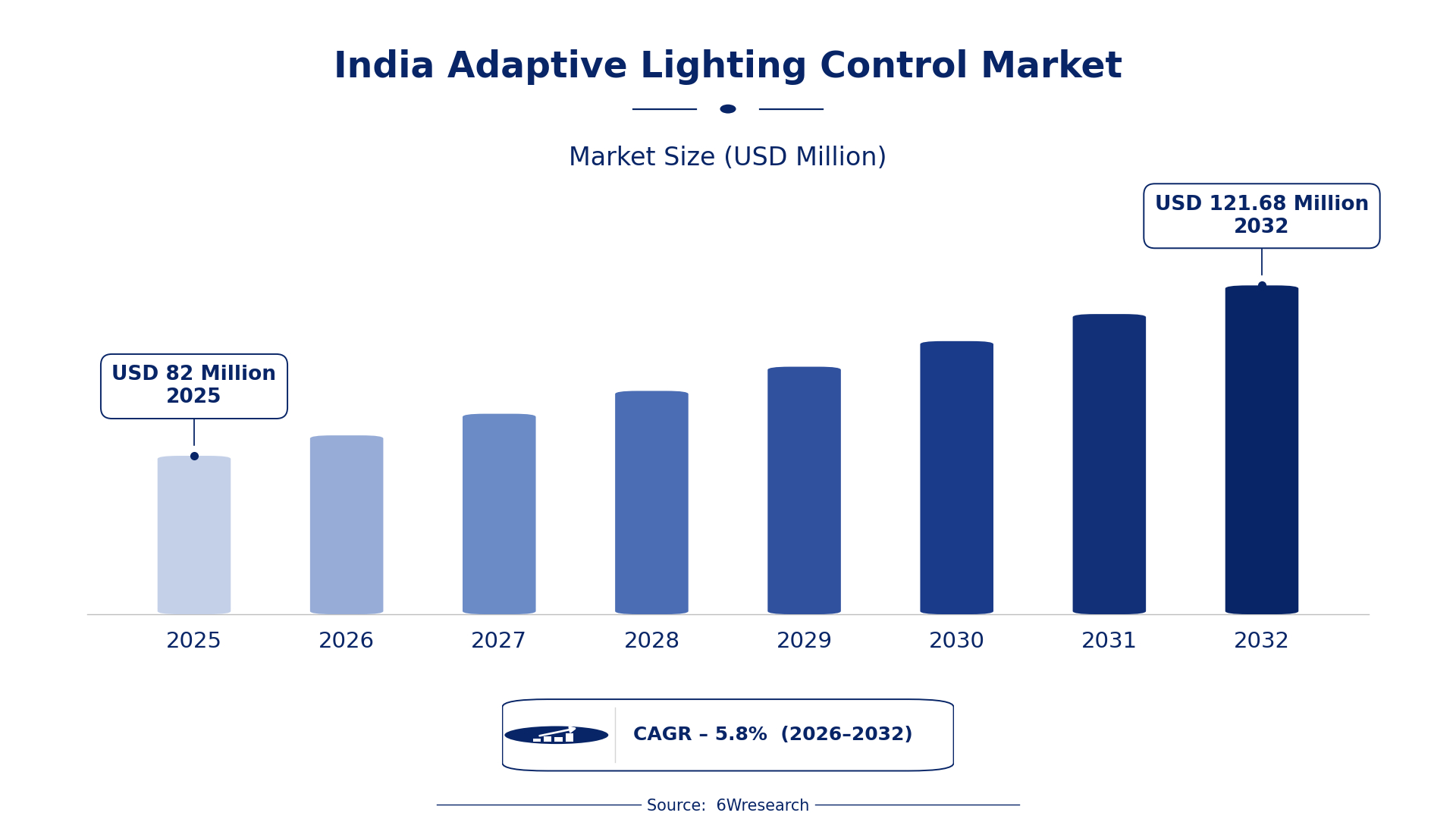
According to 6Wresearch internal database and industry insights, the India Adaptive Lighting Control Market was valued at USD 82.0 million in 2025 and is projected to reach USD 121.68 million by 2032, growing at a CAGR of approximately 5.8% during 2026–2032.
India Adaptive Lighting Control Market Highlights
| Report Metric | Details |
| Report Name | India Adaptive Lighting Control Market |
| Market Size 2025 | USD 82.0 million |
| Market Size 2032 | USD 121.68 million |
| Absolute Growth 2025–2032 | USD 39.68 million |
| CAGR 2026–2032 | 5.8% |
| Peak Annual Growth | 8.0% in 2032 |
| Forecast Period | 2026–2032 |
| Historical Data | 2022–2025 |
| Base Year | 2025 |
| Leading Control Type, 2025 | DALI Control Systems (51% share) |
| Leading Application Area, 2025 | Office Buildings (36% share) |
| Leading Distribution Channel, 2025 | Electrical Distributors (40% share) |
| Leading Lighting Technology, 2025 | LED (43% share) |
| Leading End User Segment, 2025 | Corporate Offices (36% share) |
| Fastest-Growing Control Type | Smart Wireless Control (8.1% CAGR) |
| Fastest-Growing Application Area | Smart Homes (8.2% CAGR) |
| Fastest-Growing Distribution Channel | Online Stores (7.0% CAGR) |
| Fastest-Growing Lighting Technology | Smart Bulbs (8.6% CAGR) |
| Fastest-Growing End User Segment | Commercial Spaces (8.3% CAGR) |
| Growing Sector | Commercial Spaces |
| Key End Users | Corporate Offices, Residential Buildings, Industrial Facilities, Retail Outlets |
India Adaptive Lighting Control Market Year-wise Growth Rate and Key Drivers (2022–2032)
This graph illustrates the annual growth rates of the market from 2022 to 2032, highlighting a steady upward trajectory and projected market expansion over the forecast period.
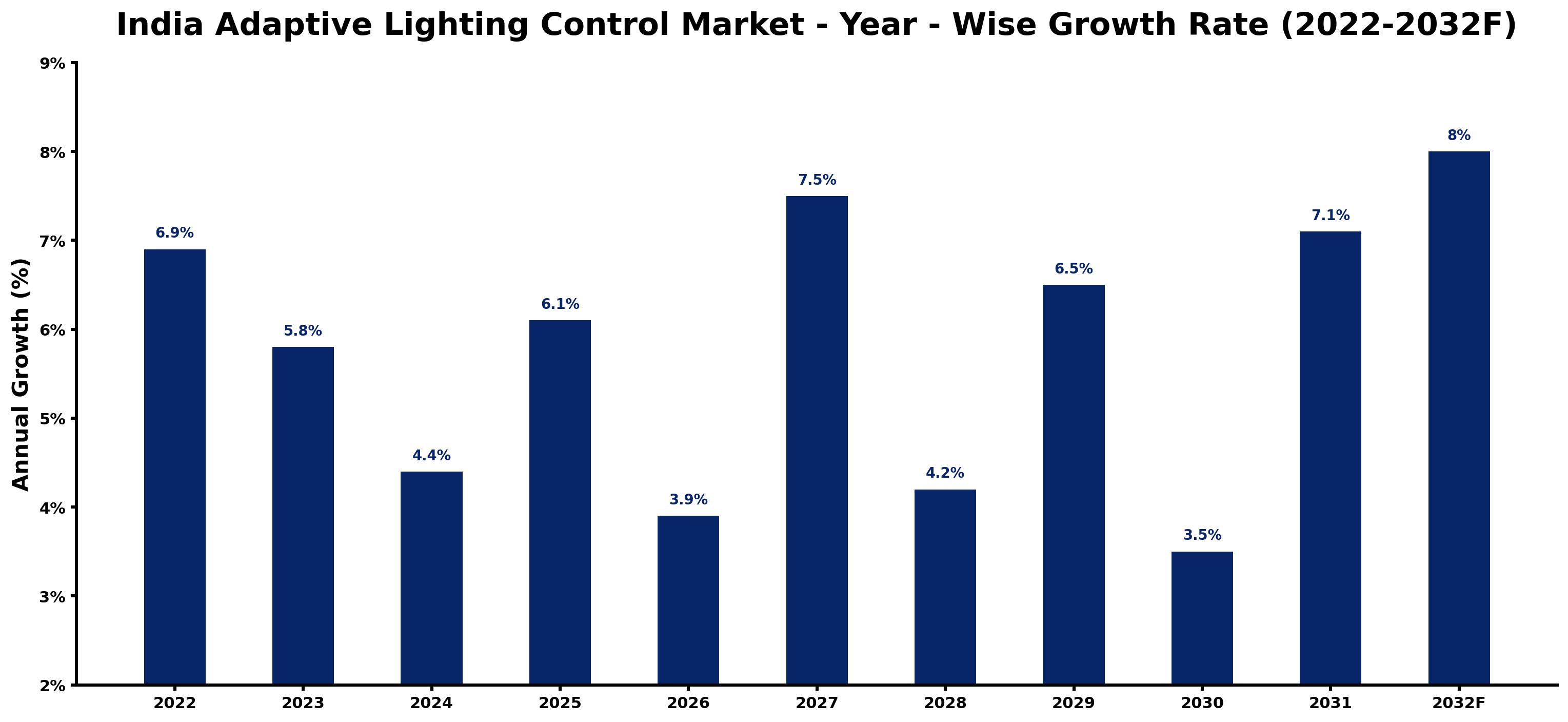
The following table presents the estimated annual growth rate for each year together with the principal factor influencing market performance.
| Year | Estimated Annual Growth (%) | Market Rationale |
| 2022 | 6.9 | The market experienced strong demand due to increased energy efficiency awareness among consumers. |
| 2023 | 5.8 | Growth slowed as the market adjusted to the previous year's high demand levels. |
| 2024 | 4.4 | A further slowdown occurred as consumers began to prioritise budget constraints over upgrades. |
| 2025 | 6.1 | Demand surged again as corporate offices sought energy-efficient solutions to reduce costs. |
| 2026 | 3.9 | Growth slowed again as market saturation began to impact new installations. |
| 2027 | 7.5 | An increase in demand emerged as more industrial facilities adopted adaptive lighting solutions. |
| 2028 | 4.2 | Growth slowed as the market faced challenges in supply chain disruptions. |
| 2029 | 6.5 | Demand increased again as the retail sector invested in adaptive lighting for enhanced customer experience. |
| 2030 | 3.5 | Growth slowed as the market stabilised with existing installations. |
| 2031 | 7.1 | A resurgence in demand occurred as corporate offices renewed focus on energy efficiency. |
| 2032 | 8.0 | The market peaked with significant investments in smart lighting technologies. |
Note: Market size estimations and growth projections presented in this report are based on 6Wresearch's proprietary forecasting methodology, utilizing the latest available industry data, government publications, and primary research inputs.
India Adaptive Lighting Control Market Synopsis
The Adaptive Lighting Control Market in India includes systems that adjust lighting based on occupancy and natural light. These systems provide energy savings and enhance user comfort in various settings. The market is expanding due to rising demand from commercial sectors, particularly corporate offices and retail outlets. Initiatives such as the Smart Cities Mission and the National Energy Efficiency Action Plan are stimulating investments in adaptive lighting solutions, with projections indicating the market will reach USD 121.68 million by 2032.
Market Dynamics Impact Analysis (2026–2032)
| Factor | Type | Impact | Primary Segment Affected |
| Growing focus on energy efficiency in commercial buildings | Driver | High | Office Buildings |
| Increased adoption of smart home technologies | Driver | High | Smart Homes |
| Rising demand for energy-efficient solutions in urban areas | Opportunity | High | Residential Buildings |
| Expansion of online sales channels for lighting products | Opportunity | Medium | Online Stores |
| High initial investment costs for adaptive systems | Restraint | High | Corporate Offices |
| Limited consumer awareness about adaptive lighting benefits | Restraint | Medium | Residential Buildings |
| Supply chain disruptions affecting product availability | Challenge | High | Commercial Spaces |
| Technological integration challenges with existing systems | Challenge | Medium | Industrial Facilities |
Evaluation of Drivers in India Adaptive Lighting Control Market (2026–2032)
Key forces behind demand, with the segment each one moves most, are listed below.
| Drivers | Primary Segment Affected | Why It Matters (Evidence) |
| Increased energy efficiency awareness | Corporate Offices | This awareness drives demand for adaptive lighting solutions to reduce operational costs, with energy-efficient systems projected to save up to 30% on energy bills. |
| Growth in smart home adoption | Smart Homes | As smart home devices become more popular, consumers are increasingly purchasing adaptive lighting solutions, contributing to a projected $9 billion market for smart home devices by 2025. |
| Government initiatives promoting energy efficiency | Residential Buildings | The National Energy Efficiency Action Plan aims to promote energy efficiency in lighting systems, encouraging households to adopt adaptive technologies. |
| Rising urbanisation leading to smart city developments | Office Buildings | The Smart Cities Mission is driving the implementation of adaptive lighting solutions in urban infrastructure, boosting demand in metropolitan areas. |
| Technological advancements in lighting control systems | Commercial Spaces | Innovations in lighting technology, particularly LED, are increasing the appeal of adaptive systems, with LEDs expected to reach 1.3 billion units by 2025. |
Increased awareness is driving demand for adaptive lighting solutions as corporate offices aim to lower operational costs. The Smart Cities Mission is facilitating the adoption of adaptive lighting solutions in urban infrastructure, especially in metropolitan areas. As smart home devices become more popular, consumers are increasingly opting for adaptive lighting solutions, contributing to a projected $9 billion market for smart home devices by 2025. Innovations in lighting technology, particularly LED, are making adaptive systems more attractive, with substantial energy savings anticipated.
Evaluation of Restraints in India Adaptive Lighting Control Market
Below mentioned are some major restraints and their influence on market dynamics.
| Market Restraint | Primary Segment Affected | Why It Matters (Evidence) |
| High initial investment costs for adaptive systems | Corporate Offices | The high upfront costs deter many businesses from adopting adaptive lighting solutions, impacting overall market growth. |
| Limited consumer awareness about adaptive lighting benefits | Residential Buildings | Many residential consumers remain unaware of the advantages of adaptive lighting, hindering market penetration. |
| Supply chain disruptions affecting product availability | Commercial Spaces | Recent supply chain issues have caused delays in product availability, impacting installation timelines for adaptive lighting systems. |
| Technological integration challenges with existing systems | Industrial Facilities | Difficulties in integrating new adaptive lighting technologies with existing infrastructure can slow adoption rates. |
| Regulatory compliance complexities | Office Buildings | Navigating regulatory requirements for energy-efficient lighting can be challenging, leading to delays in project approvals. |
India Adaptive Lighting Control Market Challenges
The India Adaptive Lighting Control Market encounters several practical problems, starting with high initial costs for buyers, which can account for over 20% of their total lighting budget. Many commercial users hesitate to invest in adaptive lighting systems due to this substantial upfront expenditure. Additionally, outdated infrastructure in existing buildings often lacks compatibility with modern technology, delaying upgrades for producers and increasing overall costs. Supply chain issues in obtaining quality sensors and control units can lead to project delays, impacting timelines for installers. Competition from low-cost alternatives also pressures suppliers to reduce prices, risking product quality and market stability.
Trends in the India Adaptive Lighting Control Market
Four trends stand out in the India Adaptive Lighting Control Market.
- Smart Cities Mission Driving Adaptive Lighting: The Smart Cities Mission is promoting adaptive lighting in urban infrastructure, focusing on energy efficiency. This initiative aims to implement smart lighting solutions across 100 cities, reducing energy consumption by 30%.
- Shift Towards Smart Home Integration: There is a growing trend of integrating adaptive lighting with smart home systems, improving user convenience and energy efficiency. The market for smart home devices in India is projected to reach $9 billion by 2025.
- Increased Adoption of Motion-Sensor Lighting: Motion-sensor lighting controls are gaining popularity, particularly in residential and commercial sectors, due to their energy-saving capabilities. The market for motion-sensor lighting controls is expected to grow significantly as energy awareness increases.
- Focus on Energy Conservation Building Code Compliance: The updated Energy Conservation Building Code mandates energy-efficient lighting technologies in new buildings, driving demand for adaptive lighting solutions. Compliance with these standards is essential for new developments.
Investment Opportunities in the India Adaptive Lighting Control Market
Investors looking at the India Adaptive Lighting Control Market should consider the following areas.
- Rising Demand for Energy-Efficient Solutions: With the Indian government aiming to reduce energy consumption in buildings by 30% by 2030, there is a strong opportunity for suppliers of adaptive lighting solutions to meet this demand.
- Expansion of Online Sales Channels: As online sales channels for lighting products grow, suppliers can tap into this market by partnering with e-commerce platforms to reach a wider audience. The online market for lighting products is expected to grow significantly in the coming years.
- Investment in Smart Urban Development Projects: Urban developers are increasingly investing in smart lighting solutions as part of city infrastructure projects. Collaborating with local authorities can provide access to these opportunities.
- Corporate Offices Upgrading Lighting Systems: Corporate offices are actively seeking energy-efficient lighting solutions to reduce operational costs. Suppliers can enter this market by showcasing the long-term savings of adaptive lighting systems.
Government Initiatives in the India Adaptive Lighting Control Market
The 'National Energy Efficiency Action Plan' by the Bureau of Energy Efficiency, 2020, aims to enhance energy efficiency in lighting systems across sectors, mandating the adoption of adaptive technologies. This law encourages producers to innovate and improve their offerings to meet energy-saving targets. The 'Energy Conservation Building Code' updated in 2021 specifies lighting control requirements for new buildings, ensuring compliance with energy-efficient standards. This regulation impacts how new constructions are designed and equipped with lighting systems.
The 'Smart Cities Mission' initiated by the Ministry of Housing and Urban Affairs, 2021, includes provisions for adaptive lighting in urban infrastructure development. This programme funds projects aimed at implementing smart lighting solutions in urban areas. The Bureau of Energy Efficiency also oversees the 'Atal Mission for Rejuvenation and Urban Transformation', promoting smart lighting to enhance safety and reduce energy consumption in cities. This initiative has allocated substantial resources for projects that integrate adaptive lighting technologies.
Future Insight of the India Adaptive Lighting Control Market
The India Adaptive Lighting Control Market will undergo significant changes by 2032, primarily driven by the Smart Cities Mission, which aims to implement advanced lighting systems across 100 urban areas. The market for smart home devices is projected to grow considerably, reflecting rising consumer demand for energy-efficient solutions. The National Energy Efficiency Action Plan will support the adoption of adaptive technologies, promoting broader market integration. Stricter guidelines from the Energy Conservation Building Code will ensure that new buildings implement these advanced systems, benefiting both buyers and suppliers.
Market Segmentation Analysis
Each segment group is reviewed below, with the leader by share and the fastest grower by CAGR.
By Control Type – DALI Control Systems Dominated, Smart Wireless Control Expected to Grow Fastest
According to Ravi Bhandari, Research Head at 6Wresearch, with a 51% revenue share in 2025, DALI Control Systems was the largest control type category. DALI Control Systems dominate the market due to their effectiveness in centralised lighting management, particularly in office buildings where energy efficiency is paramount. This system is widely adopted in commercial sectors, ensuring optimal lighting conditions and substantial energy savings. Smart Wireless Control is set to record the highest CAGR in this split, 8.1% over 2026–2032. Smart Wireless Control is rapidly growing as it meets the increasing demand for remote management in contemporary lighting solutions. The rise of smart home technologies is propelling this segment forward, appealing to tech-savvy consumers seeking convenience. Suppliers should focus on enhancing wireless solutions to align with the growing consumer preference for convenience and control.
By Application Area – Office Buildings Dominated, Smart Homes Expected to Grow Fastest
Office Buildings accounted for a 36% market share by application area in 2025. Office Buildings hold the largest market share as they require efficient lighting solutions to enhance user comfort and productivity. The emphasis on energy management in corporate environments drives the widespread adoption of adaptive lighting systems. The quickest growth will come from Smart Homes, forecast to expand at a CAGR of 8.2% between 2026 and 2032. Smart Homes are the fastest-growing segment, fuelled by the integration of adaptive lighting with home automation systems that promote energy efficiency. The projected growth of the smart home market significantly contributes to this rapid expansion. Buyers in the smart home sector will benefit from suppliers offering integrated solutions that enhance energy efficiency and user experience.
By Distribution Channel – Electrical Distributors Dominated, Online Stores Expected to Grow Fastest
Electrical Distributors held a 40% share of the India Adaptive Lighting Control Market by distribution channel in 2025. Electrical Distributors lead the market by providing essential lighting control products across various sectors, ensuring accessibility for large-scale installations. Their extensive networks facilitate the widespread adoption of adaptive lighting solutions. Online Stores are projected to grow fastest, at a CAGR of 7.0% during 2026–2032. Online Stores are witnessing the fastest growth as consumers increasingly prefer the convenience of purchasing adaptive lighting products online. The shift towards e-commerce in the lighting sector is reshaping how products reach end-users. Suppliers should strengthen their online presence to capture the growing consumer trend towards digital shopping for lighting solutions.
By Lighting Technology – LED Dominated, Smart Bulbs Expected to Grow Fastest
In 2025, LED led the lighting technology split with a 43% share. LED technology dominates the adaptive lighting market due to its energy efficiency and versatility in various applications. This widespread adoption is evident in both commercial and residential sectors, making it the preferred choice for lighting control systems. Over 2026–2032, Smart Bulbs are expected to post the fastest growth, at a CAGR of 8.6%. Smart Bulbs are rapidly gaining traction as they play a crucial role in smart home adaptive lighting solutions, appealing to consumers seeking modern and energy-efficient options. The increasing focus on home automation is driving this segment's growth. Suppliers should prioritise the development of smart bulb technologies to align with consumer demand for advanced lighting solutions.
By End User Segment – Corporate Offices Dominated, Commercial Spaces Expected to Grow Fastest
Corporate Offices took a 36% share of end user segment in 2025, more than any other category. Corporate Offices represent the largest share of the market as they prioritise energy efficiency and user comfort through adaptive lighting systems. The significant investment in office infrastructure drives the demand for advanced lighting controls. Commercial Spaces are set to record the highest CAGR in this split, 8.3% over 2026–2032. Commercial Spaces are experiencing the fastest growth, driven by the need for adaptive lighting in retail and hospitality sectors that enhance customer experiences. The increasing focus on energy management in these spaces is propelling this segment forward. Suppliers should tailor their offerings to meet the specific needs of commercial spaces, ensuring they provide effective solutions for energy efficiency and customer satisfaction.
Key Attractiveness of the Report
- 10 Years of Market Numbers
- Historical Data Starting from 2022 to 2025
- Base Year 2025
- Forecast Data until 2032
- Key Performance Indicators Impacting the Market
- Major Upcoming Developments and Projects
Key Highlights of the Report:
- India Adaptive Lighting Control Market Outlook
- Market Size of India Adaptive Lighting Control Market, 2025
- Forecast of India Adaptive Lighting Control Market, 2032
- Historical Data and Forecast of India Adaptive Lighting Control Revenues & Volume for the Period 2022 - 2032F
- India Adaptive Lighting Control Market Trend Evolution
- India Adaptive Lighting Control Market Drivers and Challenges
- India Adaptive Lighting Control Price Trends
- India Adaptive Lighting Control Porter's Five Forces
- India Adaptive Lighting Control Industry Life Cycle
- Historical Data and Forecast of India Adaptive Lighting Control Market Revenues & Volume By Control Type for the Period 2022 - 2032F
- Historical Data and Forecast of India Adaptive Lighting Control Market Revenues & Volume By DALI Control Systems for the Period 2022 - 2032F
- Historical Data and Forecast of India Adaptive Lighting Control Market Revenues & Volume By Motion-Sensor Based for the Period 2022 - 2032F
- Historical Data and Forecast of India Adaptive Lighting Control Market Revenues & Volume By Timer-Based Systems for the Period 2022 - 2032F
- Historical Data and Forecast of India Adaptive Lighting Control Market Revenues & Volume By Smart Wireless Control for the Period 2022 - 2032F
- Historical Data and Forecast of India Adaptive Lighting Control Market Revenues & Volume By Daylight Responsive for the Period 2022 - 2032F
- Historical Data and Forecast of India Adaptive Lighting Control Market Revenues & Volume By Application Area for the Period 2022 - 2032F
- Historical Data and Forecast of India Adaptive Lighting Control Market Revenues & Volume By Smart Homes for the Period 2022 - 2032F
- Historical Data and Forecast of India Adaptive Lighting Control Market Revenues & Volume By Office Buildings for the Period 2022 - 2032F
- Historical Data and Forecast of India Adaptive Lighting Control Market Revenues & Volume By Industrial Facilities for the Period 2022 - 2032F
- Historical Data and Forecast of India Adaptive Lighting Control Market Revenues & Volume By Retail Outlets for the Period 2022 - 2032F
- Historical Data and Forecast of India Adaptive Lighting Control Market Revenues & Volume By Educational Institutes for the Period 2022 - 2032F
- Historical Data and Forecast of India Adaptive Lighting Control Market Revenues & Volume By Distribution Channel for the Period 2022 - 2032F
- Historical Data and Forecast of India Adaptive Lighting Control Market Revenues & Volume By OEMs for the Period 2022 - 2032F
- Historical Data and Forecast of India Adaptive Lighting Control Market Revenues & Volume By Electrical Distributors for the Period 2022 - 2032F
- Historical Data and Forecast of India Adaptive Lighting Control Market Revenues & Volume By Online Stores for the Period 2022 - 2032F
- Historical Data and Forecast of India Adaptive Lighting Control Market Revenues & Volume By Smart Home Integrators for the Period 2022 - 2032F
- Historical Data and Forecast of India Adaptive Lighting Control Market Revenues & Volume By B2B Contracts for the Period 2022 - 2032F
- Historical Data and Forecast of India Adaptive Lighting Control Market Revenues & Volume By Lighting Technology for the Period 2022 - 2032F
- Historical Data and Forecast of India Adaptive Lighting Control Market Revenues & Volume By LED for the Period 2022 - 2032F
- Historical Data and Forecast of India Adaptive Lighting Control Market Revenues & Volume By Halogen for the Period 2022 - 2032F
- Historical Data and Forecast of India Adaptive Lighting Control Market Revenues & Volume By CFL for the Period 2022 - 2032F
- Historical Data and Forecast of India Adaptive Lighting Control Market Revenues & Volume By Smart Bulbs for the Period 2022 - 2032F
- Historical Data and Forecast of India Adaptive Lighting Control Market Revenues & Volume By Fluorescent for the Period 2022 - 2032F
- Historical Data and Forecast of India Adaptive Lighting Control Market Revenues & Volume By End User Segment for the Period 2022 - 2032F
- Historical Data and Forecast of India Adaptive Lighting Control Market Revenues & Volume By Residential Buildings for the Period 2022 - 2032F
- Historical Data and Forecast of India Adaptive Lighting Control Market Revenues & Volume By Corporate Offices for the Period 2022 - 2032F
- Historical Data and Forecast of India Adaptive Lighting Control Market Revenues & Volume By Manufacturing Plants for the Period 2022 - 2032F
- Historical Data and Forecast of India Adaptive Lighting Control Market Revenues & Volume By Commercial Spaces for the Period 2022 - 2032F
- Historical Data and Forecast of India Adaptive Lighting Control Market Revenues & Volume By Schools and Colleges for the Period 2022 - 2032F
- India Adaptive Lighting Control Import Export Trade Statistics
- Market Opportunity Assessment By Control Type
- Market Opportunity Assessment By Application Area
- Market Opportunity Assessment By Distribution Channel
- Market Opportunity Assessment By Lighting Technology
- Market Opportunity Assessment By End User Segment
- India Adaptive Lighting Control Top Companies Market Share
- India Adaptive Lighting Control Competitive Benchmarking By Technical and Operational Parameters
- India Adaptive Lighting Control Company Profiles
- India Adaptive Lighting Control Key Strategic Recommendations
Market Covered
Segments analysed in this report are listed below.
By Control Type
- DALI Control Systems
- Motion-Sensor Based
- Timer-Based Systems
- Smart Wireless Control
- Daylight Responsive
By Application Area
- Smart Homes
- Office Buildings
- Industrial Facilities
- Retail Outlets
- Educational Institutes
By Distribution Channel
- OEMs
- Electrical Distributors
- Online Stores
- Smart Home Integrators
- B2B Contracts
By Lighting Technology
- LED
- Halogen
- CFL
- Smart Bulbs
- Fluorescent
By End User Segment
- Residential Buildings
- Corporate Offices
- Manufacturing Plants
- Commercial Spaces
- Schools and Colleges































