India ADAS Components Market Size & Growth Rate
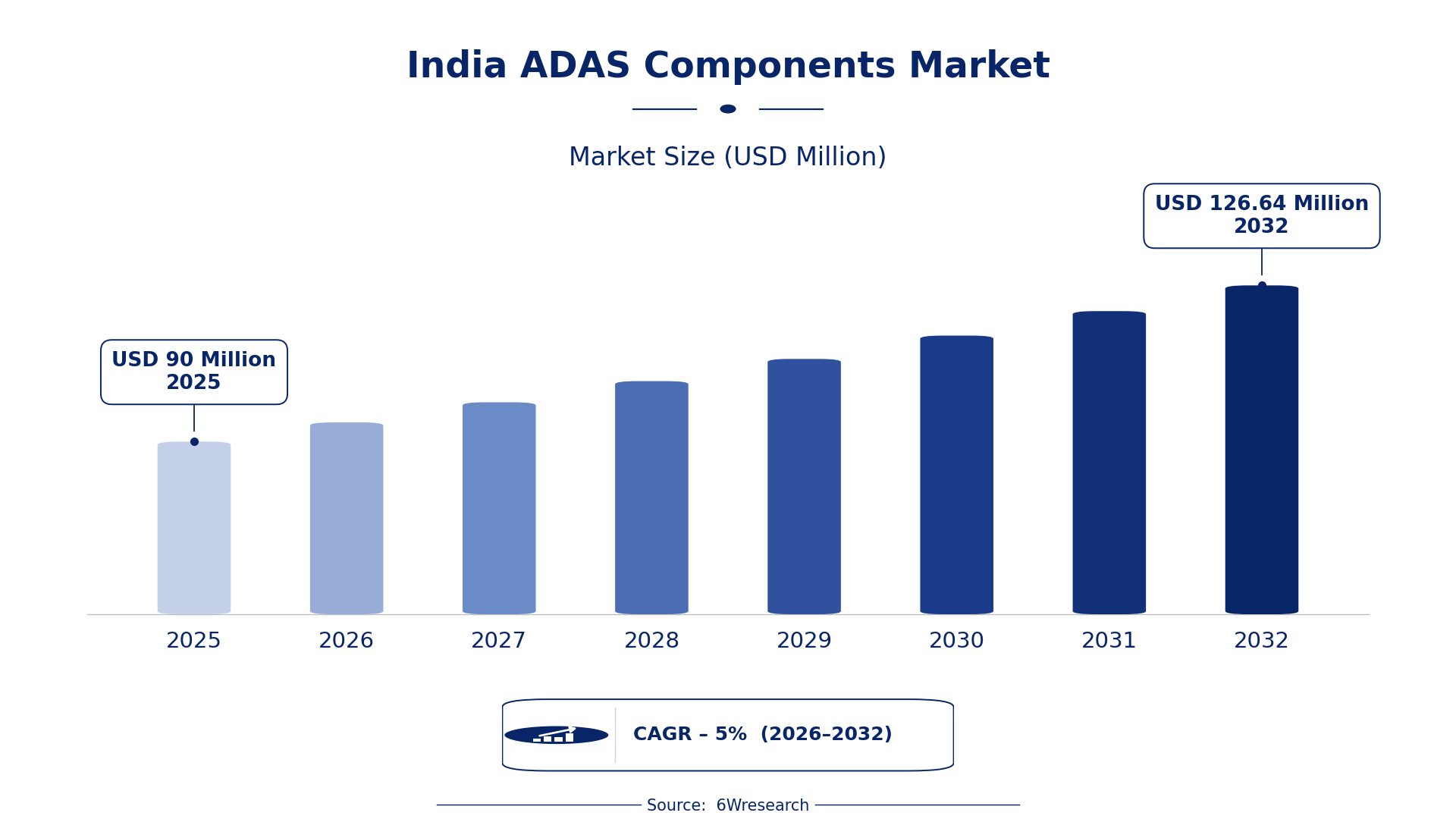
According to 6Wresearch internal database and industry insights, the India ADAS Components Market was valued at USD 90.0 million in 2025 and is projected to reach USD 126.64 million by 2032, growing at a CAGR of approximately 5% during 2026–2032.
India ADAS Components Market Highlights
| Report Metric | Details |
| Report Name | India ADAS Components Market |
| Market Size 2025 | USD 90.0 million |
| Market Size 2032 | USD 126.64 million |
| Absolute Growth 2025–2032 | USD 36.64 million |
| CAGR 2026–2032 | 5% |
| Peak Annual Growth | 7.1% in 2031 |
| Forecast Period | 2026–2032 |
| Historical Data | 2022–2025 |
| Base Year | 2025 |
| Leading ADAS Components, 2025 | Ultrasonic Sensors (39% share) |
| Leading Product Type, 2025 | Proximity Detection (34% share) |
| Leading Distribution Channel, 2025 | OEMs (40% share) |
| Leading End User, 2025 | Parking Assist Systems (48% share) |
| Fastest-Growing ADAS Components | LiDAR Modules (7.5% CAGR) |
| Fastest-Growing Product Type | Laser-Based Sensors (6.5% CAGR) |
| Fastest-Growing Distribution Channel | Tech Suppliers (6.7% CAGR) |
| Fastest-Growing End User | Autonomous Driving (6.5% CAGR) |
| Growing Sector | Automotive Safety Technologies |
| Key End Users | OEMs, automotive distributors, tech suppliers |
India ADAS Components Market Year-wise Growth Rate and Key Drivers (2022–2032)
This graph illustrates the annual growth rates of the market from 2022 to 2032, highlighting a steady upward trajectory and projected market expansion over the forecast period.
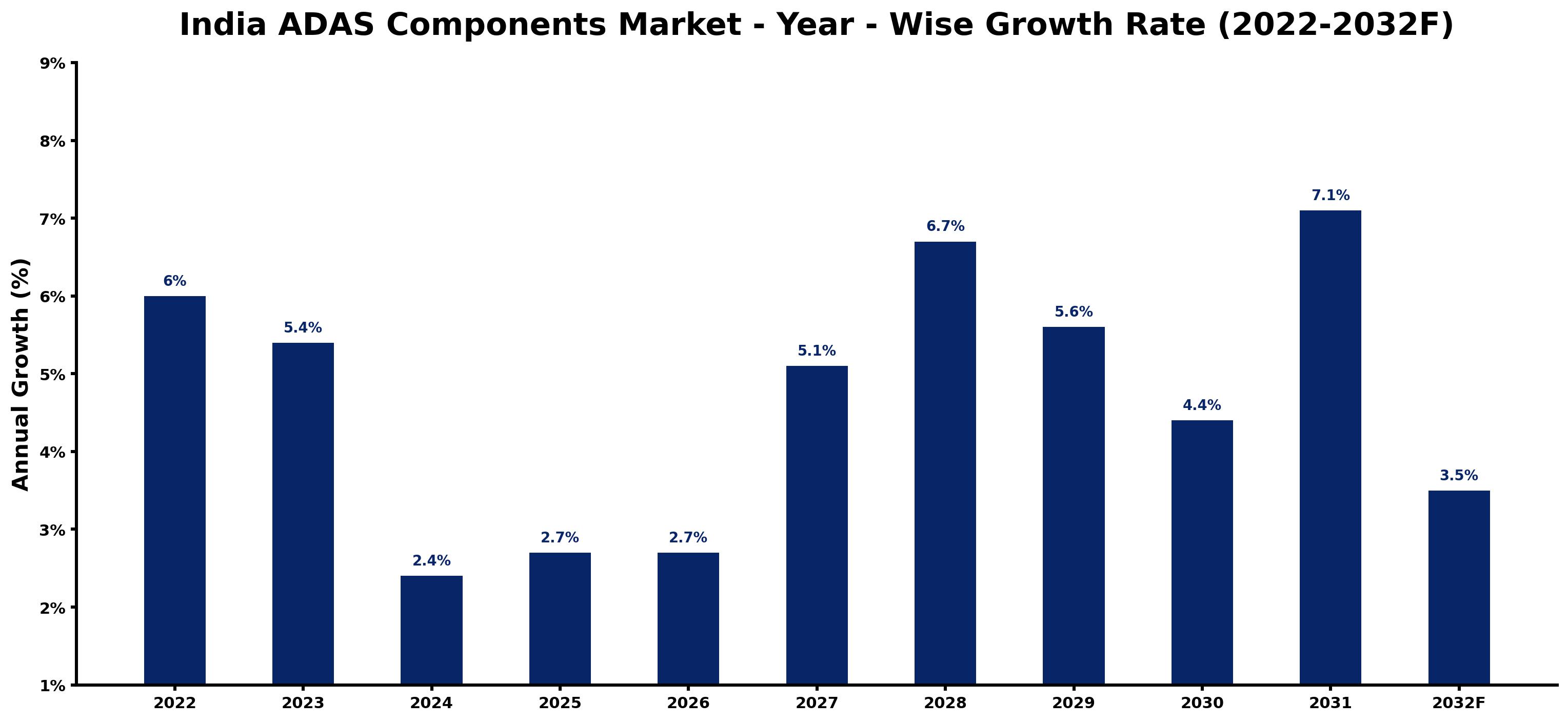
The following table presents the estimated annual growth rate for each year together with the principal factor influencing market performance.
| Year | Estimated Annual Growth (%) | Market Rationale |
| 2022 | 6.0 | The market experienced strong growth due to increased investments in vehicle safety technologies. |
| 2023 | 5.4 | Growth slowed as manufacturers adjusted to new standards and consumer preferences shifted. |
| 2024 | 2.4 | Growth slowed as the market faced challenges in component supply chains. |
| 2025 | 2.7 | Demand increased as the automotive market is expected to reach 35 million units by 2030 under the FAME scheme. |
| 2026 | 2.7 | Growth is expected to slow as the industry adapts to evolving safety regulations and standards. |
| 2027 | 5.1 | A resurgence in growth will be driven by rising consumer interest in advanced safety features and the FAME scheme. |
| 2028 | 6.7 | The market will expand as investments in smart vehicle technologies gain momentum, supported by the National Automotive Testing and R&D Infrastructure Project. |
| 2029 | 5.6 | Growth will slow as competition intensifies among component suppliers and manufacturers, particularly in the LiDAR Modules segment. |
| 2030 | 4.4 | Demand is expected to continue slowing as the market adjusts to the push for electric vehicle integration under the FAME scheme. |
| 2031 | 7.1 | The market will peak with demand driven by the FAME scheme and electric vehicle initiatives. |
| 2032 | 3.5 | Growth is projected to slow as the market stabilises with established standards from the Bureau of Indian Standards. |
Note: Market size estimations and growth projections presented in this report are based on 6Wresearch's proprietary forecasting methodology, utilizing the latest available industry data, government publications, and primary research inputs.
India ADAS Components Market Synopsis
ADAS Components in India comprise technologies that improve vehicle safety and automation, including sensors and control units. These components are produced using advanced processes that integrate electronics and software. Demand is increasing due to domestic users and ongoing investments in smart vehicle technologies. The automotive sector contributes approximately 7.1% to the GDP, while initiatives like the FAME scheme stimulate further interest in these technologies.
Market Dynamics Impact Analysis (2026–2032)
| Factor | Type | Impact | Primary Segment Affected |
| Increasing investments in vehicle safety technologies | Driver | High | Ultrasonic Sensors |
| Growing demand for collision avoidance systems | Driver | High | Radar Units |
| Expansion of testing facilities for ADAS development | Opportunity | High | LiDAR Modules |
| Rising consumer interest in autonomous driving features | Opportunity | High | Electronic Control Units |
| Challenges in component supply chains affecting production | Restraint | High | Proximity Detection |
| Slow adoption of ADAS standards hindering market growth | Restraint | Medium | ECUs |
| High costs associated with advanced technology integration | Challenge | High | Radar Units |
| Limited consumer awareness about ADAS benefits | Challenge | Medium | LiDAR Modules |
Evaluation of Drivers in India ADAS Components Market (2026–2032)
Below mentioned are some major drivers and their influence on market dynamics.
| Drivers | Primary Segment Affected | Why It Matters (Evidence) |
| Rising investments in vehicle safety technologies | Ultrasonic Sensors | The automotive sector contributes approximately 7.1% to the GDP, increasing demand for safety features. |
| Growing demand for collision avoidance systems | Radar Units | The installed base of vehicles with basic ADAS features is estimated at around 1.5 million units, driving demand. |
| Expansion of testing facilities for ADAS development | LiDAR Modules | The National Automotive Testing and R&D Infrastructure Project supports development, enhancing production capabilities. |
| Increased focus on electric vehicle integration | Electronic Control Units | The FAME scheme aims for 30% electric vehicle penetration by 2030, boosting ADAS technologies. |
| Rising consumer interest in autonomous driving features | Proximity Detection | As consumers seek enhanced safety, demand for advanced features is projected to rise. |
Market growth for ADAS Components in India is driven by rising investments in vehicle safety technologies and expanding testing facilities. The automotive sector's contribution of approximately 7.1% to the GDP fuels demand for safety features. The installed base of vehicles with basic ADAS features is estimated at around 1.5 million units, creating a greater need for collision avoidance systems. The National Automotive Testing and R&D Infrastructure Project supports the development of testing facilities, improving production capabilities for LiDAR Modules. The FAME scheme aims for 30% electric vehicle penetration by 2030, further increasing demand for Electronic Control Units.
Evaluation of Restraints in India ADAS Components Market
Below mentioned are some major restraints and their influence on market dynamics.
| Market Restraint | Primary Segment Affected | Why It Matters (Evidence) |
| Challenges in component supply chains affecting production | Proximity Detection | Supply chain disruptions have delayed the availability of critical components, impacting production timelines by up to 20%. |
| Slow adoption of ADAS standards hindering market growth | ECUs | The Bureau of Indian Standards is still developing standards, causing uncertainty in compliance and production timelines. |
| High costs associated with advanced technology integration | Radar Units | The expense of integrating advanced technologies limits adoption among smaller manufacturers, increasing costs by approximately 15%. |
| Limited consumer awareness about ADAS benefits | LiDAR Modules | Many consumers remain unaware of the advantages of ADAS, affecting demand for these technologies by around 25%. |
| Regulatory hurdles complicating market entry | Ultrasonic Sensors | Stringent regulations require extensive testing and certification, delaying product launches by up to 6 months. |
India ADAS Components Market Challenges
Buyers in the India ADAS components market struggle with slow regulatory approvals, which can delay projects by up to six months and hinder timely product launches. Technology integration issues arise as many manufacturers find it challenging to incorporate advanced electronics and software, leading to inconsistent product quality that compromises vehicle safety. Supply chain disruptions frequently occur due to reliance on imported raw materials, causing production halts for local producers and resulting in potential revenue losses of approximately 15%. Rising costs associated with advanced manufacturing processes are pushing prices higher, making it difficult for buyers to remain within budget while seeking crucial safety features.
Trends in the India ADAS Components Market
Below mentioned are some of the trends shaping the India ADAS Components Market growth.
- Shift towards Advanced Safety Features: The automotive industry is increasingly adopting advanced safety features, particularly in urban areas. For example, the National Automotive Testing and R&D Infrastructure Project is supporting testing for these technologies, with the market projected to grow significantly.
- Transition towards Electric Vehicle Integration: India is moving towards integrating ADAS technologies into electric vehicles, driven by the FAME scheme. The aim for 30% electric vehicle penetration by 2030 is influencing manufacturers to adopt these technologies.
- Emergence of Autonomous Driving Technologies: The focus on autonomous driving is intensifying, with significant investments in related technologies. The market for LiDAR Modules is expected to grow at a CAGR of 7.5% from 2026 to 2032, reflecting this trend.
- Increasing Demand for Collision Avoidance Systems: There is a growing emphasis on collision avoidance systems among consumers. Parking Assist Systems are leading this demand, accounting for 48% of the end-user market in 2025.
Investment Opportunities in the India ADAS Components Market
Some of the investment opportunities in the India ADAS Components Market are mentioned below.
- Timing for Investment in ADAS Technologies: With the automotive market projected to grow significantly, there is an opportunity for investment in ADAS technologies. OEMs are seeking solutions to improve vehicle safety, especially with the FAME scheme driving growth.
- Investment in Testing Facilities for ADAS Development: The expansion of testing facilities under the National Automotive Testing and R&D Infrastructure Project presents an opportunity for suppliers. Collaborating with local partners can facilitate entry into this growing sector, particularly in urban regions.
- Supply of Advanced Sensor Technologies: The demand for advanced sensor technologies is increasing, particularly in urban environments. Suppliers can target OEMs looking to enhance vehicle safety features, especially given the growing focus on collision avoidance.
- Focus on Autonomous Driving Features: As consumer interest in autonomous driving grows, there is a need for innovative solutions. Investing in technologies that support autonomous driving can yield substantial returns, particularly in the context of the FAME scheme.
Government Initiatives in the India ADAS Components Market
The Production Linked Incentive (PLI) scheme launched in 2022 aims to boost the manufacturing of automotive components, including ADAS technologies. This initiative encourages local production and reduces dependency on imports, benefiting manufacturers and suppliers in the sector. The Bureau of Indian Standards is developing specific standards for ADAS components to ensure safety and performance, providing a regulatory framework that supports market growth with a target of 2025 for implementation.
The Automotive Research Association of India (ARAI) is actively involved in research and development initiatives for ADAS, providing funding and support for projects that improve safety and performance. These agencies facilitate the growth of the ADAS market by approving standards and funding innovative projects, focusing on enhancing testing capabilities across multiple states.
Future Insight of the India ADAS Components Market
The India ADAS components market is set to transform by 2032, driven by the government's push for electric vehicle adoption and the establishment of robust testing facilities under the National Automotive Testing and R&D Infrastructure Project. The automotive sector is expected to see a rise in the installed base of vehicles with basic ADAS features, projected to reach around 5 million units by 2030. New safety and performance standards from the Bureau of Indian Standards will streamline the integration of these technologies, improving overall vehicle safety. Ongoing investments in smart vehicle technologies will further accelerate the development of advanced driver assistance systems.
Market Segmentation Analysis
The analysis below covers each segmentation, its leading category in 2025 and its fastest-growing category through 2032.
By ADAS Components – Ultrasonic Sensors Dominated, LiDAR Modules Expected to Grow Fastest
According to Ravi Bhandari, Research Head at 6Wresearch, the largest adas components category in 2025 was Ultrasonic Sensors, with a 39% share of total revenue. Ultrasonic sensors dominate the market share in India due to their critical function in parking assist systems, which are increasingly popular in urban settings. The installed base of approximately 1.5 million vehicles with basic ADAS features illustrates the growing dependence on these sensors for improved safety. LiDAR Modules are projected to grow fastest, at a CAGR of 7.5% during 2026–2032. LiDAR modules are set for rapid growth, driven by the escalating demand for autonomous driving technologies that necessitate precise mapping and object detection. As the automotive market is expected to reach 35 million units by 2030, the requirement for LiDAR will continue to rise, reinforcing its market position. Suppliers must scale production of LiDAR modules to effectively cater to the anticipated increase in demand.
By Product Type – Proximity Detection Dominated, Laser-Based Sensors Expected to Grow Fastest
Proximity Detection held a 34% share of the India ADAS Components Market by product type in 2025. Proximity detection leads the market share as it is integral to parking assist systems, which are increasingly standard in new vehicles. This technology is essential for detecting obstacles, making it a critical component for safety in urban environments. Over 2026–2032, Laser-Based Sensors are expected to post the fastest growth, at a CAGR of 6.5%. Laser-based sensors are expected to grow rapidly due to their role in advanced sensing applications, which are becoming more prevalent in modern vehicles. As the automotive sector pushes towards higher safety standards, the demand for these sensors will accelerate. Manufacturers must invest in research and development for laser-based sensors to capitalise on this growing trend.
By Distribution Channel – OEMs Dominated, Tech Suppliers Expected to Grow Fastest
In 2025, OEMs led the distribution channel split with a 40% share. OEMs command the largest market share as they are the primary manufacturers of vehicles that incorporate ADAS technologies, ensuring a steady demand for these components. Their established relationships with suppliers facilitate the seamless integration of advanced systems into new vehicle models, solidifying their market leadership. The quickest growth will come from Tech Suppliers, forecast to expand at a CAGR of 6.7% between 2026 and 2032. Tech suppliers are experiencing the fastest growth as they provide essential components and technologies to OEMs, aligning with the automotive industry's shift towards smarter vehicles. The increasing complexity of ADAS systems requires their specialised knowledge, driving substantial market growth. Suppliers should prioritise forming strong alliances with tech suppliers to enhance their market presence and adaptability.
By End User – Parking Assist Systems Dominated, Autonomous Driving Expected to Grow Fastest
With a 48% revenue share in 2025, Parking Assist Systems was the largest end user category. Parking assist systems hold the largest market share as they effectively utilise multiple ADAS components, making them a popular choice among consumers who prioritise safety features. The rising number of vehicles equipped with these systems highlights their importance in the market. Autonomous Driving is set to record the highest CAGR in this split, 6.5% over 2026–2032. Autonomous driving is the fastest-growing end user segment, propelled by advancements in technology and increasing consumer interest in self-driving capabilities. As the automotive sector evolves, the integration of various ADAS technologies will be crucial for the development of fully autonomous vehicles. Investing in technologies that facilitate autonomous driving will be essential for suppliers seeking to remain competitive in the market.
Key Attractiveness of the Report
- 10 Years of Market Numbers
- Historical Data Starting from 2022 to 2025
- Base Year 2025
- Forecast Data until 2032
- Key Performance Indicators Impacting the Market
- Major Upcoming Developments and Projects
Key Highlights of the Report:
- India ADAS Components Market Outlook
- Market Size of India ADAS Components Market, 2025
- Forecast of India ADAS Components Market, 2032
- Historical Data and Forecast of India ADAS Components Revenues & Volume for the Period 2022 - 2032F
- India ADAS Components Market Trend Evolution
- India ADAS Components Market Drivers and Challenges
- India ADAS Components Price Trends
- India ADAS Components Porter's Five Forces
- India ADAS Components Industry Life Cycle
- Historical Data and Forecast of India ADAS Components Market Revenues & Volume By ADAS Components for the Period 2022 - 2032F
- Historical Data and Forecast of India ADAS Components Market Revenues & Volume By Ultrasonic Sensors for the Period 2022 - 2032F
- Historical Data and Forecast of India ADAS Components Market Revenues & Volume By LiDAR Modules for the Period 2022 - 2032F
- Historical Data and Forecast of India ADAS Components Market Revenues & Volume By ECUs for the Period 2022 - 2032F
- Historical Data and Forecast of India ADAS Components Market Revenues & Volume By Radar Units for the Period 2022 - 2032F
- Historical Data and Forecast of India ADAS Components Market Revenues & Volume By Product Type for the Period 2022 - 2032F
- Historical Data and Forecast of India ADAS Components Market Revenues & Volume By Proximity Detection for the Period 2022 - 2032F
- Historical Data and Forecast of India ADAS Components Market Revenues & Volume By Laser-Based Sensors for the Period 2022 - 2032F
- Historical Data and Forecast of India ADAS Components Market Revenues & Volume By Electronic Control Units for the Period 2022 - 2032F
- Historical Data and Forecast of India ADAS Components Market Revenues & Volume By mmWave Technology for the Period 2022 - 2032F
- Historical Data and Forecast of India ADAS Components Market Revenues & Volume By Distribution Channel for the Period 2022 - 2032F
- Historical Data and Forecast of India ADAS Components Market Revenues & Volume By OEMs for the Period 2022 - 2032F
- Historical Data and Forecast of India ADAS Components Market Revenues & Volume By Tech Suppliers for the Period 2022 - 2032F
- Historical Data and Forecast of India ADAS Components Market Revenues & Volume By Automotive Distributors for the Period 2022 - 2032F
- Historical Data and Forecast of India ADAS Components Market Revenues & Volume By Direct Sales for the Period 2022 - 2032F
- Historical Data and Forecast of India ADAS Components Market Revenues & Volume By End User for the Period 2022 - 2032F
- Historical Data and Forecast of India ADAS Components Market Revenues & Volume By Parking Assist Systems for the Period 2022 - 2032F
- Historical Data and Forecast of India ADAS Components Market Revenues & Volume By Autonomous Driving for the Period 2022 - 2032F
- Historical Data and Forecast of India ADAS Components Market Revenues & Volume By Vehicle System Integrators for the Period 2022 - 2032F
- Historical Data and Forecast of India ADAS Components Market Revenues & Volume By Collision Avoidance Systems for the Period 2022 - 2032F
- India ADAS Components Import Export Trade Statistics
- Market Opportunity Assessment By ADAS Components
- Market Opportunity Assessment By Product Type
- Market Opportunity Assessment By Distribution Channel
- Market Opportunity Assessment By End User
- India ADAS Components Top Companies Market Share
- India ADAS Components Competitive Benchmarking By Technical and Operational Parameters
- India ADAS Components Company Profiles
- India ADAS Components Key Strategic Recommendations
Market Covered
The report offers an extensive study of the following market segments.
By ADAS Components
- Ultrasonic Sensors
- LiDAR Modules
- ECUs
- Radar Units
By Product Type
- Proximity Detection
- Laser-Based Sensors
- Electronic Control Units
- mmWave Technology
By Distribution Channel
- OEMs
- Tech Suppliers
- Automotive Distributors
- Direct Sales
By End User
- Parking Assist Systems
- Autonomous Driving
- Vehicle System Integrators
- Collision Avoidance Systems































