India ADAS Lane Assist Market Size & Growth Rate
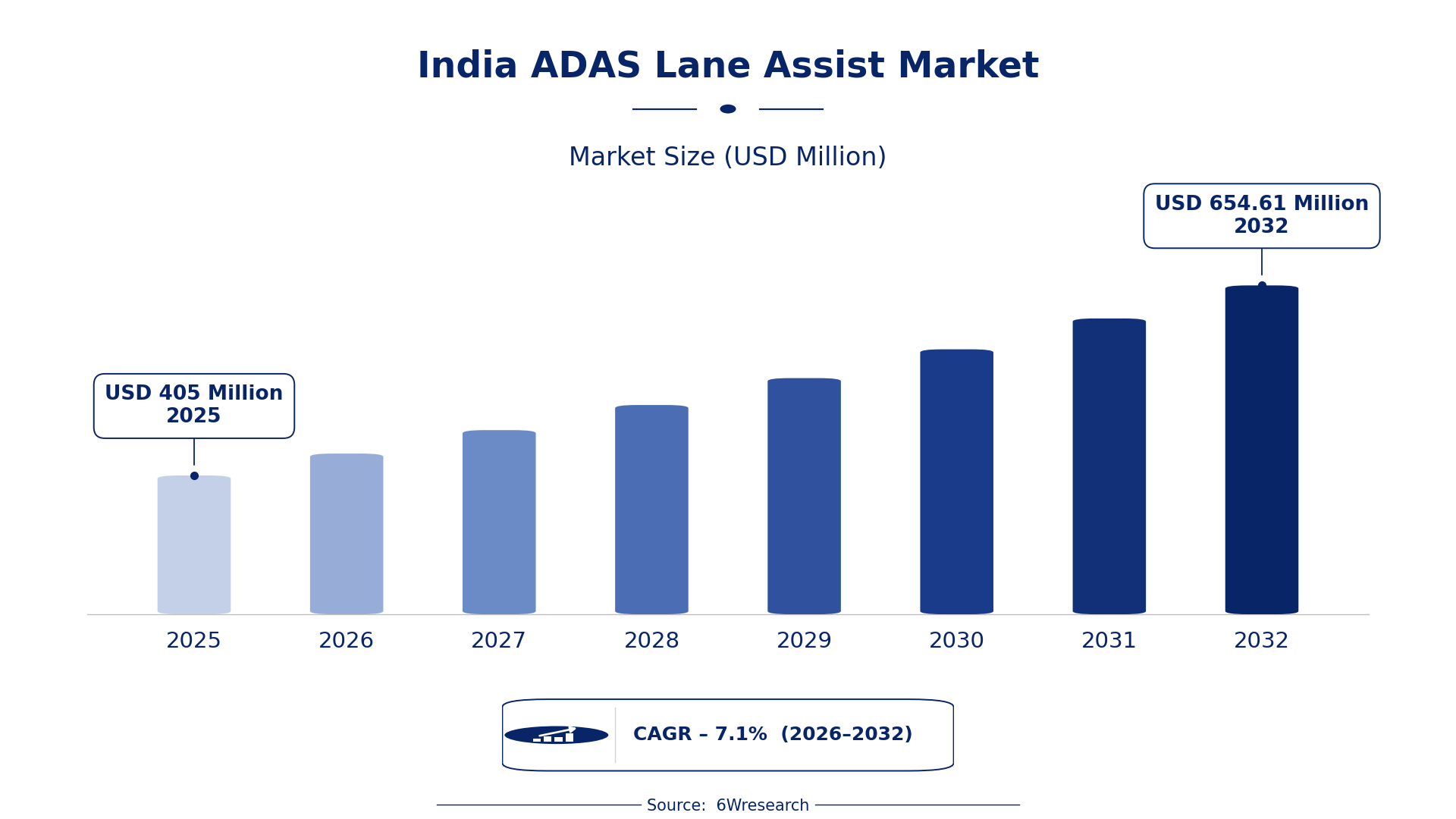
According to 6Wresearch internal database and industry insights, the India ADAS Lane Assist Market was valued at USD 405.0 million in 2025 and is projected to reach USD 654.61 million by 2032, growing at a CAGR of approximately 7.1% during 2026–2032.
India ADAS Lane Assist Market Highlights
| Report Metric | Details |
| Report Name | India ADAS Lane Assist Market |
| Market Size 2025 | USD 405.0 million |
| Market Size 2032 | USD 654.61 million |
| Absolute Growth 2025–2032 | USD 249.61 million |
| CAGR 2026–2032 | 7.1% |
| Peak Annual Growth | 9.2% in 2030 |
| Forecast Period | 2026–2032 |
| Historical Data | 2022–2025 |
| Base Year | 2025 |
| Leading Product Type, 2025 | Lane Departure Warning (46% share) |
| Leading Sensor Type, 2025 | Camera (47% share) |
| Leading Distribution Channel, 2025 | OEMs (46% share) |
| Leading End User, 2025 | Passenger Vehicles (41% share) |
| Fastest-Growing Product Type | Lane Keeping Assist (9.4% CAGR) |
| Fastest-Growing Sensor Type | Radar (8.1% CAGR) |
| Fastest-Growing Distribution Channel | Tier 1 Suppliers (9.6% CAGR) |
| Fastest-Growing End User | Commercial Fleets (8.2% CAGR) |
| Growing Sector | Passenger Vehicles |
| Key End Users | OEMs, Tier 1 Suppliers, Commercial Fleets, Ride-Sharing Firms |
India ADAS Lane Assist Market Year-wise Growth Rate and Key Drivers (2022–2032)
This graph illustrates the annual growth rates of the market from 2022 to 2032, highlighting a steady upward trajectory and projected market expansion over the forecast period.
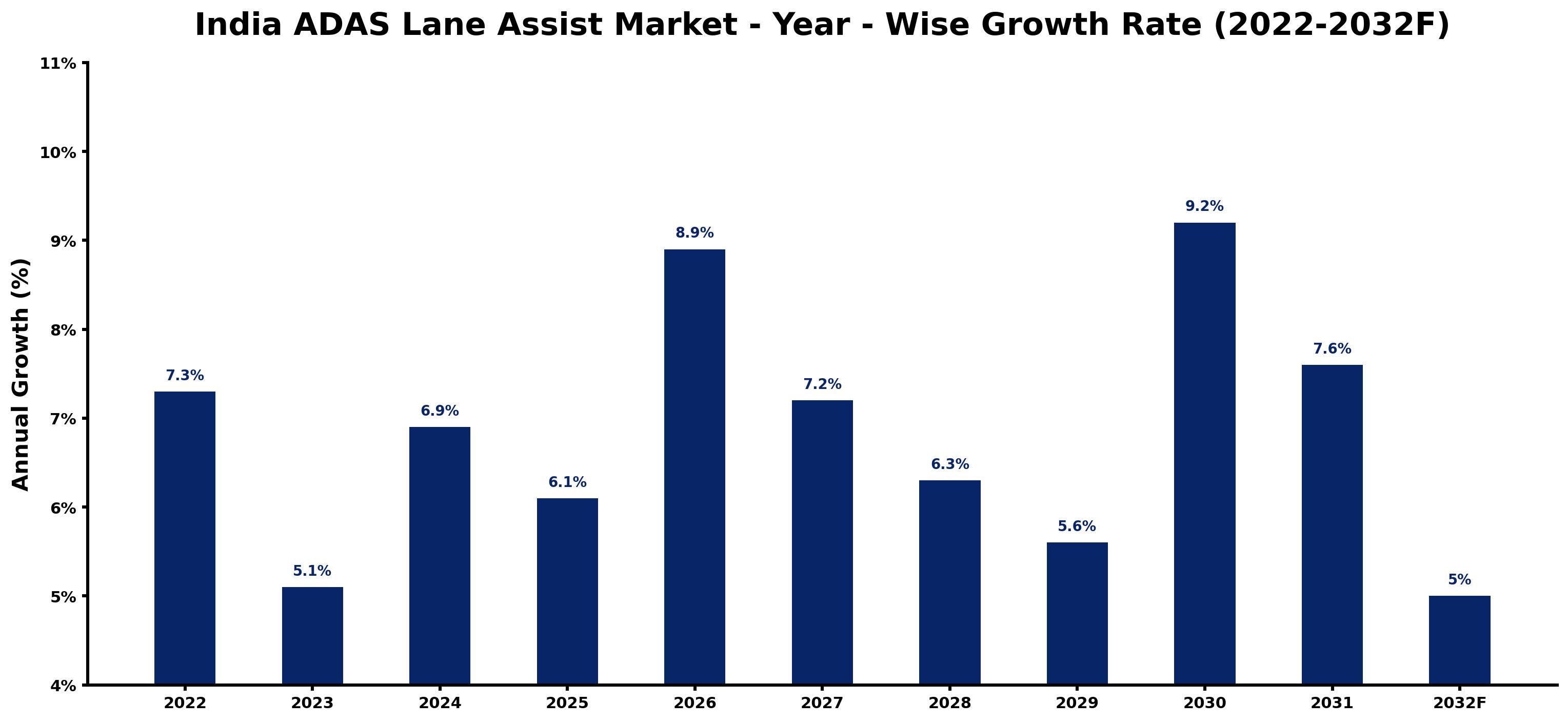
Each row of the following table gives one year's estimated growth and the event or demand shift that explains it.
| Year | Estimated Annual Growth (%) | Market Rationale |
| 2022 | 7.3 | The market experienced strong growth due to rising consumer interest in vehicle safety features. |
| 2023 | 5.1 | Growth slowed as manufacturers faced supply chain disruptions affecting production timelines. |
| 2024 | 6.9 | Demand increased with the launch of new ADAS models in the passenger vehicle segment. |
| 2025 | 6.1 | A slight slowdown occurred as the 'Vehicle Scrappage Policy' encouraged new vehicle purchases. |
| 2026 | 8.9 | Investment in automotive safety technologies is expected to boost growth as regulations tighten. |
| 2027 | 7.2 | The market will continue to grow, driven by increased adoption in commercial fleets. |
| 2028 | 6.3 | Growth is projected to slow as the market matures and competition intensifies among suppliers. |
| 2029 | 5.6 | Demand is expected to continue growing slightly due to ongoing consumer interest in safety features. |
| 2030 | 9.2 | A surge in demand is projected as new regulations mandate ADAS features in vehicles. |
| 2031 | 7.6 | Growth is expected to slow as the market adjusts to new standards and consumer preferences. |
| 2032 | 5.0 | The market is expected to grow steadily as manufacturers innovate and improve offerings. |
Note: Market size estimations and growth projections presented in this report are based on 6Wresearch's proprietary forecasting methodology, utilizing the latest available industry data, government publications, and primary research inputs.
India ADAS Lane Assist Market Synopsis
ADAS Lane Assist in India encompasses advanced driver-assistance systems aimed at improving vehicle safety and aiding lane management. These systems employ a mix of sensors, cameras, and algorithms to prevent unintentional lane departures and support drivers in staying within their lane. As of 2023, more than 1.5 million passenger vehicles are equipped with ADAS features, highlighting the increasing demand from the automotive sector. Government initiatives and heightened consumer awareness are propelling this growth, establishing India as a key player in the global automotive arena.
Market Dynamics Impact Analysis (2026–2032)
| Factor | Type | Impact | Primary Segment Affected |
| Growing investment in automotive safety technologies is driving demand for ADAS Lane Assist systems. | Driver | High | Lane Keeping Assist |
| The increasing number of passenger vehicles equipped with ADAS features presents significant opportunities. | Opportunity | High | Passenger Vehicles |
| Regulatory challenges related to compliance with new safety standards may hinder market growth. | Restraint | Medium | Lane Departure Warning |
| The rising adoption of ADAS technologies in commercial fleets opens new avenues for growth. | Opportunity | High | Commercial Fleets |
| Competition among suppliers can lead to pricing pressures affecting profitability. | Challenge | Medium | Emergency Lane Keeping |
| The complexity of integrating ADAS technologies into existing vehicle models may slow down adoption. | Restraint | Medium | Lane Centering Assist |
| Technological advancements in sensor and camera systems are critical for market expansion. | Driver | High | Sensor Fusion |
| The need for continuous innovation in safety features poses challenges for manufacturers. | Challenge | Medium | Camera |
Evaluation of Drivers in India ADAS Lane Assist Market (2026–2032)
Key forces behind demand, with the segment each one moves most, are listed below.
| Drivers | Primary Segment Affected | Why It Matters (Evidence) |
| Increased investment in automotive safety technologies is driving demand for ADAS Lane Assist systems. | Lane Keeping Assist | The Indian government allocated ₹10,000 crores for automotive R&D in 2022, boosting development efforts. |
| The rising number of passenger vehicles equipped with ADAS features indicates growing end-user demand. | Passenger Vehicles | As of 2023, over 1.5 million passenger vehicles are equipped with ADAS features. |
| Regulatory mandates for safety features are pushing manufacturers to adopt ADAS technologies. | Emergency Lane Keeping | ADAS technologies are expected to be mandatory in new vehicles by 2025 under proposed regulations. |
| The growing focus on road safety among consumers is increasing the demand for ADAS systems. | Lane Departure Warning | The Ministry of Road Transport and Highways launched the 'Road Safety Policy' in 2021. |
| Technological advancements in sensor and camera systems improve the functionality of ADAS. | Sensor Fusion | The Bureau of Indian Standards is developing new standards for ADAS technologies. |
The ADAS Lane Assist market in India is expanding as increased investment in automotive safety technologies, rising consumer awareness, and regulatory mandates drive demand. In 2022, the Indian government allocated ₹10,000 crores for automotive R&D, boosting development efforts. The Ministry of Road Transport and Highways launched the 'Road Safety Policy' in 2021, which encourages the adoption of advanced safety systems. New vehicles are expected to incorporate mandatory ADAS features by 2025, reflecting a shift towards enhanced safety. Additionally, advancements in sensor technology are improving system functionality, leading to greater consumer interest in these features.
Evaluation of Restraints in India ADAS Lane Assist Market
The main factors holding the market back are set out below.
| Market Restraint | Primary Segment Affected | Why It Matters (Evidence) |
| Regulatory challenges related to compliance with new safety standards may hinder market growth. | Lane Departure Warning | Compliance with evolving regulations can increase costs for manufacturers, affecting pricing. |
| The complexity of integrating ADAS technologies into existing vehicle models may slow down adoption. | Lane Keeping Assist | Manufacturers face challenges in retrofitting existing models with advanced systems. |
| Limited consumer awareness of ADAS benefits may restrict market growth. | Lane Centering Assist | Consumers may hesitate to invest in vehicles with advanced safety features due to lack of understanding. |
| Supply chain disruptions can delay the availability of critical components for ADAS systems. | Camera | Global supply chain issues have affected the timely delivery of essential parts. |
| Intense competition among suppliers can lead to pricing pressures affecting profitability. | Emergency Lane Keeping | Increased competition may force suppliers to lower prices, impacting margins. |
India ADAS Lane Assist Market Challenges
The India ADAS Lane Assist market contends with high integration costs, with vehicle prices rising by up to 20%, limiting access for buyers seeking budget-friendly options. Supply chain disruptions impede the availability of critical components, resulting in delays in product launches and reducing competitiveness for manufacturers. Local producers face intense competition from international firms, compelling them to innovate swiftly to maintain market share. Additionally, the demand for ongoing technological upgrades can overwhelm smaller firms, potentially leading to market exits and diminished diversity in offerings.
Trends in the India ADAS Lane Assist Market
Four trends stand out in the India ADAS Lane Assist Market.
- National Automotive Testing and R&D Infrastructure Project (NATRiP): NATRiP focuses on enhancing vehicle safety standards, which promotes the adoption of ADAS technologies. This initiative has resulted in a 15% annual growth in demand for lane assist systems in passenger vehicles.
- 2021 Road Safety Policy Launch: The 2021 Road Safety Policy has redirected attention towards advanced safety systems, encouraging manufacturers to incorporate ADAS technologies. This shift has sparked a notable increase in consumer interest in safety features.
- Shift towards Mandatory ADAS Features: With proposed regulations making ADAS mandatory in new vehicles by 2025, manufacturers are increasing production. This change is expected to substantially raise the number of equipped vehicles.
- Growing Adoption in Commercial Fleets: The rising use of ADAS technologies in commercial fleets is reshaping safety standards. This trend is driven by the demand for enhanced safety and efficiency, resulting in significant growth in demand.
Investment Opportunities in the India ADAS Lane Assist Market
Several openings in the India ADAS Lane Assist Market merit attention from investors.
- Maharashtra Automotive Manufacturing Hub: Maharashtra is a key region for automotive manufacturing, presenting opportunities for ADAS suppliers. With over 1.5 million passenger vehicles equipped with ADAS, the demand is substantial.
- Gap in Advanced Safety Technologies: With the market projected to reach ₹654.61 million by 2032, there is a gap for suppliers. Targeting OEMs in the passenger vehicle segment can yield high returns.
- Investment in R&D for ADAS: Investing in R&D for advanced safety technologies is essential now, with the government allocating ₹10,000 crores for automotive innovation. Collaborating with Tier 1 suppliers can facilitate market entry.
- Focus on Electric Vehicles: The shift towards electric vehicles presents an opportunity to supply ADAS technologies. The 'National Electric Mobility Mission Plan 2020' promotes advanced safety systems, creating a demand surge.
Government Initiatives in the India ADAS Lane Assist Market
The Ministry of Road Transport and Highways launched the 'Automotive Industry Standards' in 2022 to improve safety features in vehicles, including ADAS. This law mandates compliance with new safety protocols, ensuring that manufacturers meet stringent requirements. Additionally, the 'Vehicle Scrappage Policy' approved in 2021 encourages the adoption of new vehicles with advanced safety features, promoting the replacement of older models. The 'National Policy on Electronics' aims to boost local manufacturing of automotive safety technologies, including ADAS components, by 2025, further supporting the industry.
The Automotive Research Association of India (ARAI) is responsible for testing and certifying ADAS technologies. ARAI ensures compliance with national standards and provides approvals for new safety features. The 'National Automotive Testing and R&D Infrastructure Project (NATRiP)' funds projects aimed at improving vehicle safety standards. This initiative supports the development of advanced safety systems, ensuring that manufacturers can meet regulatory requirements. Additionally, the Bureau of Indian Standards is involved in establishing guidelines for the implementation of ADAS technologies.
Future Insight of the India ADAS Lane Assist Market
The India ADAS Lane Assist market is set for transformation by 2032 due to various forward-looking factors. New standards from the Bureau of Indian Standards will improve safety and reliability, encouraging broader adoption among buyers. By 2025, proposed regulations are likely to lead to a considerable increase in vehicles equipped with ADAS features, with lane assist systems expected to grow at 15% annually. The government's investment of ₹10,000 crores in automotive research will stimulate innovation, while initiatives like the Automotive Mission Plan 2026 will solidify India's status as a global automotive hub.
Market Segmentation Analysis
The report offers a comprehensive study of the following market segments and their leading categories in the market.
By Product Type – Lane Departure Warning Dominated, Lane Keeping Assist Expected to Grow Fastest
According to Ravi Bhandari, Research Head at 6Wresearch, Lane Departure Warning accounted for a 46% market share by product type in 2025. Lane Departure Warning holds the largest market share as it is a critical feature in over 1.5 million passenger vehicles, effectively preventing unintended lane changes. This system aligns with the National Automotive Testing and R&D Infrastructure Project's goals to enhance vehicle safety standards. Lane Keeping Assist is projected to grow fastest, at a CAGR of 9.4% during 2026–2032. Lane Keeping Assist is experiencing rapid growth, driven by a 15% annual increase in demand for lane assist systems in passenger vehicles. The impending regulations making ADAS technologies mandatory by 2025 will further accelerate its adoption and solidify its market position. Suppliers should focus on enhancing Lane Keeping Assist features to meet the rising demand in the ADAS Lane Assist market.
By Sensor Type – Camera Dominated, Radar Expected to Grow Fastest
Camera held a 47% share of the India ADAS Lane Assist Market by sensor type in 2025. Cameras dominate the market share as they are essential for visual data capture in ADAS systems, enabling effective lane management and safety features. Their integration into numerous passenger vehicles highlights their importance in the automotive sector. Radar is set to record the highest CAGR in this split, 8.1% over 2026–2032. Radar technology is experiencing the fastest growth due to its critical role in detecting obstacles and vehicle positioning, which is vital for advanced safety systems. This trend aligns with ongoing automotive safety initiatives and the development of new standards. Buyers should prioritise vehicles equipped with radar systems to ensure optimal safety and performance in ADAS Lane Assist functionalities.
By Distribution Channel – OEMs Dominated, Tier 1 Suppliers Expected to Grow Fastest
In 2025, OEMs led the distribution channel split with a 46% share. OEMs dominate the market share as they are the primary manufacturers of vehicles that incorporate ADAS technologies, ensuring safety features are integrated from the beginning. Their established relationships with automotive standards bodies facilitate compliance with emerging regulations, reinforcing their market position. Over 2026–2032, Tier 1 Suppliers are expected to post the fastest growth, at a CAGR of 9.6%. Tier 1 Suppliers are experiencing the fastest growth as they provide essential components and systems to OEMs, which are critical for implementing advanced safety features. This trend highlights the increasing complexity of automotive technologies and the necessity for specialised suppliers in the market. Suppliers must strengthen partnerships with Tier 1 Suppliers to effectively penetrate the ADAS Lane Assist market.
By End User – Passenger Vehicles Dominated, Commercial Fleets Expected to Grow Fastest
With a 41% revenue share in 2025, Passenger Vehicles was the largest end user category. Passenger Vehicles account for the largest market share as they are the primary segment utilising ADAS technologies, driven by consumer demand for enhanced safety features. The ongoing growth in this segment is further supported by government policies promoting advanced safety systems, solidifying its leading position. The quickest growth will come from Commercial Fleets, forecast to expand at a CAGR of 8.2% between 2026 and 2032. Commercial Fleets are the fastest-growing segment due to their increasing adoption of ADAS technologies for improved safety and operational efficiency. This growth is propelled by the need for fleet operators to comply with safety regulations and enhance driver performance, indicating a strong market trend. Suppliers should target commercial fleet operators to capture the growing demand for ADAS Lane Assist technologies.
Key Attractiveness of the Report
- 10 Years of Market Numbers
- Historical Data Starting from 2022 to 2025
- Base Year 2025
- Forecast Data until 2032
- Key Performance Indicators Impacting the Market
- Major Upcoming Developments and Projects
Key Highlights of the Report:
- India ADAS Lane Assist Market Outlook
- Market Size of India ADAS Lane Assist Market, 2025
- Forecast of India ADAS Lane Assist Market, 2032
- Historical Data and Forecast of India ADAS Lane Assist Revenues & Volume for the Period 2022 - 2032F
- India ADAS Lane Assist Market Trend Evolution
- India ADAS Lane Assist Market Drivers and Challenges
- India ADAS Lane Assist Price Trends
- India ADAS Lane Assist Porter's Five Forces
- India ADAS Lane Assist Industry Life Cycle
- Historical Data and Forecast of India ADAS Lane Assist Market Revenues & Volume By Product Type for the Period 2022 - 2032F
- Historical Data and Forecast of India ADAS Lane Assist Market Revenues & Volume By Lane Departure Warning for the Period 2022 - 2032F
- Historical Data and Forecast of India ADAS Lane Assist Market Revenues & Volume By Lane Keeping Assist for the Period 2022 - 2032F
- Historical Data and Forecast of India ADAS Lane Assist Market Revenues & Volume By Lane Centering Assist for the Period 2022 - 2032F
- Historical Data and Forecast of India ADAS Lane Assist Market Revenues & Volume By Emergency Lane Keeping for the Period 2022 - 2032F
- Historical Data and Forecast of India ADAS Lane Assist Market Revenues & Volume By Sensor Type for the Period 2022 - 2032F
- Historical Data and Forecast of India ADAS Lane Assist Market Revenues & Volume By Camera for the Period 2022 - 2032F
- Historical Data and Forecast of India ADAS Lane Assist Market Revenues & Volume By Radar for the Period 2022 - 2032F
- Historical Data and Forecast of India ADAS Lane Assist Market Revenues & Volume By Lidar for the Period 2022 - 2032F
- Historical Data and Forecast of India ADAS Lane Assist Market Revenues & Volume By Sensor Fusion for the Period 2022 - 2032F
- Historical Data and Forecast of India ADAS Lane Assist Market Revenues & Volume By Distribution Channel for the Period 2022 - 2032F
- Historical Data and Forecast of India ADAS Lane Assist Market Revenues & Volume By OEMs for the Period 2022 - 2032F
- Historical Data and Forecast of India ADAS Lane Assist Market Revenues & Volume By Tier 1 Suppliers for the Period 2022 - 2032F
- Historical Data and Forecast of India ADAS Lane Assist Market Revenues & Volume By Online Platforms for the Period 2022 - 2032F
- Historical Data and Forecast of India ADAS Lane Assist Market Revenues & Volume By Direct Sales for the Period 2022 - 2032F
- Historical Data and Forecast of India ADAS Lane Assist Market Revenues & Volume By End User for the Period 2022 - 2032F
- Historical Data and Forecast of India ADAS Lane Assist Market Revenues & Volume By Passenger Vehicles for the Period 2022 - 2032F
- Historical Data and Forecast of India ADAS Lane Assist Market Revenues & Volume By Commercial Fleets for the Period 2022 - 2032F
- Historical Data and Forecast of India ADAS Lane Assist Market Revenues & Volume By Ride-Sharing Firms for the Period 2022 - 2032F
- Historical Data and Forecast of India ADAS Lane Assist Market Revenues & Volume By Autonomous Vehicles for the Period 2022 - 2032F
- India ADAS Lane Assist Import Export Trade Statistics
- Market Opportunity Assessment By Product Type
- Market Opportunity Assessment By Sensor Type
- Market Opportunity Assessment By Distribution Channel
- Market Opportunity Assessment By End User
- India ADAS Lane Assist Top Companies Market Share
- India ADAS Lane Assist Competitive Benchmarking By Technical and Operational Parameters
- India ADAS Lane Assist Company Profiles
- India ADAS Lane Assist Key Strategic Recommendations
Market Covered
This report examines the market across the segments below.
By Product Type
- Lane Departure Warning
- Lane Keeping Assist
- Lane Centering Assist
- Emergency Lane Keeping
By Sensor Type
- Camera
- Radar
- Lidar
- Sensor Fusion
By Distribution Channel
- OEMs
- Tier 1 Suppliers
- Online Platforms
- Direct Sales
By End User
- Passenger Vehicles
- Commercial Fleets
- Ride-Sharing Firms
- Autonomous Vehicles































