India ADAS Sensor Integration Market Size & Growth Rate
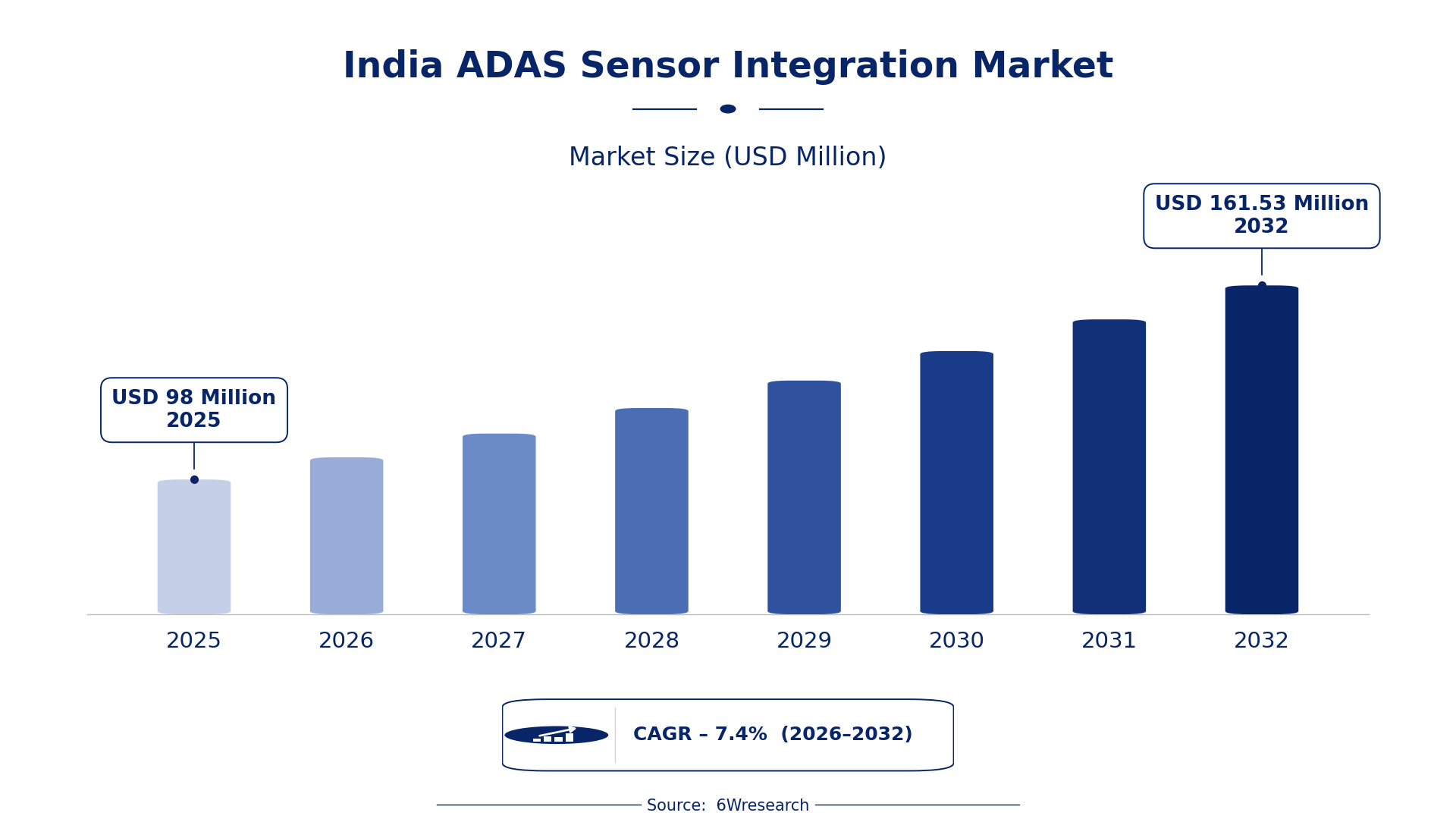
According to 6Wresearch internal database and industry insights, the India ADAS Sensor Integration Market was valued at USD 98.0 million in 2025 and is projected to reach USD 161.53 million by 2032, growing at a CAGR of approximately 7.4% during 2026–2032.
India ADAS Sensor Integration Market Highlights
| Report Metric | Details |
| Report Name | India ADAS Sensor Integration Market |
| Market Size 2025 | USD 98.0 million |
| Market Size 2032 | USD 161.53 million |
| Absolute Growth 2025–2032 | USD 63.53 million |
| CAGR 2026–2032 | 7.4% |
| Peak Annual Growth | 9.6% in 2032 |
| Forecast Period | 2026–2032 |
| Historical Data | 2022–2025 |
| Base Year | 2025 |
| Leading Integration Method, 2025 | Centralized Fusion (43% share) |
| Leading Sensor Type, 2025 | Radar + Lidar (41% share) |
| Leading Distribution Channel, 2025 | OEMs (41% share) |
| Leading End User, 2025 | ADAS Platform Makers (53% share) |
| Fastest-Growing Integration Method | Modular Integration (9.0% CAGR) |
| Fastest-Growing Sensor Type | Camera + Ultrasonic (9.7% CAGR) |
| Fastest-Growing Distribution Channel | Tier 1 Suppliers (9.8% CAGR) |
| Fastest-Growing End User | EV Startups (9.3% CAGR) |
| Growing Sector | EV Startups |
| Key End Users | ADAS Platform Makers, Luxury Vehicle Makers, EV Startups, Commercial Fleets |
India ADAS Sensor Integration Market Year-wise Growth Rate and Key Drivers (2022–2032)
This graph illustrates the annual growth rates of the market from 2022 to 2032, highlighting a steady upward trajectory and projected market expansion over the forecast period.
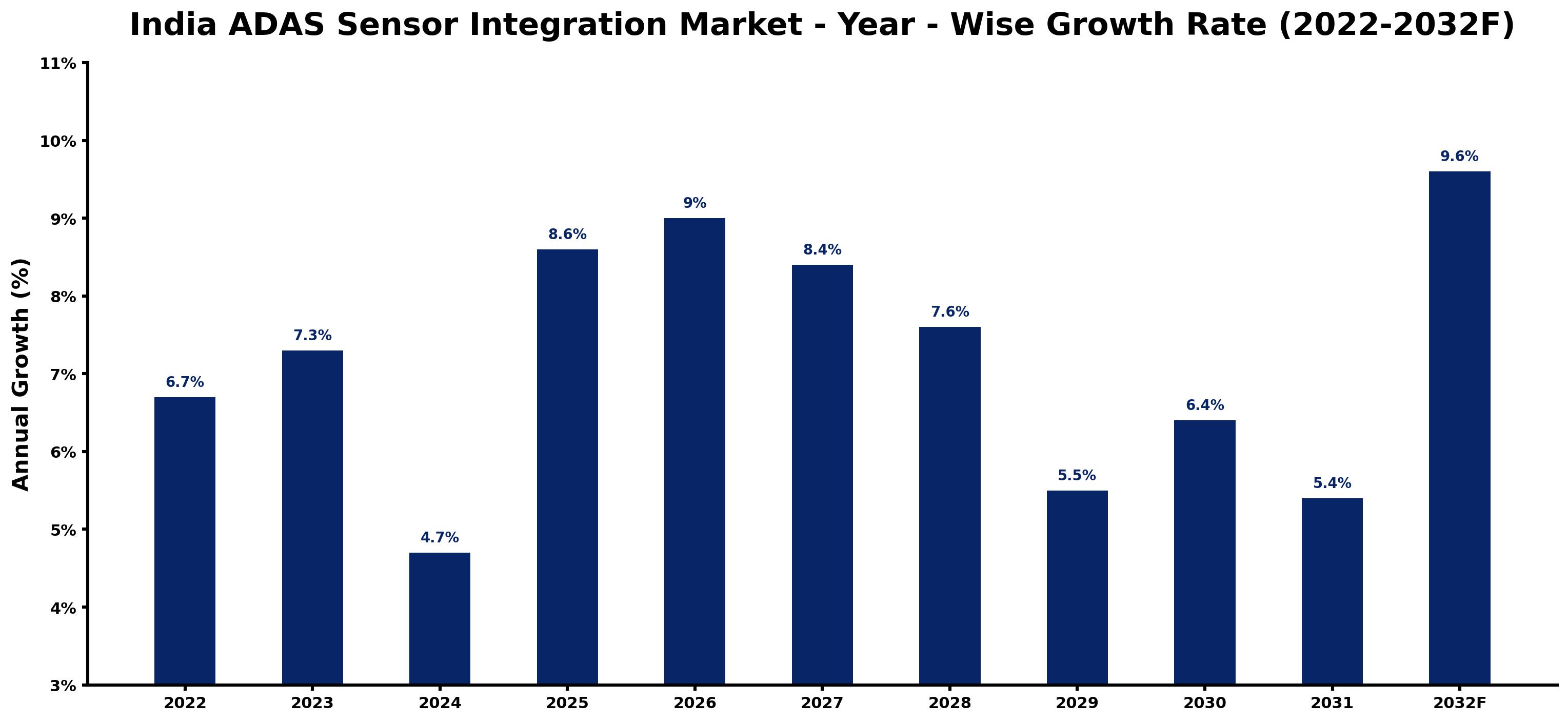
Each row of the following table gives one year's estimated growth and the event or demand shift that explains it.
| Year | Estimated Annual Growth (%) | Market Rationale |
| 2022 | 6.7 | The market experienced steady growth due to increased vehicle sales and technology adoption. |
| 2023 | 7.3 | Demand surged as more vehicles were equipped with ADAS features, reflecting consumer preferences. |
| 2024 | 4.7 | Growth slowed as manufacturers adjusted to supply chain challenges and component shortages. |
| 2025 | 8.6 | The market rebounded with a surge in investments in ADAS technologies and electric vehicles. |
| 2026 | 9.0 | Continued investments in electric vehicles and incentives from the FAME India Scheme will drive demand higher. |
| 2027 | 8.4 | Growth moderated as the market stabilised following the previous year's surge in demand for ADAS features. |
| 2028 | 7.6 | Demand continued to slow as manufacturers focused on refining existing technologies and compliance with new standards. |
| 2029 | 5.5 | The market saw further deceleration as consumer demand shifted towards affordability and understanding of ADAS. |
| 2030 | 6.4 | Growth picked up again as new government initiatives encouraged EV adoption with ADAS features. |
| 2031 | 5.4 | The market experienced a slowdown as competition intensified among manufacturers in the luxury segment. |
| 2032 | 9.6 | Demand surged again as the market reached its peak with widespread integration of advanced safety features. |
Note: Market size estimations and growth projections presented in this report are based on 6Wresearch's proprietary forecasting methodology, utilizing the latest available industry data, government publications, and primary research inputs.
India ADAS Sensor Integration Market Synopsis
The India ADAS Sensor Integration Market focuses on the integration of various sensors and software aimed at improving vehicle safety and automation. This includes technologies such as cameras, radars, and Lidar, primarily utilised for collision avoidance and lane-keeping assistance. The market is growing due to increased investments in electric vehicles and government initiatives like the National Electric Mobility Mission Plan. In 2022, the automotive sector attracted $30 billion in FDI, further propelling the development of these technologies.
Market Dynamics Impact Analysis (2026–2032)
| Factor | Type | Impact | Primary Segment Affected |
| Growing demand for vehicle safety features drives ADAS integration. | Driver | High | ADAS Platform Makers |
| Rising investments in electric vehicles are boosting ADAS technology adoption. | Driver | High | EV Startups |
| The shift towards luxury vehicles is creating opportunities for advanced ADAS features. | Opportunity | High | Luxury Vehicle Makers |
| The growing demand for safety features in vehicles presents a significant opportunity for ADAS integration. | Opportunity | High | Commercial Fleets |
| High costs associated with advanced sensor technologies limit adoption. | Restraint | Medium | Centralized Fusion |
| Lack of standardisation in ADAS technologies can hinder market growth. | Restraint | High | Modular Integration |
| The complexity of integrating multiple sensors can delay product development timelines. | Challenge | High | AI-Enhanced Integration |
| Regulatory compliance requirements can slow down the introduction of new technologies. | Challenge | Medium | Radar + Lidar |
Evaluation of Drivers in India ADAS Sensor Integration Market (2026–2032)
Below mentioned are some major drivers and their influence on market dynamics.
| Drivers | Primary Segment Affected | Why It Matters (Evidence) |
| Growing demand for vehicle safety features drives ADAS integration. | ADAS Platform Makers | In 2023, vehicle sales with ADAS features increased by 10%, encouraging manufacturers to expand their offerings. |
| Rising investments in electric vehicles are boosting ADAS technology adoption. | EV Startups | The Indian government aims for 30% electric vehicles by 2030, prompting increased integration of ADAS. |
| Government incentives for electric vehicles promote ADAS adoption. | Commercial Fleets | Incentives for electric vehicles encourage fleets to adopt advanced safety features. |
| Luxury vehicle market growth drives demand for advanced ADAS features. | Luxury Vehicle Makers | ADAS technologies in luxury vehicles are expected to grow at 15% annually until 2026. |
| The push for autonomous driving technologies is increasing ADAS integration. | ADAS Platform Makers | The Automotive Mission Plan 2026 focuses on enhancing global competitiveness, including ADAS technologies. |
Market growth in India for ADAS Sensor Integration rests on rising end-use demand from various sectors, including commercial fleets and luxury vehicle makers. In 2022, the automotive sector attracted $30 billion in FDI, boosting investments in ADAS technologies. The target of 30% electric vehicles on the road by 2030 is driving adoption. The luxury vehicle segment is projected to grow at 15% annually, pushing manufacturers to develop their offerings further.
Evaluation of Restraints in India ADAS Sensor Integration Market
The table below lists the restraints and the evidence behind each.
| Market Restraint | Primary Segment Affected | Why It Matters (Evidence) |
| High costs associated with advanced sensor technologies limit adoption. | Centralized Fusion | The integration of multiple sensors can exceed budget constraints for many manufacturers. |
| Lack of standardisation in ADAS technologies can hinder market growth. | Modular Integration | Inconsistent standards lead to confusion among consumers and manufacturers, slowing adoption. |
| Complexity of integrating multiple sensors can delay product development. | AI-Enhanced Integration | Manufacturers face challenges in ensuring compatibility and performance across various systems. |
| Regulatory compliance requirements can slow down the introduction of new technologies. | Radar + Lidar | Strict safety standards require extensive testing, delaying market entry for new products. |
| Limited consumer awareness about ADAS features may restrict market growth. | Camera + Ultrasonic | Consumers may hesitate to invest in vehicles with advanced technologies they do not understand. |
India ADAS Sensor Integration Market Challenges
The India ADAS Sensor Integration market faces a critical technology issue, as the integration of advanced sensors like Lidar and radars remains underdeveloped. This challenge arises from limited research funding, which delays the deployment of these systems and prolongs implementation timelines for automotive manufacturers. Supply chain disruptions also create challenges; reliance on imported components can increase costs by up to 20%, impacting producers' ability to meet rising consumer demand. Regulatory uncertainties complicate the situation, as unclear standards for ADAS technologies create compliance difficulties for manufacturers, potentially hindering market expansion. A skills gap in the workforce restricts training institutions' capacity to produce qualified personnel, resulting in slower innovation rates in the sector.
Trends in the India ADAS Sensor Integration Market
Buyers and suppliers in the India ADAS Sensor Integration Market are adjusting to the following trends.
- Shift towards Electric Vehicles with ADAS: The Indian government launched the 'FAME India Scheme' in 2023 to incentivise electric vehicles, promoting ADAS integration. With a budget of $1.4 billion, this initiative is expected to boost the adoption of ADAS features in electric vehicles.
- Growing Demand for Luxury Vehicles with Advanced ADAS: The luxury vehicle market in India is experiencing a shift towards advanced ADAS features, with a growth rate of 15% expected by 2026. This trend is driven by consumer preferences for improved safety and automation in high-end vehicles.
- Increased Focus on Safety Standards for ADAS: The Automotive Industry Standards Committee is updating safety standards for ADAS technologies, enhancing compliance and safety in vehicles. This initiative is important for building consumer trust and expanding the market.
- Expansion of Testing Facilities for ADAS Technologies: The National Automotive Testing and R&D Infrastructure Project is supporting the establishment of advanced testing facilities for ADAS technologies. This initiative aims to improve the reliability and performance of ADAS systems in India.
Investment Opportunities in the India ADAS Sensor Integration Market
Investors looking at the India ADAS Sensor Integration Market should consider the following areas.
- Growing Demand for ADAS in Commercial Fleets: With a 10% increase in vehicle sales featuring ADAS in 2023, there is a strong opportunity to supply advanced integration solutions. Commercial fleets are increasingly adopting these technologies to improve safety and efficiency.
- Investment in Electric Vehicle Startups: The current push for electric vehicles presents a unique opportunity for partnerships with EV startups. By collaborating with these innovators, suppliers can integrate ADAS features into new models, tapping into a rapidly growing market.
- Expansion of ADAS Features in Luxury Vehicles: The luxury vehicle segment is projected to grow by 15% annually, creating a demand for advanced ADAS technologies. Suppliers should focus on developing tailored solutions for this high-end market.
- Development of Standardised Testing Protocols: As the Automotive Research Association of India works on testing protocols for ADAS systems, there is an opportunity to invest in compliance solutions. This will ensure that products meet evolving safety standards and gain market acceptance.
Government Initiatives in the India ADAS Sensor Integration Market
The 'National Electric Mobility Mission Plan 2021' by the Ministry of Heavy Industries promotes electric vehicles, including those equipped with ADAS technologies, targeting 30% EVs by 2030. The 'Automotive Mission Plan 2026' focuses on enhancing the automotive sector's global competitiveness, including ADAS integration, with a projected investment of $8 billion. Additionally, the 'Automotive Industry Standards Committee' is updating safety standards for ADAS technologies to ensure compliance and safety in vehicles, active since 2021.
The 'FAME India Phase II' scheme by the Ministry of Heavy Industries provides incentives for electric vehicles, encouraging the adoption of ADAS features in EVs, with a budget of $1.4 billion. The National Automotive Testing and R&D Infrastructure Project supports testing and development of ADAS technologies, facilitating compliance with safety standards. These initiatives enable manufacturers to improve their offerings and ensure that buyers can access advanced safety features.
Future Insight of the India ADAS Sensor Integration Market
The India ADAS Sensor Integration market is set to evolve significantly by 2032, driven by key factors. The National Electric Mobility Mission Plan aims to have 30% electric vehicles on the road by 2030, which will increase demand for ADAS features. The Automotive Research Association of India is developing testing protocols that will improve the reliability of these technologies. With $30 billion in foreign direct investment supporting advancements, the integration of enhanced safety features in vehicles will become more prevalent. Buyers will benefit from improved vehicle safety, while suppliers will discover new opportunities for growth and innovation.
Market Segmentation Analysis
Each segment group is reviewed below, with the leader by share and the fastest grower by CAGR.
By Integration Method – Centralized Fusion Dominated, Modular Integration Expected to Grow Fastest
According to Ravi Bhandari, Research Head at 6Wresearch, with a 43% revenue share in 2025, Centralized Fusion was the largest integration method category. Centralized Fusion holds the largest share because it is essential for comprehensive data analysis from multiple sensors, ensuring optimal performance of ADAS systems. This method is particularly favoured in luxury vehicles, where safety and automation are paramount for buyers. The quickest growth will come from Modular Integration, forecast to expand at a CAGR of 9.0% between 2026 and 2032. Modular Integration is experiencing rapid growth as it allows flexibility in adding or upgrading sensors as needed, which is vital for adapting to evolving market demands. This adaptability aligns with the government's push for increased electric vehicle adoption by 2030, further driving its demand. Suppliers should focus on developing modular solutions to meet the increasing need for adaptable ADAS technologies.
By Sensor Type – Radar + Lidar Dominated, Camera + Ultrasonic Expected to Grow Fastest
Radar + Lidar took a 41% share of sensor type in 2025, more than any other category. Radar + Lidar commands the largest market share due to its extensive use for advanced object detection and distance measurement, which are crucial for vehicle safety features. This combination is particularly prevalent in high-end models, reflecting consumer preferences for enhanced safety and automation. Camera + Ultrasonic is projected to grow fastest, at a CAGR of 9.7% during 2026–2032. Camera + Ultrasonic is the fastest-growing segment, largely driven by its widespread use for close-range detection and parking assistance, which is essential in urban environments. The notable increase in vehicle sales featuring ADAS technologies highlights the rising demand for these sensor types. Buyers will benefit from the expanding availability of advanced sensor technologies that significantly enhance vehicle safety and automation.
By Distribution Channel – OEMs Dominated, Tier 1 Suppliers Expected to Grow Fastest
OEMs accounted for a 41% market share by distribution channel in 2025. OEMs lead the market share as they serve as the primary channel for integrating ADAS in new vehicles, effectively delivering the latest technologies to consumers. Their established relationships with manufacturers facilitate the widespread adoption of these systems across the automotive sector. Over 2026–2032, Tier 1 Suppliers are expected to post the fastest growth, at a CAGR of 9.8%. Tier 1 Suppliers are the fastest-growing segment, as they play a crucial role in supplying components and systems to OEMs, meeting the rising demand for ADAS integration. Their responsiveness in the supply chain is vital for the swift development of new technologies. Suppliers must strengthen their partnerships with Tier 1 Suppliers to ensure timely delivery of essential ADAS components.
By End User – ADAS Platform Makers Dominated, EV Startups Expected to Grow Fastest
In 2025, ADAS Platform Makers led the end user split with a 53% share. ADAS Platform Makers hold the largest market share as they are directly involved in developing software and systems for ADAS, making them essential to the industry's growth. Their expertise ensures that the latest advancements in safety technology are effectively implemented in vehicles. EV Startups are set to record the highest CAGR in this split, 9.3% over 2026–2032. EV Startups are the fastest-growing segment, rapidly integrating ADAS in new electric vehicle models to meet consumer expectations for safety and automation. This trend is supported by government initiatives promoting electric vehicle adoption. Investing in partnerships with EV Startups can provide suppliers with opportunities to expand their market presence.
Key Attractiveness of the Report
- 10 Years of Market Numbers
- Historical Data Starting from 2022 to 2025
- Base Year 2025
- Forecast Data until 2032
- Key Performance Indicators Impacting the Market
- Major Upcoming Developments and Projects
Key Highlights of the Report:
- India ADAS Sensor Integration Market Outlook
- Market Size of India ADAS Sensor Integration Market, 2025
- Forecast of India ADAS Sensor Integration Market, 2032
- Historical Data and Forecast of India ADAS Sensor Integration Revenues & Volume for the Period 2022 - 2032F
- India ADAS Sensor Integration Market Trend Evolution
- India ADAS Sensor Integration Market Drivers and Challenges
- India ADAS Sensor Integration Price Trends
- India ADAS Sensor Integration Porter's Five Forces
- India ADAS Sensor Integration Industry Life Cycle
- Historical Data and Forecast of India ADAS Sensor Integration Market Revenues & Volume By Integration Method for the Period 2022 - 2032F
- Historical Data and Forecast of India ADAS Sensor Integration Market Revenues & Volume By Centralized Fusion for the Period 2022 - 2032F
- Historical Data and Forecast of India ADAS Sensor Integration Market Revenues & Volume By Modular Integration for the Period 2022 - 2032F
- Historical Data and Forecast of India ADAS Sensor Integration Market Revenues & Volume By Edge-Level Processing for the Period 2022 - 2032F
- Historical Data and Forecast of India ADAS Sensor Integration Market Revenues & Volume By AI-Enhanced Integration for the Period 2022 - 2032F
- Historical Data and Forecast of India ADAS Sensor Integration Market Revenues & Volume By Sensor Type for the Period 2022 - 2032F
- Historical Data and Forecast of India ADAS Sensor Integration Market Revenues & Volume By Radar + Lidar for the Period 2022 - 2032F
- Historical Data and Forecast of India ADAS Sensor Integration Market Revenues & Volume By Camera + Ultrasonic for the Period 2022 - 2032F
- Historical Data and Forecast of India ADAS Sensor Integration Market Revenues & Volume By Infrared Sensors for the Period 2022 - 2032F
- Historical Data and Forecast of India ADAS Sensor Integration Market Revenues & Volume By Sensor Arrays for the Period 2022 - 2032F
- Historical Data and Forecast of India ADAS Sensor Integration Market Revenues & Volume By Distribution Channel for the Period 2022 - 2032F
- Historical Data and Forecast of India ADAS Sensor Integration Market Revenues & Volume By OEMs for the Period 2022 - 2032F
- Historical Data and Forecast of India ADAS Sensor Integration Market Revenues & Volume By Tier 1 Suppliers for the Period 2022 - 2032F
- Historical Data and Forecast of India ADAS Sensor Integration Market Revenues & Volume By Online Distributors for the Period 2022 - 2032F
- Historical Data and Forecast of India ADAS Sensor Integration Market Revenues & Volume By Direct Sales for the Period 2022 - 2032F
- Historical Data and Forecast of India ADAS Sensor Integration Market Revenues & Volume By End User for the Period 2022 - 2032F
- Historical Data and Forecast of India ADAS Sensor Integration Market Revenues & Volume By ADAS Platform Makers for the Period 2022 - 2032F
- Historical Data and Forecast of India ADAS Sensor Integration Market Revenues & Volume By Commercial Fleets for the Period 2022 - 2032F
- Historical Data and Forecast of India ADAS Sensor Integration Market Revenues & Volume By EV Startups for the Period 2022 - 2032F
- Historical Data and Forecast of India ADAS Sensor Integration Market Revenues & Volume By Luxury Vehicle Makers for the Period 2022 - 2032F
- India ADAS Sensor Integration Import Export Trade Statistics
- Market Opportunity Assessment By Integration Method
- Market Opportunity Assessment By Sensor Type
- Market Opportunity Assessment By Distribution Channel
- Market Opportunity Assessment By End User
- India ADAS Sensor Integration Top Companies Market Share
- India ADAS Sensor Integration Competitive Benchmarking By Technical and Operational Parameters
- India ADAS Sensor Integration Company Profiles
- India ADAS Sensor Integration Key Strategic Recommendations
Market Covered
Segments analysed in this report are listed below.
By Integration Method
- Centralized Fusion
- Modular Integration
- Edge-Level Processing
- AI-Enhanced Integration
By Sensor Type
- Radar + Lidar
- Camera + Ultrasonic
- Infrared Sensors
- Sensor Arrays
By Distribution Channel
- OEMs
- Tier 1 Suppliers
- Online Distributors
- Direct Sales
By End User
- ADAS Platform Makers
- Commercial Fleets
- EV Startups
- Luxury Vehicle Makers































