India Additive Electronics Manufacturing Market Size & Growth Rate
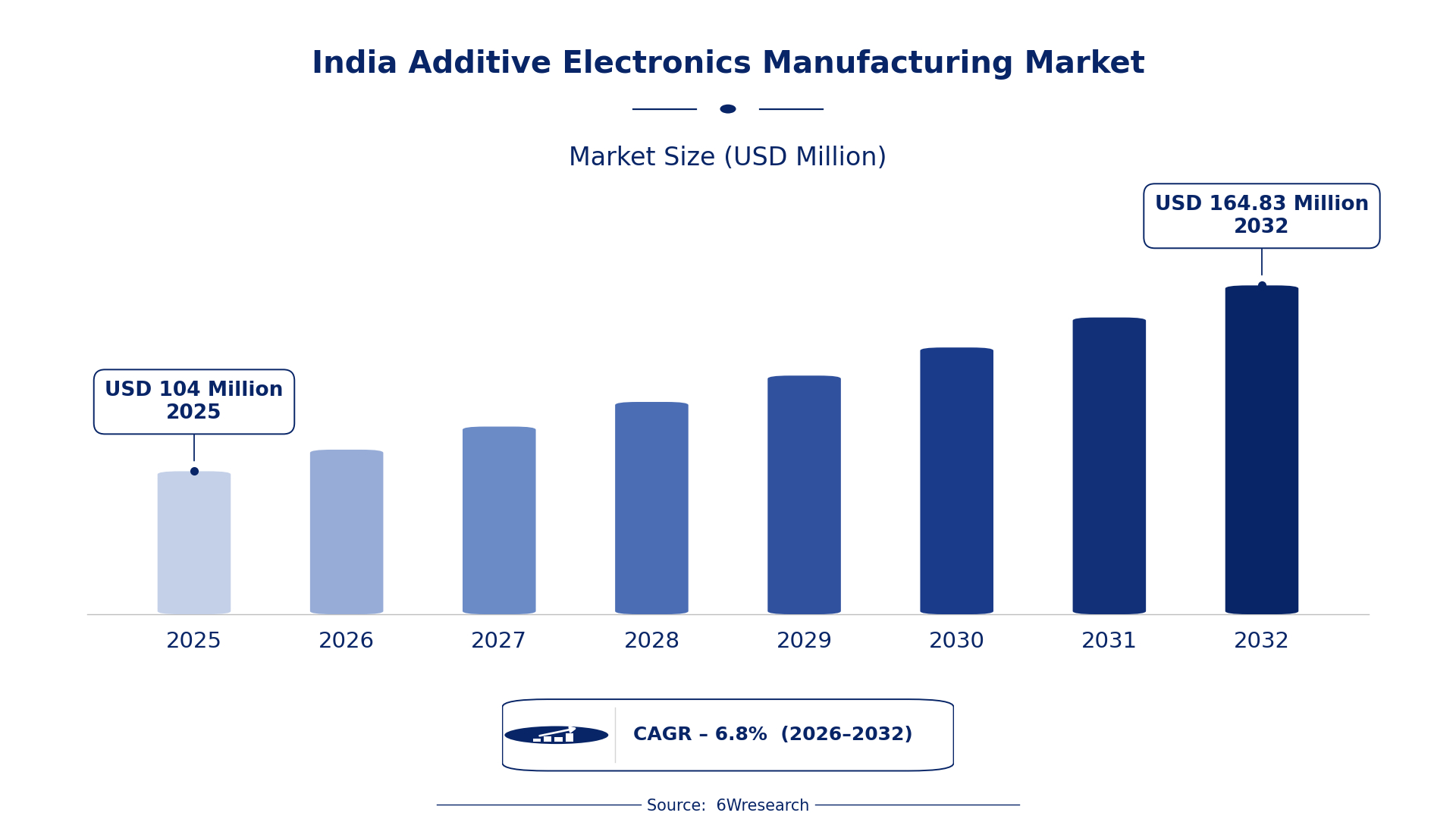
According to 6Wresearch internal database and industry insights, the India Additive Electronics Manufacturing Market was valued at USD 104.0 million in 2025 and is projected to reach USD 164.83 million by 2032, growing at a CAGR of approximately 6.8% during 2026–2032.
India Additive Electronics Manufacturing Market Highlights
| Report Metric | Details |
| Report Name | India Additive Electronics Manufacturing Market |
| Market Size 2025 | USD 104.0 million |
| Market Size 2032 | USD 164.83 million |
| Absolute Growth 2025–2032 | USD 60.83 million |
| CAGR 2026–2032 | 6.8% |
| Peak Annual Growth | 9.1% in 2030 |
| Forecast Period | 2026–2032 |
| Historical Data | 2022–2025 |
| Base Year | 2025 |
| Leading Product Type, 2025 | Inkjet Printing for PCBs (51% share) |
| Leading Distribution Channel, 2025 | Direct Sales (48% share) |
| Leading End User, 2025 | Consumer Electronics (44% share) |
| Fastest-Growing Product Type | 3D Printed Sensors (9.5% CAGR) |
| Fastest-Growing Distribution Channel | OEM Partnerships (8.7% CAGR) |
| Fastest-Growing End User | Wearable Devices (8.9% CAGR) |
| Growing Sector | Wearable Devices |
| Key End Users | Consumer Electronics, Telecommunication, Wearable Devices, Automotive Sector |
India Additive Electronics Manufacturing Market Year-wise Growth Rate and Key Drivers (2022–2032)
This graph illustrates the annual growth rates of the market from 2022 to 2032, highlighting a steady upward trajectory and projected market expansion over the forecast period.
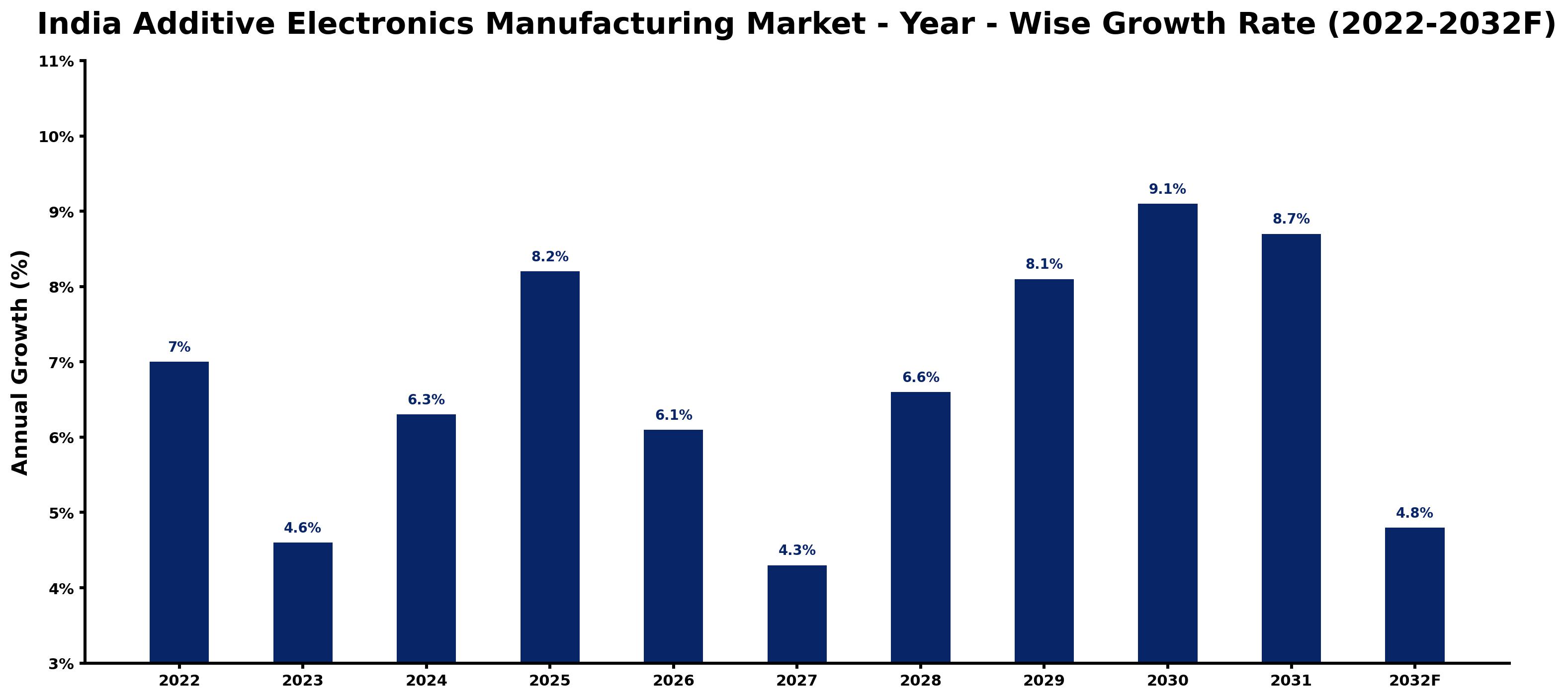
Year by year, the estimates below pair each growth rate with the development that shaped it.
| Year | Estimated Annual Growth (%) | Market Rationale |
| 2022 | 7.0 | The market experienced steady growth due to increased demand from consumer electronics. |
| 2023 | 4.6 | Growth slowed as manufacturers adjusted to supply chain challenges and material costs. |
| 2024 | 6.3 | Demand rose as new technologies in additive manufacturing gained traction in the market. |
| 2025 | 8.2 | The market peaked as the 'Make in India' initiative spurred local production capabilities. |
| 2026 | 6.1 | Growth slowed as companies faced challenges in scaling operations and meeting standards. |
| 2027 | 4.3 | A further slowdown occurred as competition intensified among local manufacturers. |
| 2028 | 6.6 | Demand increased again due to rising needs in wearable devices and telecommunications. |
| 2029 | 8.1 | Growth accelerated as advancements in 3D printed sensors captured market interest. |
| 2030 | 9.1 | The market reached its peak growth as the semiconductor market expanded significantly. |
| 2031 | 8.7 | Growth slowed slightly as the market stabilised after rapid expansion. |
| 2032 | 4.8 | A further slowdown is expected as the market matures and competition increases. |
Note: Market size estimations and growth projections presented in this report are based on 6Wresearch's proprietary forecasting methodology, utilizing the latest available industry data, government publications, and primary research inputs.
India Additive Electronics Manufacturing Market Synopsis
Additive Electronics Manufacturing in India utilises advanced printing technologies to produce electronic components such as printed circuit boards, sensors, and antennas. This market is growing due to rising domestic demand and initiatives like 'Make in India'. With over 1.3 billion mobile connections, the demand for sophisticated telecommunications components is considerable.
Market Dynamics Impact Analysis (2026–2032)
| Factor | Type | Impact | Primary Segment Affected |
| Growing demand for printed circuit boards from consumer electronics manufacturers | Driver | High | Inkjet Printing for PCBs |
| Increasing investment in wearable devices driving demand for advanced sensors | Driver | High | 3D Printed Sensors |
| Expansion of the wearable device market expected to boost additive manufacturing needs | Opportunity | High | Wearable Devices |
| Government incentives under the 'Production Linked Incentive Scheme' encourage local production | Opportunity | High | Aerosol Jet Printing |
| Challenges in meeting quality standards set by the Bureau of Indian Standards | Restraint | High | Antenna Printing |
| Supply chain disruptions affecting material availability for manufacturers | Restraint | Medium | Inkjet Printing for PCBs |
| Additive Electronics Manufacturing in India faces high competition from established players | Challenge | High | Consumer Electronics |
| Technological advancements require continuous investment, straining smaller manufacturers | Challenge | Medium | Telecommunication |
Evaluation of Drivers in India Additive Electronics Manufacturing Market (2026–2032)
The table below links each growth driver to the segment it affects and the evidence for it.
| Drivers | Primary Segment Affected | Why It Matters (Evidence) |
| Increased demand for printed circuit boards from consumer electronics | Inkjet Printing for PCBs | This demand is linked to the growing number of mobile connections, which exceeds 1.3 billion. |
| Rising investment in wearable devices and their components | 3D Printed Sensors | The wearable device market is projected to grow at a rate of 30% from 2023 to 2026, boosting demand for advanced sensors. |
| Government initiatives promoting local manufacturing capabilities | Antenna Printing | The 'Make in India' initiative supports local production, facilitating the manufacturing of efficient communication devices. |
| Growing telecommunications sector requiring advanced components | Consumer Electronics | The increasing need for connectivity drives the demand for sophisticated electronic components. |
| Expansion of manufacturing capabilities in electronics clusters | Telecommunication | The establishment of electronics manufacturing clusters provides resources to support additive manufacturing. |
Growth in the Additive Electronics Manufacturing market in India is driven by increasing demand from consumer electronics and wearable devices. The number of mobile connections in India surpasses 1.3 billion, which fuels the need for printed circuit boards. The wearable device market is anticipated to grow at a rate of 30% from 2023 to 2026, leading to a surge in demand for advanced sensors. In addition, the establishment of electronics manufacturing clusters improves resources for producers, stimulating growth in the telecommunications sector.
Evaluation of Restraints in India Additive Electronics Manufacturing Market
The main factors holding the market back are set out below.
| Market Restraint | Primary Segment Affected | Why It Matters (Evidence) |
| Challenges in meeting quality standards set by the Bureau of Indian Standards | Antenna Printing | Manufacturers must adhere to strict quality regulations, which can delay production timelines by several weeks. |
| Supply chain disruptions affecting material availability for manufacturers | Inkjet Printing for PCBs | Limited access to essential materials can hinder production capacity and lead to increased costs of up to 20%. |
| High competition from established players in the electronics sector | Consumer Electronics | New entrants struggle to gain market share against well-established manufacturers, limiting their growth potential. |
| Technological advancements require continuous investment | Telecommunication | Smaller manufacturers may find it challenging to keep pace with rapid technological changes, risking obsolescence. |
| Regulatory compliance costs burdening smaller manufacturers | 3D Printed Sensors | The costs associated with compliance can limit the ability of smaller firms to compete effectively, increasing operational expenses. |
India Additive Electronics Manufacturing Market Challenges
Producers in the India Additive Electronics Manufacturing market face significant supply chain disruptions due to a reliance on imported raw materials, which can delay production schedules by up to three months. This reliance leads to increased costs, with producers raising prices by approximately 15%, directly affecting buyers in the consumer electronics sector. Regulatory compliance with standards set by the Bureau of Indian Standards complicates manufacturing processes, resulting in product launch delays of up to six months for manufacturers. Additionally, local producers encounter fierce competition from international firms, which diminishes their market share and profit margins, ultimately forcing buyers to pay higher prices.
Trends in the India Additive Electronics Manufacturing Market
Below mentioned are some of the trends shaping the India Additive Electronics Manufacturing Market growth.
- Shift towards 3D Printed Sensors: The trend towards 3D printed sensors commenced in 2023, spurred by the rising demand in wearable devices. This shift is highlighted by the expected 30% CAGR in the wearable device market, presenting a significant opportunity for manufacturers.
- Transition from Traditional to Additive Manufacturing: Since 2019, traditional manufacturing methods have gradually been supplanted by additive techniques. The 'National Policy on Electronics 2019' supports this transition, aiming for a $400 billion electronics industry by 2025.
- Consumer Electronics Embracing Additive Technologies: Manufacturers in consumer electronics are swiftly adopting additive technologies to improve product design. This trend is reflected in the 44% market share of consumer electronics in 2025, underscoring their leadership in the sector.
- Telecommunications Sector Adopting Advanced Components: The telecommunications sector has increasingly integrated additive manufacturing since 2020. With over 1.3 billion mobile connections, the demand for advanced components is set to rise significantly.
Investment Opportunities in the India Additive Electronics Manufacturing Market
The following opportunities in the India Additive Electronics Manufacturing Market pair current demand with a clear way in.
- Growing Demand for Wearable Devices: With the wearable device market projected to grow at a rate of 30%, there is a clear opportunity for suppliers of 3D printed sensors. Collaborating with manufacturers in the consumer electronics sector can facilitate entry into this market.
- Government Incentives for Local Production: The 'Production Linked Incentive Scheme' provides substantial funding for manufacturers adopting additive technologies. This creates an opportunity for industrial suppliers to partner with local manufacturers in India, improving production capabilities.
- Expansion of Telecommunications Infrastructure: The growth of the telecommunications sector, driven by over 1.3 billion mobile connections, generates demand for advanced antennas. Suppliers can penetrate this market by collaborating with telecommunications companies to address the increasing needs.
- Investment in Additive Manufacturing Facilities: The Indian government is promoting the establishment of electronics manufacturing clusters. Investing in these clusters can offer access to resources and a growing customer base, supporting local production.
Government Initiatives in the India Additive Electronics Manufacturing Market
The 'National Policy on Electronics 2019' aims to achieve a $400 billion electronics manufacturing industry by 2025, promoting additive manufacturing. This policy encourages local production and innovation by setting clear targets and providing a framework for growth. Additionally, the 'Make in India' initiative supports local manufacturing capabilities, enhancing the competitiveness of the additive electronics sector. These measures are vital for fostering an environment conducive to investment and development in the industry.
The Electronics Sector Skill Council of India oversees the 'Production Linked Incentive Scheme', which offers incentives for electronics manufacturers, including those using additive technologies. This scheme funds projects that enhance local manufacturing capabilities, ensuring that producers can access the necessary resources to innovate. Furthermore, the Electronics Sector Skill Council of India provides training for skills in additive manufacturing, ensuring a skilled workforce is available to support industry growth. These initiatives are essential for sustaining momentum in the additive electronics market.
Future Insight of the India Additive Electronics Manufacturing Market
By 2032, buyers and suppliers in the India Additive Electronics Manufacturing market can anticipate substantial advancements, driven by initiatives like the 'National Policy on Electronics 2019' and the 'Make in India' campaign. The projected growth of the Indian semiconductor market to $70 billion by 2026 will significantly elevate demand for printed circuit boards, opening new avenues for local manufacturers. The 'Digital India' program will promote the adoption of cutting-edge technologies in production. Support for startups will also encourage innovative applications in additive manufacturing, creating a dynamic market environment.
Market Segmentation Analysis
The report offers a comprehensive study of the following market segments and their leading categories in the market.
By Product Type – Inkjet Printing for PCBs Dominated, 3D Printed Sensors Expected to Grow Fastest
According to Ravi Bhandari, Research Head at 6Wresearch, Inkjet Printing for PCBs accounted for a 51% market share by product type in 2025. Inkjet printing for PCBs commands the largest share as it is crucial for efficiently creating intricate circuit designs, essential for various electronic applications. This technology is widely adopted across India's electronics manufacturing units, particularly in states like Maharashtra and Tamil Nadu. The quickest growth will come from 3D Printed Sensors, forecast to expand at a CAGR of 9.5% between 2026 and 2032. 3D printed sensors are experiencing rapid growth due to their ability to enable quick prototyping and customisation, meeting the rising demand for innovative sensor solutions. The wearable device market's projected CAGR of 30% from 2023 to 2026 significantly fuels this expansion. Suppliers should enhance their offerings in 3D printed sensors to align with the increasing demand within the electronics sector.
By Distribution Channel – Direct Sales Dominated, OEM Partnerships Expected to Grow Fastest
Direct Sales took a 48% share of distribution channel in 2025, more than any other category. Direct sales lead the market as this method effectively connects manufacturers with industrial clients, ensuring tailored solutions for their specific needs. This approach is essential for building strong relationships and understanding client requirements in the additive electronics sector. OEM Partnerships are projected to grow fastest, at a CAGR of 8.7% during 2026–2032. OEM partnerships are rapidly increasing in importance as they allow for the integration of additive solutions into existing products, leveraging established distribution networks. This trend is expected to continue as companies seek to enhance their product offerings through collaboration. Buyers should consider engaging with OEM partners to access advanced additive technologies that can elevate their product lines.
By End User – Consumer Electronics Dominated, Wearable Devices Expected to Grow Fastest
Consumer Electronics held a 44% share of the India Additive Electronics Manufacturing Market by end user in 2025. Consumer electronics is the predominant end user of additive manufacturing technologies, driven by the demand for innovative electronic devices and components. The extensive utilisation of printed circuit boards in this sector highlights its critical role in the overall market share. Over 2026–2032, Wearable Devices are expected to post the fastest growth, at a CAGR of 8.9%. Wearable devices are the fastest-growing segment, employing advanced manufacturing techniques to meet the rising consumer demand for health and fitness technology. The anticipated growth in this market underscores the need for efficient additive manufacturing solutions. Suppliers should focus on developing solutions tailored for the wearable devices segment to capitalise on emerging opportunities.
Key Attractiveness of the Report
- 10 Years of Market Numbers
- Historical Data Starting from 2022 to 2025
- Base Year 2025
- Forecast Data until 2032
- Key Performance Indicators Impacting the Market
- Major Upcoming Developments and Projects
Key Highlights of the Report:
- India Additive Electronics Manufacturing Market Outlook
- Market Size of India Additive Electronics Manufacturing Market, 2025
- Forecast of India Additive Electronics Manufacturing Market, 2032
- Historical Data and Forecast of India Additive Electronics Manufacturing Revenues & Volume for the Period 2022 - 2032F
- India Additive Electronics Manufacturing Market Trend Evolution
- India Additive Electronics Manufacturing Market Drivers and Challenges
- India Additive Electronics Manufacturing Price Trends
- India Additive Electronics Manufacturing Porter's Five Forces
- India Additive Electronics Manufacturing Industry Life Cycle
- Historical Data and Forecast of India Additive Electronics Manufacturing Market Revenues & Volume By Product Type for the Period 2022 - 2032F
- Historical Data and Forecast of India Additive Electronics Manufacturing Market Revenues & Volume By Inkjet Printing for PCBs for the Period 2022 - 2032F
- Historical Data and Forecast of India Additive Electronics Manufacturing Market Revenues & Volume By Aerosol Jet Printing for the Period 2022 - 2032F
- Historical Data and Forecast of India Additive Electronics Manufacturing Market Revenues & Volume By 3D Printed Sensors for the Period 2022 - 2032F
- Historical Data and Forecast of India Additive Electronics Manufacturing Market Revenues & Volume By Antenna Printing for the Period 2022 - 2032F
- Historical Data and Forecast of India Additive Electronics Manufacturing Market Revenues & Volume By Distribution Channel for the Period 2022 - 2032F
- Historical Data and Forecast of India Additive Electronics Manufacturing Market Revenues & Volume By Direct Sales for the Period 2022 - 2032F
- Historical Data and Forecast of India Additive Electronics Manufacturing Market Revenues & Volume By Online Platforms for the Period 2022 - 2032F
- Historical Data and Forecast of India Additive Electronics Manufacturing Market Revenues & Volume By Industrial Suppliers for the Period 2022 - 2032F
- Historical Data and Forecast of India Additive Electronics Manufacturing Market Revenues & Volume By OEM Partnerships for the Period 2022 - 2032F
- Historical Data and Forecast of India Additive Electronics Manufacturing Market Revenues & Volume By End User for the Period 2022 - 2032F
- Historical Data and Forecast of India Additive Electronics Manufacturing Market Revenues & Volume By Consumer Electronics for the Period 2022 - 2032F
- Historical Data and Forecast of India Additive Electronics Manufacturing Market Revenues & Volume By Wearable Devices for the Period 2022 - 2032F
- Historical Data and Forecast of India Additive Electronics Manufacturing Market Revenues & Volume By Automotive Sector for the Period 2022 - 2032F
- Historical Data and Forecast of India Additive Electronics Manufacturing Market Revenues & Volume By Telecommunication for the Period 2022 - 2032F
- India Additive Electronics Manufacturing Import Export Trade Statistics
- Market Opportunity Assessment By Product Type
- Market Opportunity Assessment By Distribution Channel
- Market Opportunity Assessment By End User
- India Additive Electronics Manufacturing Top Companies Market Share
- India Additive Electronics Manufacturing Competitive Benchmarking By Technical and Operational Parameters
- India Additive Electronics Manufacturing Company Profiles
- India Additive Electronics Manufacturing Key Strategic Recommendations
Market Covered
The report offers an extensive study of the following market segments.
By Product Type
- Inkjet Printing for PCBs
- Aerosol Jet Printing
- 3D Printed Sensors
- Antenna Printing
By Distribution Channel
- Direct Sales
- Online Platforms
- Industrial Suppliers
- OEM Partnerships
By End User
- Consumer Electronics
- Wearable Devices
- Automotive Sector
- Telecommunication































