India Advanced Aerospace Materials Market Size & Growth Rate
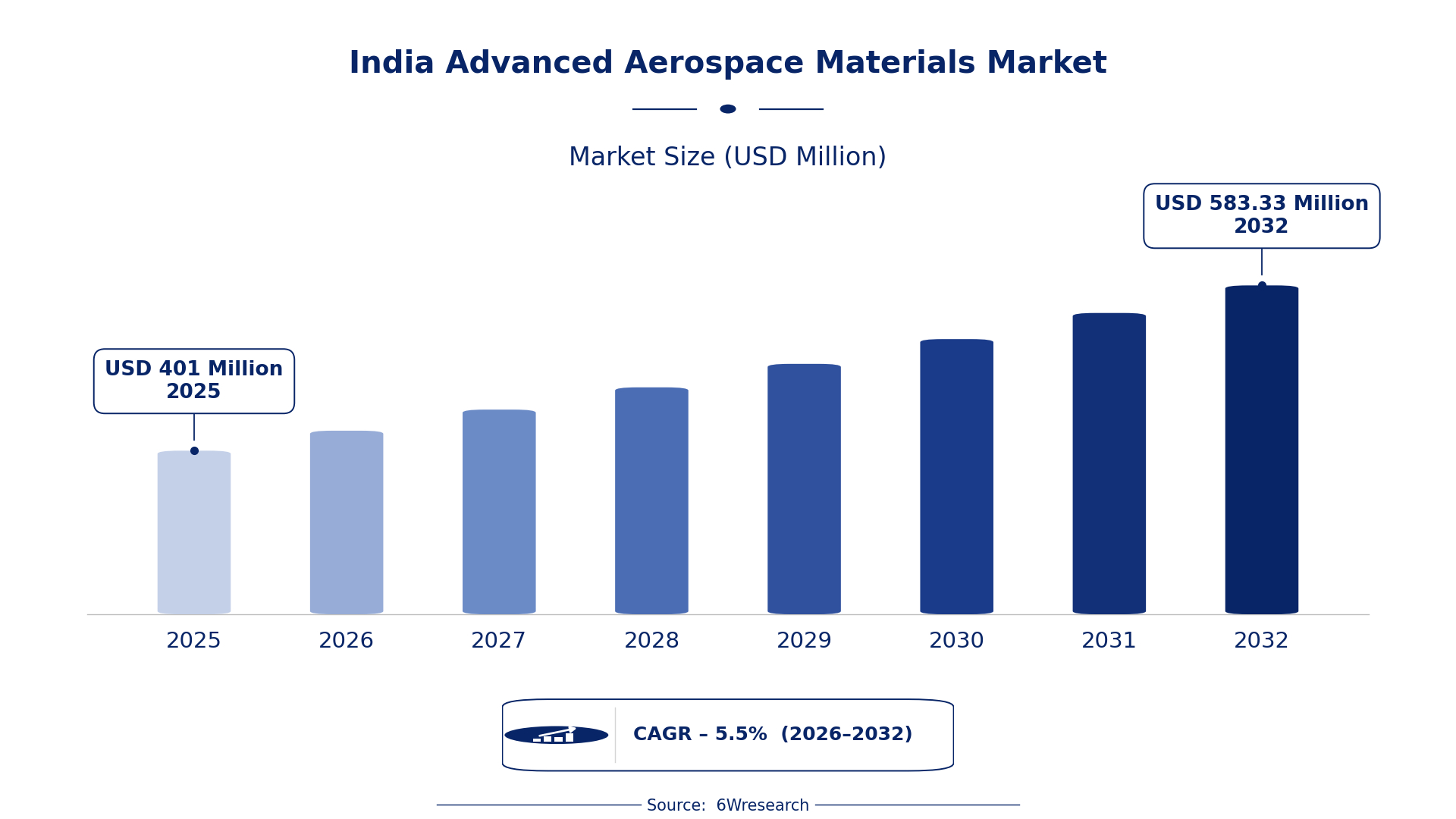
According to 6Wresearch internal database and industry insights, the India Advanced Aerospace Materials Market was valued at USD 401.0 million in 2025 and is projected to reach USD 583.33 million by 2032, growing at a CAGR of approximately 5.5% during 2026–2032.
India Advanced Aerospace Materials Market Highlights
| Report Metric | Details |
| Report Name | India Advanced Aerospace Materials Market |
| Market Size 2025 | USD 401.0 million |
| Market Size 2032 | USD 583.33 million |
| Absolute Growth 2025–2032 | USD 182.33 million |
| CAGR 2026–2032 | 5.5% |
| Peak Annual Growth | 7.3% in 2028 |
| Forecast Period | 2026–2032 |
| Historical Data | 2022–2025 |
| Base Year | 2025 |
| Leading Material Type, 2025 | Titanium Alloys (45% share) |
| Leading Application, 2025 | Aircraft Structures (48% share) |
| Leading Form Type, 2025 | Sheets & Plates (47% share) |
| Leading Distribution Channel, 2025 | Direct Sales (40% share) |
| Leading End User Industry, 2025 | Aerospace Manufacturers (40% share) |
| Fastest-Growing Material Type | Carbon Composites (7.2% CAGR) |
| Fastest-Growing Application | Engine Components (6.9% CAGR) |
| Fastest-Growing Form Type | Prepregs (7.3% CAGR) |
| Fastest-Growing Distribution Channel | Online Platforms (7.4% CAGR) |
| Fastest-Growing End User Industry | Defense Contractors (7.6% CAGR) |
| Growing Sector | Engine Components |
| Key End Users | Aircraft Structures, Engine Components, Thermal Insulation, Fuselage & Wings |
India Advanced Aerospace Materials Market Year-wise Growth Rate and Key Drivers (2022–2032)
This graph illustrates the annual growth rates of the market from 2022 to 2032, highlighting a steady upward trajectory and projected market expansion over the forecast period.
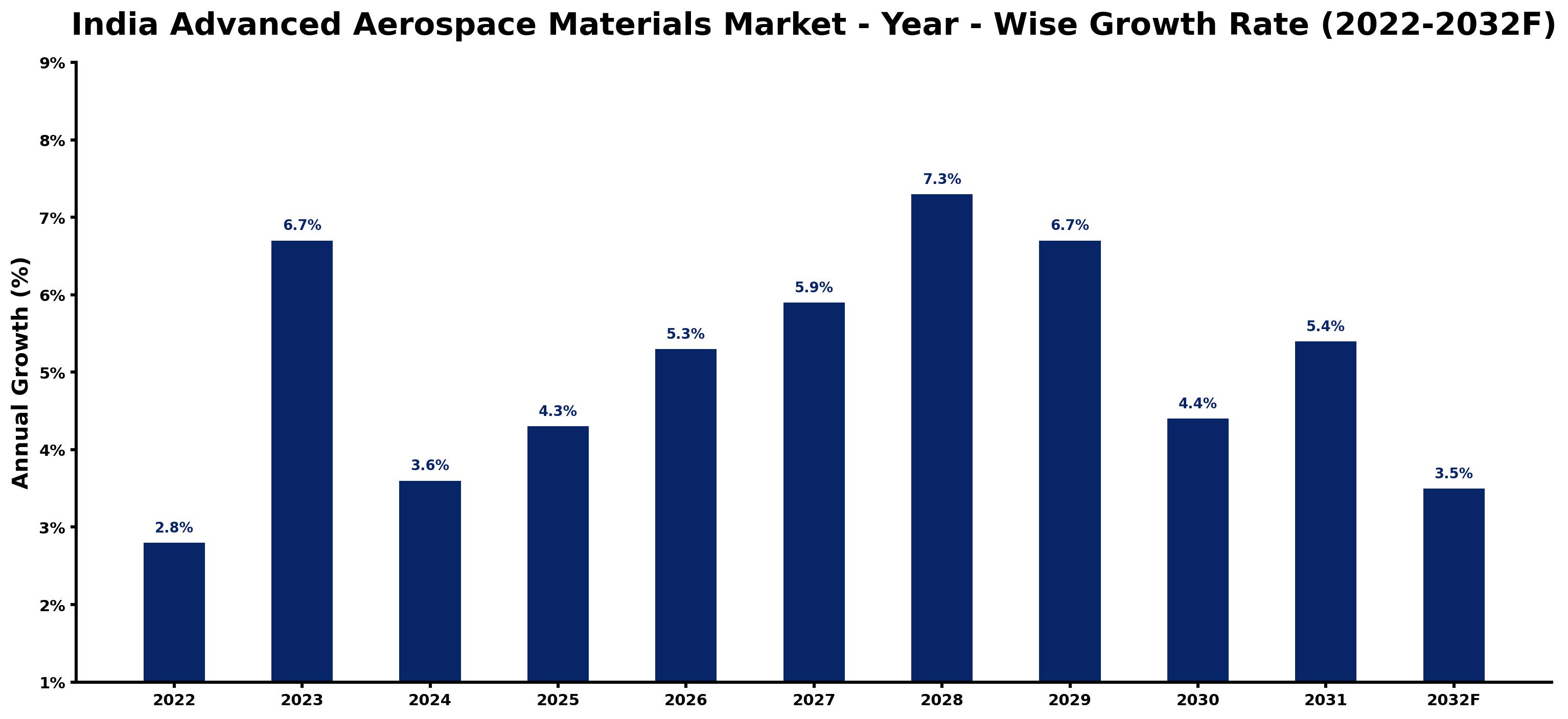
Below, each year's estimated growth is shown next to the factor that most influenced it.
| Year | Estimated Annual Growth (%) | Market Rationale |
| 2022 | 2.8 | The market experienced initial growth driven by rising aerospace activity. |
| 2023 | 6.7 | Demand surged due to increased investments in domestic aerospace manufacturing. |
| 2024 | 3.6 | Growth slowed as manufacturers adjusted to supply chain challenges. |
| 2025 | 4.3 | A boost in defense contracts led to faster growth in aerospace materials. |
| 2026 | 5.3 | Investment in advanced manufacturing techniques is expected to support higher demand. |
| 2027 | 5.9 | Increased production capabilities in Karnataka will enhance market growth. |
| 2028 | 7.3 | The peak growth is driven by expanding commercial aviation needs. |
| 2029 | 6.7 | Growth slowed as the market began to stabilise after rapid expansion. |
| 2030 | 4.4 | A slight slowdown is expected as demand normalises post-peak. |
| 2031 | 5.4 | Growth will accelerate again due to new aerospace projects and contracts. |
| 2032 | 3.5 | The market continues to grow, albeit at a slower rate than before. |
Note: Market size estimations and growth projections presented in this report are based on 6Wresearch's proprietary forecasting methodology, utilizing the latest available industry data, government publications, and primary research inputs.
India Advanced Aerospace Materials Market Synopsis
The Advanced Aerospace Materials Market in India includes high-performance materials such as titanium alloys and carbon composites, which are crucial for creating lightweight and durable aerospace components. These materials are manufactured using advanced techniques and play a key role in aircraft structures and engine components. Growth in this market is propelled by rising domestic manufacturing and defense contracts, with initiatives like the 'Atmanirbhar Bharat' programme driving expansion in the sector.
Market Dynamics Impact Analysis (2026–2032)
| Factor | Type | Impact | Primary Segment Affected |
| Increased domestic manufacturing capabilities driven by government initiatives | Driver | High | Titanium Alloys |
| Growing demand for lightweight materials in aircraft structures | Driver | High | Carbon Composites |
| Rising defense contracts creating a need for advanced materials | Opportunity | High | Engine Components |
| Expansion of commercial aviation leading to more aircraft production | Opportunity | High | Aircraft Structures |
| High production costs associated with advanced manufacturing processes | Restraint | Medium | Aluminum Alloys |
| Limited availability of skilled workforce for advanced aerospace materials | Restraint | Medium | Titanium Alloys |
| The Advanced Aerospace Materials Market in India faces high production costs | Challenge | High | Carbon Composites |
| Competition from imported materials affecting local producers | Challenge | Medium | Aircraft Structures |
Evaluation of Drivers in India Advanced Aerospace Materials Market (2026–2032)
The main growth drivers and the segments they affect most are set out below.
| Drivers | Primary Segment Affected | Why It Matters (Evidence) |
| Increased investments in aerospace manufacturing | Titanium Alloys | The government aims for a 25% increase in indigenous production by 2025. |
| Growing adoption of lightweight materials for fuel efficiency | Carbon Composites | The commercial aviation sector increasingly utilises carbon composites. |
| Expansion of the defense sector requiring advanced materials | Engine Components | Investment in next-generation aircraft boosts demand for high-performance materials. |
| Rising demand for durable materials in aircraft structures | Aircraft Structures | Aiming to double air traffic by 2024 increases the need for advanced materials. |
| Technological advancements in manufacturing processes | Aluminum Alloys | Research at national laboratories is driving innovations in aerospace materials. |
Market growth in India for Advanced Aerospace Materials rests on increasing investments in domestic aerospace manufacturing, demand for lightweight materials, and expanding defense contracts. The commercial aviation sector increasingly utilises carbon composites, improving fuel efficiency in aircraft. Investment in next-generation aircraft is boosting demand for engine components. The goal to double air traffic by 2024 further supports growth in aircraft structures.
Evaluation of Restraints in India Advanced Aerospace Materials Market
The following restraints limit how fast demand can grow.
| Market Restraint | Primary Segment Affected | Why It Matters (Evidence) |
| High production costs associated with advanced materials | Carbon Composites | Manufacturers face high expenses in sourcing and processing high-performance materials. |
| Limited availability of skilled workforce for aerospace manufacturing | Titanium Alloys | The aerospace industry struggles to find qualified workers trained in advanced materials. |
| Regulatory compliance costs for aerospace materials | Aluminum Alloys | Producers must adhere to strict standards set by the Bureau of Indian Standards. |
| Supply chain disruptions affecting material availability | Aircraft Structures | Global supply chain issues have delayed the procurement of essential materials. |
| Competition from imported advanced materials | Engine Components | Local manufacturers face challenges from lower-priced imports affecting market share. |
India Advanced Aerospace Materials Market Challenges
The Advanced Aerospace Materials market in India faces notable challenges, beginning with buyers who encounter inflated costs for imported titanium alloys, which can rise by 20% in just three months. Suppliers face regulatory hurdles; compliance with Bureau of Indian Standards specifications can delay product launches by up to six months, impacting their ability to meet market demand. Additionally, manufacturers must navigate evolving requirements under IS 10362, which can consume valuable time and resources. A persistent skills shortage further limits production capabilities, as the Aerospace and Defense Skill Sector Council reports a gap that hinders domestic manufacturers and defense contractors.
Trends in the India Advanced Aerospace Materials Market
Buyers and suppliers in the India Advanced Aerospace Materials Market are adjusting to the following trends.
- Shift from Traditional to Advanced Materials: The Indian aerospace industry is progressively adopting advanced materials like carbon composites for aircraft structures. This transition began in 2022, with a projected CAGR of 7.2% for carbon composites through 2032.
- Growing Use of Online Platforms for Procurement: Aerospace manufacturers are increasingly utilising online platforms for sourcing materials. This trend started gaining traction in 2023, with a projected CAGR of 7.4% for online sales channels.
- Increased Focus on Indigenous Production: The 'Atmanirbhar Bharat' initiative launched in 2020 has strengthened local production of aerospace materials. This policy aims for a 25% increase in indigenous production by 2025.
- Expansion of Defense Contracts Driving Demand: The Indian government’s focus on defence modernisation has led to increased contracts for advanced aerospace materials. In 2023, the government allocated $1.5 billion for defence modernisation projects.
Investment Opportunities in the India Advanced Aerospace Materials Market
Several openings in the India Advanced Aerospace Materials Market merit attention from investors.
- $401 million Market Potential by 2025: With the market projected to reach $401 million by 2025, there is an opportunity for suppliers of titanium alloys. Collaborating with aerospace manufacturers in Maharashtra can facilitate market entry.
- Growing Demand from Defense Contractors: Defense contractors are increasingly seeking advanced materials for military applications. The projected growth in this segment presents an opportunity for suppliers to engage with the Defense Research and Development Organisation.
- Investment in Advanced Manufacturing Facilities: The establishment of new manufacturing facilities in Karnataka offers an opportunity for investment in advanced aerospace materials. Local partnerships can improve market access and production capabilities.
- Expansion in Commercial Aviation Sector: The doubling of air traffic by 2024 creates a demand for lightweight materials. Suppliers can target commercial aviation manufacturers to satisfy this growing need.
Government Initiatives in the India Advanced Aerospace Materials Market
The 'Atmanirbhar Bharat' initiative, launched in 2020, aims to increase self-reliance in defense manufacturing by targeting a 25% increase in indigenous production by 2025. This measure encourages local production of advanced aerospace materials, reducing dependency on imports. Additionally, the updated 'Make in India' program promotes local manufacturing, further supporting the market for advanced aerospace materials. These initiatives create a supportive environment for domestic producers and buyers.
The Ministry of Defense oversees programs that encourage local manufacturing of advanced aerospace materials. This initiative funds projects aimed at improving indigenous production capabilities. The Aerospace and Defense Skill Sector Council, established in 2020, focuses on improving workforce skills in the aerospace industry, particularly in advanced materials training. These efforts ensure that the industry has the necessary talent to support growth and innovation.
Future Insight of the India Advanced Aerospace Materials Market
The Advanced Aerospace Materials market in India is poised for transformative changes by 2032, driven by several key factors. The 'Atmanirbhar Bharat' initiative will improve local production capabilities and reduce reliance on imports. Investment from the Indian Air Force in advanced materials for next-generation aircraft will significantly boost demand. Research at institutions like the Indian Institute of Technology will encourage innovations in composites, while the updated National Aerospace and Defense Policy aims to enhance indigenous defence manufacturing, creating new opportunities for suppliers and buyers.
Market Segmentation Analysis
Each segment group is reviewed below, with the leader by share and the fastest grower by CAGR.
By Material Type – Titanium Alloys Dominated, Carbon Composites Expected to Grow Fastest
According to Ravi Bhandari, Research Head at 6Wresearch, Titanium Alloys accounted for a 45% market share by material type in 2025. Titanium alloys hold the largest market share in India due to their critical high strength and corrosion resistance required in aerospace applications. The significant production capabilities in Maharashtra and Gujarat underpin a strong local aerospace manufacturing base, ensuring steady demand. The quickest growth will come from Carbon Composites, forecast to expand at a CAGR of 7.2% between 2026 and 2032. Carbon composites are experiencing rapid growth, driven by their lightweight and high stiffness, making them ideal for aircraft structures. Their increasing use in the commercial aviation sector is a key factor propelling this segment forward. Suppliers should prioritise the development of carbon composites to meet the rising demand within the aerospace industry.
By Application – Aircraft Structures Dominated, Engine Components Expected to Grow Fastest
The largest application category in 2025 was Aircraft Structures, with a 48% share of total revenue. Aircraft structures dominate the market share as they include essential components like wings and fuselage, which require advanced materials for safety and performance. The growth of aerospace companies across India further fuels the demand for these critical materials. Engine Components are projected to grow fastest, at a CAGR of 6.9% during 2026–2032. Engine components are the fastest-growing application, driven by the need for high-performance materials that enhance engine efficiency. The Indian Air Force's investments in advanced materials for next-generation aircraft are accelerating this segment's expansion. Buyers in the aerospace sector must focus on sourcing superior materials for engine components to ensure optimal operational performance.
By Form Type – Sheets & Plates Dominated, Prepregs Expected to Grow Fastest
With a 47% revenue share in 2025, Sheets & Plates was the largest form type category. Sheets and plates are the leading form type in the market, commonly used in manufacturing various aircraft parts, ensuring necessary structural integrity. Their widespread application across numerous aerospace projects reinforces their dominant position. Prepregs are set to record the highest CAGR in this split, 7.3% over 2026–2032. Prepregs are witnessing significant growth due to their essential role in composite layup processes, increasingly favoured in aerospace applications. This trend aligns with the industry's focus on lightweight materials that enhance fuel efficiency. Suppliers should consider enhancing their production capabilities for prepregs to capitalise on the rising demand in the aerospace sector.
By Distribution Channel – Direct Sales Dominated, Online Platforms Expected to Grow Fastest
Direct Sales took a 40% share of distribution channel in 2025, more than any other category. Direct sales lead the distribution channels as they serve as the primary procurement method for industrial buyers in the aerospace sector. This channel allows for tailored solutions and direct engagement with manufacturers. Over 2026–2032, Online Platforms are expected to post the fastest growth, at a CAGR of 7.4%. Online platforms are emerging as the fastest-growing distribution channel, reflecting a shift towards digital purchasing methods in the aerospace materials market. This trend is driven by the convenience and accessibility of online transactions for procurement. Suppliers should invest in online sales strategies to reach a broader customer base and adapt to changing purchasing behaviours.
By End User Industry – Aerospace Manufacturers Dominated, Defense Contractors Expected to Grow Fastest
Aerospace Manufacturers held a 40% share of the India Advanced Aerospace Materials Market by end user industry in 2025. Aerospace manufacturers represent the largest end-user industry for advanced aerospace materials, being the primary consumers of these high-performance materials. The increasing number of aerospace companies in India significantly drives this demand. The quickest growth will come from Defense Contractors, forecast to expand at a CAGR of 7.6% between 2026 and 2032. Defense contractors are the fastest-growing end-user segment, propelled by substantial investments in advanced materials for military applications. The Indian government's commitment to increasing the defense manufacturing share further accelerates this growth trajectory. Suppliers should strategically focus on defense contractors to capitalise on the rising demand for advanced aerospace materials in military applications.
Key Attractiveness of the Report
- 10 Years of Market Numbers
- Historical Data Starting from 2022 to 2025
- Base Year 2025
- Forecast Data until 2032
- Key Performance Indicators Impacting the Market
- Major Upcoming Developments and Projects
Key Highlights of the Report:
- India Advanced Aerospace Materials Market Outlook
- Market Size of India Advanced Aerospace Materials Market, 2025
- Forecast of India Advanced Aerospace Materials Market, 2032
- Historical Data and Forecast of India Advanced Aerospace Materials Revenues & Volume for the Period 2022 - 2032F
- India Advanced Aerospace Materials Market Trend Evolution
- India Advanced Aerospace Materials Market Drivers and Challenges
- India Advanced Aerospace Materials Price Trends
- India Advanced Aerospace Materials Porter's Five Forces
- India Advanced Aerospace Materials Industry Life Cycle
- Historical Data and Forecast of India Advanced Aerospace Materials Market Revenues & Volume By Material Type for the Period 2022 - 2032F
- Historical Data and Forecast of India Advanced Aerospace Materials Market Revenues & Volume By Titanium Alloys for the Period 2022 - 2032F
- Historical Data and Forecast of India Advanced Aerospace Materials Market Revenues & Volume By Carbon Composites for the Period 2022 - 2032F
- Historical Data and Forecast of India Advanced Aerospace Materials Market Revenues & Volume By Ceramic Matrix for the Period 2022 - 2032F
- Historical Data and Forecast of India Advanced Aerospace Materials Market Revenues & Volume By Aluminum Alloys for the Period 2022 - 2032F
- Historical Data and Forecast of India Advanced Aerospace Materials Market Revenues & Volume By Application for the Period 2022 - 2032F
- Historical Data and Forecast of India Advanced Aerospace Materials Market Revenues & Volume By Aircraft Structures for the Period 2022 - 2032F
- Historical Data and Forecast of India Advanced Aerospace Materials Market Revenues & Volume By Engine Components for the Period 2022 - 2032F
- Historical Data and Forecast of India Advanced Aerospace Materials Market Revenues & Volume By Thermal Insulation for the Period 2022 - 2032F
- Historical Data and Forecast of India Advanced Aerospace Materials Market Revenues & Volume By Fuselage & Wings for the Period 2022 - 2032F
- Historical Data and Forecast of India Advanced Aerospace Materials Market Revenues & Volume By Form Type for the Period 2022 - 2032F
- Historical Data and Forecast of India Advanced Aerospace Materials Market Revenues & Volume By Sheets & Plates for the Period 2022 - 2032F
- Historical Data and Forecast of India Advanced Aerospace Materials Market Revenues & Volume By Prepregs for the Period 2022 - 2032F
- Historical Data and Forecast of India Advanced Aerospace Materials Market Revenues & Volume By Powders for the Period 2022 - 2032F
- Historical Data and Forecast of India Advanced Aerospace Materials Market Revenues & Volume By Rods & Bars for the Period 2022 - 2032F
- Historical Data and Forecast of India Advanced Aerospace Materials Market Revenues & Volume By Distribution Channel for the Period 2022 - 2032F
- Historical Data and Forecast of India Advanced Aerospace Materials Market Revenues & Volume By Direct Sales for the Period 2022 - 2032F
- Historical Data and Forecast of India Advanced Aerospace Materials Market Revenues & Volume By Online Platforms for the Period 2022 - 2032F
- Historical Data and Forecast of India Advanced Aerospace Materials Market Revenues & Volume By Industrial Suppliers for the Period 2022 - 2032F
- Historical Data and Forecast of India Advanced Aerospace Materials Market Revenues & Volume By Specialty Stores for the Period 2022 - 2032F
- Historical Data and Forecast of India Advanced Aerospace Materials Market Revenues & Volume By End User Industry for the Period 2022 - 2032F
- Historical Data and Forecast of India Advanced Aerospace Materials Market Revenues & Volume By Aerospace Manufacturers for the Period 2022 - 2032F
- Historical Data and Forecast of India Advanced Aerospace Materials Market Revenues & Volume By Defense Contractors for the Period 2022 - 2032F
- Historical Data and Forecast of India Advanced Aerospace Materials Market Revenues & Volume By Satellite Industry for the Period 2022 - 2032F
- Historical Data and Forecast of India Advanced Aerospace Materials Market Revenues & Volume By Commercial Aviation for the Period 2022 - 2032F
- India Advanced Aerospace Materials Import Export Trade Statistics
- Market Opportunity Assessment By Material Type
- Market Opportunity Assessment By Application
- Market Opportunity Assessment By Form Type
- Market Opportunity Assessment By Distribution Channel
- Market Opportunity Assessment By End User Industry
- India Advanced Aerospace Materials Top Companies Market Share
- India Advanced Aerospace Materials Competitive Benchmarking By Technical and Operational Parameters
- India Advanced Aerospace Materials Company Profiles
- India Advanced Aerospace Materials Key Strategic Recommendations
Market Covered
This report examines the market across the segments below.
By Material Type
- Titanium Alloys
- Carbon Composites
- Ceramic Matrix
- Aluminum Alloys
By Application
- Aircraft Structures
- Engine Components
- Thermal Insulation
- Fuselage & Wings
By Form Type
- Sheets & Plates
- Prepregs
- Powders
- Rods & Bars
By Distribution Channel
- Direct Sales
- Online Platforms
- Industrial Suppliers
- Specialty Stores
By End User Industry
- Aerospace Manufacturers
- Defense Contractors
- Satellite Industry
- Commercial Aviation































