India Advanced Automotive Materials Market Size & Growth Rate
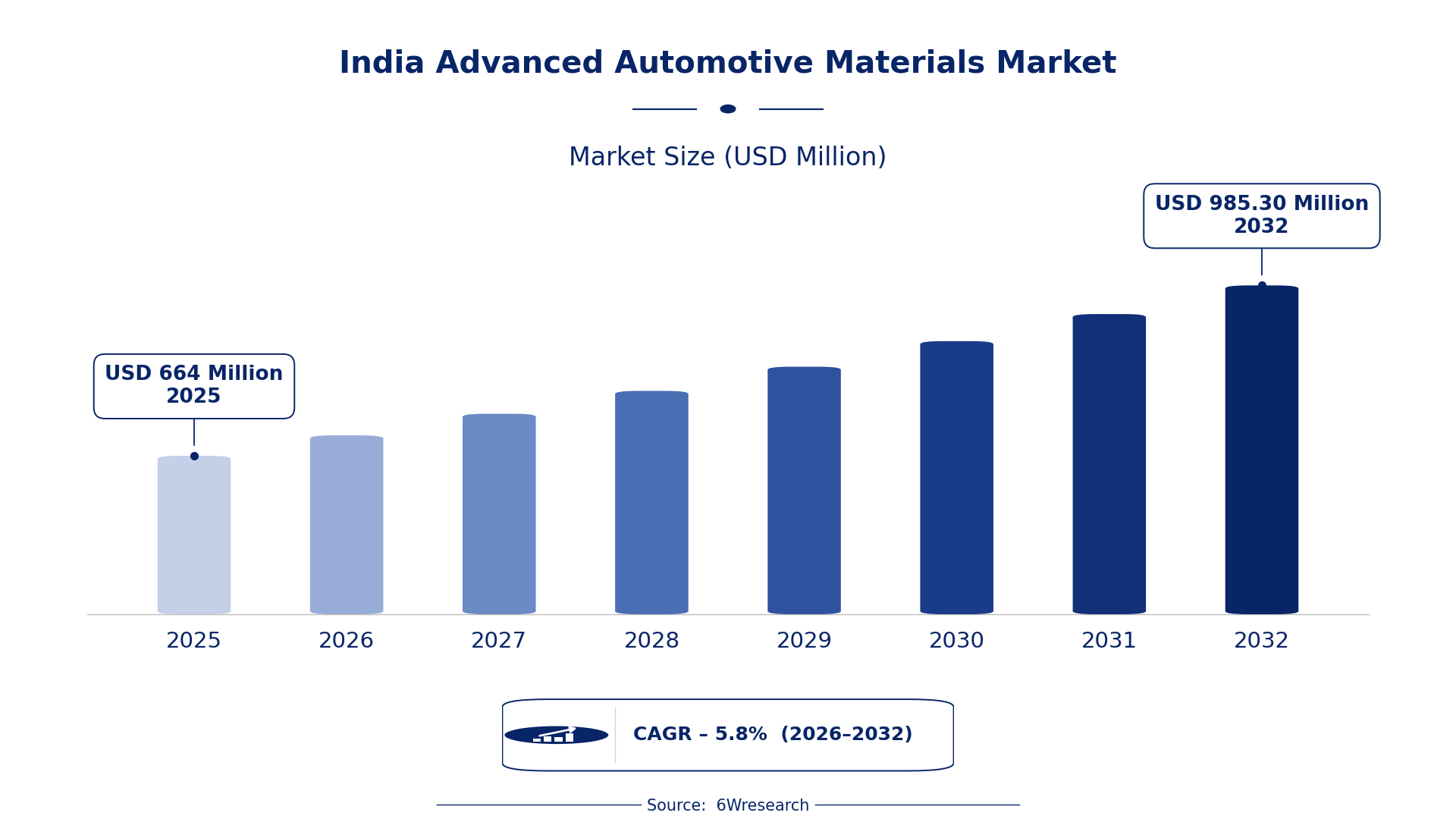
According to 6Wresearch internal database and industry insights, the India Advanced Automotive Materials Market was valued at USD 664.0 million in 2025 and is projected to reach USD 985.30 million by 2032, growing at a CAGR of approximately 5.8% during 2026–2032.
India Advanced Automotive Materials Market Highlights
| Report Metric | Details |
| Report Name | India Advanced Automotive Materials Market |
| Market Size 2025 | USD 664.0 million |
| Market Size 2032 | USD 985.30 million |
| Absolute Growth 2025–2032 | USD 321.30 million |
| CAGR 2026–2032 | 5.8% |
| Peak Annual Growth | 8.3% in 2029 |
| Forecast Period | 2026–2032 |
| Historical Data | 2022–2025 |
| Base Year | 2025 |
| Leading Material Type, 2025 | AHSS (37% share) |
| Leading Application Area, 2025 | Body Structure (48% share) |
| Leading Vehicle Type, 2025 | Passenger Cars (50% share) |
| Leading Distribution Channel, 2025 | OEMs (49% share) |
| Leading End User Segment, 2025 | Auto Manufacturers (39% share) |
| Fastest-Growing Material Type | Carbon Fiber (8.5% CAGR) |
| Fastest-Growing Application Area | Interior & Exterior (7.0% CAGR) |
| Fastest-Growing Vehicle Type | Sports Cars (7.9% CAGR) |
| Fastest-Growing Distribution Channel | Direct Sales (7.7% CAGR) |
| Fastest-Growing End User Segment | Luxury Car Segment (7.5% CAGR) |
| Growing Sector | Electric Vehicles |
| Key End Users | Auto Manufacturers, EV Manufacturers, Luxury Car Segment, Commercial Vehicle Producers |
India Advanced Automotive Materials Market Year-wise Growth Rate and Key Drivers (2022–2032)
This graph illustrates the annual growth rates of the market from 2022 to 2032, highlighting a steady upward trajectory and projected market expansion over the forecast period.
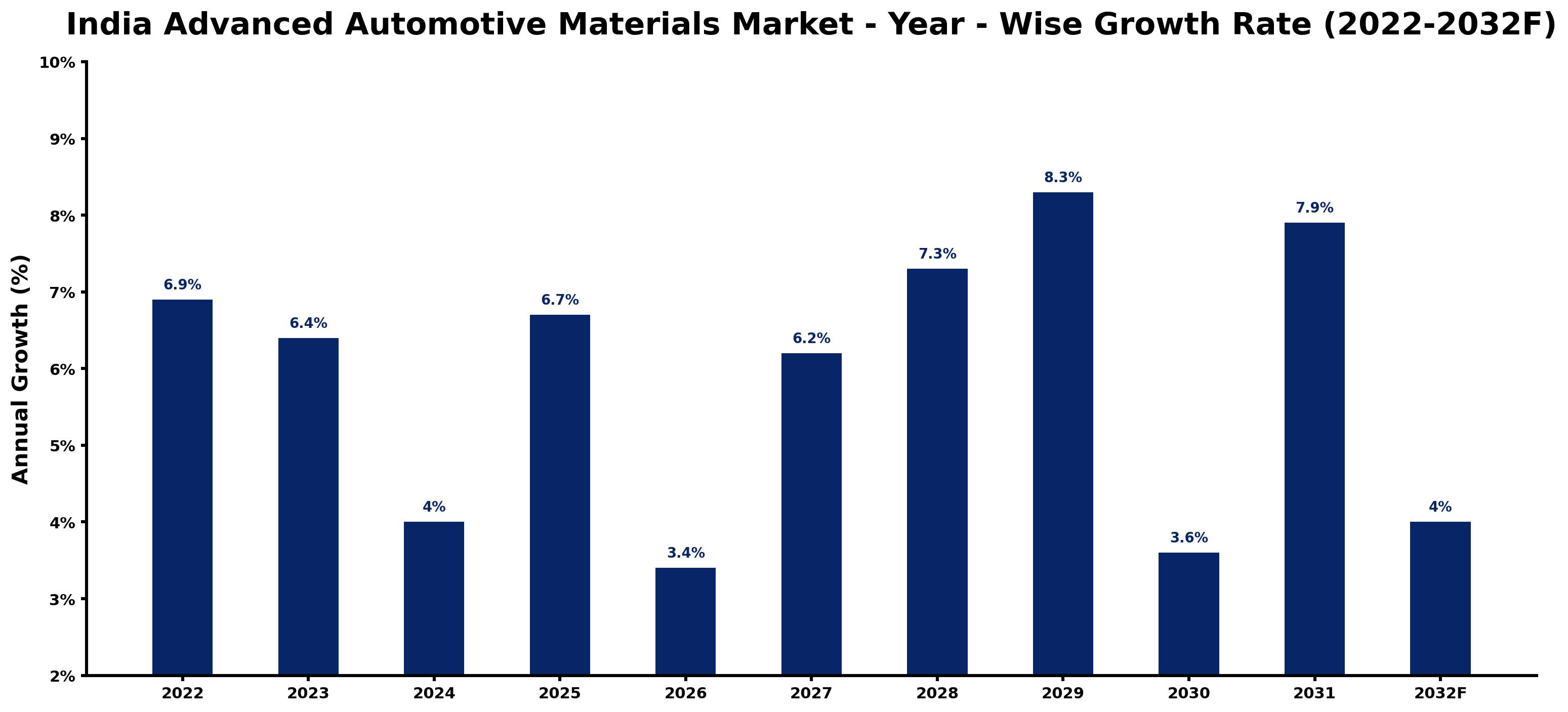
Year by year, the estimates below pair each growth rate with the development that shaped it.
| Year | Estimated Annual Growth (%) | Market Rationale |
| 2022 | 6.9 | The market experienced strong demand due to the production of 4.5 million passenger vehicles. |
| 2023 | 6.4 | Growth slowed as the automotive sector faced supply chain disruptions affecting material availability. |
| 2024 | 4.0 | Continued challenges in sourcing advanced materials led to further slowdown in growth rates. |
| 2025 | 6.7 | Demand increased as the luxury car segment showed a 20% annual growth, boosting material needs. |
| 2026 | 3.4 | Growth is expected to slow as the market adjusts to new material standards and production processes. |
| 2027 | 6.2 | New electric vehicle models are projected to spur demand for advanced materials, driving growth. |
| 2028 | 7.3 | Increased adoption of lightweight materials for efficiency improvements is likely to drive growth rates higher. |
| 2029 | 8.3 | The peak growth rate is expected as the market responds to heightened demand for electric vehicles. |
| 2030 | 3.6 | Growth is projected to slow as manufacturers face challenges in meeting new regulatory standards for materials. |
| 2031 | 7.9 | A resurgence in demand for high-performance vehicles is likely to lead to increased material purchases, boosting growth. |
| 2032 | 4.0 | Growth is expected to slow again as the market stabilises, reflecting a mature phase in advanced materials adoption. |
Note: Market size estimations and growth projections presented in this report are based on 6Wresearch's proprietary forecasting methodology, utilizing the latest available industry data, government publications, and primary research inputs.
India Advanced Automotive Materials Market Synopsis
Advanced Automotive Materials in India encompass high-strength steel, carbon fiber, magnesium alloys, and aluminium alloys, which are crucial for vehicle manufacturing. These materials improve fuel efficiency and safety in passenger cars and electric vehicles. The India Advanced Automotive Materials Market is expanding due to robust domestic demand from auto manufacturers and the rising production of electric vehicles. Contributing 7.1% to India's GDP, the automotive sector drives the need for advanced materials, supported by initiatives like the National Electric Mobility Mission Plan, which aims for widespread EV adoption by 2030.
Market Dynamics Impact Analysis (2026–2032)
| Factor | Type | Impact | Primary Segment Affected |
| Increasing production of electric vehicles drives demand for lightweight materials. | Driver | High | Electric Vehicles |
| The growing luxury car segment requires advanced materials for performance enhancements. | Driver | High | Luxury Car Segment |
| Investment in lightweight materials offers opportunities for suppliers to meet rising demand. | Opportunity | High | Carbon Fiber |
| The expansion of the commercial vehicle sector presents a chance for advanced material suppliers. | Opportunity | Medium | Commercial Vehicles |
| High costs associated with advanced materials can limit market growth. | Restraint | High | Aluminum Alloys |
| Supply chain disruptions have affected the availability of critical materials. | Restraint | Medium | AHSS |
| The Advanced Automotive Materials Market in India faces challenges in sourcing raw materials. | Challenge | High | Carbon Fiber |
| Regulatory compliance for material standards poses challenges for manufacturers. | Challenge | Medium | Magnesium Alloys |
Evaluation of Drivers in India Advanced Automotive Materials Market (2026–2032)
Below mentioned are some major drivers and their influence on market dynamics.
| Drivers | Primary Segment Affected | Why It Matters (Evidence) |
| Investment in electric vehicle production increases the demand for lightweight materials. | Electric Vehicles | The Indian automotive industry is projected to reach $300 billion by 2026, driving material purchases. |
| The luxury car segment's growth leads to higher demand for advanced materials. | Luxury Car Segment | This segment is anticipated to grow by 20% annually, increasing material needs. |
| The adoption of high-strength steel in vehicle body structures improves safety and performance. | AHSS | AHSS is increasingly used in 45% of new vehicle body structures in India. |
| The shift towards fuel-efficient vehicles drives the use of aluminum alloys. | Aluminum Alloys | These alloys are used in 60% of commercial vehicle applications for weight reduction. |
| The rising demand for high-performance parts boosts carbon fiber usage. | Carbon Fiber | Carbon fiber composites are utilized in high-end sports cars manufactured in India. |
The Advanced Automotive Materials market in India is growing on the back of significant investments in electric vehicle production, which increases the demand for lightweight materials. The luxury car segment is expected to grow by 20% annually, leading to higher demand for materials that enhance performance and safety. The introduction of new electric vehicle models is driving demand for advanced materials, particularly in the sports car segment. Furthermore, the increased adoption of lightweight materials for efficiency improvements is contributing to growth. The automotive sector's contribution to India's GDP underscores the rising need for advanced materials across various vehicle types.
Evaluation of Restraints in India Advanced Automotive Materials Market
Below mentioned are some major restraints and their influence on market dynamics.
| Market Restraint | Primary Segment Affected | Why It Matters (Evidence) |
| High costs associated with advanced materials limit market growth. | Aluminum Alloys | Producers face challenges in sourcing affordable materials, impacting pricing strategies. |
| Supply chain disruptions affect the availability of critical materials. | AHSS | Manufacturers struggle to obtain necessary materials, delaying production schedules. |
| Regulatory compliance for material standards can hinder market expansion. | Carbon Fiber | Stricter guidelines require additional testing and certification, increasing costs. |
| Limited awareness of advanced materials among smaller manufacturers restricts adoption. | Magnesium Alloys | Smaller firms may lack the resources to invest in new technologies and materials. |
| Market volatility in raw material prices creates uncertainty for buyers. | Electric Vehicles | Fluctuating prices can lead to budget constraints for manufacturers. |
India Advanced Automotive Materials Market Challenges
The India Advanced Automotive Materials market encounters several practical challenges, with technology integration being a major hurdle. Many manufacturers find it difficult to adopt advanced metallurgical processes, leading to production delays that hinder efficiency for auto manufacturers. A shortage of skilled workers exacerbates this issue, as the lack of trained personnel in composite manufacturing restricts innovation and forces reliance on outdated methods. Intense competition from lower-cost imports pressures local producers to lower prices, risking profit margins. Additionally, fluctuating raw material costs create financial unpredictability, resulting in budget constraints for suppliers.
Trends in the India Advanced Automotive Materials Market
Several trends are reshaping the India Advanced Automotive Materials Market; the most important are set out below.
- Shift from Traditional to Lightweight Materials: Since 2022, the automotive industry has increasingly embraced lightweight materials to enhance fuel efficiency. The Bureau of Indian Standards has set guidelines under IS 15961, promoting the use of advanced materials.
- Transition to Electric Vehicle Production: The National Electric Mobility Mission Plan, launched in 2020, aims to accelerate electric vehicle adoption by 2030. This initiative is anticipated to boost demand for lightweight materials.
- Growing Demand for Carbon Fiber in Sports Cars: Starting in 2023, carbon fiber has emerged as a preferred material for high-performance sports cars. This trend is evident as carbon fiber composites are increasingly used in a growing number of vehicles, enhancing performance.
- Increased Focus on Safety Standards: Since 2022, auto manufacturers have prioritised safety in vehicle design, resulting in a rise in the use of advanced materials. This trend is reflected in the increasing adoption of AHSS in vehicle body structures.
Investment Opportunities in the India Advanced Automotive Materials Market
Several openings in the India Advanced Automotive Materials Market merit attention from investors.
- Current Demand for Lightweight Materials: With the luxury car segment projected to grow by 20% annually, suppliers should concentrate on providing advanced materials. Collaborating with auto manufacturers can facilitate entry into this market.
- Investment in Electric Vehicle Components: The anticipated growth of the electric vehicle market offers an opportunity to supply advanced materials. Engaging with EV manufacturers can lead to partnerships that address rising material needs.
- Expansion of Commercial Vehicle Applications: The commercial vehicle sector is progressively adopting advanced materials for efficiency improvements. Suppliers can penetrate this market by forming joint ventures with established manufacturers.
- Growing Need for Performance Parts: As demand for high-performance vehicles increases, there is a gap in the supply of advanced materials. Suppliers can capitalise on this by targeting sports car manufacturers.
Government Initiatives in the India Advanced Automotive Materials Market
The Bureau of Indian Standards has established guidelines for automotive materials under IS 15961, ensuring that producers comply with quality and safety standards. Additionally, the Indian government allocated ₹10,000 crore for the Faster Adoption and Manufacturing of Hybrid and Electric Vehicles scheme in 2021, promoting the use of advanced materials in EV production. These measures support the growth of the advanced automotive materials market by encouraging compliance and innovation in material usage.
The Automotive Research Association of India plays a key role in testing and certifying advanced materials. This agency ensures that materials meet the necessary standards for safety and performance, facilitating smoother market entry for new products. Furthermore, the association provides funding for research and development projects aimed at improving material properties, benefiting manufacturers and buyers alike.
Future Insight of the India Advanced Automotive Materials Market
Transformative changes are anticipated in the Advanced Automotive Materials market in India by 2032, primarily driven by the National Electric Mobility Mission Plan that aims to boost electric vehicle adoption. The automotive sector will increasingly focus on lightweight materials, with projections indicating that aluminium alloys will be crucial in 60% of commercial vehicle applications. The luxury car segment is set to expand rapidly, with demand for advanced materials surging as the market reaches an estimated $300 billion by 2026. Enhanced testing and certification standards from the Bureau of Indian Standards will elevate quality benchmarks in automotive manufacturing.
Market Segmentation Analysis
The report offers a comprehensive study of the following market segments and their leading categories in the market.
By Material Type – AHSS Dominated, Carbon Fiber Expected to Grow Fastest
According to Ravi Bhandari, Research Head at 6Wresearch, AHSS took a 37% share of material type in 2025, more than any other category. AHSS holds the largest share due to its essential role in providing strength and safety in vehicle structures, with 45% of new vehicles in India incorporating this material. This widespread adoption among auto manufacturers indicates a robust installed base that drives ongoing demand. Carbon Fiber is set to record the highest CAGR in this split, 8.5% over 2026–2032. Carbon fiber is witnessing rapid growth as it is increasingly utilised in high-performance vehicle parts, appealing to manufacturers focused on weight reduction and enhanced performance. The anticipated growth of the luxury car segment further fuels this demand, ensuring carbon fiber's prominence in the market. Suppliers should concentrate on developing advanced carbon fiber solutions to meet the rising demand from performance-oriented vehicle manufacturers.
By Application Area – Body Structure Dominated, Interior & Exterior Expected to Grow Fastest
Body Structure held a 48% share of the India Advanced Automotive Materials Market by application area in 2025. The body structure segment leads the market as it is critical for vehicle safety and integrity, making it a primary focus for auto manufacturers. This importance is underscored by the substantial percentage of advanced materials used in structural components. The quickest growth will come from Interior & Exterior, forecast to expand at a CAGR of 7.0% between 2026 and 2032. The interior and exterior application area is expanding quickly, driven by the growing consumer preference for aesthetic and functional components in vehicles. This trend is particularly evident in the luxury car segment, which demands high-quality materials for both appearance and performance. Manufacturers should prioritise innovations in interior and exterior materials to cater to the evolving preferences of consumers in the automotive market.
By Vehicle Type – Passenger Cars Dominated, Sports Cars Expected to Grow Fastest
In 2025, Passenger Cars led the vehicle type split with a 50% share. Passenger cars dominate the market share as they represent the largest segment utilising advanced materials for improved fuel efficiency and safety. The production of 4.5 million passenger vehicles in 2022 highlights their significant role in driving material demand. Over 2026–2032, Sports Cars are expected to post the fastest growth, at a CAGR of 7.9%. Sports cars are experiencing the fastest growth due to the high demand for performance and weight savings, appealing to a niche market of enthusiasts. As luxury and performance vehicles become more popular, the need for advanced materials in this segment will continue to rise. Suppliers should align their strategies to cater to the growing demand for lightweight and high-performance materials in the sports car segment.
By Distribution Channel – OEMs Dominated, Direct Sales Expected to Grow Fastest
With a 49% revenue share in 2025, OEMs was the largest distribution channel category. OEMs command the largest share as they are the primary buyers of advanced materials, forming essential partnerships with suppliers to ensure quality and reliability. Their significant role in the automotive supply chain reinforces their market position and drives consistent demand. Direct Sales is projected to grow fastest, at a CAGR of 7.7% during 2026–2032. Direct sales are growing rapidly as manufacturers seek more control over their supply chains, allowing them to reduce costs and improve efficiency. This shift is particularly evident in the luxury car segment, where bespoke solutions are increasingly valued by consumers. Suppliers must adapt their distribution strategies to accommodate the rising trend of direct sales among manufacturers.
By End User Segment – Auto Manufacturers Dominated, Luxury Car Segment Expected to Grow Fastest
Auto Manufacturers accounted for a 39% market share by end user segment in 2025. Auto manufacturers represent the largest end user of advanced materials, driven by their need for high-strength components to meet safety and performance standards. Their substantial production volumes ensure a consistent demand for these materials across the industry. Luxury Car Segment is set to record the highest CAGR in this split, 7.5% over 2026–2032. The luxury car segment is growing at a fast pace, reflecting the high demand for premium materials that enhance vehicle aesthetics and performance. This growth is supported by the expected 20% annual increase in the luxury car market, indicating a shift in consumer preferences. Suppliers should focus on developing high-quality advanced materials tailored for the luxury car segment to capture this expanding market.
Key Attractiveness of the Report
- 10 Years of Market Numbers
- Historical Data Starting from 2022 to 2025
- Base Year 2025
- Forecast Data until 2032
- Key Performance Indicators Impacting the Market
- Major Upcoming Developments and Projects
Key Highlights of the Report:
- India Advanced Automotive Materials Market Outlook
- Market Size of India Advanced Automotive Materials Market, 2025
- Forecast of India Advanced Automotive Materials Market, 2032
- Historical Data and Forecast of India Advanced Automotive Materials Revenues & Volume for the Period 2022 - 2032F
- India Advanced Automotive Materials Market Trend Evolution
- India Advanced Automotive Materials Market Drivers and Challenges
- India Advanced Automotive Materials Price Trends
- India Advanced Automotive Materials Porter's Five Forces
- India Advanced Automotive Materials Industry Life Cycle
- Historical Data and Forecast of India Advanced Automotive Materials Market Revenues & Volume By Material Type for the Period 2022 - 2032F
- Historical Data and Forecast of India Advanced Automotive Materials Market Revenues & Volume By AHSS for the Period 2022 - 2032F
- Historical Data and Forecast of India Advanced Automotive Materials Market Revenues & Volume By Carbon Fiber for the Period 2022 - 2032F
- Historical Data and Forecast of India Advanced Automotive Materials Market Revenues & Volume By Magnesium Alloys for the Period 2022 - 2032F
- Historical Data and Forecast of India Advanced Automotive Materials Market Revenues & Volume By Aluminum Alloys for the Period 2022 - 2032F
- Historical Data and Forecast of India Advanced Automotive Materials Market Revenues & Volume By Application Area for the Period 2022 - 2032F
- Historical Data and Forecast of India Advanced Automotive Materials Market Revenues & Volume By Body Structure for the Period 2022 - 2032F
- Historical Data and Forecast of India Advanced Automotive Materials Market Revenues & Volume By Interior & Exterior for the Period 2022 - 2032F
- Historical Data and Forecast of India Advanced Automotive Materials Market Revenues & Volume By Transmission Parts for the Period 2022 - 2032F
- Historical Data and Forecast of India Advanced Automotive Materials Market Revenues & Volume By Engine Components for the Period 2022 - 2032F
- Historical Data and Forecast of India Advanced Automotive Materials Market Revenues & Volume By Vehicle Type for the Period 2022 - 2032F
- Historical Data and Forecast of India Advanced Automotive Materials Market Revenues & Volume By Passenger Cars for the Period 2022 - 2032F
- Historical Data and Forecast of India Advanced Automotive Materials Market Revenues & Volume By Sports Cars for the Period 2022 - 2032F
- Historical Data and Forecast of India Advanced Automotive Materials Market Revenues & Volume By Commercial Vehicles for the Period 2022 - 2032F
- Historical Data and Forecast of India Advanced Automotive Materials Market Revenues & Volume By Electric Vehicles for the Period 2022 - 2032F
- Historical Data and Forecast of India Advanced Automotive Materials Market Revenues & Volume By Distribution Channel for the Period 2022 - 2032F
- Historical Data and Forecast of India Advanced Automotive Materials Market Revenues & Volume By OEMs for the Period 2022 - 2032F
- Historical Data and Forecast of India Advanced Automotive Materials Market Revenues & Volume By Direct Sales for the Period 2022 - 2032F
- Historical Data and Forecast of India Advanced Automotive Materials Market Revenues & Volume By Industrial Suppliers for the Period 2022 - 2032F
- Historical Data and Forecast of India Advanced Automotive Materials Market Revenues & Volume By Online Platforms for the Period 2022 - 2032F
- Historical Data and Forecast of India Advanced Automotive Materials Market Revenues & Volume By End User Segment for the Period 2022 - 2032F
- Historical Data and Forecast of India Advanced Automotive Materials Market Revenues & Volume By Auto Manufacturers for the Period 2022 - 2032F
- Historical Data and Forecast of India Advanced Automotive Materials Market Revenues & Volume By Luxury Car Segment for the Period 2022 - 2032F
- Historical Data and Forecast of India Advanced Automotive Materials Market Revenues & Volume By Trucking Companies for the Period 2022 - 2032F
- Historical Data and Forecast of India Advanced Automotive Materials Market Revenues & Volume By EV Manufacturers for the Period 2022 - 2032F
- India Advanced Automotive Materials Import Export Trade Statistics
- Market Opportunity Assessment By Material Type
- Market Opportunity Assessment By Application Area
- Market Opportunity Assessment By Vehicle Type
- Market Opportunity Assessment By Distribution Channel
- Market Opportunity Assessment By End User Segment
- India Advanced Automotive Materials Top Companies Market Share
- India Advanced Automotive Materials Competitive Benchmarking By Technical and Operational Parameters
- India Advanced Automotive Materials Company Profiles
- India Advanced Automotive Materials Key Strategic Recommendations
Market Covered
The report offers an extensive study of the following market segments.
By Material Type
- AHSS
- Carbon Fiber
- Magnesium Alloys
- Aluminum Alloys
By Application Area
- Body Structure
- Interior & Exterior
- Transmission Parts
- Engine Components
By Vehicle Type
- Passenger Cars
- Sports Cars
- Commercial Vehicles
- Electric Vehicles
By Distribution Channel
- OEMs
- Direct Sales
- Industrial Suppliers
- Online Platforms
By End User Segment
- Auto Manufacturers
- Luxury Car Segment
- Trucking Companies
- EV Manufacturers































