India Advanced Battery Technologies Market Size & Growth Rate
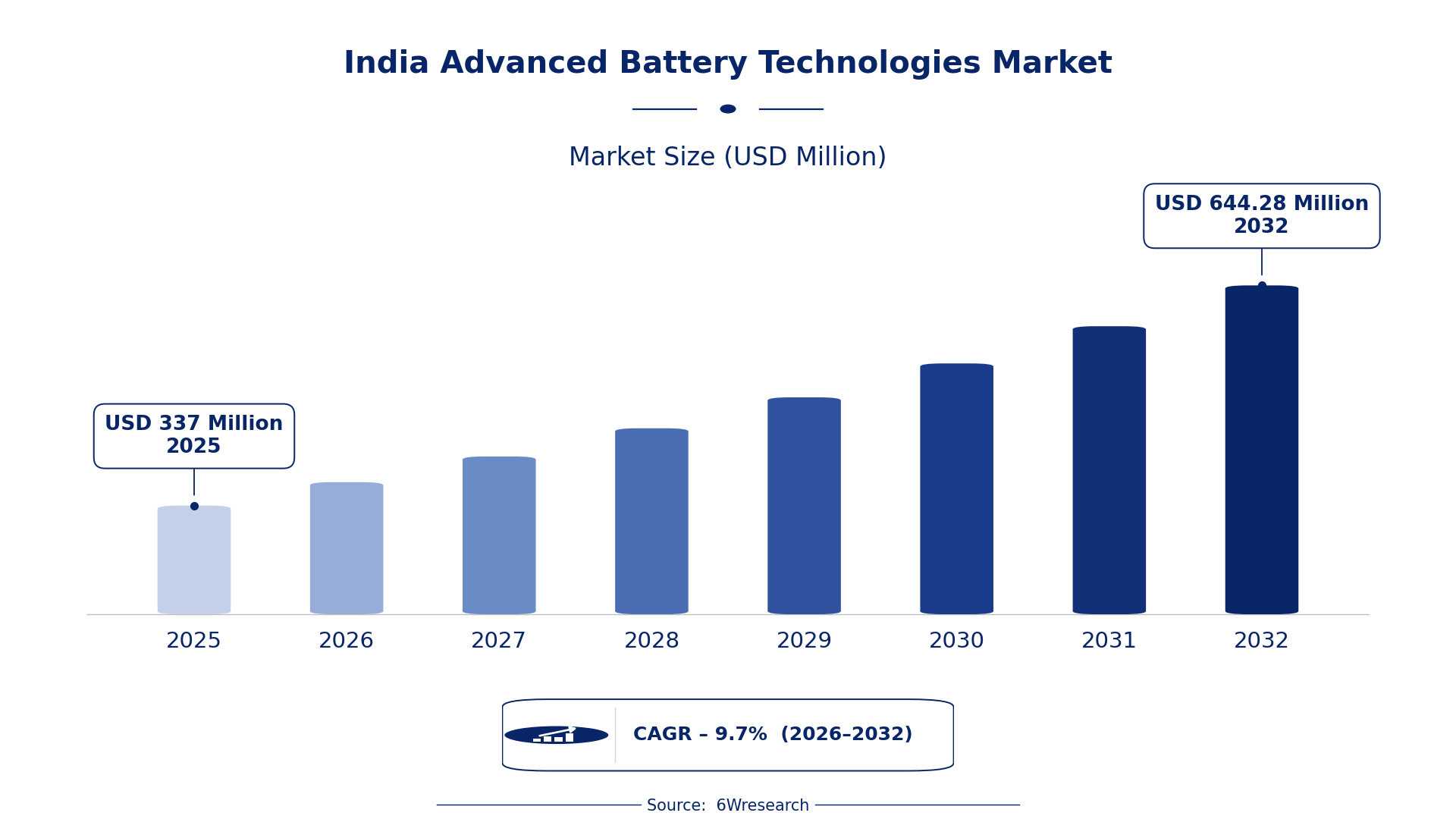
According to 6Wresearch internal database and industry insights, the India Advanced Battery Technologies Market was valued at USD 337.0 million in 2025 and is projected to reach USD 644.28 million by 2032, growing at a CAGR of approximately 9.7% during 2026–2032.
India Advanced Battery Technologies Market Highlights
| Report Metric | Details |
| Report Name | India Advanced Battery Technologies Market |
| Market Size 2025 | USD 337.0 million |
| Market Size 2032 | USD 644.28 million |
| Absolute Growth 2025–2032 | USD 307.28 million |
| CAGR 2026–2032 | 9.7% |
| Peak Annual Growth | 11.6% in 2026 |
| Forecast Period | 2026–2032 |
| Historical Data | 2022–2025 |
| Base Year | 2025 |
| Leading Technology Type, 2025 | Solid-State Batteries (37% share) |
| Leading Battery Chemistry, 2025 | Lithium (57% share) |
| Leading Application, 2025 | Electric Vehicles (43% share) |
| Leading Distribution Channel, 2025 | OEMs (41% share) |
| Leading End User, 2025 | Automotive Sector (46% share) |
| Fastest-Growing Battery Chemistry | Lithium Polymer (11.9% CAGR) |
| Fastest-Growing Application | Grid Storage (12.3% CAGR) |
| Fastest-Growing Distribution Channel | Direct Sales (11.5% CAGR) |
| Fastest-Growing End User | Energy Providers (11.2% CAGR) |
| Growing Sector | Electric Vehicles |
| Key End Users | Automotive Sector, Energy Providers, Tech Manufacturers, Consumers |
India Advanced Battery Technologies Market Year-wise Growth Rate and Key Drivers (2022–2032)
This graph illustrates the annual growth rates of the market from 2022 to 2032, highlighting a steady upward trajectory and projected market expansion over the forecast period.
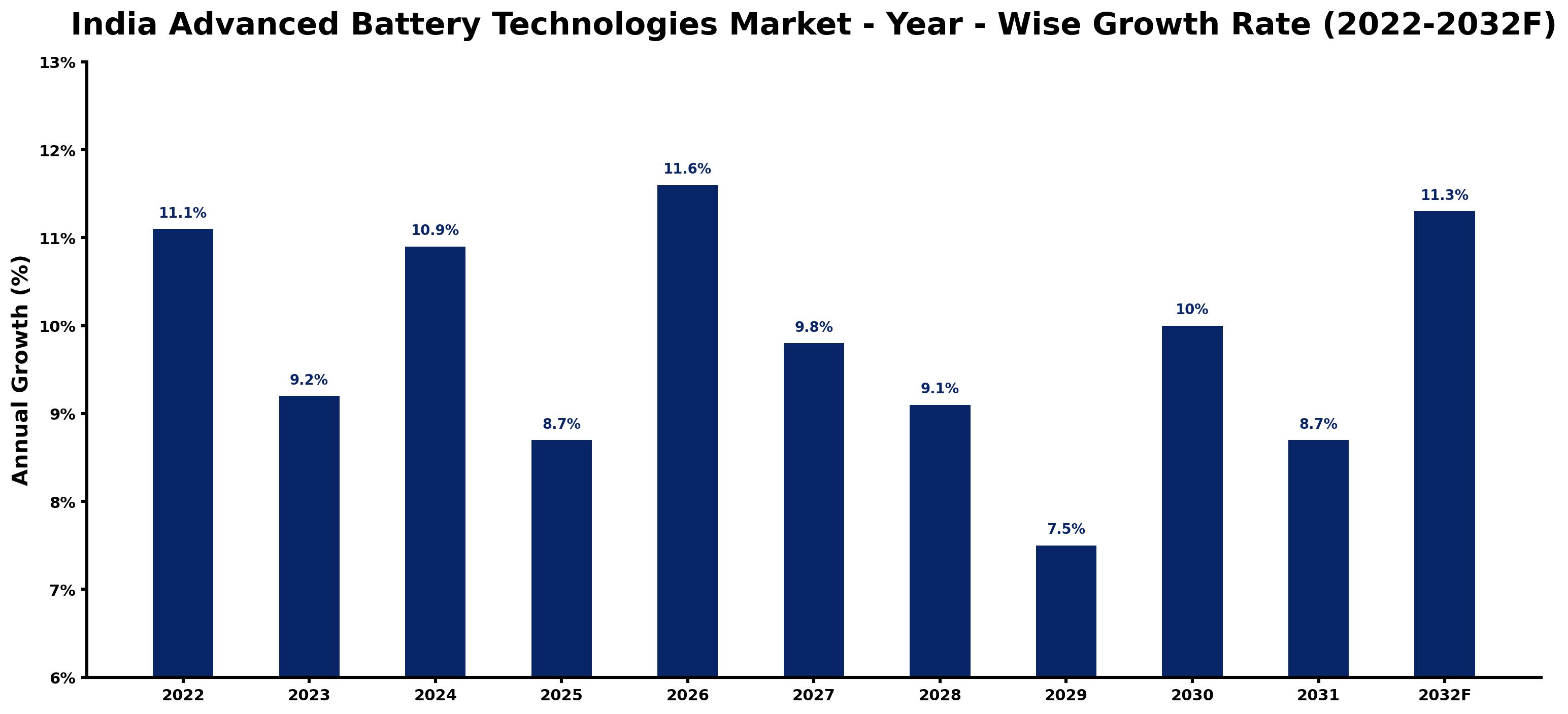
Each row of the following table gives one year's estimated growth and the event or demand shift that explains it.
| Year | Estimated Annual Growth (%) | Market Rationale |
| 2022 | 11.1 | The market experienced strong demand driven by electric vehicle adoption and consumer electronics. |
| 2023 | 9.2 | Growth slowed as manufacturers adjusted to supply chain disruptions affecting battery components. |
| 2024 | 10.9 | Demand increased due to heightened investments in renewable energy and electric vehicle infrastructure. |
| 2025 | 8.7 | Growth slowed again as the market began to stabilise after rapid expansion in previous years. |
| 2026 | 11.6 | The market peaked with investments exceeding $1 billion in battery manufacturing capacity, boosting supply. |
| 2027 | 9.8 | Growth slowed as the market adjusted to new production capacities and technology advancements. |
| 2028 | 9.1 | The market continued to grow, supported by increasing electric vehicle penetration and grid storage needs. |
| 2029 | 7.5 | Growth slowed as the market approached saturation in certain segments, particularly consumer electronics. |
| 2030 | 10.0 | Demand surged again as India aimed for 30% electric vehicle penetration by 2030, driving purchases. |
| 2031 | 8.7 | Growth slowed as the market stabilised after reaching significant milestones in battery production. |
| 2032 | 11.3 | The market is expected to grow as new technologies and applications emerge, enhancing battery capabilities. |
Note: Market size estimations and growth projections presented in this report are based on 6Wresearch's proprietary forecasting methodology, utilizing the latest available industry data, government publications, and primary research inputs.
India Advanced Battery Technologies Market Synopsis
The India Advanced Battery Technologies Market encompasses various battery chemistries designed for energy storage and power supply. These technologies are essential for powering electric vehicles, smartphones, and grid storage systems. The market is growing due to a surge in electric vehicle adoption, with the National Electric Mobility Mission Plan targeting a 30% penetration rate by 2030. Investments exceeding $1 billion are boosting local manufacturing capacity, driving further demand. The automotive sector remains the primary buyer group, leading to increased purchases of advanced battery solutions.
Market Dynamics Impact Analysis (2026–2032)
| Factor | Type | Impact | Primary Segment Affected |
| Increased investments in battery manufacturing capacity | Driver | High | Lithium |
| Growing demand for electric vehicles and grid storage solutions | Driver | High | Electric Vehicles |
| Emerging opportunities in renewable energy storage | Opportunity | High | Grid Storage |
| Rising consumer electronics demand for portable energy solutions | Opportunity | High | Smartphones |
| Supply chain disruptions affecting battery components | Restraint | High | Lithium Polymer |
| Limited adoption of emerging battery technologies | Restraint | Medium | Lithium-Sulfur |
| High production costs impacting profitability | Challenge | High | Solid-State Batteries |
| Technological challenges in battery recycling processes | Challenge | Medium | Flow Batteries |
Evaluation of Drivers in India Advanced Battery Technologies Market (2026–2032)
The factors lifting demand, and the evidence behind each, are summarised below.
| Drivers | Primary Segment Affected | Why It Matters (Evidence) |
| Investments in battery manufacturing capacity | Lithium | Investments exceeding $1 billion are increasing production capabilities, boosting supply for consumer electronics and electric vehicles. |
| Growing adoption of electric vehicles | Electric Vehicles | The National Electric Mobility Mission Plan aims for 30% penetration by 2030, driving demand for advanced batteries. |
| Rising demand for renewable energy storage solutions | Grid Storage | The energy storage market is projected to reach 2 GW by 2025, increasing demand for advanced battery technologies. |
| Increased consumer electronics usage | Smartphones | India's population of over 1.4 billion creates a vast market for portable energy solutions, boosting battery purchases. |
| Supportive government policies promoting battery technologies | Solid-State Batteries | The National Battery Storage Policy encourages local manufacturing and R&D, driving market growth. |
Investments exceeding $1 billion are boosting production capabilities, especially in Maharashtra and Tamil Nadu. The energy storage market is expected to reach 2 GW by 2025, further increasing the need for advanced battery technologies. With over 1.4 billion people, India offers a vast market for portable energy solutions, particularly in the smartphone sector. The National Electric Mobility Mission Plan targets a 30% electric vehicle penetration by 2030, driving battery demand significantly.
Evaluation of Restraints in India Advanced Battery Technologies Market
The following restraints limit how fast demand can grow.
| Market Restraint | Primary Segment Affected | Why It Matters (Evidence) |
| Supply chain disruptions affecting battery components | Lithium Polymer | Manufacturers faced delays in sourcing critical materials, impacting production timelines and increasing costs. |
| Limited adoption of emerging battery technologies | Lithium-Sulfur | The technology is still in its infancy, limiting its application and market penetration. |
| High production costs impacting profitability | Solid-State Batteries | The complexity of manufacturing solid-state batteries leads to higher costs, affecting market competitiveness. |
| Technological challenges in battery recycling processes | Flow Batteries | Inefficient recycling methods hinder sustainability efforts and increase operational costs for manufacturers. |
| Regulatory hurdles in battery safety standards | Lithium | Compliance with updated safety standards increases production costs and time for manufacturers. |
India Advanced Battery Technologies Market Challenges
The India Advanced Battery Technologies Market faces several practical issues, starting with supply chain inefficiencies. Many producers depend heavily on imported materials, resulting in production delays and higher costs for manufacturers. Rising prices directly affect buyers, as the average cost of lithium-ion batteries has increased by 15% over the past year due to these disruptions. Competition intensifies as local manufacturers struggle to meet demand, especially with India's goal of 30% electric vehicle penetration by 2030. Regulatory challenges arise, as compliance with Bureau of Indian Standards guidelines requires substantial investment, delaying product launches for suppliers.
Trends in the India Advanced Battery Technologies Market
The trends below show where the India Advanced Battery Technologies Market is heading.
- Shift towards Solid-State Batteries: India is increasingly adopting solid-state batteries for electric vehicles, improving safety and energy density. This shift began in 2022, with a projected CAGR of 12.3% for this segment.
- Emergence of Grid Storage Solutions: The focus on renewable energy integration has led to a rise in grid storage solutions. The energy storage market is projected to reach 2 GW by 2025, driving demand for advanced battery technologies.
- Growing Adoption of Lithium Polymer Batteries: Lithium polymer batteries are gaining traction in consumer electronics, particularly smartphones. This trend is supported by a projected CAGR of 11.9% for this battery chemistry.
- Increased Incentives for Electric Vehicles: The FAME India Phase II scheme, initiated in 2021, incentivizes electric vehicle adoption, boosting battery usage. With a budget of INR 10,000 crore, this initiative impacts market growth.
Investment Opportunities in the India Advanced Battery Technologies Market
Some of the investment opportunities in the India Advanced Battery Technologies Market are mentioned below.
- Investment in Battery Manufacturing Facilities: With India's battery manufacturing capacity projected to grow, investing in local production facilities is vital. The National Battery Storage Policy aims to boost local manufacturing, presenting a significant opportunity.
- Supply of Advanced Battery Technologies for EVs: The automotive sector is rapidly expanding, with a target of 30% electric vehicle penetration by 2030. This creates a demand for advanced battery technologies, particularly in states like Maharashtra.
- Development of Recycling Technologies: As sustainability becomes a priority, developing efficient battery recycling technologies presents an opportunity. The growing focus on environmental impact will drive demand for innovative solutions.
- Expansion into Grid Storage Solutions: The energy storage market is projected to reach 2 GW by 2025, indicating a need for advanced battery solutions. Collaborating with energy providers will facilitate market entry.
Government Initiatives in the India Advanced Battery Technologies Market
The National Electric Mobility Mission Plan 2020 aims to promote electric vehicles and battery technologies, targeting a 30% penetration rate by 2030. This initiative encourages manufacturers to invest in advanced battery technologies while ensuring compliance with safety standards. The Bureau of Indian Standards has updated safety guidelines for lithium-ion batteries, improving consumer protection and product reliability. These measures support the growth of the advanced battery market in India.
The Production-Linked Incentive Scheme for Advanced Chemistry Cell Battery Storage, launched in 2021, has a budget of INR 18,100 crore to boost local manufacturing and reduce import reliance. The Ministry of Heavy Industries oversees this scheme, ensuring that manufacturers meet the required standards and guidelines. The National Battery Storage Policy introduced in 2022 aims to strengthen domestic battery manufacturing, encouraging research and development in battery technologies.
Future Insight of the India Advanced Battery Technologies Market
The Advanced Battery Technologies Market in India is set for substantial changes by 2032, primarily driven by the National Battery Storage Policy. This initiative will improve local manufacturing capabilities, allowing suppliers to lessen reliance on imports. The energy storage market is projected to reach 2 GW by 2025, driven by renewable energy integration, creating new opportunities for buyers. Continued support from the FAME India scheme will further encourage electric vehicle adoption, stimulating advancements in battery technologies and expanding the market.
Market Segmentation Analysis
Each segment group is reviewed below, with the leader by share and the fastest grower by CAGR.
By Technology Type – Solid-State Batteries Dominated and Is Expected to Record the Fastest Growth
According to Ravi Bhandari, Research Head at 6Wresearch, in 2025, Solid-State Batteries led the technology type split with a 37% share. Solid-State Batteries hold the largest market share due to their superior safety and energy density, making them ideal for electric vehicles. Their prominence is further supported by government initiatives like the National Electric Mobility Mission Plan, which encourages electric vehicle adoption across India. The same category are also set to grow fastest, at a CAGR of 12.3% during 2026–2032. The growth of Solid-State Batteries is propelled by their potential to enhance electric vehicle performance, with investments surpassing $1 billion in this technology. As electric vehicle penetration targets increase, Solid-State Batteries are set to widen their market lead. Suppliers must focus on advancing Solid-State Battery technology to meet the surging demand from the electric vehicle sector.
By Battery Chemistry – Lithium Dominated, Lithium Polymer Expected to Grow Fastest
Lithium accounted for a 57% market share by battery chemistry in 2025. Lithium batteries dominate the market share as they are extensively used in consumer electronics and electric vehicles, both rapidly expanding sectors in India. Their established manufacturing processes and compliance with safety standards solidify their leading position. Lithium Polymer is set to record the highest CAGR in this split, 11.9% over 2026–2032. Lithium Polymer batteries are experiencing rapid growth due to their lightweight and flexible design, making them ideal for smartphones and portable devices. As the consumer electronics market continues to grow, the demand for Lithium Polymer batteries is expected to rise significantly. Manufacturers need to invest in Lithium Polymer technology to effectively capture the expanding consumer electronics market.
By Application – Electric Vehicles Dominated, Grid Storage Expected to Grow Fastest
With a 43% revenue share in 2025, Electric Vehicles was the largest application category. Electric Vehicles represent the largest application segment, driven by significant investments and government initiatives aimed at boosting electric vehicle adoption. This sector's growth is crucial for advancing battery technology in India. Grid Storage is projected to grow fastest, at a CAGR of 12.3% during 2026–2032. Grid Storage is the fastest-growing application, essential for integrating renewable energy sources and ensuring grid stability. With India's energy storage market projected to reach 2 GW by 2025, this segment is poised for substantial expansion. Suppliers should concentrate on developing solutions for grid storage to align with the ongoing efforts in renewable energy integration.
By Distribution Channel – OEMs Dominated, Direct Sales Expected to Grow Fastest
The largest distribution channel category in 2025 was OEMs, with a 41% share of total revenue. OEMs account for the largest market share as they incorporate advanced batteries into their final products, particularly in the automotive sector. Their established relationships with manufacturers ensure a consistent demand for high-quality battery solutions. The quickest growth will come from Direct Sales, forecast to expand at a CAGR of 11.5% between 2026 and 2032. Direct Sales is witnessing rapid growth as manufacturers aim to strengthen connections with end-users, enhancing customer engagement and satisfaction. This trend indicates a shift towards more personalised distribution strategies, improving market responsiveness. Suppliers should explore direct sales channels to enhance relationships with customers and strengthen their market presence.
By End User – Automotive Sector Dominated, Energy Providers Expected to Grow Fastest
Automotive Sector held a 46% share of the India Advanced Battery Technologies Market by end user in 2025. The Automotive Sector leads the market due to its substantial demand for advanced battery technologies in electric vehicles. This sector's growth is supported by government policies promoting electric mobility and local manufacturing initiatives. Over 2026–2032, Energy Providers are expected to post the fastest growth, at a CAGR of 11.2%. Energy Providers are the fastest-growing end-user segment, driven by the increasing need for efficient energy storage solutions to support renewable energy initiatives. As the energy landscape evolves, this segment is expected to expand further. Manufacturers should focus on developing tailored solutions for energy providers to capitalise on the growing energy storage market.
Key Attractiveness of the Report
- 10 Years of Market Numbers
- Historical Data Starting from 2022 to 2025
- Base Year 2025
- Forecast Data until 2032
- Key Performance Indicators Impacting the Market
- Major Upcoming Developments and Projects
Key Highlights of the Report:
- India Advanced Battery Technologies Market Outlook
- Market Size of India Advanced Battery Technologies Market, 2025
- Forecast of India Advanced Battery Technologies Market, 2032
- Historical Data and Forecast of India Advanced Battery Technologies Revenues & Volume for the Period 2022 - 2032F
- India Advanced Battery Technologies Market Trend Evolution
- India Advanced Battery Technologies Market Drivers and Challenges
- India Advanced Battery Technologies Price Trends
- India Advanced Battery Technologies Porter's Five Forces
- India Advanced Battery Technologies Industry Life Cycle
- Historical Data and Forecast of India Advanced Battery Technologies Market Revenues & Volume By Technology Type for the Period 2022 - 2032F
- Historical Data and Forecast of India Advanced Battery Technologies Market Revenues & Volume By Solid-State Batteries for the Period 2022 - 2032F
- Historical Data and Forecast of India Advanced Battery Technologies Market Revenues & Volume By Flow Batteries for the Period 2022 - 2032F
- Historical Data and Forecast of India Advanced Battery Technologies Market Revenues & Volume By Lithium-Sulfur for the Period 2022 - 2032F
- Historical Data and Forecast of India Advanced Battery Technologies Market Revenues & Volume By Thin-Film Batteries for the Period 2022 - 2032F
- Historical Data and Forecast of India Advanced Battery Technologies Market Revenues & Volume By Battery Chemistry for the Period 2022 - 2032F
- Historical Data and Forecast of India Advanced Battery Technologies Market Revenues & Volume By Lithium for the Period 2022 - 2032F
- Historical Data and Forecast of India Advanced Battery Technologies Market Revenues & Volume By Zinc-Bromine for the Period 2022 - 2032F
- Historical Data and Forecast of India Advanced Battery Technologies Market Revenues & Volume By Lithium for the Period 2022 - 2032F
- Historical Data and Forecast of India Advanced Battery Technologies Market Revenues & Volume By Lithium Polymer for the Period 2022 - 2032F
- Historical Data and Forecast of India Advanced Battery Technologies Market Revenues & Volume By Application for the Period 2022 - 2032F
- Historical Data and Forecast of India Advanced Battery Technologies Market Revenues & Volume By Smartphones for the Period 2022 - 2032F
- Historical Data and Forecast of India Advanced Battery Technologies Market Revenues & Volume By Grid Storage for the Period 2022 - 2032F
- Historical Data and Forecast of India Advanced Battery Technologies Market Revenues & Volume By Electric Vehicles for the Period 2022 - 2032F
- Historical Data and Forecast of India Advanced Battery Technologies Market Revenues & Volume By Wearables for the Period 2022 - 2032F
- Historical Data and Forecast of India Advanced Battery Technologies Market Revenues & Volume By Distribution Channel for the Period 2022 - 2032F
- Historical Data and Forecast of India Advanced Battery Technologies Market Revenues & Volume By Online Platforms for the Period 2022 - 2032F
- Historical Data and Forecast of India Advanced Battery Technologies Market Revenues & Volume By Industrial Suppliers for the Period 2022 - 2032F
- Historical Data and Forecast of India Advanced Battery Technologies Market Revenues & Volume By OEMs for the Period 2022 - 2032F
- Historical Data and Forecast of India Advanced Battery Technologies Market Revenues & Volume By Direct Sales for the Period 2022 - 2032F
- Historical Data and Forecast of India Advanced Battery Technologies Market Revenues & Volume By End User for the Period 2022 - 2032F
- Historical Data and Forecast of India Advanced Battery Technologies Market Revenues & Volume By Consumers for the Period 2022 - 2032F
- Historical Data and Forecast of India Advanced Battery Technologies Market Revenues & Volume By Energy Providers for the Period 2022 - 2032F
- Historical Data and Forecast of India Advanced Battery Technologies Market Revenues & Volume By Automotive Sector for the Period 2022 - 2032F
- Historical Data and Forecast of India Advanced Battery Technologies Market Revenues & Volume By Tech Manufacturers for the Period 2022 - 2032F
- India Advanced Battery Technologies Import Export Trade Statistics
- Market Opportunity Assessment By Technology Type
- Market Opportunity Assessment By Battery Chemistry
- Market Opportunity Assessment By Application
- Market Opportunity Assessment By Distribution Channel
- Market Opportunity Assessment By End User
- India Advanced Battery Technologies Top Companies Market Share
- India Advanced Battery Technologies Competitive Benchmarking By Technical and Operational Parameters
- India Advanced Battery Technologies Company Profiles
- India Advanced Battery Technologies Key Strategic Recommendations
Market Covered
Segments analysed in this report are listed below.
By Technology Type
- Solid-State Batteries
- Flow Batteries
- Lithium-Sulfur
- Thin-Film Batteries
By Battery Chemistry
- Lithium
- Zinc-Bromine
- Lithium Polymer
By Application
- Smartphones
- Grid Storage
- Electric Vehicles
- Wearables
By Distribution Channel
- Online Platforms
- Industrial Suppliers
- OEMs
- Direct Sales
By End User
- Consumers
- Energy Providers
- Automotive Sector
- Tech Manufacturers































