India Advanced Farming Automation Market Size & Growth Rate
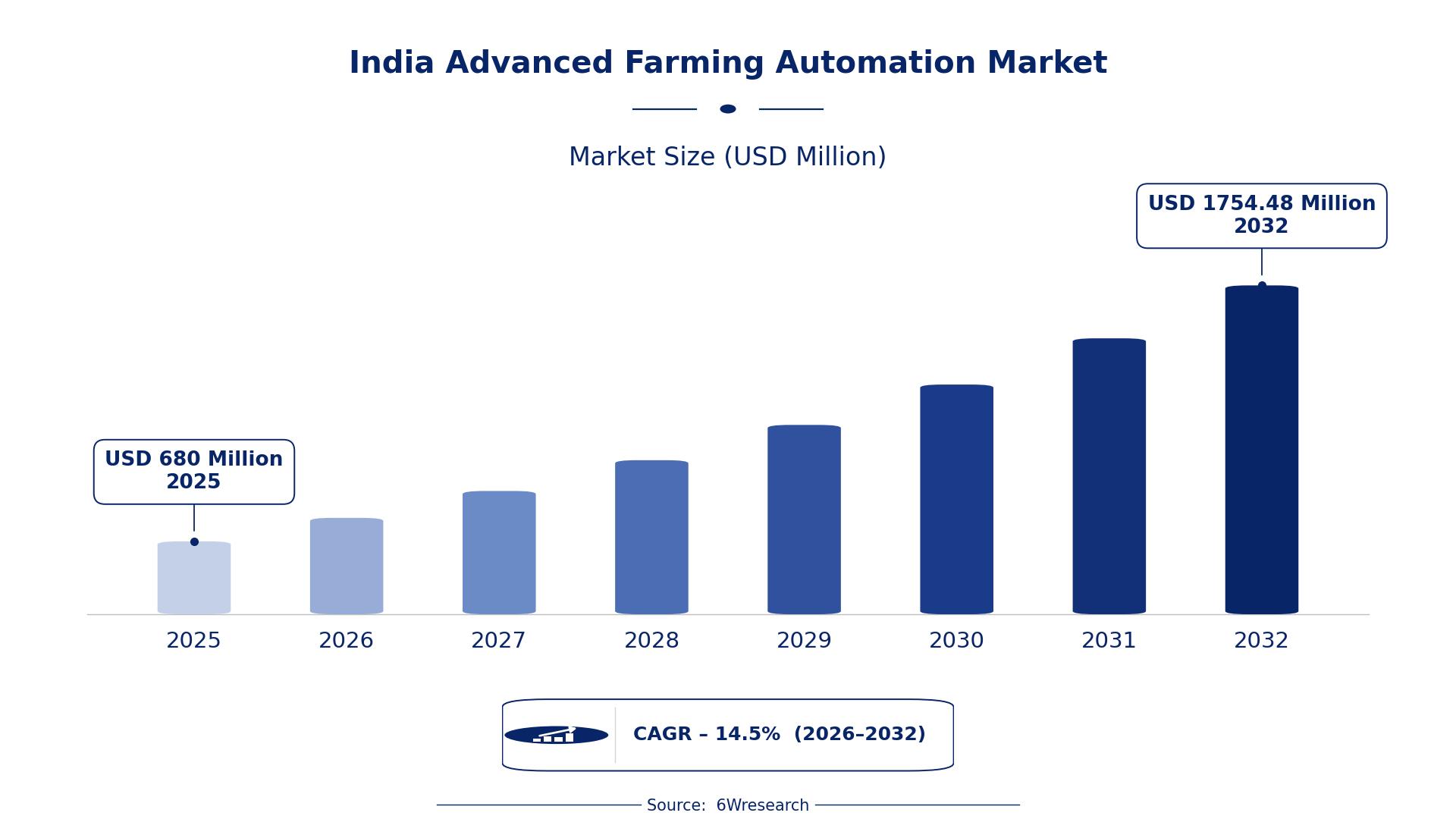
According to 6Wresearch internal database and industry insights, the India Advanced Farming Automation Market was valued at USD 680 million in 2025 and is projected to reach USD 1,754.48 million by 2032, growing at a CAGR of approximately 14.5% during 2026–2032.
India Advanced Farming Automation Market Highlights
| Report Metric | Details |
| Report Name | India Advanced Farming Automation Market |
| Market Size 2025 | USD 680 million |
| Market Size 2032 | USD 1,754.48 million |
| Absolute Growth 2025–2032 | USD 1,074.48 million |
| CAGR 2026–2032 | 14.5% |
| Peak Annual Growth | 17.5% in 2032 |
| Forecast Period | 2026–2032 |
| Historical Data | 2022–2025 |
| Base Year | 2025 |
| Leading Advanced Farming Automation Market, 2025 | Drone Sprayers (46% share) |
| Leading Automation Type, 2025 | Smart Machinery (48% share) |
| Leading Technology Used, 2025 | AI and Machine Vision (41% share) |
| Leading Distribution Channel, 2025 | Agricultural Suppliers (52% share) |
| Leading End User Sector, 2025 | Large-Scale Farmers (50% share) |
| Fastest-Growing Automation Type | UAV-Based Equipment (16.6% CAGR) |
| Fastest-Growing Technology Used | GPS and IoT (16.0% CAGR) |
| Fastest-Growing Distribution Channel | Online Platforms (16.2% CAGR) |
| Fastest-Growing End User Sector | Agri-Tech Companies (15.8% CAGR) |
| Growing Sector | Large-Scale Farmers |
| Key End Users | Large-Scale Farmers, Agri-Tech Companies, Crop Growers, Organic & Vertical Farms |
India Advanced Farming Automation Market Year-wise Growth Rate and Key Drivers (2022–2032)
This graph illustrates the annual growth rates of the market from 2022 to 2032, highlighting a steady upward trajectory and projected market expansion over the forecast period.
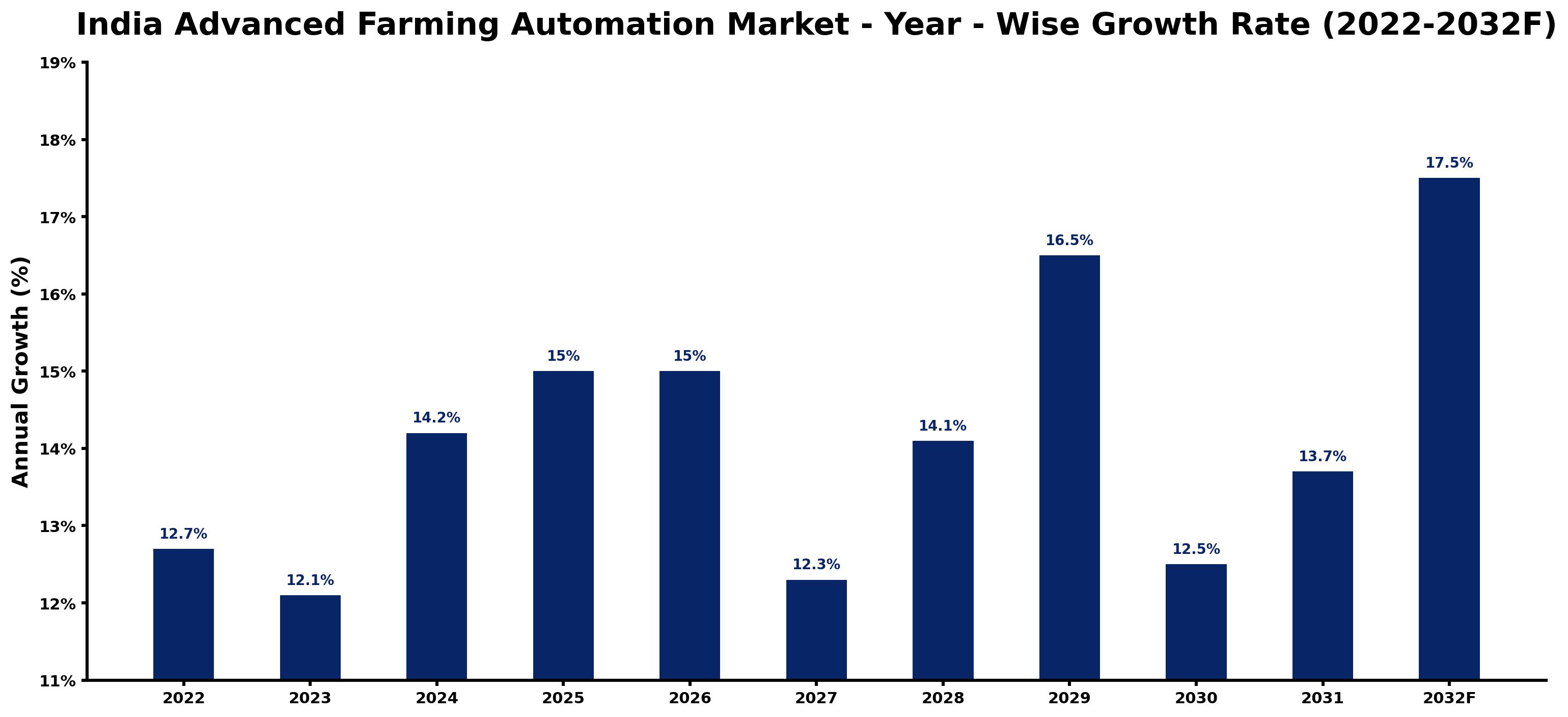
The table below sets out the estimated growth rate for each year and the main factor behind it.
| Year | Estimated Annual Growth (%) | Market Rationale |
| 2022 | 12.7 | The market experienced steady growth due to ongoing agricultural reforms and technology adoption. |
| 2023 | 12.1 | Growth slowed slightly as farmers adjusted to new technologies and market conditions. |
| 2024 | 14.2 | Demand increased as precision planters gained popularity in regions like Punjab and Haryana. |
| 2025 | 15.0 | The market peaked with strong adoption of drone sprayers, enhancing efficiency in large-scale farming. |
| 2026 | 15.0 | Growth decelerated as the market stabilised after the previous peak in demand. |
| 2027 | 12.3 | A further slowdown occurred as market dynamics adjusted to evolving agricultural practices. |
| 2028 | 14.1 | Demand rose again, driven by increasing interest in UAV-based equipment for crop monitoring. |
| 2029 | 16.5 | The market accelerated as agri-tech companies expanded their investments in automation technologies. |
| 2030 | 12.5 | Growth slowed as the market matured and farmers adapted to existing technologies. |
| 2031 | 13.7 | Demand increased again due to rising food needs from a growing population. |
| 2032 | 17.5 | The market is expected to peak with significant advancements in AI and machine vision technologies. |
Note: Market size estimations and growth projections presented in this report are based on 6Wresearch's proprietary forecasting methodology, utilizing the latest available industry data, government publications, and primary research inputs.
India Advanced Farming Automation Market Synopsis
Advanced Farming Automation in India includes technologies that boost agricultural productivity through automation and data analytics. This encompasses precision planters, autonomous tractors, and drone sprayers, which enhance efficiency in planting and harvesting. The India Advanced Farming Automation Market is expanding due to strong demand from large-scale farmers and agri-tech companies. Government initiatives, such as the Digital Agriculture Mission, are encouraging technology adoption. Additionally, the growing population is increasing the need for improved agricultural productivity.
Market Dynamics Impact Analysis (2026–2032)
| Factor | Type | Impact | Primary Segment Affected |
| Growing adoption of precision planters enhances planting efficiency and crop yield. | Driver | High | Precision Planters |
| Increased investment in UAV-based equipment supports crop monitoring and management. | Driver | High | Drone Sprayers |
| Rising interest in organic farming creates demand for automation technologies. | Opportunity | Medium | Organic & Vertical Farms |
| Expansion of agri-tech companies drives innovation and technology adoption. | Opportunity | High | Agri-Tech Companies |
| High initial investment costs deter small-scale farmers from adopting automation. | Restraint | High | Autonomous Tractors |
| Limited access to financing options restricts technology adoption among farmers. | Restraint | Medium | Drone Sprayers |
| The Advanced Farming Automation Market in India faces challenges from fluctuating agricultural policies. | Challenge | High | Drone Sprayers |
| Lack of skilled workforce to operate advanced technologies hampers market growth. | Challenge | Medium | Smart Machinery |
Evaluation of Drivers in India Advanced Farming Automation Market (2026–2032)
Key forces behind demand, with the segment each one moves most, are listed below.
| Drivers | Primary Segment Affected | Why It Matters (Evidence) |
| Increasing demand for precision agriculture techniques. | Precision Planters | This trend is driven by the need for optimal crop yield, especially in regions known for high agricultural output. |
| Growing investment in UAV-based solutions for agriculture. | Drone Sprayers | Investment in UAV technology is projected to increase by 30% by 2025, improving crop monitoring capabilities for farmers. |
| Rising population leading to increased food demand. | Large-Scale Farmers | With the population expected to reach 1.5 billion by 2030, farmers are adopting automation to meet food needs efficiently. |
| Government initiatives supporting technology adoption. | Agri-Tech Companies | Programs like the Digital Agriculture Mission encourage farmers to invest in advanced farming technologies, boosting demand. |
| Technological advancements in AI and machine vision. | Smart Machinery | These technologies enable intelligent decision-making, improving operational efficiency and productivity in farming operations. |
Market growth in India for Advanced Farming Automation relies on rising end-use demand from large-scale farmers and a growing supply response from agri-tech companies. The population is expected to reach 1.5 billion by 2030, which will drive the need for efficient food production. Investment in automation technologies is anticipated to increase as farmers aim to optimise yields, with UAV-based equipment gaining popularity in Maharashtra. Precision planters are being adopted more frequently in regions like Punjab, where high agricultural output is crucial. These developments will boost productivity and operational efficiency for farmers nationwide.
Evaluation of Restraints in India Advanced Farming Automation Market
Below mentioned are some major restraints and their influence on market dynamics.
| Market Restraint | Primary Segment Affected | Why It Matters (Evidence) |
| High initial costs of advanced farming technologies limit adoption. | Autonomous Tractors | Many small-scale farmers cannot afford the upfront investment, hindering market penetration and adoption rates. |
| Limited access to financing options for farmers. | Drone Sprayers | Farmers often struggle to secure loans for purchasing advanced equipment, affecting adoption rates and market growth. |
| Fluctuating agricultural policies create uncertainty for investors. | Drone Sprayers | Changes in regulations can deter investment in automation technologies, impacting market growth and supplier confidence. |
| Lack of skilled workforce to operate advanced technologies. | Smart Machinery | The shortage of trained personnel limits the effective use of advanced farming automation, restricting market expansion. |
| Resistance to change among traditional farmers. | Precision Planters | Some farmers prefer conventional methods, slowing the transition to automated solutions and limiting market growth. |
India Advanced Farming Automation Market Challenges
India's Advanced Farming Automation market encounters various challenges, beginning with competition from traditional farming methods that impede producers from embracing new technologies. Many farmers remain unaware of the benefits of automation, leading to a lag in technology uptake that limits productivity gains. The initial costs of advanced farming tools, such as precision planters and autonomous tractors, can consume over 10% of a farmer's annual income, discouraging investment. Regulatory hurdles, including compliance with ISO 50001 for energy management, complicate operations for suppliers, potentially extending project timelines and restricting their ability to meet market demand.
Trends in the India Advanced Farming Automation Market
Buyers and suppliers in the India Advanced Farming Automation Market are adjusting to the following trends.
- Shift towards UAV-Based Equipment in Maharashtra: Farmers in Maharashtra are increasingly adopting UAV-based equipment for crop monitoring and management, with usage rising by 15% annually. This shift is supported by government initiatives and is projected to improve agricultural productivity.
- Growth of Smart Machinery Adoption in Punjab: The adoption of smart machinery is accelerating in Punjab, driven by the need for precision in farming. The region is seeing a 30% increase in investments in smart farming technologies, improving operational efficiency.
- Increase in AI and Machine Vision Technologies: AI and machine vision technologies are becoming more prevalent in Indian agriculture, enabling better decision-making. The market for these technologies is projected to grow by 16% annually as farmers seek to optimise yields.
- Rising Popularity of Precision Agriculture: Precision agriculture techniques are gaining traction across India, particularly among large-scale farmers. The market for precision planters is expected to grow by 15% annually, reflecting the increasing focus on efficiency.
Investment Opportunities in the India Advanced Farming Automation Market
Investors looking at the India Advanced Farming Automation Market should consider the following areas.
- Supply of Drone Sprayers for Efficient Crop Management: There is a growing demand for drone sprayers, especially in Maharashtra, where farmers are adopting technology for efficient crop management. This segment is projected to grow by 16% annually, presenting investment opportunities for suppliers.
- Investment in Smart Machinery for Large-Scale Farmers: Large-scale farmers are increasingly seeking smart machinery to improve productivity. With a projected market growth of 15% by 2026, suppliers can enter through partnerships with local agricultural suppliers.
- Provision of Financing Solutions for Farmers: Now is an opportune time to provide financing solutions for farmers looking to adopt advanced technologies. With government support, this sector is expected to grow, facilitating access to automation.
- Expansion of Online Platforms for Agricultural Technology: The rise of online platforms for purchasing agricultural technology presents a unique opportunity. With a projected growth rate of 16% annually, suppliers can use this channel to reach more farmers.
Government Initiatives in the India Advanced Farming Automation Market
The Digital Agriculture Mission was launched by the Ministry of Agriculture in 2021 to promote technology adoption in farming. This initiative provides farmers with access to advanced farming solutions, encouraging the use of modern agricultural practices. Additionally, the Pradhan Mantri Kisan Samman Nidhi scheme offers direct income support to farmers, facilitating investment in automation technologies. The National Agricultural Policy aims to promote sustainable farming practices and technology adoption by 2025, ensuring that farmers are equipped with the necessary tools for efficient operations. Furthermore, the Soil Health Card Scheme encourages the use of precision agriculture techniques based on soil health data, initiated in 2015 and ongoing.
The National Agricultural Innovation Project supports research in smart farming technologies, providing funding for innovative projects. Agencies like the Indian Council of Agricultural Research (ICAR) promote research and development in automation technologies, ensuring that farmers have access to the latest advancements. The Ministry of Agriculture also oversees various training programs to educate farmers on the use of advanced farming technologies, improving their operational capabilities. These initiatives collectively support the adoption of automation in agriculture, fostering a more efficient farming environment.
Future Insight of the India Advanced Farming Automation Market
The Advanced Farming Automation market in India is set for transformative changes by 2032, primarily driven by robust government initiatives like the Digital Agriculture Mission. As food demand increases, the focus on efficient production will lead to a surge in investment in automation technologies. Research in smart farming solutions will accelerate, with a projected 30% rise in funding for agri-tech companies by 2025. These developments will enable a shift towards more efficient agricultural practices, creating opportunities for both buyers and suppliers.
Market Segmentation Analysis
Each segment group is reviewed below, with the leader by share and the fastest grower by CAGR.
By Advanced Farming Automation Market – Drone Sprayers Dominated and Is Expected to Record the Fastest Growth
According to Ravi Bhandari, Research Head at 6Wresearch, with a 46% revenue share in 2025, Drone Sprayers was the largest advanced farming automation market category. Drone sprayers hold the largest share as they enable precise pesticide and nutrient application, crucial for enhancing crop yields in India’s vast agricultural landscape. Their adoption is particularly high among large-scale farmers who manage extensive arable land, ensuring efficient resource use. Drone Sprayers are also forecast to expand faster than any other category, at a CAGR of 15.7% over 2026–2032. The rapid growth of drone sprayers is propelled by initiatives like the Digital Agriculture Mission, which encourages farmers to adopt advanced technology. This trend indicates that as the agricultural sector modernises, the demand for drone sprayers will continue to expand, solidifying their market position. Suppliers should focus on increasing the availability of drone sprayers to meet the rising demand from large-scale farmers.
By Automation Type – Smart Machinery Dominated, UAV-Based Equipment Expected to Grow Fastest
The largest automation type category in 2025 was Smart Machinery, with a 48% share of total revenue. Smart machinery leads the market due to its integration of advanced technology for various farming tasks, making it essential for efficient agricultural operations. This segment thrives in high-output regions like Punjab and Haryana, where farmers seek to maximise productivity. UAV-Based Equipment is projected to grow fastest, at a CAGR of 16.6% during 2026–2032. UAV-based equipment is experiencing rapid growth, particularly for its effectiveness in aerial monitoring and crop management in states like Maharashtra and Karnataka. As farmers increasingly prioritise efficiency, the demand for UAV technology is expected to surge, widening the gap with other automation types. Suppliers should invest in both smart machinery and UAV-based equipment to align with the evolving needs of the agricultural sector.
By Technology Used – AI and Machine Vision Dominated, GPS and IoT Expected to Grow Fastest
AI and Machine Vision held a 41% share of the India Advanced Farming Automation Market by technology used in 2025. AI and machine vision dominate the market as they facilitate intelligent decision-making, enhancing operational efficiency in farming. This technology is particularly favoured by large-scale farmers aiming to optimise their agricultural practices and improve yields. Over 2026–2032, GPS and IoT is expected to post the fastest growth, at a CAGR of 16.0%. GPS and IoT are rapidly gaining traction due to their importance in precision farming and real-time data collection, essential for modern agricultural practices. As the demand for data-driven solutions grows, the adoption of these technologies is set to increase significantly. Suppliers must prioritise the integration of GPS and IoT technologies alongside AI and machine vision to stay competitive in the market.
By Distribution Channel – Agricultural Suppliers Dominated, Online Platforms Expected to Grow Fastest
Agricultural Suppliers accounted for a 52% market share by distribution channel in 2025. Agricultural suppliers are the primary distribution channel for farming automation products, serving as the main link between technology providers and large-scale farmers. Their established networks and understanding of agricultural needs make them crucial for effective product distribution. Online Platforms are set to record the highest CAGR in this split, 16.2% over 2026–2032. Online platforms are emerging as a rapidly preferred channel for purchasing agricultural technology, driven by the digitalisation trend in the farming sector. This shift reflects a growing demand for convenience and accessibility in acquiring advanced farming solutions. Suppliers should enhance their online distribution strategies to capture the increasing demand through digital channels.
By End User Sector – Large-Scale Farmers Dominated, Agri-Tech Companies Expected to Grow Fastest
Large-Scale Farmers took a 50% share of end user sector in 2025, more than any other category. Large-scale farmers represent the largest user group of advanced farming automation technologies, leveraging these solutions to boost their agricultural output significantly. Their substantial investments in technology position them as key drivers of market growth. The quickest growth will come from Agri-Tech Companies, forecast to expand at a CAGR of 15.8% between 2026 and 2032. Agri-tech companies are the fastest-growing segment, acting as innovators and users of automation solutions that improve efficiency. With a projected 30% increase in investment by 2025, this sector is poised for rapid expansion, influencing overall market trends. Suppliers should cultivate partnerships with agri-tech companies to harness their innovative approaches and further promote the adoption of automation technologies.
Key Attractiveness of the Report
- 10 Years of Market Numbers
- Historical Data Starting from 2022 to 2025
- Base Year 2025
- Forecast Data until 2032
- Key Performance Indicators Impacting the Market
- Major Upcoming Developments and Projects
Key Highlights of the Report:
- India Advanced Farming Automation Market Outlook
- Market Size of India Advanced Farming Automation Market, 2025
- Forecast of India Advanced Farming Automation Market, 2032
- Historical Data and Forecast of India Advanced Farming Automation Revenues & Volume for the Period 2022 - 2032F
- India Advanced Farming Automation Market Trend Evolution
- India Advanced Farming Automation Market Drivers and Challenges
- India Advanced Farming Automation Price Trends
- India Advanced Farming Automation Porter's Five Forces
- India Advanced Farming Automation Industry Life Cycle
- Historical Data and Forecast of India Advanced Farming Automation Market Revenues & Volume By Advanced Farming Automation Market for the Period 2022 - 2032F
- Historical Data and Forecast of India Advanced Farming Automation Market Revenues & Volume By Precision Planters for the Period 2022 - 2032F
- Historical Data and Forecast of India Advanced Farming Automation Market Revenues & Volume By Autonomous Tractors for the Period 2022 - 2032F
- Historical Data and Forecast of India Advanced Farming Automation Market Revenues & Volume By Drone Sprayers for the Period 2022 - 2032F
- Historical Data and Forecast of India Advanced Farming Automation Market Revenues & Volume By Robotic Harvesters for the Period 2022 - 2032F
- Historical Data and Forecast of India Advanced Farming Automation Market Revenues & Volume By Automation Type for the Period 2022 - 2032F
- Historical Data and Forecast of India Advanced Farming Automation Market Revenues & Volume By Smart Machinery for the Period 2022 - 2032F
- Historical Data and Forecast of India Advanced Farming Automation Market Revenues & Volume By Driverless Systems for the Period 2022 - 2032F
- Historical Data and Forecast of India Advanced Farming Automation Market Revenues & Volume By UAV-Based Equipment for the Period 2022 - 2032F
- Historical Data and Forecast of India Advanced Farming Automation Market Revenues & Volume By Automated Arms for the Period 2022 - 2032F
- Historical Data and Forecast of India Advanced Farming Automation Market Revenues & Volume By Technology Used for the Period 2022 - 2032F
- Historical Data and Forecast of India Advanced Farming Automation Market Revenues & Volume By GPS and IoT for the Period 2022 - 2032F
- Historical Data and Forecast of India Advanced Farming Automation Market Revenues & Volume By AI and Machine Vision for the Period 2022 - 2032F
- Historical Data and Forecast of India Advanced Farming Automation Market Revenues & Volume By Aerial Imaging for the Period 2022 - 2032F
- Historical Data and Forecast of India Advanced Farming Automation Market Revenues & Volume By AI-Based Harvest Logic for the Period 2022 - 2032F
- Historical Data and Forecast of India Advanced Farming Automation Market Revenues & Volume By Distribution Channel for the Period 2022 - 2032F
- Historical Data and Forecast of India Advanced Farming Automation Market Revenues & Volume By Agricultural Suppliers for the Period 2022 - 2032F
- Historical Data and Forecast of India Advanced Farming Automation Market Revenues & Volume By Direct Sales for the Period 2022 - 2032F
- Historical Data and Forecast of India Advanced Farming Automation Market Revenues & Volume By Online Platforms for the Period 2022 - 2032F
- Historical Data and Forecast of India Advanced Farming Automation Market Revenues & Volume By Equipment Dealers for the Period 2022 - 2032F
- Historical Data and Forecast of India Advanced Farming Automation Market Revenues & Volume By End User Sector for the Period 2022 - 2032F
- Historical Data and Forecast of India Advanced Farming Automation Market Revenues & Volume By Large-Scale Farmers for the Period 2022 - 2032F
- Historical Data and Forecast of India Advanced Farming Automation Market Revenues & Volume By Agri-Tech Companies for the Period 2022 - 2032F
- Historical Data and Forecast of India Advanced Farming Automation Market Revenues & Volume By Crop Growers for the Period 2022 - 2032F
- Historical Data and Forecast of India Advanced Farming Automation Market Revenues & Volume By Organic & Vertical Farms for the Period 2022 - 2032F
- India Advanced Farming Automation Import Export Trade Statistics
- Market Opportunity Assessment By Advanced Farming Automation Market
- Market Opportunity Assessment By Automation Type
- Market Opportunity Assessment By Technology Used
- Market Opportunity Assessment By Distribution Channel
- Market Opportunity Assessment By End User Sector
- India Advanced Farming Automation Top Companies Market Share
- India Advanced Farming Automation Competitive Benchmarking By Technical and Operational Parameters
- India Advanced Farming Automation Company Profiles
- India Advanced Farming Automation Key Strategic Recommendations
Market Covered
The report offers an extensive study of the following market segments.
By Advanced Farming Automation Market
- Precision Planters
- Autonomous Tractors
- Drone Sprayers
- Robotic Harvesters
By Automation Type
- Smart Machinery
- Driverless Systems
- UAV-Based Equipment
- Automated Arms
By Technology Used
- GPS and IoT
- AI and Machine Vision
- Aerial Imaging
- AI-Based Harvest Logic
By Distribution Channel
- Agricultural Suppliers
- Direct Sales
- Online Platforms
- Equipment Dealers
By End User Sector
- Large-Scale Farmers
- Agri-Tech Companies
- Crop Growers
- Organic & Vertical Farms































