India Advanced Mobility Market Size & Growth Rate
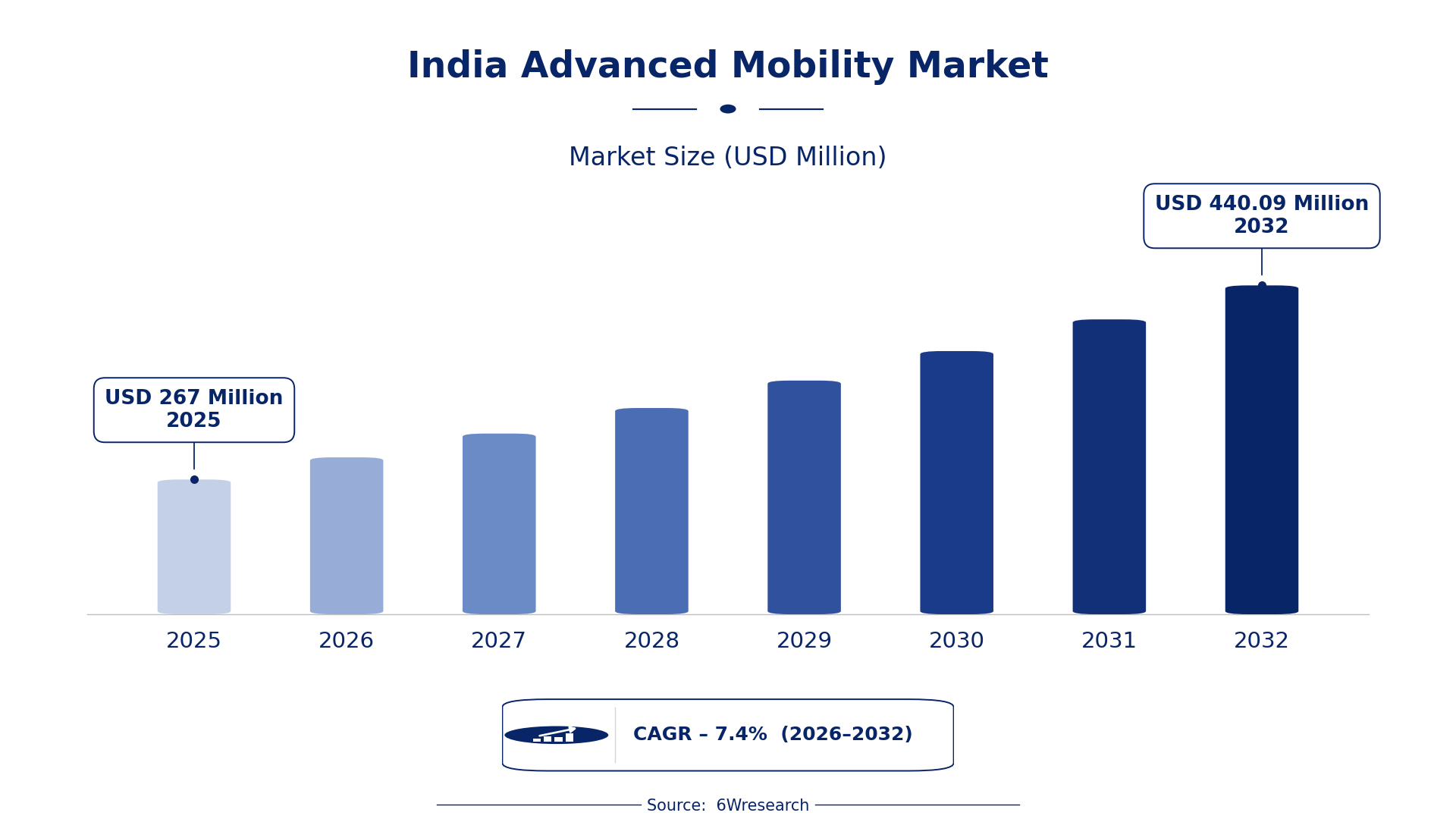
According to 6Wresearch internal database and industry insights, the India Advanced Mobility Market was valued at USD 267.0 million in 2025 and is projected to reach USD 440.09 million by 2032, growing at a CAGR of approximately 7.4% during 2026–2032.
India Advanced Mobility Market Highlights
| Report Metric | Details |
| Report Name | India Advanced Mobility Market |
| Market Size 2025 | USD 267.0 million |
| Market Size 2032 | USD 440.09 million |
| Absolute Growth 2025–2032 | USD 173.09 million |
| CAGR 2026–2032 | 7.4% |
| Peak Annual Growth | 9.9% in 2026 |
| Forecast Period | 2026–2032 |
| Historical Data | 2022–2025 |
| Base Year | 2025 |
| Leading Advanced Mobility Market, 2025 | Electric Mobility (eMobility) (51% share) |
| Leading Solution Type, 2025 | Battery Electric (35% share) |
| Leading Technology Used, 2025 | Lithium-Ion Batteries (40% share) |
| Leading Vehicle Type, 2025 | Electric Cars (37% share) |
| Leading End User, 2025 | Urban Commuters (37% share) |
| Fastest-Growing Advanced Mobility Market | Shared Mobility Solutions (9.9% CAGR) |
| Fastest-Growing Solution Type | E-Scooters & Bikes (9.2% CAGR) |
| Fastest-Growing Technology Used | AI (9.7% CAGR) |
| Fastest-Growing Vehicle Type | Two-Wheelers (9.5% CAGR) |
| Fastest-Growing End User | Mobility Startups (9.6% CAGR) |
| Growing Sector | Electric Mobility (eMobility) |
| Key End Users | Urban Commuters, Mobility Startups, Smart Cities, Last-Mile Delivery Firms |
India Advanced Mobility Market Year-wise Growth Rate and Key Drivers (2022–2032)
This graph illustrates the annual growth rates of the market from 2022 to 2032, highlighting a steady upward trajectory and projected market expansion over the forecast period.
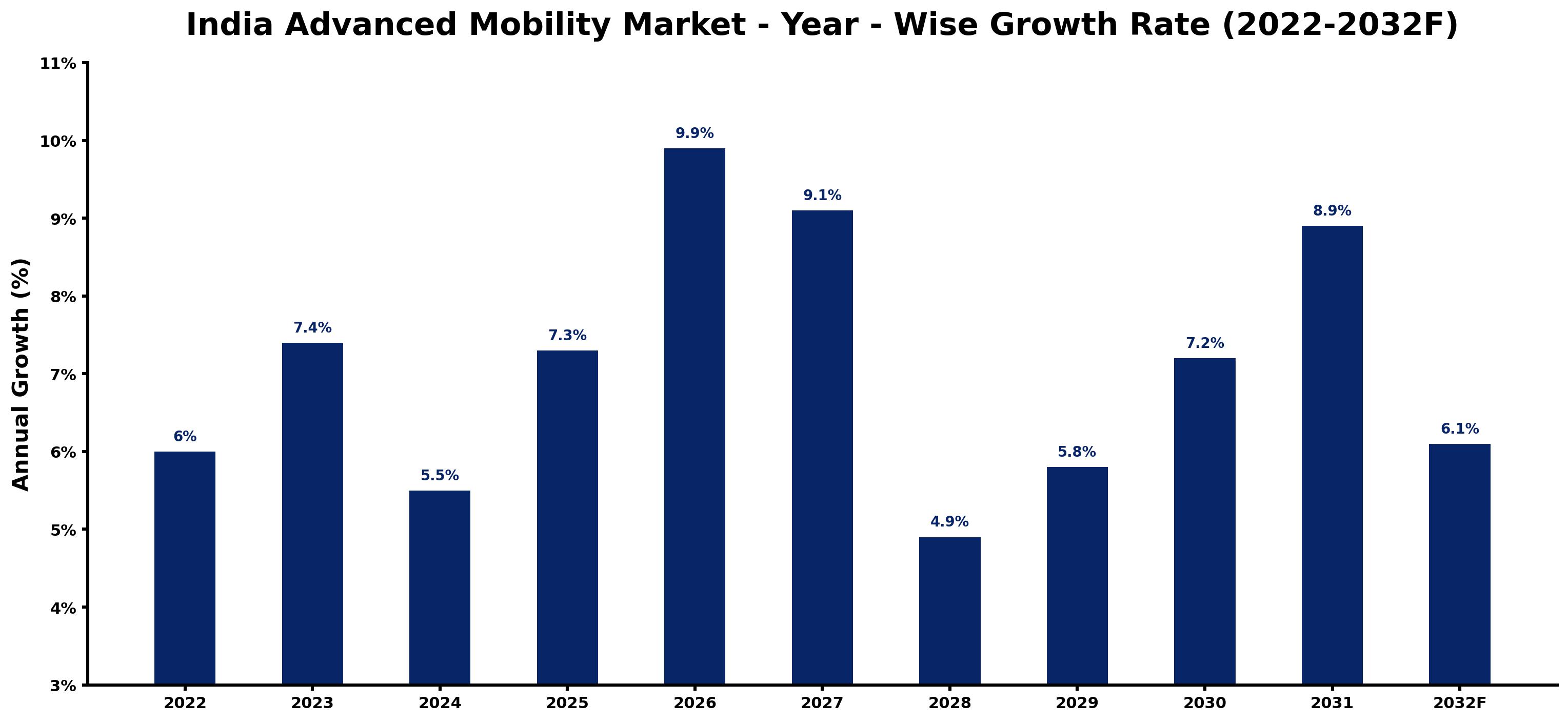
Below, each year's estimated growth is shown next to the factor that most influenced it.
| Year | Estimated Annual Growth (%) | Market Rationale |
| 2022 | 6.0 | The market experienced steady growth due to increasing urban mobility needs. |
| 2023 | 7.4 | Growth accelerated as the government promoted electric vehicle initiatives. |
| 2024 | 5.5 | A slowdown occurred as the market adjusted to previous rapid growth rates. |
| 2025 | 7.3 | Demand surged again, driven by urban commuters seeking efficient transport. |
| 2026 | 9.9 | The market peaked with significant investments in electric mobility solutions. |
| 2027 | 9.1 | Growth slowed as the market stabilised after the peak year. |
| 2028 | 4.9 | A further slowdown was noted as demand began to normalise. |
| 2029 | 5.8 | Growth picked up again, supported by rising interest in shared mobility. |
| 2030 | 7.2 | Urbanisation continued to drive demand for advanced mobility solutions. |
| 2031 | 8.9 | The market grew faster as more electric vehicles entered the market. |
| 2032 | 6.1 | Growth slowed again as the market approached maturity. |
Note: Market size estimations and growth projections presented in this report are based on 6Wresearch's proprietary forecasting methodology, utilizing the latest available industry data, government publications, and primary research inputs.
India Advanced Mobility Market Synopsis
The Advanced Mobility Market in India encompasses technologies and services that enhance transportation efficiency and sustainability. This includes electric vehicles, shared mobility, and autonomous systems, developed using advanced technologies like AI and IoT. The market is growing due to urbanisation, environmental concerns, and government initiatives such as the National Electric Mobility Mission Plan, which aims for 30% electric vehicle penetration by 2030. With over 100 smart cities being developed, the demand for advanced mobility solutions is expected to rise significantly in the coming years.
Market Dynamics Impact Analysis (2026–2032)
| Factor | Type | Impact | Primary Segment Affected |
| Government initiatives promoting electric vehicles and smart city projects drive demand. | Driver | High | Electric Mobility (eMobility) |
| Urban population growth increases the need for efficient transport solutions. | Driver | High | Shared Mobility Solutions |
| Investment in electric vehicle infrastructure creates opportunities for suppliers. | Opportunity | High | Battery Electric |
| The rise of mobility startups presents new avenues for innovation and investment. | Opportunity | High | Mobility Startups |
| High initial costs of electric vehicles may deter some buyers. | Restraint | Medium | Electric Mobility (eMobility) |
| Limited charging infrastructure can restrict electric vehicle adoption. | Restraint | Medium | Battery Electric |
| Competition from traditional fuel vehicles poses challenges for market growth. | Challenge | High | Electric Mobility (eMobility) |
| Technological barriers in autonomous systems slow their market entry. | Challenge | Medium | Autonomous Mobility |
Evaluation of Drivers in India Advanced Mobility Market (2026–2032)
The table below links each growth driver to the segment it affects and the evidence for it.
| Drivers | Primary Segment Affected | Why It Matters (Evidence) |
| Government incentives for electric vehicles boost consumer interest. | Electric Mobility (eMobility) | The National Electric Mobility Mission Plan aims for 30% electric vehicle penetration by 2030, encouraging buyers. |
| Urbanisation drives demand for efficient transportation options. | Shared Mobility Solutions | India's population is expected to reach 1.5 billion by 2030, increasing urban mobility needs significantly. |
| Investment in battery manufacturing boosts electric vehicle production. | Battery Electric | The Ministry of Heavy Industries announced incentives for battery manufacturing in 2023, enhancing local production capabilities. |
| Development of smart cities integrates advanced mobility solutions into urban planning. | Smart Cities | Over 100 smart cities are being developed across India, focusing on sustainable transport solutions and infrastructure. |
| Rising consumer awareness of environmental issues supports electric vehicle adoption. | Electric Cars | The National Policy on Biofuels promotes biofuels for transportation, enhancing sustainability and encouraging electric vehicle use. |
Growth in the Advanced Mobility market in India stems from rising end-use demand, technological progress, and increased investment in infrastructure. The National Electric Mobility Mission Plan's goal of 30% electric vehicle penetration by 2030 is generating consumer interest in electric mobility. Urbanisation is projected to push India's population to 1.5 billion by 2030, amplifying the need for efficient transport solutions. Incentives for battery manufacturing announced in 2023 will enhance production capabilities for electric vehicles. Furthermore, the development of smart cities will incorporate advanced mobility solutions into urban planning, significantly boosting market demand.
Evaluation of Restraints in India Advanced Mobility Market
The following restraints limit how fast demand can grow.
| Market Restraint | Primary Segment Affected | Why It Matters (Evidence) |
| High initial costs of electric vehicles may deter some buyers. | Electric Mobility (eMobility) | The average cost of electric vehicles remains higher than traditional vehicles, limiting accessibility for consumers. |
| Limited charging infrastructure can restrict electric vehicle adoption. | Battery Electric | Insufficient charging stations across urban areas hinder the growth of electric vehicle usage, affecting consumer confidence. |
| Competition from traditional fuel vehicles poses challenges for market growth. | Electric Mobility (eMobility) | Consumers often prefer established fuel vehicles due to perceived reliability and lower costs, impacting electric vehicle sales. |
| Technological barriers in autonomous systems slow their market entry. | Autonomous Mobility | Development and testing of autonomous technologies face regulatory and technical hurdles, delaying commercial applications. |
| Consumer hesitance regarding the reliability of new mobility solutions. | Shared Mobility Solutions | Concerns about safety and service quality affect user adoption rates, limiting market expansion. |
India Advanced Mobility Market Challenges
The India Advanced Mobility Market faces several practical problems, starting with high costs for producers due to expensive components required for electric vehicles. This situation arises from limited domestic manufacturing capabilities, leading to reliance on imports, which can inflate production costs by up to 20%. Regulatory hurdles complicate compliance for suppliers, as navigating the evolving standards set by the Bureau of Indian Standards can delay product launches by several months. Skills shortages in advanced technology sectors hinder growth, with a reported gap of 1 million skilled workers needed by 2030, affecting producers' ability to meet rising demand. Supply chain disruptions also impact buyers, as fluctuations in battery material availability can lead to delays in electric vehicle deliveries, causing potential revenue losses of up to 15%.
Trends in the India Advanced Mobility Market
The trends below show where the India Advanced Mobility Market is heading.
- Shift towards Electric Mobility Solutions: India is undergoing a shift towards electric mobility solutions as the government promotes sustainable transport. The National Electric Mobility Mission Plan aims for 30% electric vehicle penetration by 2030, supporting this transition.
- Growth of Smart Cities: Smart cities are incorporating advanced mobility solutions into urban planning, improving transportation efficiency. Over 100 smart cities are being developed across India, focusing on sustainable transport solutions.
- Rise of E-Scooters and Bikes: E-scooters and bikes are becoming popular in urban areas for short-distance travel. The electric two-wheeler segment is expected to grow significantly, driven by urban commuters seeking efficient transport options.
- Increased Focus on Battery Manufacturing: There is a growing emphasis on battery manufacturing to support electric vehicle production. The Ministry of Heavy Industries announced incentives in 2023, aiming to boost domestic battery production capabilities.
Investment Opportunities in the India Advanced Mobility Market
Investors looking at the India Advanced Mobility Market should consider the following areas.
- Electric Vehicle Infrastructure Development: Investing in charging infrastructure is essential as the government aims for 30% electric vehicle penetration by 2030. Urban areas with high commuter traffic present opportunities for infrastructure providers to establish charging stations.
- Partnerships with Mobility Startups: Forming partnerships with mobility startups can diversify service offerings in the sector. The rise of mobility startups is creating innovative solutions for urban transport challenges, presenting investment opportunities.
- Electric Buses for Urban Transport: The Indian government has approved a scheme for promoting electric buses in urban areas. This initiative presents opportunities for manufacturers to supply electric buses and related infrastructure, enhancing public transport options.
- Battery Production Facilities: Now is the time to invest in battery production facilities, given the government's incentives for domestic manufacturing. This aligns with the growing demand for electric vehicles and energy storage solutions.
Government Initiatives in the India Advanced Mobility Market
The National Electric Mobility Mission Plan 2020 aims to promote electric vehicles with a budget of INR 10,000 crore until 2024, enhancing infrastructure and incentives for manufacturers. This initiative encourages the development of charging infrastructure and the production of electric vehicles, aiming for 30% penetration by 2030. The FAME II scheme, initiated in 2019, continues to provide subsidies for electric vehicles and charging infrastructure, supporting the transition to eMobility. Additionally, the Bureau of Indian Standards set standards for electric vehicle safety and performance in 2021, ensuring compliance and consumer safety. These measures collectively enhance the operational environment for producers and buyers in the Advanced Mobility Market.
The Ministry of Heavy Industries oversees the Production Linked Incentive Scheme introduced in 2021, which boosts domestic manufacturing of electric vehicles and components. This scheme provides financial incentives to manufacturers, promoting local production and reducing dependency on imports. The Ministry of Road Transport and Highways launched the Automated Driving System Policy in 2021 to facilitate the testing and deployment of autonomous vehicles in India. This policy aims to create a regulatory framework for the safe operation of autonomous systems, fostering innovation in the sector. These initiatives are crucial for advancing the capabilities of the Advanced Mobility Market in India.
Future Insight of the India Advanced Mobility Market
The Advanced Mobility Market in India is set to undergo substantial changes by 2032, particularly with the goal of 30% electric vehicle penetration under the National Electric Mobility Mission Plan. This initiative will encourage suppliers to focus on battery technology and infrastructure development, improving overall market capabilities. The establishment of over 100 smart cities will create opportunities for integrating advanced transportation solutions, promoting collaboration among various stakeholders. Government support for renewable energy initiatives, targeting 175 GW capacity, will further facilitate the transition to sustainable transportation.
Market Segmentation Analysis
Each segment group is reviewed below, with the leader by share and the fastest grower by CAGR.
By Advanced Mobility Market – Electric Mobility (eMobility) Dominated, Shared Mobility Solutions Expected to Grow Fastest
According to Ravi Bhandari, Research Head at 6Wresearch, Electric Mobility (eMobility) accounted for a 51% market share by advanced mobility market in 2025. Electric Mobility holds the largest market share due to the government's commitment to achieving 30% electric vehicle penetration by 2030 under the National Electric Mobility Mission Plan. This focus on sustainability and urban transport efficiency has led to widespread adoption among urban commuters. Shared Mobility Solutions are projected to grow fastest, at a CAGR of 9.9% during 2026–2032. Shared Mobility Solutions are experiencing rapid growth as India's urban population increases, creating a pressing need for efficient transport options. The Smart Cities Mission's emphasis on mobility further fuels this demand, ensuring that shared services become integral to urban planning. Suppliers should focus on enhancing shared mobility offerings to capture the growing demand from urban populations.
By Solution Type – Battery Electric Dominated, E-Scooters & Bikes Expected to Grow Fastest
In 2025, Battery Electric led the solution type split with a 35% share. Battery Electric technology commands a significant market share as it is the core technology for electric vehicles, essential for the broader eMobility framework. This technology underpins the government's initiatives to promote electric vehicles across various segments. Over 2026–2032, E-Scooters & Bikes are expected to post the fastest growth, at a CAGR of 9.2%. E-Scooters & Bikes are rapidly gaining traction, particularly in urban areas, due to their convenience for last-mile connectivity. The increasing number of urban commuters seeking efficient transport options drives this segment's growth. Suppliers should invest in the development of e-scooters and bikes to meet the rising demand for last-mile solutions.
By Technology Used – Lithium-Ion Batteries Dominated, AI Expected to Grow Fastest
The largest technology used category in 2025 was Lithium-Ion Batteries, with a 40% share of total revenue. Lithium-Ion Batteries dominate the market share as they are critical components in electric vehicles and energy storage systems. Their widespread use aligns with the government's push for electric mobility and sustainability initiatives. The quickest growth will come from AI, forecast to expand at a CAGR of 9.7% between 2026 and 2032. AI is emerging as the fastest-growing technology, integral for developing smart mobility solutions and enhancing autonomous systems. The increasing integration of AI in transportation is set to revolutionise the sector, driving further innovation. Suppliers must prioritise AI integration in their solutions to stay competitive in the rapidly advancing mobility market.
By Vehicle Type – Electric Cars Dominated, Two-Wheelers Expected to Grow Fastest
With a 37% revenue share in 2025, Electric Cars was the largest vehicle type category. Electric Cars represent the largest share in the market as they are the primary focus of eMobility initiatives in India. Government incentives and consumer interest in sustainable transport options contribute significantly to their adoption. Two-Wheelers are set to record the highest CAGR in this split, 9.5% over 2026–2032. Two-Wheelers are the fastest-growing vehicle type, driven by their popularity in urban settings for micro-mobility. The convenience and cost-effectiveness of electric two-wheelers make them an attractive choice for urban commuters. Suppliers should focus on expanding their electric two-wheeler offerings to capture the growing market segment.
By End User – Urban Commuters Dominated, Mobility Startups Expected to Grow Fastest
Urban Commuters held a 37% share of the India Advanced Mobility Market by end user in 2025. Urban Commuters account for the largest share of users in the advanced mobility market, as they seek efficient and sustainable transport solutions. The increasing urban population in India further amplifies this demand. Mobility Startups are projected to grow fastest, at a CAGR of 9.6% during 2026–2032. Mobility Startups are the fastest-growing end user segment, as they drive innovation and diversify services within the advanced mobility sector. Their agility in adopting new technologies positions them well to meet changing consumer needs. Suppliers should engage with mobility startups to leverage their innovative approaches and expand market reach.
Key Attractiveness of the Report
- 10 Years of Market Numbers
- Historical Data Starting from 2022 to 2025
- Base Year 2025
- Forecast Data until 2032
- Key Performance Indicators Impacting the Market
- Major Upcoming Developments and Projects
Key Highlights of the Report:
- India Advanced Mobility Market Outlook
- Market Size of India Advanced Mobility Market, 2025
- Forecast of India Advanced Mobility Market, 2032
- Historical Data and Forecast of India Advanced Mobility Revenues & Volume for the Period 2022 - 2032F
- India Advanced Mobility Market Trend Evolution
- India Advanced Mobility Market Drivers and Challenges
- India Advanced Mobility Price Trends
- India Advanced Mobility Porter's Five Forces
- India Advanced Mobility Industry Life Cycle
- Historical Data and Forecast of India Advanced Mobility Market Revenues & Volume By Advanced Mobility Market for the Period 2022 - 2032F
- Historical Data and Forecast of India Advanced Mobility Market Revenues & Volume By Electric Mobility (eMobility) for the Period 2022 - 2032F
- Historical Data and Forecast of India Advanced Mobility Market Revenues & Volume By Shared Mobility Solutions for the Period 2022 - 2032F
- Historical Data and Forecast of India Advanced Mobility Market Revenues & Volume By Autonomous Mobility for the Period 2022 - 2032F
- Historical Data and Forecast of India Advanced Mobility Market Revenues & Volume By Micro-Mobility for the Period 2022 - 2032F
- Historical Data and Forecast of India Advanced Mobility Market Revenues & Volume By Solution Type for the Period 2022 - 2032F
- Historical Data and Forecast of India Advanced Mobility Market Revenues & Volume By Battery Electric for the Period 2022 - 2032F
- Historical Data and Forecast of India Advanced Mobility Market Revenues & Volume By Ride Sharing for the Period 2022 - 2032F
- Historical Data and Forecast of India Advanced Mobility Market Revenues & Volume By Self-Driving Tech for the Period 2022 - 2032F
- Historical Data and Forecast of India Advanced Mobility Market Revenues & Volume By E-Scooters & Bikes for the Period 2022 - 2032F
- Historical Data and Forecast of India Advanced Mobility Market Revenues & Volume By Technology Used for the Period 2022 - 2032F
- Historical Data and Forecast of India Advanced Mobility Market Revenues & Volume By Lithium-Ion Batteries for the Period 2022 - 2032F
- Historical Data and Forecast of India Advanced Mobility Market Revenues & Volume By Mobile Platforms for the Period 2022 - 2032F
- Historical Data and Forecast of India Advanced Mobility Market Revenues & Volume By Lidar, AI for the Period 2022 - 2032F
- Historical Data and Forecast of India Advanced Mobility Market Revenues & Volume By IoT-Enabled for the Period 2022 - 2032F
- Historical Data and Forecast of India Advanced Mobility Market Revenues & Volume By Vehicle Type for the Period 2022 - 2032F
- Historical Data and Forecast of India Advanced Mobility Market Revenues & Volume By Electric Cars for the Period 2022 - 2032F
- Historical Data and Forecast of India Advanced Mobility Market Revenues & Volume By Four-Wheelers for the Period 2022 - 2032F
- Historical Data and Forecast of India Advanced Mobility Market Revenues & Volume By Autonomous Shuttles for the Period 2022 - 2032F
- Historical Data and Forecast of India Advanced Mobility Market Revenues & Volume By Two-Wheelers for the Period 2022 - 2032F
- Historical Data and Forecast of India Advanced Mobility Market Revenues & Volume By End User for the Period 2022 - 2032F
- Historical Data and Forecast of India Advanced Mobility Market Revenues & Volume By Urban Commuters for the Period 2022 - 2032F
- Historical Data and Forecast of India Advanced Mobility Market Revenues & Volume By Mobility Startups for the Period 2022 - 2032F
- Historical Data and Forecast of India Advanced Mobility Market Revenues & Volume By Smart Cities for the Period 2022 - 2032F
- Historical Data and Forecast of India Advanced Mobility Market Revenues & Volume By Last-Mile Delivery Firms for the Period 2022 - 2032F
- India Advanced Mobility Import Export Trade Statistics
- Market Opportunity Assessment By Advanced Mobility Market
- Market Opportunity Assessment By Solution Type
- Market Opportunity Assessment By Technology Used
- Market Opportunity Assessment By Vehicle Type
- Market Opportunity Assessment By End User
- India Advanced Mobility Top Companies Market Share
- India Advanced Mobility Competitive Benchmarking By Technical and Operational Parameters
- India Advanced Mobility Company Profiles
- India Advanced Mobility Key Strategic Recommendations
Market Covered
This report examines the market across the segments below.
By Advanced Mobility Market
- Electric Mobility (eMobility)
- Shared Mobility Solutions
- Autonomous Mobility
- Micro-Mobility
By Solution Type
- Battery Electric
- Ride Sharing
- Self-Driving Tech
- E-Scooters & Bikes
By Technology Used
- Lithium-Ion Batteries
- Mobile Platforms
- Lidar
- AI
- IoT-Enabled
By Vehicle Type
- Electric Cars
- Four-Wheelers
- Autonomous Shuttles
- Two-Wheelers
By End User
- Urban Commuters
- Mobility Startups
- Smart Cities
- Last-Mile Delivery Firms































