India Advanced Sensing Market Size & Growth Rate
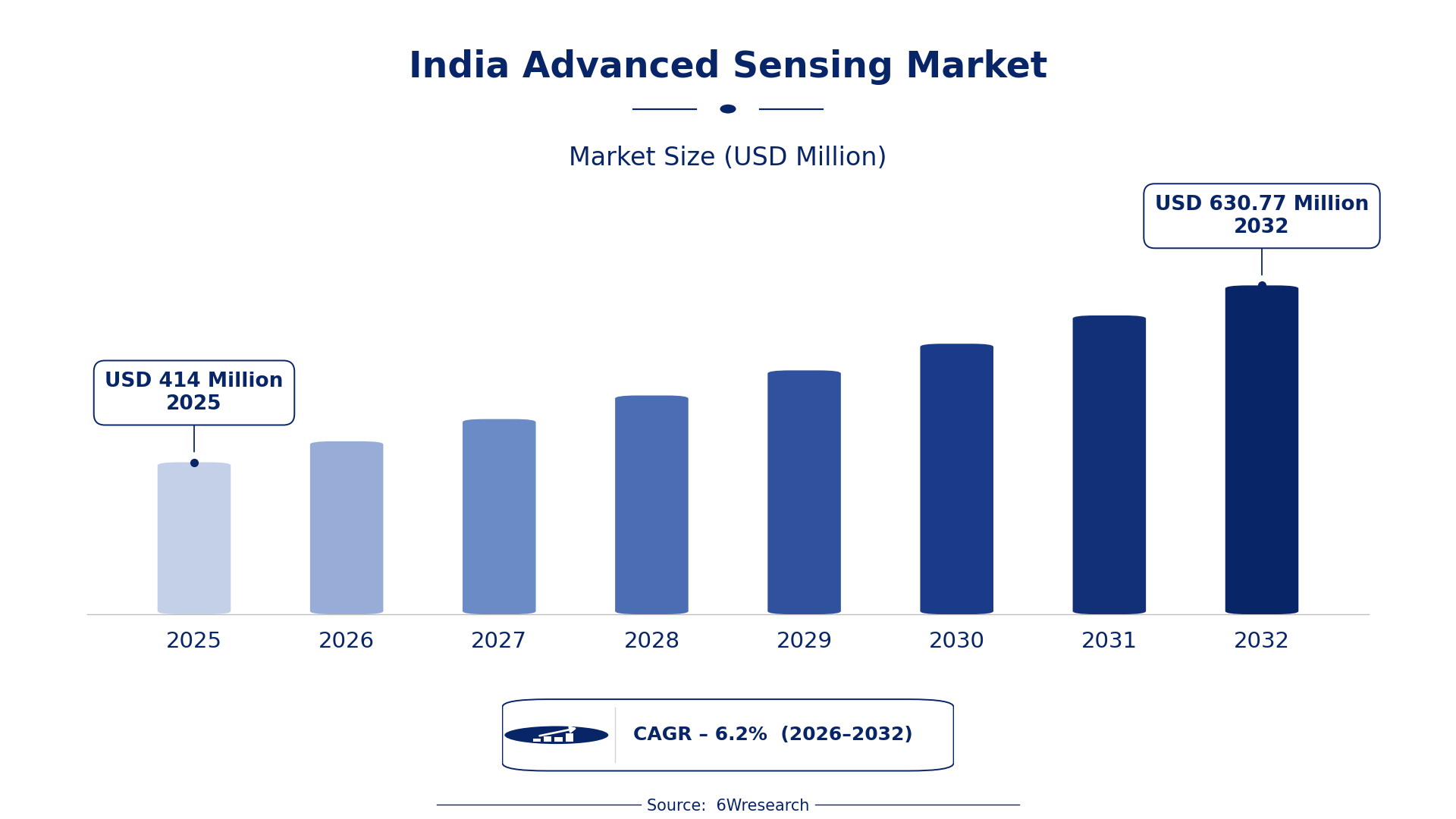
According to 6Wresearch internal database and industry insights, the India Advanced Sensing Market was valued at USD 414.0 million in 2025 and is projected to reach USD 630.77 million by 2032, growing at a CAGR of approximately 6.2% during 2026–2032.
India Advanced Sensing Market Highlights
| Report Metric | Details |
| Report Name | India Advanced Sensing Market |
| Market Size 2025 | USD 414.0 million |
| Market Size 2032 | USD 630.77 million |
| Absolute Growth 2025–2032 | USD 216.77 million |
| CAGR 2026–2032 | 6.2% |
| Peak Annual Growth | 8.7% in 2032 |
| Forecast Period | 2026–2032 |
| Historical Data | 2022–2025 |
| Base Year | 2025 |
| Leading Advanced Sensing Market, 2025 | LiDAR Sensors (39% share) |
| Leading Sensor Type, 2025 | MEMS-Based (41% share) |
| Leading Sensing Mechanism, 2025 | Electrochemical/Optical (43% share) |
| Leading Application Area, 2025 | Healthcare Diagnostics (40% share) |
| Leading End User Sector, 2025 | Medical Device Companies (38% share) |
| Fastest-Growing Advanced Sensing Market | Bio-Sensors (7.5% CAGR) |
| Fastest-Growing Sensing Mechanism | Piezoresistive/Capacitive (8.4% CAGR) |
| Fastest-Growing Application Area | Autonomous Navigation (8.5% CAGR) |
| Fastest-Growing End User Sector | Automotive & Robotics (8.0% CAGR) |
| Growing Sector | Autonomous Navigation |
| Key End Users | Healthcare Diagnostics, Autonomous Navigation, Industrial Monitoring, Air Quality Control |
India Advanced Sensing Market Year-wise Growth Rate and Key Drivers (2022–2032)
This graph illustrates the annual growth rates of the market from 2022 to 2032, highlighting a steady upward trajectory and projected market expansion over the forecast period.
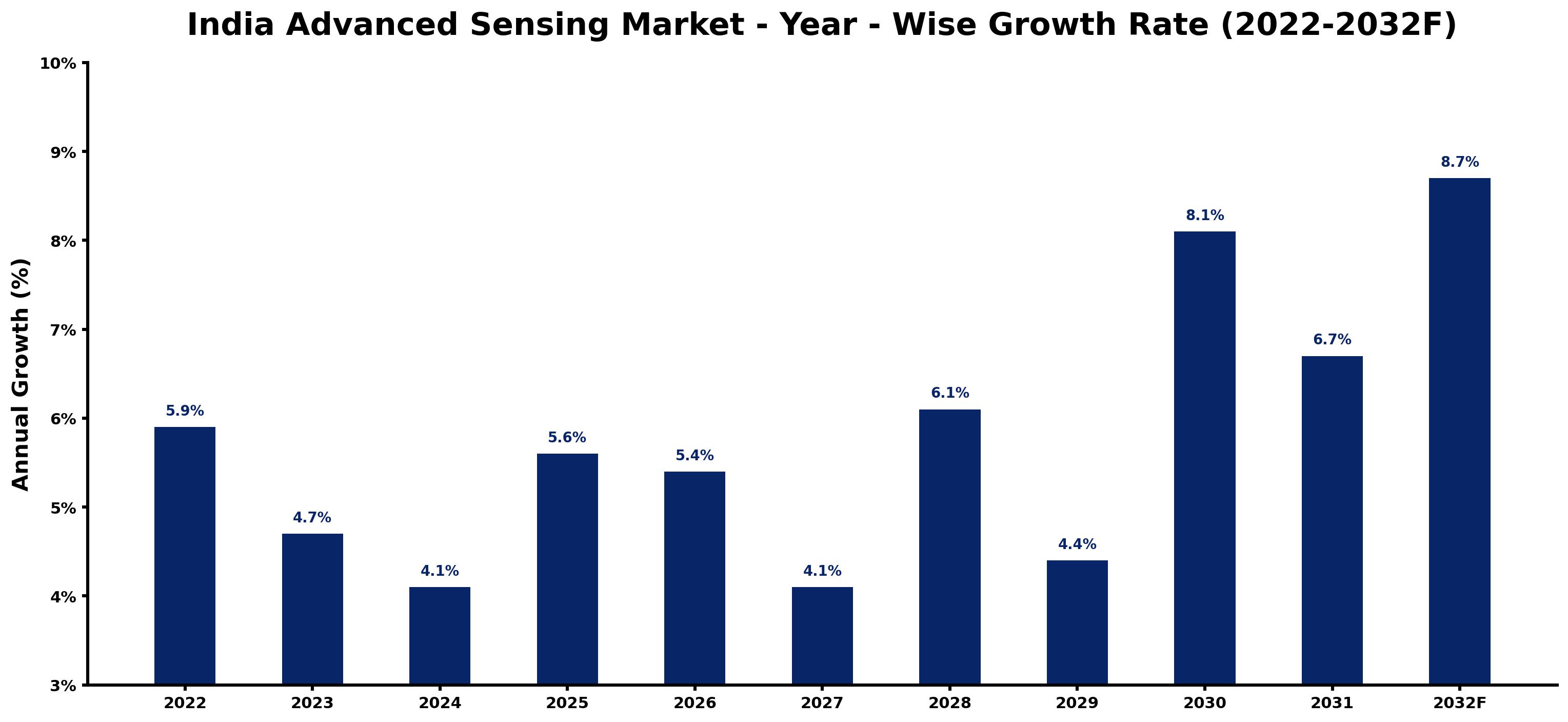
The following table presents the estimated annual growth rate for each year together with the principal factor influencing market performance.
| Year | Estimated Annual Growth (%) | Market Rationale |
| 2022 | 5.9 | The market showed strong demand from the automotive sector, boosting sensor adoption. |
| 2023 | 4.7 | Growth slowed due to a temporary dip in automotive production and supply chain issues. |
| 2024 | 4.1 | Demand continued to slow as manufacturers faced challenges in sourcing materials. |
| 2025 | 5.6 | The market rebounded with increased investments in smart city projects and healthcare. |
| 2026 | 5.4 | Growth slowed again as competition intensified in the advanced sensing sector. |
| 2027 | 4.1 | The market faced challenges from regulatory changes affecting sensor approvals. |
| 2028 | 6.1 | Demand surged with advancements in autonomous vehicle technologies and healthcare diagnostics. |
| 2029 | 4.4 | Growth slowed as market saturation began to impact new sensor deployments. |
| 2030 | 8.1 | The automotive sector's expansion drove demand for LiDAR sensors. |
| 2031 | 6.7 | Growth slowed as manufacturers adjusted to evolving market conditions and competition. |
| 2032 | 8.7 | The market peaked as smart city initiatives and healthcare needs surged. |
Note: Market size estimations and growth projections presented in this report are based on 6Wresearch's proprietary forecasting methodology, utilizing the latest available industry data, government publications, and primary research inputs.
India Advanced Sensing Market Synopsis
Advanced Sensing Market in India encompasses technologies that improve detection and measurement capabilities. These sensors, made from semiconductor materials, are vital in autonomous vehicles, healthcare diagnostics, and industrial automation. The India Advanced Sensing Market is growing due to rising demand from the automotive sector and smart city initiatives. The Smart Cities Mission's funding is driving sensor deployment, while the National Health Mission's focus on healthcare delivery is increasing the need for advanced diagnostics sensors.
Market Dynamics Impact Analysis (2026–2032)
| Factor | Type | Impact | Primary Segment Affected |
| Rising demand for advanced sensing technologies in the automotive sector. | Driver | High | LiDAR Sensors |
| Increased investment in smart city initiatives driving sensor deployment. | Driver | High | Bio-Sensors |
| Growing need for air quality monitoring solutions in urban areas. | Opportunity | Medium | Gas Sensors |
| Expanding healthcare infrastructure requiring advanced diagnostic tools. | Opportunity | High | Healthcare Diagnostics |
| Challenges in sourcing materials for sensor production. | Restraint | High | MEMS-Based |
| Regulatory hurdles affecting sensor approvals and market entry. | Restraint | Medium | Electrochemical/Optical |
| Intense competition among manufacturers leading to price pressures. | Challenge | High | Pressure Sensors |
| Supply chain disruptions impacting timely sensor availability. | Challenge | Medium | Gas Sensors |
Evaluation of Drivers in India Advanced Sensing Market (2026–2032)
Key forces behind demand, with the segment each one moves most, are listed below.
| Drivers | Primary Segment Affected | Why It Matters (Evidence) |
| Increased automotive production and demand for advanced sensing technologies. | LiDAR Sensors | The automotive sector in India is projected to reach $300 billion by 2026, driving demand for advanced sensing technologies. |
| Investment in smart city projects improving urban infrastructure. | Bio-Sensors | The Smart Cities Mission allocated ₹1,000 crore in 2021, promoting sensor deployment across urban areas. |
| Rising healthcare needs for advanced diagnostics and monitoring. | Healthcare Diagnostics | The National Health Mission aims to improve healthcare delivery, promoting the use of bio-sensors in diagnostics. |
| Growing focus on environmental monitoring and air quality control. | Gas Sensors | India's population exceeds 1.4 billion, increasing the need for air quality monitoring solutions. |
| Technological advancements in MEMS technology for sensor applications. | MEMS-Based | The Ministry of Electronics and Information Technology promotes MEMS development under the Digital India initiative. |
The Advanced Sensing market in India is growing on the back of increased automotive production, smart city investments, and rising healthcare needs. The Smart Cities Mission allocated ₹1,000 crore in 2021, promoting sensor deployment across urban areas. Rising healthcare needs are pushing the National Health Mission to enhance the use of bio-sensors for diagnostics. Additionally, the growing population of over 1.4 billion is increasing the demand for air quality monitoring solutions, leading to further sensor adoption.
Evaluation of Restraints in India Advanced Sensing Market
The table below lists the restraints and the evidence behind each.
| Market Restraint | Primary Segment Affected | Why It Matters (Evidence) |
| Material sourcing challenges affecting sensor production timelines. | MEMS-Based | Manufacturers face difficulties in obtaining raw materials, delaying production schedules by approximately 15%. |
| Regulatory changes impacting sensor approval processes. | Electrochemical/Optical | New regulations require additional testing and certification, extending time to market by 20%. |
| Intense competition leading to price pressures in the market. | Pressure Sensors | Manufacturers are forced to lower prices, impacting profit margins by up to 10%. |
| Supply chain disruptions affecting sensor availability. | Gas Sensors | Global supply chain issues have resulted in delays and increased costs for manufacturers by around 25%. |
| Market saturation limiting new sensor deployments. | Bio-Sensors | As more players enter the market, differentiation becomes challenging, slowing growth by approximately 5%. |
India Advanced Sensing Market Challenges
Buyers in the India Advanced Sensing Market struggle with outdated technology, as many existing sensors fail to meet current performance standards, delaying smart city projects by up to six months. High production costs burden suppliers, with semiconductor materials inflating expenses by around 20%, squeezing profit margins. Regulatory hurdles from the Bureau of Indian Standards can extend product approval timelines, causing delays in deploying healthcare diagnostics that are critical for patient care. Local manufacturers face intense competition from cheaper imported sensors, compelling them to reduce prices and limiting their capacity to invest in research and development.
Trends in the India Advanced Sensing Market
Buyers and suppliers in the India Advanced Sensing Market are adjusting to the following trends.
- Shift Towards Smart City Integration: The Smart Cities Mission is driving the integration of advanced sensing technologies in urban planning, with ₹1,000 crore allocated for sensor deployment in 2021. This trend improves urban infrastructure and services.
- Growing Adoption of Bio-Sensors: Healthcare diagnostics are increasingly relying on bio-sensors, with the National Health Mission promoting their use for patient monitoring. This shift is expected to increase demand significantly in the coming years.
- Expansion of LiDAR Applications: LiDAR sensors are becoming essential in autonomous vehicle navigation, with the Indian automotive market projected to be the third-largest by 2030. This growth is driving investments in advanced sensing technologies.
- Increased Focus on Air Quality Monitoring: With India's population exceeding 1.4 billion, there is a heightened emphasis on air quality monitoring solutions. This trend is prompting investments in gas sensors and environmental monitoring technologies.
Investment Opportunities in the India Advanced Sensing Market
Several openings in the India Advanced Sensing Market merit attention from investors.
- Investment in Smart City Projects: Urban planners in India are increasingly adopting advanced sensing technologies, with ₹1,000 crore allocated for the Smart Cities Mission. This funding creates opportunities for suppliers to provide innovative sensor solutions.
- Healthcare Sector Expansion: Medical device companies are seeking advanced diagnostic sensors to improve patient care, driven by the National Health Mission's initiatives. Suppliers can tap into this growing demand by offering high-quality bio-sensors.
- Automotive Innovations: The automotive industry is rapidly evolving, with a projected market size of $300 billion by 2026. Suppliers can invest in advanced sensing technologies to meet the increasing demand for autonomous vehicle applications.
- Environmental Monitoring Solutions: With rising concerns about air quality, there is a growing need for gas sensors in India. Suppliers can enter this market by providing innovative solutions tailored to environmental monitoring.
Government Initiatives in the India Advanced Sensing Market
The Smart Cities Mission, initiated by the Ministry of Housing and Urban Affairs in 2015, aims to enhance urban infrastructure using advanced sensing technologies, with a budget of ₹48,000 crore. This initiative promotes the deployment of sensors in urban areas, benefiting both producers and buyers by improving service delivery and infrastructure efficiency. The National Health Mission, launched by the Ministry of Health and Family Welfare in 2013, focuses on improving healthcare access and quality, promoting the use of bio-sensors in diagnostics. This initiative encourages manufacturers to develop innovative healthcare solutions, enhancing patient monitoring capabilities.
The Atal Innovation Mission, established by NITI Aayog in 2016, supports innovation in sensor technologies with funding and mentorship programs for startups. This scheme provides financial assistance and resources for developing advanced sensing technologies, enabling new entrants to thrive in the market. Additionally, the National Policy on Electronics 2019 aims to increase domestic production of electronic components, including sensors, to reduce import dependence. This policy encourages local manufacturers to invest in advanced sensing technologies, fostering growth in the sector.
Future Insight of the India Advanced Sensing Market
The India Advanced Sensing Market will undergo significant advancements by 2032, primarily due to the Smart Cities Mission and Make in India initiatives, which will strengthen local manufacturing capabilities. The automotive sector's growth is projected to drive a surge in demand for sensors, particularly for autonomous vehicles, fostering innovation in the industry. Enhanced healthcare delivery under the National Health Mission will further increase the need for diagnostic sensors. With a budget of ₹1,000 crore allocated for smart city projects, sensor deployment will accelerate, facilitating technological integration in urban environments.
Market Segmentation Analysis
The analysis below covers each segmentation, its leading category in 2025 and its fastest-growing category through 2032.
By Advanced Sensing Market – LiDAR Sensors Dominated, Bio-Sensors Expected to Grow Fastest
According to Ravi Bhandari, Research Head at 6Wresearch, LiDAR Sensors took a 39% share of advanced sensing market in 2025, more than any other category. LiDAR sensors hold the largest share in the advanced sensing market because they are vital for mapping and navigation in autonomous vehicles, which are gaining traction in India. The automotive sector's projected growth to $300 billion by 2026 underscores the strong demand for these sensors. Bio-Sensors are set to record the highest CAGR in this split, 7.5% over 2026–2032. Bio-sensors are experiencing rapid growth, driven by the increasing need for healthcare diagnostics, particularly as India's healthcare system, with over 1.5 million hospital beds, seeks advanced monitoring solutions. This trend is likely to continue as healthcare delivery improves under the National Health Mission. Suppliers should focus on enhancing bio-sensing technologies to address the rising demands in healthcare diagnostics.
By Sensor Type – MEMS-Based Dominated and Is Expected to Record the Fastest Growth
MEMS-Based held a 41% share of the India Advanced Sensing Market by sensor type in 2025. MEMS-based sensors dominate the market due to their extensive application in consumer electronics and automotive sectors, making them essential in India. Their reliability and adaptability across various applications contribute to their significant market share. MEMS-Based is also forecast to expand faster than any other category, at a CAGR of 8.2% over 2026–2032. The MEMS-based segment is also the fastest-growing, propelled by their increasing integration into smart devices and automotive technologies. As the automotive industry expands, the demand for MEMS sensors will continue to strengthen, solidifying their market leadership. Buyers should prioritise sourcing MEMS-based sensors to leverage their versatility across multiple applications.
By Sensing Mechanism – Electrochemical/Optical Dominated, Piezoresistive/Capacitive Expected to Grow Fastest
In 2025, Electrochemical/Optical led the sensing mechanism split with a 43% share. Electrochemical and optical sensing mechanisms lead the market, primarily due to their widespread use in gas and chemical sensing applications that are critical for safety and environmental monitoring. Their established reliability ensures a strong market presence across various sectors. The quickest growth will come from Piezoresistive/Capacitive, forecast to expand at a CAGR of 8.4% between 2026 and 2032. Piezoresistive and capacitive mechanisms are the fastest-growing, essential for pressure sensing applications, particularly in automotive and industrial sectors. As these sectors expand, the demand for these sensing mechanisms is expected to rise significantly. Suppliers must innovate in piezoresistive and capacitive technologies to capture the growing market opportunities.
By Application Area – Healthcare Diagnostics Dominated, Autonomous Navigation Expected to Grow Fastest
The largest application area category in 2025 was Healthcare Diagnostics, with a 40% share of total revenue. Healthcare diagnostics is the leading application area due to its crucial role in patient monitoring and diagnostics within India's extensive healthcare infrastructure. The increasing focus on enhancing healthcare delivery highlights the importance of advanced sensing technologies in this field. Over 2026–2032, Autonomous Navigation is expected to post the fastest growth, at a CAGR of 8.5%. Autonomous navigation is the fastest-growing application area, driven by the rapid development of self-driving vehicles in India. As the automotive sector evolves, the reliance on advanced sensing technologies for navigation will continue to increase. Investing in technologies for autonomous navigation will be vital for suppliers aiming to stay competitive in the advanced sensing market.
By End User Sector – Medical Device Companies Dominated, Automotive & Robotics Expected to Grow Fastest
With a 38% revenue share in 2025, Medical Device Companies was the largest end user sector category. Medical device companies represent the largest end user sector, largely due to their significant consumption of bio-sensing technologies for diagnostics and monitoring. The growth of the healthcare industry creates a robust demand for advanced sensing solutions in this sector. Automotive & Robotics are set to record the highest CAGR in this split, 8.0% over 2026–2032. The automotive and robotics sector is the fastest-growing end user, as the integration of advanced sensing technologies becomes crucial for enhancing vehicle automation and robotics applications. This growth is expected to accelerate with the automotive market's expansion. Suppliers should align their strategies with the automotive and robotics sectors to capitalise on emerging opportunities.
Key Attractiveness of the Report
- 10 Years of Market Numbers
- Historical Data Starting from 2022 to 2025
- Base Year 2025
- Forecast Data until 2032
- Key Performance Indicators Impacting the Market
- Major Upcoming Developments and Projects
Key Highlights of the Report:
- India Advanced Sensing Market Outlook
- Market Size of India Advanced Sensing Market, 2025
- Forecast of India Advanced Sensing Market, 2032
- Historical Data and Forecast of India Advanced Sensing Revenues & Volume for the Period 2022 - 2032F
- India Advanced Sensing Market Trend Evolution
- India Advanced Sensing Market Drivers and Challenges
- India Advanced Sensing Price Trends
- India Advanced Sensing Porter's Five Forces
- India Advanced Sensing Industry Life Cycle
- Historical Data and Forecast of India Advanced Sensing Market Revenues & Volume By Advanced Sensing Market for the Period 2022 - 2032F
- Historical Data and Forecast of India Advanced Sensing Market Revenues & Volume By LiDAR Sensors for the Period 2022 - 2032F
- Historical Data and Forecast of India Advanced Sensing Market Revenues & Volume By Bio-Sensors for the Period 2022 - 2032F
- Historical Data and Forecast of India Advanced Sensing Market Revenues & Volume By Pressure Sensors for the Period 2022 - 2032F
- Historical Data and Forecast of India Advanced Sensing Market Revenues & Volume By Gas Sensors for the Period 2022 - 2032F
- Historical Data and Forecast of India Advanced Sensing Market Revenues & Volume By Sensor Type for the Period 2022 - 2032F
- Historical Data and Forecast of India Advanced Sensing Market Revenues & Volume By Optical Distance Sensors for the Period 2022 - 2032F
- Historical Data and Forecast of India Advanced Sensing Market Revenues & Volume By Enzyme/Antibody-Based for the Period 2022 - 2032F
- Historical Data and Forecast of India Advanced Sensing Market Revenues & Volume By MEMS-Based for the Period 2022 - 2032F
- Historical Data and Forecast of India Advanced Sensing Market Revenues & Volume By Semiconductor-Based for the Period 2022 - 2032F
- Historical Data and Forecast of India Advanced Sensing Market Revenues & Volume By Sensing Mechanism for the Period 2022 - 2032F
- Historical Data and Forecast of India Advanced Sensing Market Revenues & Volume By Pulsed Laser Measurement for the Period 2022 - 2032F
- Historical Data and Forecast of India Advanced Sensing Market Revenues & Volume By Electrochemical/Optical for the Period 2022 - 2032F
- Historical Data and Forecast of India Advanced Sensing Market Revenues & Volume By Piezoresistive/Capacitive for the Period 2022 - 2032F
- Historical Data and Forecast of India Advanced Sensing Market Revenues & Volume By Catalytic/Oxide Sensing for the Period 2022 - 2032F
- Historical Data and Forecast of India Advanced Sensing Market Revenues & Volume By Application Area for the Period 2022 - 2032F
- Historical Data and Forecast of India Advanced Sensing Market Revenues & Volume By Autonomous Navigation for the Period 2022 - 2032F
- Historical Data and Forecast of India Advanced Sensing Market Revenues & Volume By Healthcare Diagnostics for the Period 2022 - 2032F
- Historical Data and Forecast of India Advanced Sensing Market Revenues & Volume By Industrial Monitoring for the Period 2022 - 2032F
- Historical Data and Forecast of India Advanced Sensing Market Revenues & Volume By Air Quality Control for the Period 2022 - 2032F
- Historical Data and Forecast of India Advanced Sensing Market Revenues & Volume By End User Sector for the Period 2022 - 2032F
- Historical Data and Forecast of India Advanced Sensing Market Revenues & Volume By Automotive & Robotics for the Period 2022 - 2032F
- Historical Data and Forecast of India Advanced Sensing Market Revenues & Volume By Medical Device Companies for the Period 2022 - 2032F
- Historical Data and Forecast of India Advanced Sensing Market Revenues & Volume By Manufacturing Sector for the Period 2022 - 2032F
- Historical Data and Forecast of India Advanced Sensing Market Revenues & Volume By Smart Building Integrators for the Period 2022 - 2032F
- India Advanced Sensing Import Export Trade Statistics
- Market Opportunity Assessment By Advanced Sensing Market
- Market Opportunity Assessment By Sensor Type
- Market Opportunity Assessment By Sensing Mechanism
- Market Opportunity Assessment By Application Area
- Market Opportunity Assessment By End User Sector
- India Advanced Sensing Top Companies Market Share
- India Advanced Sensing Competitive Benchmarking By Technical and Operational Parameters
- India Advanced Sensing Company Profiles
- India Advanced Sensing Key Strategic Recommendations
Market Covered
This report examines the market across the segments below.
By Advanced Sensing Market
- LiDAR Sensors
- Bio-Sensors
- Pressure Sensors
- Gas Sensors
By Sensor Type
- Optical Distance Sensors
- Enzyme/Antibody-Based
- MEMS-Based
- Semiconductor-Based
By Sensing Mechanism
- Pulsed Laser Measurement
- Electrochemical/Optical
- Piezoresistive/Capacitive
- Catalytic/Oxide Sensing
By Application Area
- Autonomous Navigation
- Healthcare Diagnostics
- Industrial Monitoring
- Air Quality Control
By End User Sector
- Automotive & Robotics
- Medical Device Companies
- Manufacturing Sector
- Smart Building Integrators































