India Advanced Sensor Materials Market Size & Growth Rate
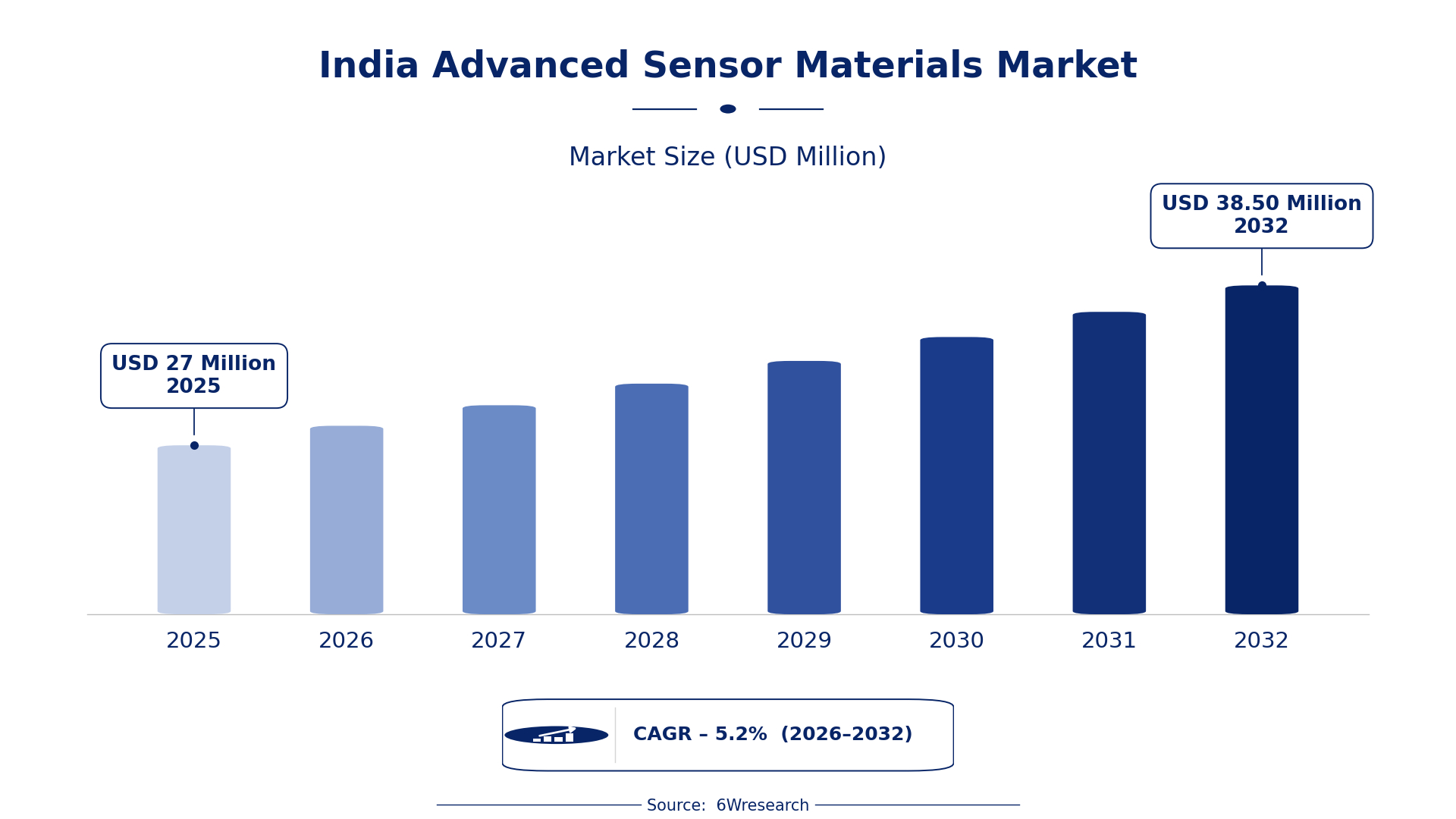
According to 6Wresearch internal database and industry insights, the India Advanced Sensor Materials Market was valued at USD 27.0 million in 2025 and is projected to reach USD 38.50 million by 2032, growing at a CAGR of approximately 5.2% during 2026–2032.
India Advanced Sensor Materials Market Highlights
| Report Metric | Details |
| Report Name | India Advanced Sensor Materials Market |
| Market Size 2025 | USD 27.0 million |
| Market Size 2032 | USD 38.50 million |
| Absolute Growth 2025–2032 | USD 11.50 million |
| CAGR 2026–2032 | 5.2% |
| Peak Annual Growth | 6.8% in 2032 |
| Forecast Period | 2026–2032 |
| Historical Data | 2022–2025 |
| Base Year | 2025 |
| Leading Advanced Sensor Materials Market, 2025 | Graphene-Based Materials (40% share) |
| Leading Material Type, 2025 | Nanomaterial (37% share) |
| Leading Sensor Application, 2025 | Gas Sensors (47% share) |
| Leading Distribution Channel, 2025 | Direct Sales (43% share) |
| Leading End User Sector, 2025 | Automotive (42% share) |
| Fastest-Growing Advanced Sensor Materials Market | Metal Oxides (7.7% CAGR) |
| Fastest-Growing Sensor Application | Biosensors (7.2% CAGR) |
| Fastest-Growing Distribution Channel | Online Platforms (7.5% CAGR) |
| Fastest-Growing End User Sector | Healthcare (7.0% CAGR) |
| Growing Sector | Automotive |
| Key End Users | Automotive, Healthcare, Consumer Electronics, Smart Building Systems |
India Advanced Sensor Materials Market Year-wise Growth Rate and Key Drivers (2022–2032)
This graph illustrates the annual growth rates of the market from 2022 to 2032, highlighting a steady upward trajectory and projected market expansion over the forecast period.
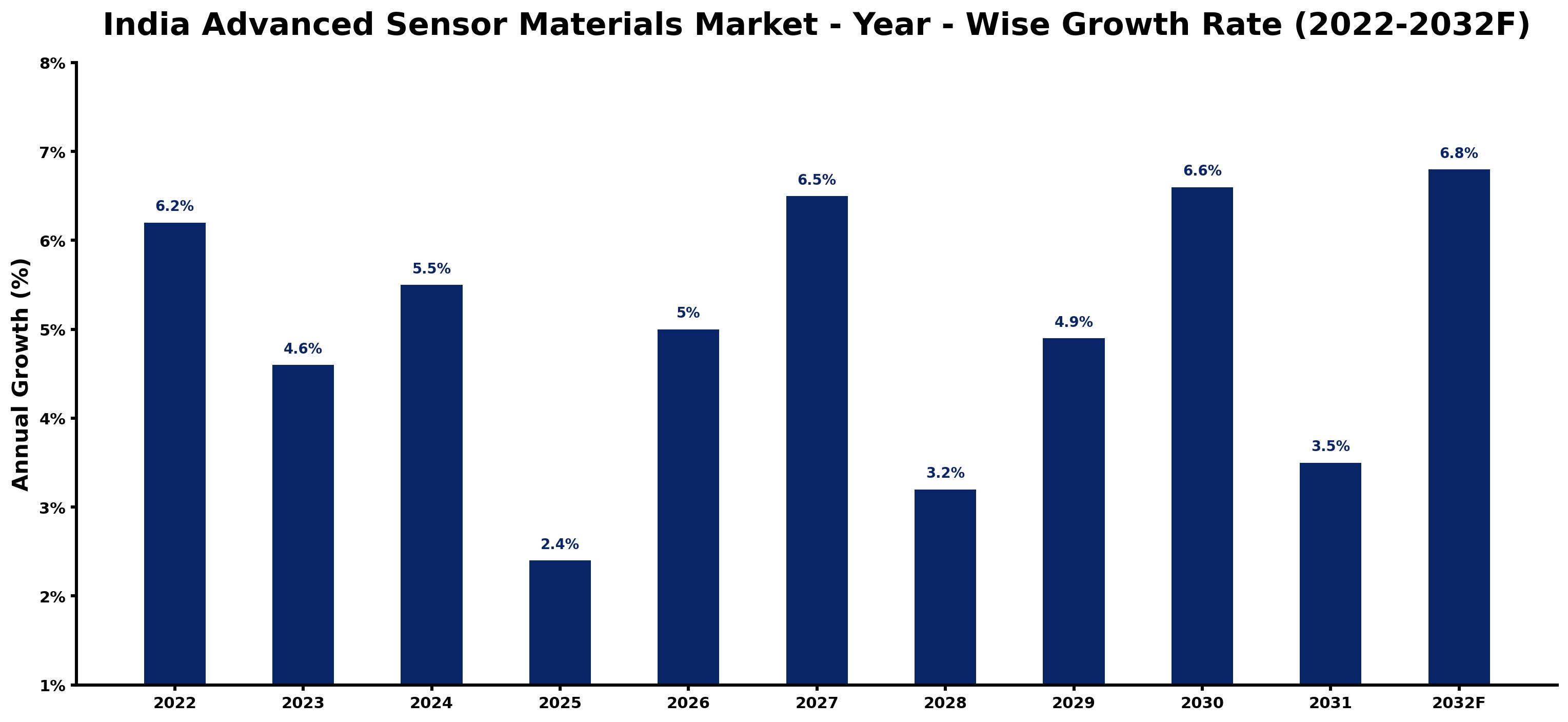
Each row of the following table gives one year's estimated growth and the event or demand shift that explains it.
| Year | Estimated Annual Growth (%) | Market Rationale |
| 2022 | 6.2 | The market experienced strong demand from automotive and healthcare sectors. |
| 2023 | 4.6 | Growth slowed due to supply chain disruptions impacting production timelines. |
| 2024 | 5.5 | Increased investments in sensor technologies spurred faster growth. |
| 2025 | 2.4 | Demand growth slowed as the automotive sector faced challenges from supply chain issues. |
| 2026 | 5.0 | Rising interest in smart building technologies is expected to boost sensor material demand. |
| 2027 | 6.5 | The automotive sector's expansion will lead to higher demand for advanced sensors. |
| 2028 | 3.2 | Growth is projected to slow as the market adjusts to previous high demand levels. |
| 2029 | 4.9 | Increased healthcare applications for biosensors will drive faster growth. |
| 2030 | 6.6 | The automotive sector's continuous innovation is expected to spur demand for advanced materials. |
| 2031 | 3.5 | Market growth will slow as demand stabilises after several high-growth years. |
| 2032 | 6.8 | Rising investments in smart textiles and wearable devices will drive growth. |
Note: Market size estimations and growth projections presented in this report are based on 6Wresearch's proprietary forecasting methodology, utilizing the latest available industry data, government publications, and primary research inputs.
India Advanced Sensor Materials Market Synopsis
Advanced Sensor Materials in India encompass materials such as graphene-based substances, metal oxides, and conductive polymers utilised in a variety of sensors. These materials are manufactured using techniques like chemical vapor deposition and sol-gel processes. The India Advanced Sensor Materials Market is projected to reach 1.5 billion USD by 2025, driven by demand from the automotive and healthcare sectors. The automotive sector is expected to grow by 15% annually, leading to an increased requirement for advanced sensors. The National Electronics Policy aims to support semiconductor manufacturing, further propelling market expansion.
Market Dynamics Impact Analysis (2026–2032)
| Factor | Type | Impact | Primary Segment Affected |
| Growing demand for automotive safety features drives sensor material use. | Driver | High | Automotive |
| Increased healthcare applications for biosensors create new opportunities. | Driver | High | Healthcare |
| The automotive sector's growth presents opportunities for sensor suppliers. | Opportunity | High | Automotive |
| The rise of smart building systems creates demand for advanced sensors. | Opportunity | Medium | Smart Building Systems |
| Supply chain disruptions affect the timely availability of materials. | Restraint | High | Graphene-Based Materials |
| High production costs may limit the adoption of advanced sensor materials. | Restraint | Medium | Graphene-Based Materials |
| Regulatory compliance can delay product approvals for manufacturers. | Challenge | High | Graphene-Based Materials |
| Limited skilled workforce in sensor technologies hampers growth. | Challenge | Medium | Graphene-Based Materials |
Evaluation of Drivers in India Advanced Sensor Materials Market (2026–2032)
The table below links each growth driver to the segment it affects and the evidence for it.
| Drivers | Primary Segment Affected | Why It Matters (Evidence) |
| Increased automotive production leads to higher demand for sensor materials. | Automotive | India produced over 2 million vehicles in 2022, increasing sensor material purchases. |
| Growing healthcare sector drives demand for advanced biosensors. | Healthcare | The healthcare sector in India has over 1.3 billion patients, boosting biosensor needs. |
| Rising smart building projects create demand for advanced sensor applications. | Smart Building Systems | India's smart building market is projected to grow at a CAGR of 20% from 2023 to 2030. |
| Investment in semiconductor manufacturing boosts sensor material supply. | Graphene-Based Materials | The National Electronics Policy aims for a 1 billion USD investment by 2025. |
| Training initiatives increase workforce capabilities in sensor technologies. | Graphene-Based Materials | The Electronics Sector Skill Council of India aims to train 1 million workers by 2025. |
The Advanced Sensor Materials market in India is growing as demand from the automotive and healthcare sectors rises sharply. In 2022, India produced over 2 million vehicles, resulting in heightened purchases of sensor materials for safety and automation applications. The healthcare sector, which serves over 1.3 billion patients, drives the need for advanced biosensors for diagnostics and monitoring. The smart building market is projected to grow at a CAGR of 20% from 2023 to 2030, creating new opportunities for sensor applications.
Evaluation of Restraints in India Advanced Sensor Materials Market
The key brakes on demand, and where they bite hardest, are shown below.
| Market Restraint | Primary Segment Affected | Why It Matters (Evidence) |
| Supply chain disruptions affect the timely availability of materials. | Graphene-Based Materials | These disruptions can delay production and increase costs for manufacturers, impacting their ability to meet demand. |
| High production costs may limit the adoption of advanced sensor materials. | Graphene-Based Materials | Manufacturers face challenges in maintaining competitive pricing due to rising raw material costs. |
| Regulatory compliance can delay product approvals for manufacturers. | Graphene-Based Materials | Manufacturers must navigate complex regulations, affecting their time-to-market and increasing operational costs. |
| Limited skilled workforce in sensor technologies hampers growth. | Graphene-Based Materials | This shortage can slow down innovation and production capabilities, limiting market expansion opportunities. |
| Market fluctuations can impact investment in advanced sensor technologies. | Graphene-Based Materials | Economic uncertainties may lead to reduced funding for R&D initiatives, affecting long-term growth. |
India Advanced Sensor Materials Market Challenges
India's advanced sensor materials market encounters a skills shortage, with the Electronics Sector Skill Council aiming to train 1 million workers by 2025, which delays production for manufacturers. Regulatory challenges arise from the Bureau of Indian Standards, imposing compliance costs that hinder market entry for producers. Supply chain issues are apparent as the automotive sector produced over 2 million vehicles in 2022, leading to heightened demand for automotive sensors that suppliers struggle to meet promptly. Technology limitations persist, as research on graphene-based materials for applications in smart textiles remains in early stages, restricting innovation for end users across various sectors.
Trends in the India Advanced Sensor Materials Market
Below mentioned are some of the trends shaping the India Advanced Sensor Materials Market growth.
- Shift from Traditional to Smart Sensors: Since 2022, India has experienced a shift towards smart sensors in automotive applications, with over 2 million vehicles produced in 2022. This transition is driving demand for advanced sensor materials, improving vehicle safety and efficiency.
- Transition to Biosensors in Healthcare: The healthcare sector is increasingly adopting biosensors for diagnostics, supported by a growing population of over 1.3 billion patients. This trend is boosting the demand for advanced sensor materials, particularly in patient monitoring.
- Emergence of Smart Building Systems: Beginning in 2023, smart building systems are gaining traction in India, projected to grow at a CAGR of 20% until 2030. This growth is creating new opportunities for sensor material suppliers in energy management applications.
- Prioritisation of Semiconductor Manufacturing: The National Electronics Policy launched in 2020 is prioritising semiconductor manufacturing in India, targeting a 1 billion USD investment by 2025. This initiative is expected to strengthen the supply chain for sensor materials, benefiting local manufacturers.
Investment Opportunities in the India Advanced Sensor Materials Market
Investors looking at the India Advanced Sensor Materials Market should consider the following areas.
- Automotive Manufacturers Seeking Advanced Sensors: With the automotive sector projected to grow by 15% annually, there is an opportunity for suppliers of advanced sensor materials. Engaging with automotive manufacturers can facilitate entry into this expanding market, broadening product offerings.
- Healthcare Providers Increasing Demand for Biosensors: The growing healthcare sector creates a pressing need for biosensors, providing an opportunity for suppliers to invest in this area. Collaborating with healthcare providers can enhance market penetration and product adoption.
- Smart Building Developers Looking for Sensor Solutions: The rise of smart building systems presents an opportunity for suppliers of advanced sensor materials. Partnering with developers in this sector can lead to successful market entry and increased sales.
- Investment in Semiconductor Manufacturing: The National Electronics Policy aims for a 1 billion USD investment by 2025, creating opportunities for suppliers of semiconductor materials. Establishing local partnerships can facilitate access to this growing market and improve competitiveness.
Government Initiatives in the India Advanced Sensor Materials Market
The National Electronics Policy 2020, initiated by the Ministry of Electronics and Information Technology, aims to boost domestic manufacturing of semiconductor materials with a target of 1 billion USD investment by 2025. This policy supports the production of advanced sensor materials, encouraging local manufacturers to invest in R&D and production capabilities. The Atmanirbhar Bharat initiative, launched in 2020, promotes self-reliance in electronics manufacturing, including advanced sensor materials, with a budget allocation of 400 million INR. This initiative encourages manufacturers to develop local supply chains and reduce dependency on imports. The Department of Science and Technology initiated the Advanced Materials Technology Mission in 2021 to support R&D in sensor technologies with a budget of 300 million INR. This mission funds research projects aimed at developing advanced sensor materials and applications.
The Electronics Sector Skill Council of India oversees various training programmes aimed at enhancing workforce capabilities in sensor technologies. The Electronics Manufacturing Cluster Scheme promotes local manufacturing of sensors, providing financial assistance to manufacturers. The Advanced Materials Technology Mission funds research projects aimed at developing advanced sensor materials and applications. Additionally, the Electronics Sector Skill Council of India has launched a training programme aimed at upskilling 100,000 individuals in sensor technology and applications, ensuring a skilled workforce for the industry.
Future Insight of the India Advanced Sensor Materials Market
The India advanced sensor materials market is set for transformation by 2032, driven by the National Electronics Policy that encourages local manufacturing and semiconductor production. The automotive sector's anticipated 15% annual growth will significantly boost demand for advanced sensors. Rapid expansion in the smart building market, projected to grow at a CAGR of 20% from 2023 to 2030, will create new applications for these materials. Investment from the Ministry of Electronics and Information Technology, with a budget of 500 million INR for R&D, will further accelerate advancements in sensor technologies.
Market Segmentation Analysis
The report offers a comprehensive study of the following market segments and their leading categories in the market.
By Advanced Sensor Materials Market – Graphene-Based Materials Dominated, Metal Oxides Expected to Grow Fastest
According to Ravi Bhandari, Research Head at 6Wresearch, the largest advanced sensor materials market category in 2025 was Graphene-Based Materials, with a 40% share of total revenue. Graphene-based materials dominate India's advanced sensor materials market due to their exceptional conductivity and versatility in high-performance sensors. Their critical role in automotive applications, where safety and efficiency are paramount, solidifies their leading position. Over 2026–2032, Metal Oxides are expected to post the fastest growth, at a CAGR of 7.7%. Metal oxides are experiencing rapid growth, increasingly utilised in gas sensors for environmental monitoring. The rising focus on air quality and safety is expected to significantly boost demand for these materials, further widening the lead of graphene-based materials. Suppliers should enhance their offerings in metal oxides to capitalise on the growing environmental awareness.
By Material Type – Nanomaterial Dominated and Is Expected to Record the Fastest Growth
With a 37% revenue share in 2025, Nanomaterial was the largest material type category. Nanomaterials hold the largest market share as they are essential for enhancing sensor performance and sensitivity across various applications. Their unique properties make them highly sought after in sectors such as automotive and healthcare, ensuring a robust installed base. The same category is also set to grow fastest, at a CAGR of 8.0% during 2026–2032. Nanomaterials are also the fastest-growing segment, propelled by continuous advancements in sensor technologies that require superior materials. This dual role reinforces their critical position in the industry and strengthens their market share. Buyers will benefit from investing in nanomaterials to ensure they have access to the most advanced sensor technologies.
By Sensor Application – Gas Sensors Dominated, Biosensors Expected to Grow Fastest
Gas Sensors took a 47% share of sensor application in 2025, more than any other category. Gas sensors lead the market due to their vital role in air quality monitoring and safety applications, especially in urban environments. Their widespread use across various industries ensures a substantial market share, reflecting their importance in public health. Biosensors are projected to grow fastest, at a CAGR of 7.2% during 2026–2032. Biosensors are the fastest-growing application, driven by the increasing demand for healthcare diagnostics and monitoring solutions. The healthcare sector's expansion, with over 1.3 billion patients, is expected to further accelerate this growth, enhancing the overall market share. Suppliers should prioritise the development of biosensors to meet the rising healthcare demands and capture new market opportunities.
By Distribution Channel – Direct Sales Dominated, Online Platforms Expected to Grow Fastest
Direct Sales held a 43% share of the India Advanced Sensor Materials Market by distribution channel in 2025. Direct sales remain the primary channel for industrial clients purchasing advanced sensor materials, ensuring a strong market share. This channel allows for tailored solutions and direct engagement with large-scale buyers, solidifying its position in the market. Online Platforms are set to record the highest CAGR in this split, 7.5% over 2026–2032. Online platforms are emerging as the fastest-growing distribution channel, particularly for consumer electronics and small-scale buyers seeking convenience. This trend indicates a shift towards digital purchasing behaviours, which could reshape market dynamics. Suppliers should enhance their online presence to tap into the growing consumer market and facilitate easier access to their products.
By End User Sector – Automotive Dominated, Healthcare Expected to Grow Fastest
In 2025, Automotive led the end user sector split with a 42% share. The automotive sector commands the largest share as a significant user of advanced sensors for safety and automation features in vehicles. The production of over 2 million vehicles in 2022 underscores this demand, highlighting the sector's reliance on advanced sensor technologies. Over 2026–2032, Healthcare is expected to post the fastest growth, at a CAGR of 7.0%. Healthcare is the fastest-growing sector for advanced sensors, driven by the need for biosensor applications in diagnostics and patient monitoring. This growth reflects the sector's increasing focus on technological advancements, further expanding its market share. Suppliers must align their strategies with the healthcare sector's growth to capture emerging opportunities in biosensor technologies.
Key Attractiveness of the Report
- 10 Years of Market Numbers
- Historical Data Starting from 2022 to 2025
- Base Year 2025
- Forecast Data until 2032
- Key Performance Indicators Impacting the Market
- Major Upcoming Developments and Projects
Key Highlights of the Report:
- India Advanced Sensor Materials Market Outlook
- Market Size of India Advanced Sensor Materials Market, 2025
- Forecast of India Advanced Sensor Materials Market, 2032
- Historical Data and Forecast of India Advanced Sensor Materials Revenues & Volume for the Period 2022 - 2032F
- India Advanced Sensor Materials Market Trend Evolution
- India Advanced Sensor Materials Market Drivers and Challenges
- India Advanced Sensor Materials Price Trends
- India Advanced Sensor Materials Porter's Five Forces
- India Advanced Sensor Materials Industry Life Cycle
- Historical Data and Forecast of India Advanced Sensor Materials Market Revenues & Volume By Advanced Sensor Materials Market for the Period 2022 - 2032F
- Historical Data and Forecast of India Advanced Sensor Materials Market Revenues & Volume By Graphene-Based Materials for the Period 2022 - 2032F
- Historical Data and Forecast of India Advanced Sensor Materials Market Revenues & Volume By Metal Oxides for the Period 2022 - 2032F
- Historical Data and Forecast of India Advanced Sensor Materials Market Revenues & Volume By Piezoelectric Ceramics for the Period 2022 - 2032F
- Historical Data and Forecast of India Advanced Sensor Materials Market Revenues & Volume By Conductive Polymers for the Period 2022 - 2032F
- Historical Data and Forecast of India Advanced Sensor Materials Market Revenues & Volume By Material Type for the Period 2022 - 2032F
- Historical Data and Forecast of India Advanced Sensor Materials Market Revenues & Volume By Nanomaterial for the Period 2022 - 2032F
- Historical Data and Forecast of India Advanced Sensor Materials Market Revenues & Volume By Semiconductor Material for the Period 2022 - 2032F
- Historical Data and Forecast of India Advanced Sensor Materials Market Revenues & Volume By Functional Material for the Period 2022 - 2032F
- Historical Data and Forecast of India Advanced Sensor Materials Market Revenues & Volume By Organic Material for the Period 2022 - 2032F
- Historical Data and Forecast of India Advanced Sensor Materials Market Revenues & Volume By Sensor Application for the Period 2022 - 2032F
- Historical Data and Forecast of India Advanced Sensor Materials Market Revenues & Volume By Pressure & Strain Sensors for the Period 2022 - 2032F
- Historical Data and Forecast of India Advanced Sensor Materials Market Revenues & Volume By Gas Sensors for the Period 2022 - 2032F
- Historical Data and Forecast of India Advanced Sensor Materials Market Revenues & Volume By Motion Sensors for the Period 2022 - 2032F
- Historical Data and Forecast of India Advanced Sensor Materials Market Revenues & Volume By Biosensors for the Period 2022 - 2032F
- Historical Data and Forecast of India Advanced Sensor Materials Market Revenues & Volume By Distribution Channel for the Period 2022 - 2032F
- Historical Data and Forecast of India Advanced Sensor Materials Market Revenues & Volume By Direct Sales for the Period 2022 - 2032F
- Historical Data and Forecast of India Advanced Sensor Materials Market Revenues & Volume By Online Platforms for the Period 2022 - 2032F
- Historical Data and Forecast of India Advanced Sensor Materials Market Revenues & Volume By Industrial Suppliers for the Period 2022 - 2032F
- Historical Data and Forecast of India Advanced Sensor Materials Market Revenues & Volume By Specialty Stores for the Period 2022 - 2032F
- Historical Data and Forecast of India Advanced Sensor Materials Market Revenues & Volume By End User Sector for the Period 2022 - 2032F
- Historical Data and Forecast of India Advanced Sensor Materials Market Revenues & Volume By Automotive for the Period 2022 - 2032F
- Historical Data and Forecast of India Advanced Sensor Materials Market Revenues & Volume By Smart Building Systems for the Period 2022 - 2032F
- Historical Data and Forecast of India Advanced Sensor Materials Market Revenues & Volume By Consumer Electronics for the Period 2022 - 2032F
- Historical Data and Forecast of India Advanced Sensor Materials Market Revenues & Volume By Healthcare for the Period 2022 - 2032F
- India Advanced Sensor Materials Import Export Trade Statistics
- Market Opportunity Assessment By Advanced Sensor Materials Market
- Market Opportunity Assessment By Material Type
- Market Opportunity Assessment By Sensor Application
- Market Opportunity Assessment By Distribution Channel
- Market Opportunity Assessment By End User Sector
- India Advanced Sensor Materials Top Companies Market Share
- India Advanced Sensor Materials Competitive Benchmarking By Technical and Operational Parameters
- India Advanced Sensor Materials Company Profiles
- India Advanced Sensor Materials Key Strategic Recommendations
Market Covered
Segments analysed in this report are listed below.
By Advanced Sensor Materials Market
- Graphene-Based Materials
- Metal Oxides
- Piezoelectric Ceramics
- Conductive Polymers
By Material Type
- Nanomaterial
- Semiconductor Material
- Functional Material
- Organic Material
By Sensor Application
- Pressure & Strain Sensors
- Gas Sensors
- Motion Sensors
- Biosensors
By Distribution Channel
- Direct Sales
- Online Platforms
- Industrial Suppliers
- Specialty Stores
By End User Sector
- Automotive
- Smart Building Systems
- Consumer Electronics
- Healthcare































