India Advanced Vehicle Collision Avoidance Technologies Market Size & Growth Rate
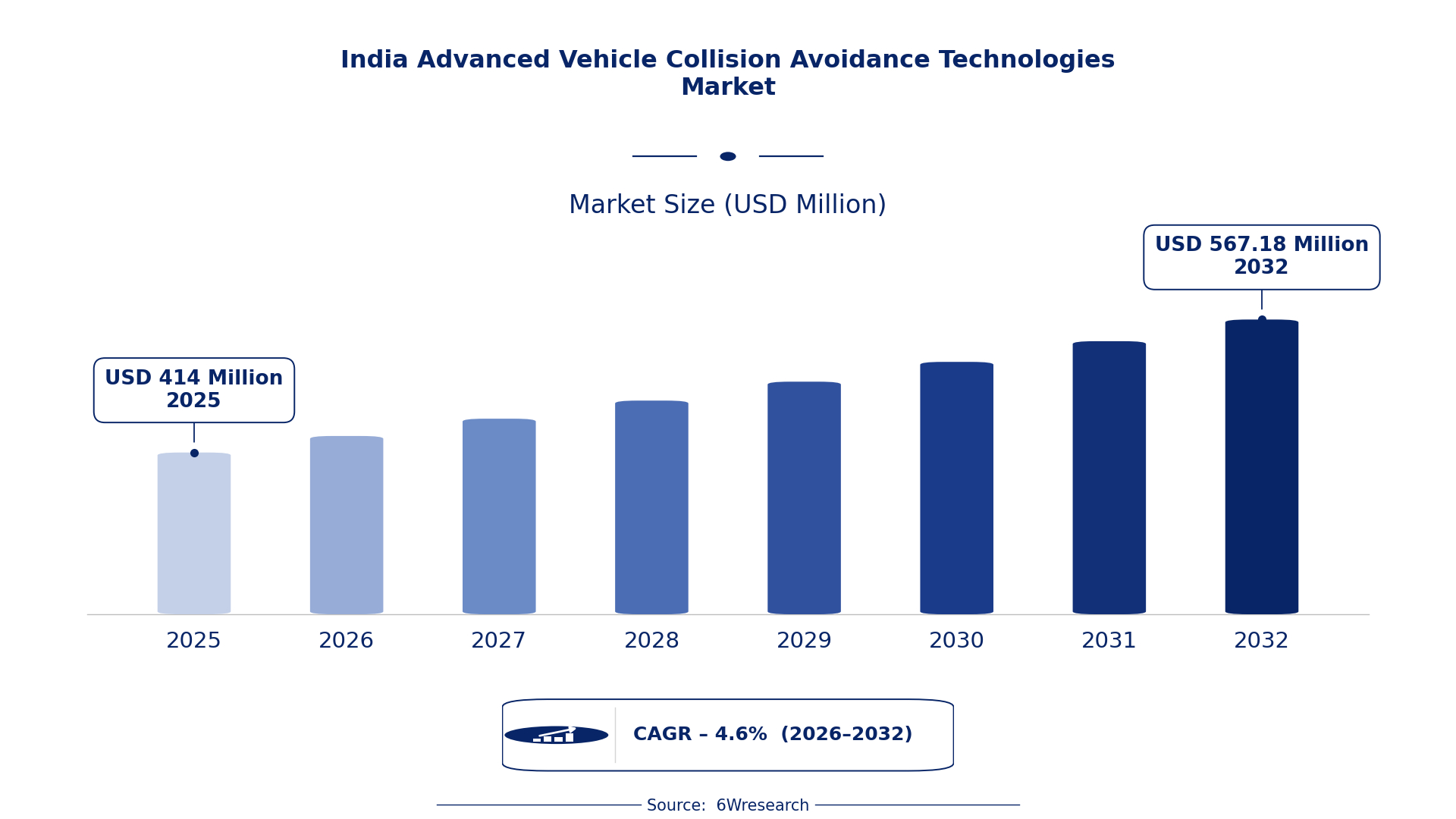
According to 6Wresearch internal database and industry insights, the India Advanced Vehicle Collision Avoidance Technologies Market was valued at USD 414.0 million in 2025 and is projected to reach USD 567.18 million by 2032, growing at a CAGR of approximately 4.6% during 2026–2032.
India Advanced Vehicle Collision Avoidance Technologies Market Highlights
| Report Metric | Details |
| Report Name | India Advanced Vehicle Collision Avoidance Technologies Market |
| Market Size 2025 | USD 414.0 million |
| Market Size 2032 | USD 567.18 million |
| Absolute Growth 2025–2032 | USD 153.18 million |
| CAGR 2026–2032 | 4.6% |
| Peak Annual Growth | 6.7% in 2026 |
| Forecast Period | 2026–2032 |
| Historical Data | 2022–2025 |
| Base Year | 2025 |
| Leading Advanced Vehicle Collision Avoidance Technologies Market, 2025 | Forward Collision Warning (FCW) (38% share) |
| Leading Technology Type, 2025 | AI-Based (41% share) |
| Leading Detection Method, 2025 | Camera + Radar (44% share) |
| Leading Integration Type, 2025 | OEM-Integrated (54% share) |
| Leading Vehicle Segment, 2025 | Passenger Cars (44% share) |
| Fastest-Growing Advanced Vehicle Collision Avoidance Technologies Market | Automatic Emergency Braking (AEB) (5.7% CAGR) |
| Fastest-Growing Detection Method | Sensor Fusion (6.6% CAGR) |
| Fastest-Growing Integration Type | Aftermarket & OEM (6.8% CAGR) |
| Fastest-Growing Vehicle Segment | SUVs & Sedans (7.1% CAGR) |
| Growing Sector | automotive safety |
| Key End Users | automotive manufacturers, safety technology developers, regulatory bodies, consumers |
India Advanced Vehicle Collision Avoidance Technologies Market Year-wise Growth Rate and Key Drivers (2022–2032)
This graph illustrates the annual growth rates of the market from 2022 to 2032, highlighting a steady upward trajectory and projected market expansion over the forecast period.
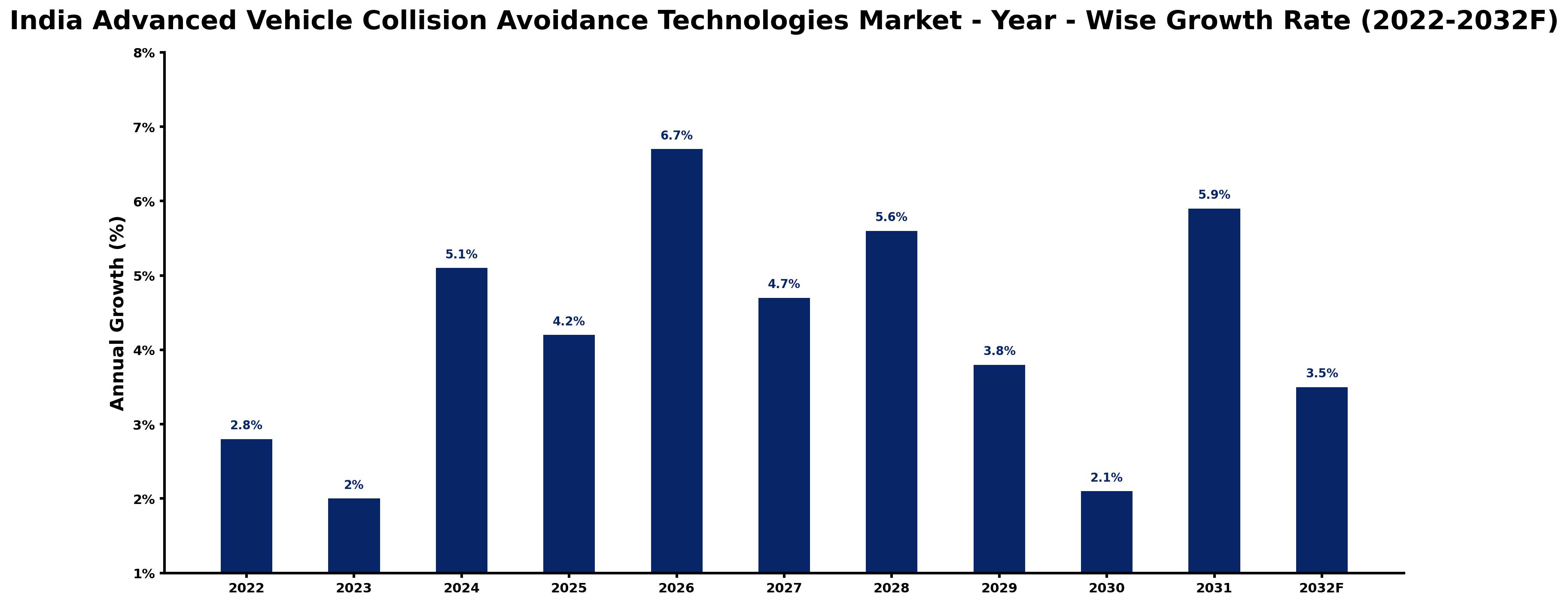
The following table presents the estimated annual growth rate for each year together with the principal factor influencing market performance.
| Year | Estimated Annual Growth (%) | Market Rationale |
| 2022 | 2.8 | The market showed steady growth due to increasing awareness of vehicle safety features among consumers. |
| 2023 | 2.0 | Growth slowed as manufacturers faced challenges in integrating advanced technologies into existing models. |
| 2024 | 5.1 | Demand surged as more vehicles adopted collision avoidance systems, driven by rising safety standards set by the Bureau of Indian Standards. |
| 2025 | 4.2 | Growth slowed again as the market adjusted to rapid technological advancements and consumer expectations. |
| 2026 | 6.7 | The market peaked with heightened investments in safety technologies and government initiatives promoting advanced features, including the Automotive Industry Standards 145. |
| 2027 | 4.7 | Growth slowed as the market began to stabilise following the peak in demand for safety technologies. |
| 2028 | 5.6 | Demand increased due to ongoing consumer interest in vehicle safety and compliance with the National Road Safety Policy. |
| 2029 | 3.8 | Growth slowed as the market faced challenges in maintaining technological advancements and consumer expectations. |
| 2030 | 2.1 | The market continued to grow, albeit at a slower pace, as safety standards became more stringent under the National Electric Mobility Mission Plan. |
| 2031 | 5.9 | Demand increased again as manufacturers focused on integrating advanced safety features into new models, aligning with the FAME II scheme. |
| 2032 | 3.5 | Growth slowed as the market matured, with established safety technologies becoming standard in vehicles. |
Note: Market size estimations and growth projections presented in this report are based on 6Wresearch's proprietary forecasting methodology, utilizing the latest available industry data, government publications, and primary research inputs.
India Advanced Vehicle Collision Avoidance Technologies Market Synopsis
Advanced Vehicle Collision Avoidance Technologies in India encompass systems designed to prevent accidents by alerting drivers or automatically taking control of the vehicle. Rising consumer demand for safety features further fuels this growth.
Market Dynamics Impact Analysis (2026–2032)
| Factor | Type | Impact | Primary Segment Affected |
| Increasing vehicle production drives demand for advanced safety features. | Driver | High | Forward Collision Warning (FCW) |
| Government regulations mandate the inclusion of collision avoidance systems in new vehicles. | Driver | High | Forward Collision Warning (FCW) |
| Growing investment in safety technology development presents opportunities for suppliers. | Opportunity | High | Forward Collision Warning (FCW) |
| The rise in consumer awareness about vehicle safety features creates demand for advanced technologies. | Opportunity | High | Forward Collision Warning (FCW) |
| Challenges in technology integration may hinder market growth. | Restraint | Medium | Forward Collision Warning (FCW) |
| High costs associated with advanced safety technologies can limit adoption. | Restraint | Medium | Forward Collision Warning (FCW) |
| The market faces challenges in keeping up with rapid technological advancements. | Challenge | High | Forward Collision Warning (FCW) |
| Supply chain disruptions can delay the availability of advanced safety features. | Challenge | Medium | Forward Collision Warning (FCW) |
Evaluation of Drivers in India Advanced Vehicle Collision Avoidance Technologies Market (2026–2032)
Below mentioned are some major drivers and their influence on market dynamics.
| Drivers | Primary Segment Affected | Why It Matters (Evidence) |
| Increased vehicle production supports demand for safety technologies. | Forward Collision Warning (FCW) | India's automotive industry produced approximately 4.4 million vehicles in 2022, leading to higher demand for collision avoidance systems. |
| Government regulations promote the adoption of advanced safety features. | Forward Collision Warning (FCW) | The Bureau of Indian Standards has set safety standards for vehicle collision avoidance systems, driving manufacturers to comply. |
| Growing consumer awareness boosts demand for advanced safety technologies. | Forward Collision Warning (FCW) | As consumers become more safety-conscious, they seek vehicles equipped with collision avoidance technologies. |
| Investment in safety technology development supports market growth. | Forward Collision Warning (FCW) | The National Automotive Testing and R&D Infrastructure Project supports safety technology development, encouraging manufacturers to innovate. |
| The push for electric vehicles with advanced safety features creates new opportunities. | Forward Collision Warning (FCW) | The FAME II scheme promotes electric vehicles with advanced safety technologies, expanding market potential. |
Approximately 4.4 million vehicles were produced in 2022, leading to higher demand for safety technologies. The National Automotive Testing and R&D Infrastructure Project supports safety technology development, encouraging investment in new systems. The FAME II scheme promotes electric vehicles with advanced safety features, expanding the market. As consumers become more safety-conscious, they increasingly seek vehicles equipped with collision avoidance technologies, driving further demand.
Evaluation of Restraints in India Advanced Vehicle Collision Avoidance Technologies Market
The table below lists the restraints and the evidence behind each.
| Market Restraint | Primary Segment Affected | Why It Matters (Evidence) |
| Integration challenges can hinder the adoption of advanced safety technologies. | Forward Collision Warning (FCW) | Manufacturers face difficulties in seamlessly integrating collision avoidance systems into existing vehicle models, impacting production timelines. |
| High costs associated with advanced safety technologies can limit market growth. | Forward Collision Warning (FCW) | The expense of implementing advanced collision avoidance systems may deter some manufacturers from adopting these technologies. |
| Supply chain disruptions can delay the availability of advanced safety features. | Forward Collision Warning (FCW) | Global supply chain issues can impact the timely delivery of components needed for advanced safety technologies. |
| Consumer resistance to new technologies may slow market adoption. | Forward Collision Warning (FCW) | Some consumers may be hesitant to embrace new safety technologies due to unfamiliarity or perceived complexity. |
| Limited infrastructure for testing and certification can restrict market growth. | Forward Collision Warning (FCW) | A lack of adequate testing facilities may delay the certification of new safety technologies, impacting their market entry. |
India Advanced Vehicle Collision Avoidance Technologies Market Challenges
The India Advanced Vehicle Collision Avoidance Technologies market faces several practical problems, starting with stringent regulations that can delay product launches. The government mandates 100% adoption of advanced safety features by 2025, which can extend producers' timelines by six months, affecting their ability to meet market demand. Increased competition among manufacturers leads to a race for innovation, raising costs by 15% for buyers who seek the latest features. Additionally, the high initial investment for these technologies can deter consumers, with some facing up to a 20% increase in vehicle prices, limiting overall market penetration.
Trends in the India Advanced Vehicle Collision Avoidance Technologies Market
Four trends stand out in the India Advanced Vehicle Collision Avoidance Technologies Market.
- Shift Towards AI-Based Technologies: By 2025, AI-Based collision avoidance technologies are anticipated to command a 41% market share. This shift illustrates manufacturers' investments in AI to refine decision-making in collision scenarios, improving overall vehicle safety.
- Increase in Camera + Radar Systems: In 2025, Camera + Radar systems are projected to capture a 44% share in the detection method segment. This trend reflects the growing dependence on these technologies for thorough monitoring and collision avoidance.
- Passenger Cars Leading the Market: Passenger Cars are expected to represent 44% of the vehicle segment in 2025. This prevalence underscores the rising adoption of advanced safety features among everyday consumers.
- Emergence of Aftermarket Solutions: The Aftermarket & OEM integration type is likely to experience notable growth, with a CAGR of 6.8% by 2032. This trend indicates increasing demand for safety technologies in existing vehicles, broadening market opportunities.
Investment Opportunities in the India Advanced Vehicle Collision Avoidance Technologies Market
The following opportunities in the India Advanced Vehicle Collision Avoidance Technologies Market pair current demand with a clear way in.
- Investment in Advanced Safety Technologies: With the government's aim for 100% adoption of advanced safety features by 2025, suppliers should focus on developing collision avoidance systems. This presents a notable opportunity for manufacturers targeting the passenger car segment.
- Collaboration with Automotive Manufacturers: Now is the time for partnerships with automotive manufacturers to enhance safety technologies. Collaborating with firms in the Delhi-NCR region can facilitate entry into the growing market for collision avoidance systems.
- Development of Testing Facilities: Investment in testing facilities for advanced safety technologies is essential. The National Automotive Testing and R&D Infrastructure Project supports this initiative, providing a pathway for suppliers to enter the market.
- Focus on Electric Vehicles: The FAME II scheme promotes electric vehicles with advanced safety features, creating opportunities for suppliers. Engaging with manufacturers focused on electric vehicles can lead to successful market entry.
Government Initiatives in the India Advanced Vehicle Collision Avoidance Technologies Market
The Ministry of Road Transport and Highways oversees the enforcement of safety regulations, ensuring compliance among manufacturers. The National Automotive Testing and R&D Infrastructure Project finances the development of advanced safety technologies, aiding testing and certification processes. The Automotive Research Association of India plays a role in testing safety technologies, offering vital support to manufacturers in meeting regulatory standards. These initiatives help buyers ensure that vehicles comply with safety regulations, enhancing overall road safety.
The Bureau of Indian Standards has set safety standards for vehicle collision avoidance systems that manufacturers must follow. The National Road Safety Policy aims to cut road fatalities by 50% by 2030, encouraging the adoption of advanced safety technologies. The FAME II scheme supports the development of electric vehicles with advanced safety features, providing financial backing to manufacturers. These measures collectively improve vehicle safety on Indian roads.
Future Insight of the India Advanced Vehicle Collision Avoidance Technologies Market
By 2032, buyers and suppliers in the India Advanced Vehicle Collision Avoidance Technologies market can expect substantial changes driven by government initiatives and technological progress. The National Automotive Testing and R&D Infrastructure Project will advance safety technology development, while the Automotive Mission Plan 2026 aims to raise vehicle standards. The Ministry of Road Transport and Highways will enforce stricter regulations, ensuring that more vehicles are equipped with collision avoidance technologies. With over 4.4 million vehicles produced in 2022, the demand for advanced safety features will continue to rise, reshaping the market.
Market Segmentation Analysis
The analysis below covers each segmentation, its leading category in 2025 and its fastest-growing category through 2032.
By Advanced Vehicle Collision Avoidance Technologies Market – Forward Collision Warning (FCW) Dominated, Automatic Emergency Braking (AEB) Expected to Grow Fastest
According to Ravi Bhandari, Research Head at 6Wresearch, in 2025, Forward Collision Warning (FCW) led the advanced vehicle collision avoidance technologies market split with a 38% share. Forward Collision Warning (FCW) holds the largest market share as it plays a crucial role in alerting drivers to potential collisions, thereby enhancing safety. With over 50% of new passenger vehicles expected to include this technology by 2025, it is a key component in the push for safer driving. Automatic Emergency Braking (AEB) is set to record the highest CAGR in this split, 5.7% over 2026–2032. Automatic Emergency Braking (AEB) is rapidly gaining popularity as it automatically applies brakes to prevent accidents, reflecting the government's commitment to stringent safety regulations. This technology's increasing adoption aligns with consumer demand for advanced safety features, ensuring its growth trajectory continues. Suppliers must focus on advancing collision avoidance technologies to meet the rising consumer expectations for vehicle safety.
By Technology Type – AI-Based Dominated and Is Expected to Record the Fastest Growth
AI-Based accounted for a 41% market share by technology type in 2025. AI-Based technologies dominate the market share because they significantly enhance decision-making in collision scenarios, making them essential for vehicle safety. Their integration is vital for complying with the rising safety standards set by regulatory authorities, ensuring a safer driving environment. Its lead should widen, with a projected CAGR of 6.0% during 2026–2032, the highest in this split. The AI-Based segment is also the fastest-growing, as its ability to process real-time data improves overall vehicle safety. This growth is driven by the increasing incorporation of smart technologies in the automotive sector, which keeps suppliers competitive in the market. Suppliers should invest in AI-based solutions to maintain a competitive edge in the advanced vehicle safety technology market.
By Detection Method – Camera + Radar Dominated, Sensor Fusion Expected to Grow Fastest
Camera + Radar held a 44% share of the India Advanced Vehicle Collision Avoidance Technologies Market by detection method in 2025. Camera + Radar technology leads the market share due to its effective combination of monitoring systems that provide comprehensive safety coverage. This method is crucial for ensuring the reliability and effectiveness of collision avoidance systems across various driving conditions. Sensor Fusion is projected to grow fastest, at a CAGR of 6.6% during 2026–2032. Sensor Fusion is the fastest-growing detection method as it integrates data from multiple sensors, enhancing accuracy and reliability in collision avoidance. This growth is propelled by the rising demand for sophisticated safety technologies in modern vehicles, making it a key area for development. Suppliers should prioritise advancements in sensor fusion technologies to meet the increasing expectations for accuracy and reliability in collision avoidance systems.
By Integration Type – OEM-Integrated Dominated, Aftermarket & OEM Expected to Grow Fastest
With a 54% revenue share in 2025, OEM-Integrated was the largest integration type category. OEM-Integrated systems command the largest market share as they are built directly into vehicles during manufacturing, ensuring optimal functionality and performance. This integration is essential for meeting the stringent safety standards expected by consumers and regulatory bodies alike. The quickest growth will come from Aftermarket & OEM, forecast to expand at a CAGR of 6.8% between 2026 and 2032. The Aftermarket & OEM segment is experiencing rapid growth as it offers safety solutions for existing vehicles, expanding the reach of advanced technologies. This trend reflects consumer interest in upgrading safety features post-purchase, creating significant opportunities for suppliers. Suppliers should explore the development of aftermarket solutions to capture the growing demand for enhanced safety features in older vehicle models.
By Vehicle Segment – Passenger Cars Dominated, SUVs & Sedans Expected to Grow Fastest
The largest vehicle segment category in 2025 was Passenger Cars, with a 44% share of total revenue. Passenger Cars represent the largest share of the market for collision avoidance technologies, primarily due to their widespread use among consumers prioritising safety. This segment's growth is critical as it aligns with the increasing focus on safety features in personal vehicles. SUVs & Sedans are set to record the highest CAGR in this split, 7.1% over 2026–2032. SUVs & Sedans are the fastest-growing segments as they increasingly adopt advanced safety technologies, reflecting changing consumer preferences. This trend indicates a shift towards prioritising safety in larger vehicle categories, which presents new opportunities for suppliers. Suppliers should target the growing SUV and Sedan segments to capitalise on the rising demand for advanced vehicle safety technologies.
Key Attractiveness of the Report
- 10 Years of Market Numbers
- Historical Data Starting from 2022 to 2025
- Base Year 2025
- Forecast Data until 2032
- Key Performance Indicators Impacting the Market
- Major Upcoming Developments and Projects
Key Highlights of the Report:
- India Advanced Vehicle Collision Avoidance Technologies Market Outlook
- Market Size of India Advanced Vehicle Collision Avoidance Technologies Market, 2025
- Forecast of India Advanced Vehicle Collision Avoidance Technologies Market, 2032
- Historical Data and Forecast of India Advanced Vehicle Collision Avoidance Technologies Revenues & Volume for the Period 2022 - 2032F
- India Advanced Vehicle Collision Avoidance Technologies Market Trend Evolution
- India Advanced Vehicle Collision Avoidance Technologies Market Drivers and Challenges
- India Advanced Vehicle Collision Avoidance Technologies Price Trends
- India Advanced Vehicle Collision Avoidance Technologies Porter's Five Forces
- India Advanced Vehicle Collision Avoidance Technologies Industry Life Cycle
- Historical Data and Forecast of India Advanced Vehicle Collision Avoidance Technologies Market Revenues & Volume By Advanced Vehicle Collision Avoidance Technologies Market for the Period 2022 - 2032F
- Historical Data and Forecast of India Advanced Vehicle Collision Avoidance Technologies Market Revenues & Volume By Forward Collision Warning (FCW) for the Period 2022 - 2032F
- Historical Data and Forecast of India Advanced Vehicle Collision Avoidance Technologies Market Revenues & Volume By Automatic Emergency Braking (AEB) for the Period 2022 - 2032F
- Historical Data and Forecast of India Advanced Vehicle Collision Avoidance Technologies Market Revenues & Volume By Lane Departure Warning Systems for the Period 2022 - 2032F
- Historical Data and Forecast of India Advanced Vehicle Collision Avoidance Technologies Market Revenues & Volume By Blind Spot Detection Systems for the Period 2022 - 2032F
- Historical Data and Forecast of India Advanced Vehicle Collision Avoidance Technologies Market Revenues & Volume By Technology Type for the Period 2022 - 2032F
- Historical Data and Forecast of India Advanced Vehicle Collision Avoidance Technologies Market Revenues & Volume By Vision-Based for the Period 2022 - 2032F
- Historical Data and Forecast of India Advanced Vehicle Collision Avoidance Technologies Market Revenues & Volume By AI-Based for the Period 2022 - 2032F
- Historical Data and Forecast of India Advanced Vehicle Collision Avoidance Technologies Market Revenues & Volume By LIDAR/GPS Enabled for the Period 2022 - 2032F
- Historical Data and Forecast of India Advanced Vehicle Collision Avoidance Technologies Market Revenues & Volume By Radar-Based for the Period 2022 - 2032F
- Historical Data and Forecast of India Advanced Vehicle Collision Avoidance Technologies Market Revenues & Volume By Detection Method for the Period 2022 - 2032F
- Historical Data and Forecast of India Advanced Vehicle Collision Avoidance Technologies Market Revenues & Volume By Camera + Radar for the Period 2022 - 2032F
- Historical Data and Forecast of India Advanced Vehicle Collision Avoidance Technologies Market Revenues & Volume By Sensor Fusion for the Period 2022 - 2032F
- Historical Data and Forecast of India Advanced Vehicle Collision Avoidance Technologies Market Revenues & Volume By Road Edge Detection for the Period 2022 - 2032F
- Historical Data and Forecast of India Advanced Vehicle Collision Avoidance Technologies Market Revenues & Volume By Side Monitoring Sensors for the Period 2022 - 2032F
- Historical Data and Forecast of India Advanced Vehicle Collision Avoidance Technologies Market Revenues & Volume By Integration Type for the Period 2022 - 2032F
- Historical Data and Forecast of India Advanced Vehicle Collision Avoidance Technologies Market Revenues & Volume By OEM-Integrated for the Period 2022 - 2032F
- Historical Data and Forecast of India Advanced Vehicle Collision Avoidance Technologies Market Revenues & Volume By Aftermarket & OEM for the Period 2022 - 2032F
- Historical Data and Forecast of India Advanced Vehicle Collision Avoidance Technologies Market Revenues & Volume By In-Vehicle Module for the Period 2022 - 2032F
- Historical Data and Forecast of India Advanced Vehicle Collision Avoidance Technologies Market Revenues & Volume By Mirror Integration for the Period 2022 - 2032F
- Historical Data and Forecast of India Advanced Vehicle Collision Avoidance Technologies Market Revenues & Volume By Vehicle Segment for the Period 2022 - 2032F
- Historical Data and Forecast of India Advanced Vehicle Collision Avoidance Technologies Market Revenues & Volume By Passenger Cars for the Period 2022 - 2032F
- Historical Data and Forecast of India Advanced Vehicle Collision Avoidance Technologies Market Revenues & Volume By SUVs & Sedans for the Period 2022 - 2032F
- Historical Data and Forecast of India Advanced Vehicle Collision Avoidance Technologies Market Revenues & Volume By Commercial Fleets for the Period 2022 - 2032F
- Historical Data and Forecast of India Advanced Vehicle Collision Avoidance Technologies Market Revenues & Volume By Luxury Vehicles for the Period 2022 - 2032F
- India Advanced Vehicle Collision Avoidance Technologies Import Export Trade Statistics
- Market Opportunity Assessment By Advanced Vehicle Collision Avoidance Technologies Market
- Market Opportunity Assessment By Technology Type
- Market Opportunity Assessment By Detection Method
- Market Opportunity Assessment By Integration Type
- Market Opportunity Assessment By Vehicle Segment
- India Advanced Vehicle Collision Avoidance Technologies Top Companies Market Share
- India Advanced Vehicle Collision Avoidance Technologies Competitive Benchmarking By Technical and Operational Parameters
- India Advanced Vehicle Collision Avoidance Technologies Company Profiles
- India Advanced Vehicle Collision Avoidance Technologies Key Strategic Recommendations
Market Covered
The report offers an extensive study of the following market segments.
By Advanced Vehicle Collision Avoidance Technologies Market
- Forward Collision Warning (FCW)
- Automatic Emergency Braking (AEB)
- Lane Departure Warning Systems
- Blind Spot Detection Systems
By Technology Type
- Vision-Based
- AI-Based
- LIDAR/GPS Enabled
- Radar-Based
By Detection Method
- Camera + Radar
- Sensor Fusion
- Road Edge Detection
- Side Monitoring Sensors
By Integration Type
- OEM-Integrated
- Aftermarket & OEM
- In-Vehicle Module
- Mirror Integration
By Vehicle Segment
- Passenger Cars
- SUVs & Sedans
- Commercial Fleets
- Luxury Vehicles































