India Aerial Broadband Market Size & Growth Rate
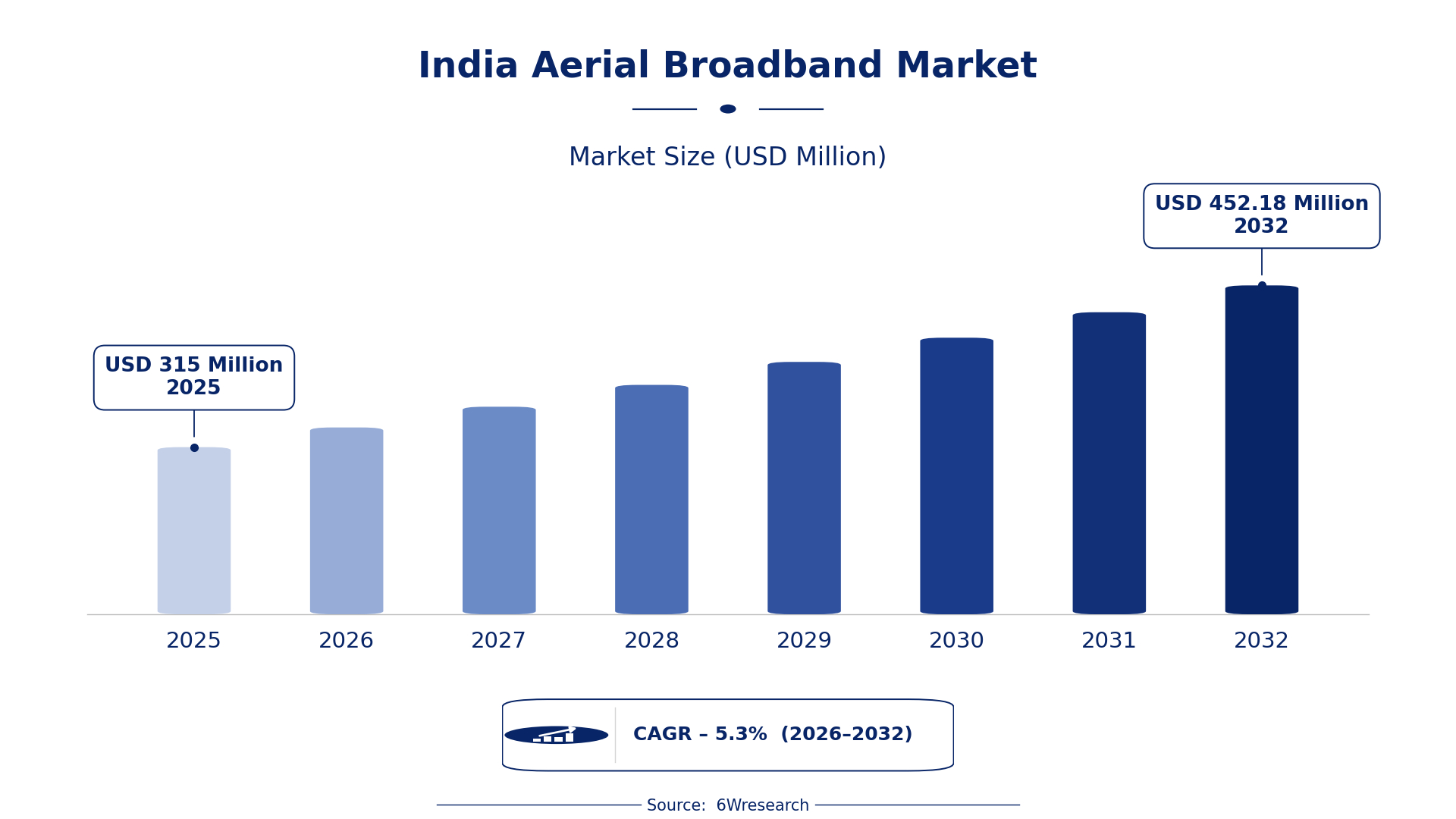
According to 6Wresearch internal database and industry insights, the India Aerial Broadband Market was valued at USD 315.0 million in 2025 and is projected to reach USD 452.18 million by 2032, growing at a CAGR of approximately 5.3% during 2026–2032.
India Aerial Broadband Market Highlights
| Report Metric | Details |
| Report Name | India Aerial Broadband Market |
| Market Size 2025 | USD 315.0 million |
| Market Size 2032 | USD 452.18 million |
| Absolute Growth 2025–2032 | USD 137.18 million |
| CAGR 2026–2032 | 5.3% |
| Peak Annual Growth | 7.6% in 2029 |
| Forecast Period | 2026–2032 |
| Historical Data | 2022–2025 |
| Base Year | 2025 |
| Leading Aerial Broadband Market, 2025 | Balloon-Based Internet (40% share) |
| Leading Technology Type, 2025 | High Altitude Platforms (41% share) |
| Leading Transmission Mode, 2025 | Radio Frequency (37% share) |
| Leading Application Type, 2025 | Rural Connectivity (41% share) |
| Leading End User Sector, 2025 | Telecom Providers (51% share) |
| Fastest-Growing Aerial Broadband Market | Drone-Based Network Relay (6.5% CAGR) |
| Fastest-Growing Technology Type | UAV Networks (7.1% CAGR) |
| Fastest-Growing Transmission Mode | LTE/5G Relay (7.1% CAGR) |
| Fastest-Growing Application Type | Disaster Zones (7.9% CAGR) |
| Fastest-Growing End User Sector | Emergency Response Units (6.8% CAGR) |
| Growing Sector | Telecom Providers |
| Key End Users | Telecom Providers, Emergency Response Units, Internet Service Providers, Government Connectivity Projects |
India Aerial Broadband Market Year-wise Growth Rate and Key Drivers (2022–2032)
This graph illustrates the annual growth rates of the market from 2022 to 2032, highlighting a steady upward trajectory and projected market expansion over the forecast period.
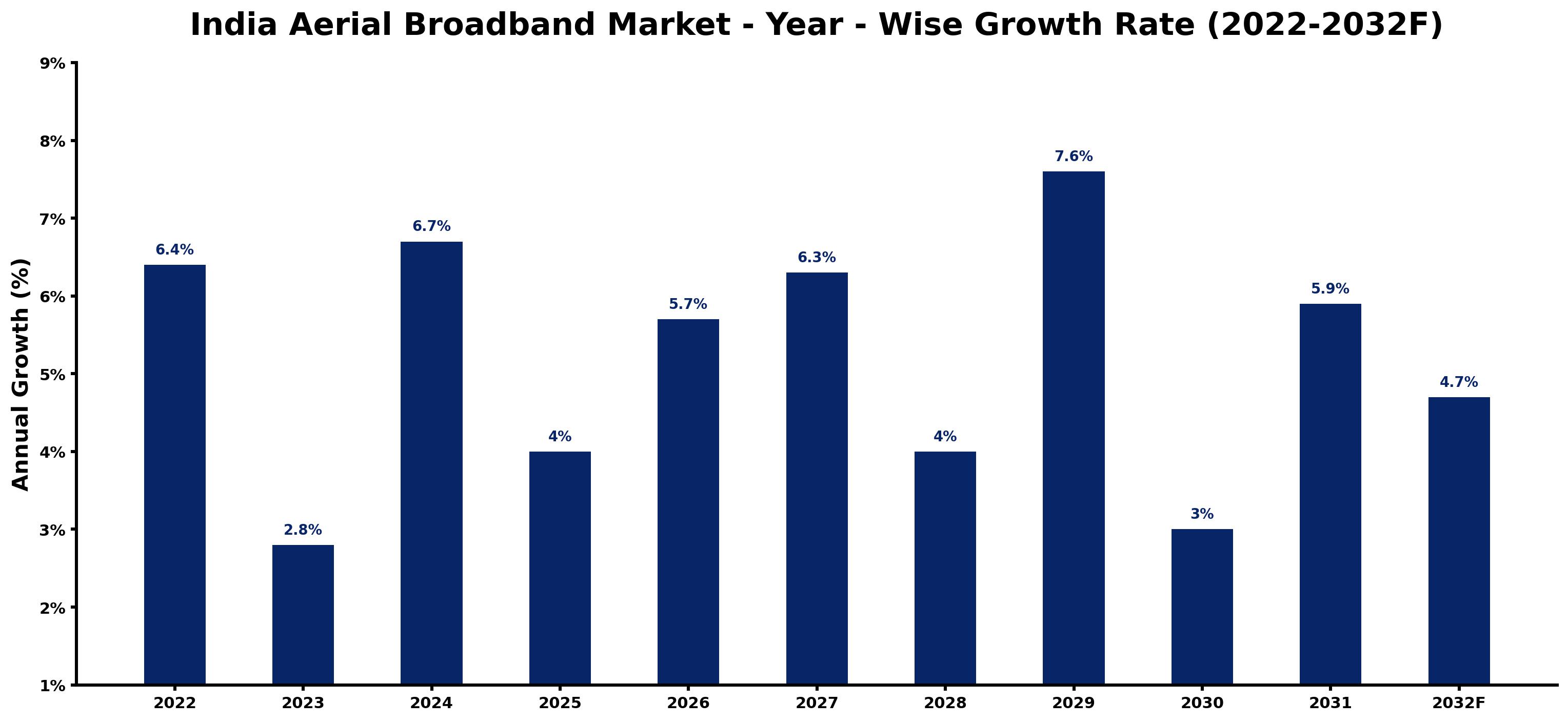
Annual growth estimates for each year appear below with the principal reason behind them, explaining the shifts that set the pace of the market.
| Year | Estimated Annual Growth (%) | Market Rationale |
| 2022 | 6.4 | The market experienced strong growth due to rising connectivity needs in rural areas. |
| 2023 | 2.8 | Growth slowed as initial enthusiasm from the Digital India initiative began to stabilise. |
| 2024 | 6.7 | Demand surged again as rural connectivity projects gained momentum through government support. |
| 2025 | 4.0 | Challenges in infrastructure deployment in remote regions limited growth. |
| 2026 | 5.7 | Investment in aerial broadband technologies is expected to increase as demand for connectivity rises. |
| 2027 | 6.3 | Telecom providers are expanding their service offerings to meet growing demand. |
| 2028 | 4.0 | Growth is projected to slow again as market saturation begins to affect new investments. |
| 2029 | 7.6 | Emergency response units are expected to adopt aerial broadband solutions, driving demand. |
| 2030 | 3.0 | Competition among service providers is likely to slow growth in the market. |
| 2031 | 5.9 | New technologies are projected to improve service delivery and user experience. |
| 2032 | 4.7 | The market will mature, with established players dominating. |
Note: Market size estimations and growth projections presented in this report are based on 6Wresearch's proprietary forecasting methodology, utilizing the latest available industry data, government publications, and primary research inputs.
India Aerial Broadband Market Synopsis
Aerial broadband in India refers to wireless internet connectivity provided through platforms like drones and satellites. This technology improves connectivity, particularly in remote areas. The India Aerial Broadband Market is growing due to initiatives like Digital India, aiming to provide internet access to all citizens by 2025. The telecommunications sector is investing heavily in aerial broadband solutions, driven by increasing demand for rural connectivity and disaster response capabilities.
Market Dynamics Impact Analysis (2026–2032)
| Factor | Type | Impact | Primary Segment Affected |
| Government initiatives promoting rural connectivity | Driver | High | Rural Connectivity |
| Investment in aerial broadband technologies by telecom providers | Driver | High | Telecom Providers |
| Growing need for emergency communication solutions | Opportunity | High | Emergency Response Units |
| Expansion of smart city projects incorporating aerial broadband | Opportunity | High | Government Connectivity Projects |
| Infrastructure challenges in remote areas | Restraint | High | Rural Connectivity |
| High costs associated with satellite-based systems | Restraint | Medium | Satellite-Linked Airships |
| Limited awareness of aerial broadband solutions among potential users | Challenge | Medium | Telecom Providers |
| Regulatory hurdles affecting deployment timelines | Challenge | High | Emergency Response Units |
Evaluation of Drivers in India Aerial Broadband Market (2026–2032)
Key forces behind demand, with the segment each one moves most, are listed below.
| Drivers | Primary Segment Affected | Why It Matters (Evidence) |
| Government support for rural connectivity initiatives | Rural Connectivity | The Digital India initiative aims to provide internet access to all by 2025, driving demand for aerial broadband. |
| Increased investment from telecom providers | Telecom Providers | Investment in aerial broadband solutions is projected to rise as the telecom sector seeks to meet growing demand. |
| Emerging demand for disaster response capabilities | Emergency Response Units | Aerial broadband is being tested in disaster-prone regions to improve emergency response capabilities. |
| Integration with smart city projects | Government Connectivity Projects | Aerial broadband is being integrated into smart city projects across various Indian states, expanding its usage. |
| Advancements in communication technology | UAV Networks | UAV networks facilitate communication in hard-to-reach locations, improving service delivery. |
Aerial broadband can support up to 100 Mbps in optimal conditions, improving user experience. The integration of aerial broadband into smart city projects across various states is expected to create new demand. The increasing focus on disaster response capabilities will further stimulate market growth.
Evaluation of Restraints in India Aerial Broadband Market
The table below lists the restraints and the evidence behind each.
| Market Restraint | Primary Segment Affected | Why It Matters (Evidence) |
| Infrastructure challenges in deploying aerial broadband systems | Rural Connectivity | Deployment in remote areas faces logistical issues, delaying service availability. |
| High costs associated with satellite-based systems | Satellite-Linked Airships | The high costs limit the adoption of satellite-linked aerial broadband solutions. |
| Limited awareness of aerial broadband solutions among potential users | Telecom Providers | Many potential users remain unaware of the benefits and availability of aerial broadband. |
| Regulatory hurdles affecting deployment timelines | Emergency Response Units | Complex regulations can delay the implementation of aerial broadband in emergency situations. |
| Competition among service providers leading to pricing pressures | Telecom Providers | Intense competition may reduce profit margins and slow investment in new technologies. |
India Aerial Broadband Market Challenges
Aerial broadband deployment in India faces hurdles related to regulatory delays, with approval processes potentially extending up to six months, preventing timely internet access for buyers. Compliance with Telecom Regulatory Authority of India (TRAI) regulations raises operational costs for providers, consuming as much as 15% of project budgets. High initial costs for satellite technology, often exceeding $1 million, deter smaller providers from entering the market, limiting competition and innovation. Supply chain disruptions in remote areas can lead to installation delays, resulting in connectivity gaps for rural users reliant on these services.
Trends in the India Aerial Broadband Market
Four trends stand out in the India Aerial Broadband Market.
- Shift from Traditional to Aerial Connectivity: Since 2022, India has experienced a shift towards aerial connectivity solutions, particularly in rural areas. The government has been testing aerial broadband in disaster-prone regions, improving emergency response capabilities with a focus on connectivity.
- Emergence of Drone-Based Internet Solutions: In 2023, several states, including Maharashtra, began piloting drone-based internet relay systems. This development aims to provide connectivity in hard-to-reach areas, with initial tests yielding promising results.
- Telecom Providers Prioritising Aerial Solutions: Telecom providers are increasingly prioritising aerial broadband solutions to meet rising demand. The integration of these technologies into service offerings is evident, especially in underserved regions.
- Expansion of Smart City Initiatives: Since 2021, smart city projects across India have started incorporating aerial broadband solutions. This integration aims to improve connectivity and urban infrastructure, with substantial investments being made.
Investment Opportunities in the India Aerial Broadband Market
Several openings in the India Aerial Broadband Market merit attention from investors.
- Partnerships for Rural Connectivity Projects: Local partnerships are crucial for expanding aerial broadband services in rural areas. With over 1.4 billion people in India, the demand for connectivity solutions is immense, particularly in underserved regions.
- Investment in Drone-Based Internet Solutions: Investing in drone-based internet solutions offers a valuable opportunity. Emergency response units are increasingly seeking reliable connectivity solutions, creating a demand for advanced aerial technologies.
- Supply of High Altitude Platforms: High altitude platforms are essential for providing wide area coverage. With the government’s focus on rural connectivity, suppliers can effectively tap into this growing market.
- Approval for Satellite-Based Projects: The gap in satellite-based internet solutions presents a promising opportunity. By securing the necessary approvals, suppliers can meet the rising demand for reliable connectivity in remote areas.
Government Initiatives in the India Aerial Broadband Market
The framework for aerial broadband in India is shaped by several key measures, including the National Digital Communications Policy of 2018, which aims to provide broadband access to all citizens by 2022. The Digital India initiative launched in 2015 focuses on improving digital infrastructure across the country, particularly in rural areas. The Ministry of Electronics and Information Technology (MeitY) has been instrumental in supporting aerial broadband projects, allocating funds to improve connectivity in underserved regions. In 2022, the government allocated additional funds to enhance the reach of these initiatives.
Telecom providers utilise funding from government schemes like the BharatNet project, which aims to expand broadband access in rural areas. The Telecom Regulatory Authority of India (TRAI) oversees regulations for aerial broadband services, ensuring compliance and quality standards. The Indian Space Research Organisation (ISRO) is also involved in satellite-based internet projects, providing technical support and expertise to improve connectivity. In 2023, the government approved several projects aimed at enhancing aerial broadband infrastructure.
Future Insight of the India Aerial Broadband Market
By 2032, buyers and suppliers in the India aerial broadband market can expect notable advancements driven by the Digital India initiative, which aims for universal internet access. The Indian Space Research Organisation (ISRO) will enhance satellite-based connectivity in remote regions, supporting rural broadband expansion. Investment in aerial broadband solutions is projected to rise by 30% over the next decade, improving infrastructure capabilities. Pilot projects using drones for internet relay will create new service delivery models, broadening access for rural communities.
Market Segmentation Analysis
The analysis below covers each segmentation, its leading category in 2025 and its fastest-growing category through 2032.
By Aerial Broadband Market – Balloon-Based Internet Dominated, Drone-Based Network Relay Expected to Grow Fastest
According to Ravi Bhandari, Research Head at 6Wresearch, in 2025, Balloon-Based Internet led the aerial broadband market split with a 40% share. Balloon-based internet captures the largest share due to its effectiveness in providing connectivity in remote areas, particularly under initiatives like Digital India. This method has been successfully implemented in various rural regions, making it a preferred choice for enhancing connectivity. Drone-Based Network Relay is projected to grow fastest, at a CAGR of 6.5% during 2026–2032. The drone-based network relay segment is experiencing rapid growth as it supports temporary network setups in emergencies, which is increasingly vital in disaster-prone areas. The Indian government's focus on improving disaster response capabilities is accelerating this trend. Suppliers should prioritise advancements in drone technology to meet the rising demand for emergency connectivity solutions.
By Technology Type – High Altitude Platforms Dominated, UAV Networks Expected to Grow Fastest
High Altitude Platforms accounted for a 41% market share by technology type in 2025. High altitude platforms dominate the market share as they enable wide area coverage, essential for reaching underserved populations across India. Their deployment aligns with government initiatives aimed at expanding internet access nationwide. The quickest growth will come from UAV Networks, forecast to expand at a CAGR of 7.1% between 2026 and 2032. UAV networks are growing quickly because they facilitate communication in hard-to-reach locations, particularly during emergencies. The increasing investment in aerial broadband solutions is likely to boost this segment's growth further. Suppliers should focus on developing UAV technologies to capitalise on the increasing demand for versatile communication solutions.
By Transmission Mode – Radio Frequency Dominated, LTE/5G Relay Expected to Grow Fastest
With a 37% revenue share in 2025, Radio Frequency was the largest transmission mode category. Radio frequency technology commands the largest market share as it is essential for wireless communication, forming the backbone of aerial broadband systems. Its established infrastructure supports widespread deployment across various regions in India. LTE/5G Relay is set to record the highest CAGR in this split, 7.1% over 2026–2032. The LTE/5G relay segment is witnessing the fastest growth as it supports modern communication standards that enhance user experience. The push for high-speed connectivity is driving significant investments in this area. Suppliers need to align their offerings with the latest communication standards to remain competitive.
By Application Type – Rural Connectivity Dominated, Disaster Zones Expected to Grow Fastest
Rural Connectivity took a 41% share of application type in 2025, more than any other category. Rural connectivity is the leading application type, capturing the largest share as it addresses the critical need for internet access in remote areas. Government projects like BharatNet are pivotal in promoting this application. Over 2026–2032, Disaster Zones are expected to post the fastest growth, at a CAGR of 7.9%. Disaster zones represent the fastest-growing application type as they are critical for emergency communication during crises. The increasing frequency of natural disasters in India is driving this urgent need for reliable connectivity. Suppliers must develop tailored solutions for emergency communication in disaster-prone regions.
By End User Sector – Telecom Providers Dominated, Emergency Response Units Expected to Grow Fastest
The largest end user sector category in 2025 was Telecom Providers, with a 51% share of total revenue. Telecom providers hold the largest market share as they are key users of aerial broadband solutions, integrating these technologies to enhance service offerings. Their established customer base and infrastructure support widespread adoption. Emergency Response Units are projected to grow fastest, at a CAGR of 6.8% during 2026–2032. Emergency response units are the fastest-growing end user sector, utilising aerial broadband for quick deployment in crisis situations. The increasing focus on disaster management is propelling this segment's growth. Suppliers should engage with emergency service providers to develop effective aerial broadband solutions.
Key Attractiveness of the Report
- 10 Years of Market Numbers
- Historical Data Starting from 2022 to 2025
- Base Year 2025
- Forecast Data until 2032
- Key Performance Indicators Impacting the Market
- Major Upcoming Developments and Projects
Key Highlights of the Report:
- India Aerial Broadband Market Outlook
- Market Size of India Aerial Broadband Market, 2025
- Forecast of India Aerial Broadband Market, 2032
- Historical Data and Forecast of India Aerial Broadband Revenues & Volume for the Period 2022 - 2032F
- India Aerial Broadband Market Trend Evolution
- India Aerial Broadband Market Drivers and Challenges
- India Aerial Broadband Price Trends
- India Aerial Broadband Porter's Five Forces
- India Aerial Broadband Industry Life Cycle
- Historical Data and Forecast of India Aerial Broadband Market Revenues & Volume By Aerial Broadband Market for the Period 2022 - 2032F
- Historical Data and Forecast of India Aerial Broadband Market Revenues & Volume By Balloon-Based Internet for the Period 2022 - 2032F
- Historical Data and Forecast of India Aerial Broadband Market Revenues & Volume By Drone-Based Network Relay for the Period 2022 - 2032F
- Historical Data and Forecast of India Aerial Broadband Market Revenues & Volume By Satellite-Linked Airships for the Period 2022 - 2032F
- Historical Data and Forecast of India Aerial Broadband Market Revenues & Volume By Microwave Beam Aerial for the Period 2022 - 2032F
- Historical Data and Forecast of India Aerial Broadband Market Revenues & Volume By Technology Type for the Period 2022 - 2032F
- Historical Data and Forecast of India Aerial Broadband Market Revenues & Volume By High Altitude Platforms for the Period 2022 - 2032F
- Historical Data and Forecast of India Aerial Broadband Market Revenues & Volume By UAV Networks for the Period 2022 - 2032F
- Historical Data and Forecast of India Aerial Broadband Market Revenues & Volume By Hybrid Communication for the Period 2022 - 2032F
- Historical Data and Forecast of India Aerial Broadband Market Revenues & Volume By LOS Transmission for the Period 2022 - 2032F
- Historical Data and Forecast of India Aerial Broadband Market Revenues & Volume By Transmission Mode for the Period 2022 - 2032F
- Historical Data and Forecast of India Aerial Broadband Market Revenues & Volume By Radio Frequency for the Period 2022 - 2032F
- Historical Data and Forecast of India Aerial Broadband Market Revenues & Volume By LTE/5G Relay for the Period 2022 - 2032F
- Historical Data and Forecast of India Aerial Broadband Market Revenues & Volume By Satellite + RF for the Period 2022 - 2032F
- Historical Data and Forecast of India Aerial Broadband Market Revenues & Volume By Microwave Technology for the Period 2022 - 2032F
- Historical Data and Forecast of India Aerial Broadband Market Revenues & Volume By Application Type for the Period 2022 - 2032F
- Historical Data and Forecast of India Aerial Broadband Market Revenues & Volume By Rural Connectivity for the Period 2022 - 2032F
- Historical Data and Forecast of India Aerial Broadband Market Revenues & Volume By Disaster Zones for the Period 2022 - 2032F
- Historical Data and Forecast of India Aerial Broadband Market Revenues & Volume By Underserved Areas for the Period 2022 - 2032F
- Historical Data and Forecast of India Aerial Broadband Market Revenues & Volume By Remote Villages for the Period 2022 - 2032F
- Historical Data and Forecast of India Aerial Broadband Market Revenues & Volume By End User Sector for the Period 2022 - 2032F
- Historical Data and Forecast of India Aerial Broadband Market Revenues & Volume By Telecom Providers for the Period 2022 - 2032F
- Historical Data and Forecast of India Aerial Broadband Market Revenues & Volume By Emergency Response Units for the Period 2022 - 2032F
- Historical Data and Forecast of India Aerial Broadband Market Revenues & Volume By Internet Service Providers for the Period 2022 - 2032F
- Historical Data and Forecast of India Aerial Broadband Market Revenues & Volume By Government Connectivity Projects for the Period 2022 - 2032F
- India Aerial Broadband Import Export Trade Statistics
- Market Opportunity Assessment By Aerial Broadband Market
- Market Opportunity Assessment By Technology Type
- Market Opportunity Assessment By Transmission Mode
- Market Opportunity Assessment By Application Type
- Market Opportunity Assessment By End User Sector
- India Aerial Broadband Top Companies Market Share
- India Aerial Broadband Competitive Benchmarking By Technical and Operational Parameters
- India Aerial Broadband Company Profiles
- India Aerial Broadband Key Strategic Recommendations
Market Covered
Segments analysed in this report are listed below.
By Aerial Broadband Market
- Balloon-Based Internet
- Drone-Based Network Relay
- Satellite-Linked Airships
- Microwave Beam Aerial
By Technology Type
- High Altitude Platforms
- UAV Networks
- Hybrid Communication
- LOS Transmission
By Transmission Mode
- Radio Frequency
- LTE/5G Relay
- Satellite + RF
- Microwave Technology
By Application Type
- Rural Connectivity
- Disaster Zones
- Underserved Areas
- Remote Villages
By End User Sector
- Telecom Providers
- Emergency Response Units
- Internet Service Providers
- Government Connectivity Projects































