India Aerial Threat Awareness Market Size & Growth Rate
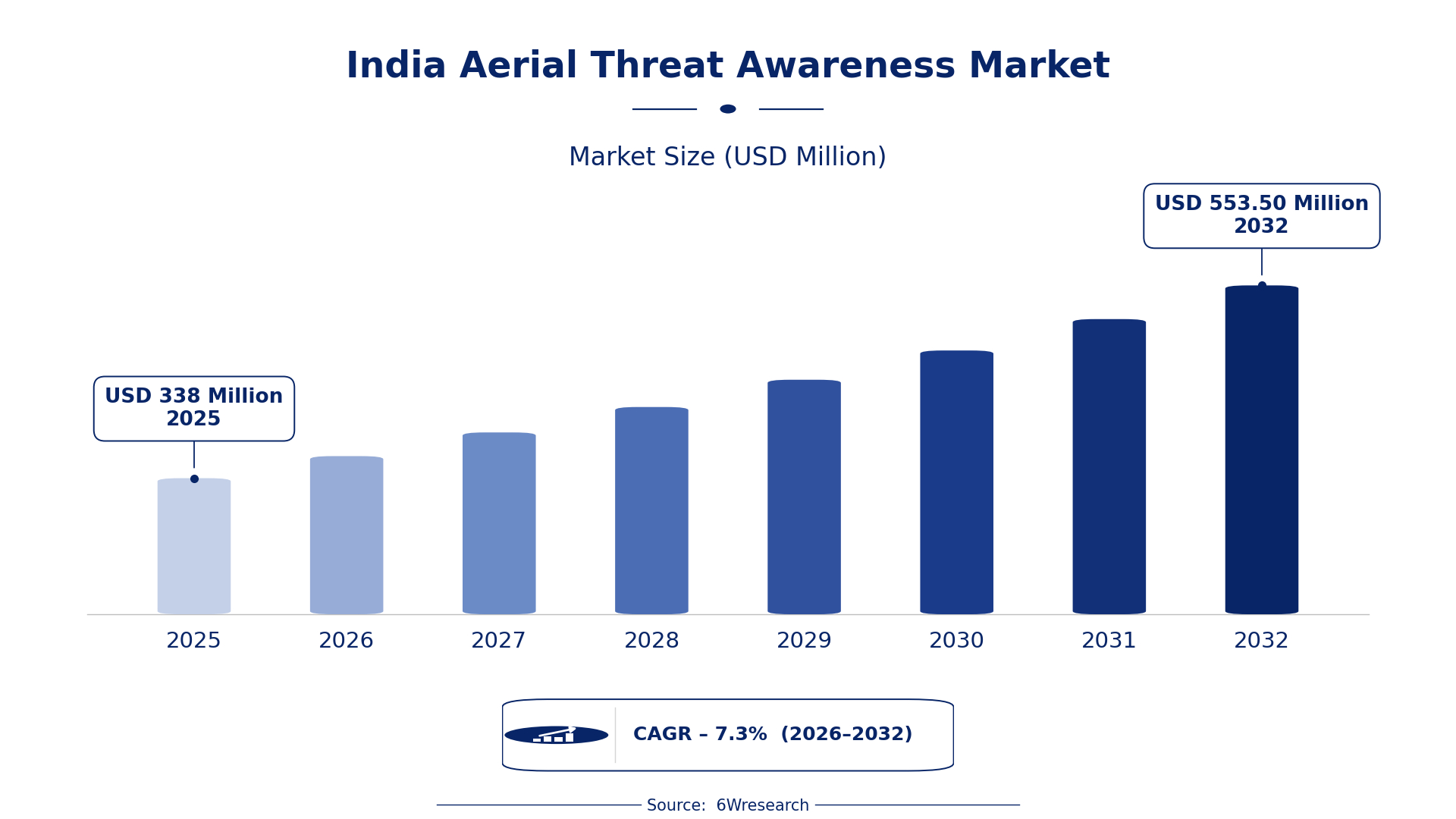
According to 6Wresearch internal database and industry insights, the India Aerial Threat Awareness Market was valued at USD 338.0 million in 2025 and is projected to reach USD 553.50 million by 2032, growing at a CAGR of approximately 7.3% during 2026–2032.
India Aerial Threat Awareness Market Highlights
| Report Metric | Details |
| Report Name | India Aerial Threat Awareness Market |
| Market Size 2025 | USD 338.0 million |
| Market Size 2032 | USD 553.50 million |
| Absolute Growth 2025–2032 | USD 215.50 million |
| CAGR 2026–2032 | 7.3% |
| Peak Annual Growth | 9.7% in 2031 |
| Forecast Period | 2026–2032 |
| Historical Data | 2022–2025 |
| Base Year | 2025 |
| Leading Product Type, 2025 | Radar-Based Systems (51% share) |
| Leading Detection Mode, 2025 | Long-Range (42% share) |
| Leading Technology Used, 2025 | LIDAR & AI (54% share) |
| Leading Distribution Channel, 2025 | Government Procurement (41% share) |
| Leading End User, 2025 | Military Bases (43% share) |
| Fastest-Growing Product Type | Infrared Sensors (9.3% CAGR) |
| Fastest-Growing Detection Mode | Medium-Range (9.1% CAGR) |
| Fastest-Growing Distribution Channel | OEMs (9.2% CAGR) |
| Fastest-Growing End User | Border Security Forces (9.1% CAGR) |
| Growing Sector | Defense |
| Key End Users | Military Bases, Border Security Forces, Critical Infrastructure |
India Aerial Threat Awareness Market Year-wise Growth Rate and Key Drivers (2022–2032)
This graph illustrates the annual growth rates of the market from 2022 to 2032, highlighting a steady upward trajectory and projected market expansion over the forecast period.
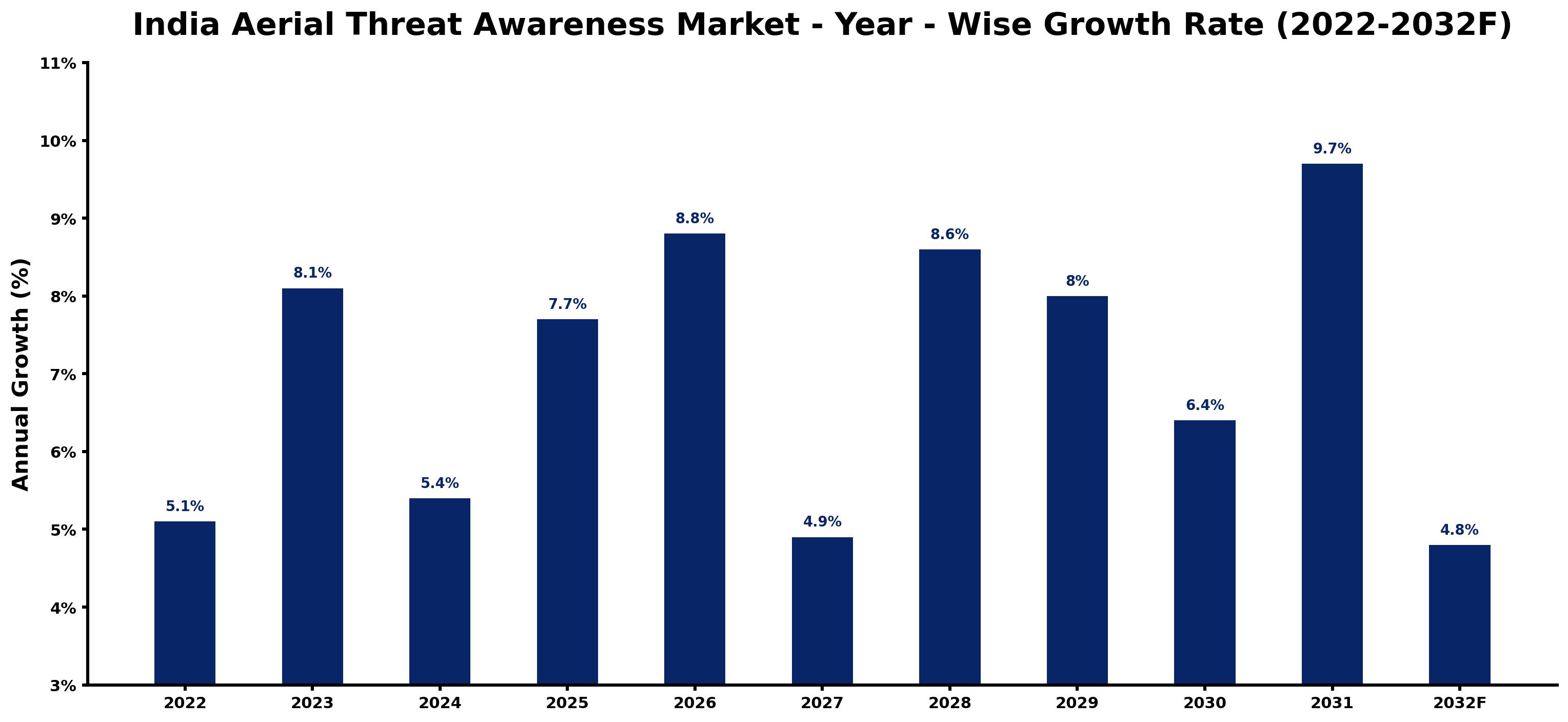
Year by year, the estimates below pair each growth rate with the development that shaped it.
| Year | Estimated Annual Growth (%) | Market Rationale |
| 2022 | 5.1 | The market experienced steady growth driven by ongoing military modernization efforts. |
| 2023 | 8.1 | Demand surged as the Indian Air Force improved its aerial surveillance capabilities with new radar systems. |
| 2024 | 5.4 | Growth slowed slightly due to adjustments in procurement strategies within the defense sector. |
| 2025 | 7.7 | The market rebounded with increased government procurement for aerial threat awareness systems. |
| 2026 | 8.8 | Demand is expected to accelerate as the Ministry of Defence expands the 'Make in India' programme for local production. |
| 2027 | 4.9 | Growth is projected to decelerate as the market adjusts to new standards and procurement processes. |
| 2028 | 8.6 | A renewed focus on aerial threat detection technologies is expected to lead to faster growth in this year. |
| 2029 | 8.0 | The market is projected to experience a slight slowdown as military bases reassess their procurement priorities. |
| 2030 | 6.4 | Growth is expected to moderate as the Indian government sets new targets for indigenization in defense procurement. |
| 2031 | 9.7 | A peak in growth is projected as the government allocates significant funding for upgrading surveillance systems. |
| 2032 | 4.8 | Growth is expected to slow as the market stabilizes after the rapid expansion of previous years. |
Note: Market size estimations and growth projections presented in this report are based on 6Wresearch's proprietary forecasting methodology, utilizing the latest available industry data, government publications, and primary research inputs.
India Aerial Threat Awareness Market Synopsis
The India Aerial Threat Awareness Market encompasses technologies used to detect and respond to aerial threats through radar, infrared, and visual systems. These technologies are essential for military surveillance, border security, and the protection of critical infrastructure. The market is growing due to increased defense spending and government initiatives like 'Make in India', which aims to boost local production. With a defense budget of approximately ₹5.25 lakh crore for 2023-24, demand is rising, driven by domestic military needs and local production initiatives.
Market Dynamics Impact Analysis (2026–2032)
| Factor | Type | Impact | Primary Segment Affected |
| Increased defense spending by the government | Driver | High | Radar-Based Systems |
| Growing domestic production capabilities | Driver | High | LIDAR & AI |
| Expansion of border security operations | Opportunity | High | Infrared Sensors |
| Rising demand for military surveillance technologies | Opportunity | High | EO Cameras |
| Challenges in meeting indigenization targets | Restraint | High | Government Procurement |
| Dependence on foreign technology for some systems | Restraint | Medium | Acoustic Sensors |
| Limited adoption of advanced technologies in some sectors | Challenge | Medium | Short-Range |
| Budget constraints affecting procurement timelines | Challenge | High | Military Bases |
Evaluation of Drivers in India Aerial Threat Awareness Market (2026–2032)
The factors lifting demand, and the evidence behind each, are summarised below.
| Drivers | Primary Segment Affected | Why It Matters (Evidence) |
| Increased defense budget allocations | Radar-Based Systems | India's defense budget for 2023-24 is approximately ₹5.25 lakh crore, driving demand for advanced radar systems. |
| Growing border security operations | Infrared Sensors | India's border security forces are expanding aerial surveillance along the 3,488 km border with Pakistan and China. |
| Investment in advanced sensor technologies | LIDAR & AI | The National Aerospace Laboratories (NAL) is developing advanced sensors for aerial threat detection. |
| Support for indigenous manufacturing initiatives | Government Procurement | The 'Make in India' programme promotes local production, increasing demand for aerial threat awareness systems. |
| Expansion of military capabilities | EO Cameras | The Indian Air Force has enhanced its aerial surveillance capabilities with new EO camera systems. |
The defense budget for 2023-24 is approximately ₹5.25 lakh crore, which fuels demand for advanced radar systems. The Indian Air Force has boosted its aerial surveillance capabilities with new EO camera systems. Border security forces are also enhancing surveillance along the 3,488 km border, driving demand for infrared sensors and improving overall security measures.
Evaluation of Restraints in India Aerial Threat Awareness Market
The key brakes on demand, and where they bite hardest, are shown below.
| Market Restraint | Primary Segment Affected | Why It Matters (Evidence) |
| Challenges in meeting indigenization targets | Government Procurement | The Indian government aims for 70% indigenization in defense procurement by 2025, which poses challenges for compliance. |
| Dependence on foreign technology for some systems | Acoustic Sensors | Certain advanced technologies remain reliant on foreign suppliers, complicating local production efforts. |
| Limited adoption of advanced technologies in some sectors | Short-Range | Short-range systems have seen less investment and adoption compared to long-range solutions, limiting market growth. |
| Budget constraints affecting procurement timelines | Military Bases | Budget limitations can delay the acquisition of necessary aerial threat awareness systems for military bases. |
| Slow integration of new technologies | Infrared Sensors | The integration of new infrared sensor technologies can be hindered by existing infrastructure and training needs. |
India Aerial Threat Awareness Market Challenges
The India Aerial Threat Awareness Market still faces several pressing challenges, beginning with regulatory hurdles that delay the approval of new technologies. Lengthy compliance processes can extend project timelines by up to six months, impacting suppliers reliant on timely government contracts. A lack of skilled personnel in advanced sensor technology further hampers progress, costing producers valuable time and resources. Additionally, competition from foreign manufacturers can lead to price reductions, forcing local suppliers to cut margins and limiting their ability to invest in innovation.
Trends in the India Aerial Threat Awareness Market
Several trends are reshaping the India Aerial Threat Awareness Market; the most important are set out below.
- Shift Towards Advanced Radar Systems: Military bases are increasingly adopting advanced radar systems to improve detection capabilities. In 2023, the Indian Air Force upgraded its radar systems, reflecting a trend towards modernisation.
- Transition from Traditional to AI-Driven Technologies: The integration of AI in aerial threat awareness systems is becoming more prevalent. The 'Make in India' initiative supports local development of LIDAR and AI technologies, improving detection accuracy.
- Growing Focus on Border Security: Border security forces are significantly expanding their aerial surveillance capabilities. In 2023, the Indian government allocated ₹20,000 crore for upgrading surveillance systems along the border with Pakistan and China.
- Emergence of Indigenous Manufacturing: The 'Atmanirbhar Bharat' initiative is promoting self-reliance in defence manufacturing. Launched in 2020, it aims for a 25% increase in local production of aerial threat awareness systems by 2025.
Investment Opportunities in the India Aerial Threat Awareness Market
Several openings in the India Aerial Threat Awareness Market merit attention from investors.
- Investment in Local Manufacturing: With a target of 70% indigenisation by 2025, there is an opportunity for investment in local manufacturing of aerial threat awareness systems. Government procurement channels are vital for suppliers.
- Supply of Advanced Sensor Technologies: The demand for advanced sensor technologies is rising, particularly for military bases. Collaborating with local manufacturers can facilitate entry into this growing market.
- Development of AI-Driven Systems: The integration of AI in aerial threat awareness presents a valuable opportunity. Engaging with the Indian Air Force can lead to partnerships in developing these technologies.
- Expansion of Border Security Solutions: The focus on border security creates a demand for enhanced aerial threat awareness systems. Partnering with government agencies can provide access to procurement opportunities.
Government Initiatives in the India Aerial Threat Awareness Market
The 'Defence Production and Export Promotion Policy' launched by the Ministry of Defence in 2022 aims to increase domestic manufacturing of aerial threat awareness systems. This policy targets a 25% increase in local production by 2025, supporting local manufacturers and improving procurement processes for buyers. The 'Atmanirbhar Bharat' initiative, launched in 2020, promotes self-reliance in defense manufacturing, further impacting aerial threat awareness technologies. In 2023, the Indian government allocated ₹20,000 crore for upgrading surveillance systems across critical infrastructure. The Ministry of Defence oversees this funding, ensuring that it is directed towards improving aerial threat awareness capabilities.
In 2023, the Indian government allocated ₹20,000 crore for upgrading surveillance systems across critical infrastructure. The Ministry of Defence oversees this funding, ensuring that it is directed towards enhancing aerial threat awareness capabilities. The Defence Innovation Organisation, established in 2021, fosters innovation in defense technologies, including aerial threat detection, supporting local manufacturers.
Future Insight of the India Aerial Threat Awareness Market
The India Aerial Threat Awareness Market is expected to evolve significantly by 2032, driven by key developments. The 'Make in India' programme will enhance local production capabilities, allowing suppliers to meet domestic demand more effectively. Government initiatives targeting 70% indigenisation in defence procurement by 2025 will support local manufacturers in improving their offerings. In 2023, the Indian government allocated ₹5,250 crore for modernising aerial surveillance technologies, providing buyers with access to advanced systems. Collaborations between the Indian Air Force and National Aerospace Laboratories will further advance the development of cutting-edge aerial threat detection technologies.
Market Segmentation Analysis
The report offers a comprehensive study of the following market segments and their leading categories in the market.
By Product Type – Radar-Based Systems Dominated, Infrared Sensors Expected to Grow Fastest
According to Ravi Bhandari, Research Head at 6Wresearch, in 2025, Radar-Based Systems led the product type split with a 51% share. Radar-based systems dominate the market due to their essential role in long-range detection of aerial threats, which is critical for military operations. The Indian Air Force's increased capabilities highlight their necessity in modern aerial surveillance. Infrared Sensors are set to record the highest CAGR in this split, 9.3% over 2026–2032. Infrared sensors are witnessing rapid growth as they are crucial for detecting heat signatures from aerial objects, particularly in surveillance missions. The push for modernisation in aerial threat detection technologies is significantly driving this segment's expansion. Suppliers should prioritise the development of advanced infrared technologies to meet the rising demand from defence sectors.
By Detection Mode – Long-Range Dominated, Medium-Range Expected to Grow Fastest
With a 42% revenue share in 2025, Long-Range was the largest detection mode category. Long-range detection modes capture the largest market share as they are vital for early detection of aerial threats, allowing timely responses. This capability is especially important for military bases that require comprehensive surveillance. Over 2026–2032, Medium-Range is expected to post the fastest growth, at a CAGR of 9.1%. Medium-range detection modes are experiencing swift growth as they are specifically utilised for surveillance in operational areas, enabling targeted monitoring. The expansion of border security operations plays a significant role in this segment's growth. Buyers should invest in medium-range systems to enhance operational efficiency in specific surveillance areas.
By Technology Used – LIDAR & AI Dominated and Is Expected to Record the Fastest Growth
The largest technology used category in 2025 was LIDAR & AI, with a 54% share of total revenue. LIDAR and AI technologies dominate the market because they greatly improve detection accuracy through advanced processing capabilities. Their integration into aerial threat awareness systems is becoming a standard requirement for contemporary military applications. Its lead should widen, with a projected CAGR of 8.4% during 2026–2032, the highest in this split. The growth of LIDAR and AI technologies continues rapidly due to their unmatched accuracy and efficiency in threat detection, solidifying their market dominance. This trend highlights the importance of these technologies in future defence strategies. Suppliers must advance LIDAR and AI capabilities to maintain a competitive edge in the aerial threat awareness market.
By Distribution Channel – Government Procurement Dominated, OEMs Expected to Grow Fastest
Government Procurement held a 41% share of the India Aerial Threat Awareness Market by distribution channel in 2025. Government procurement is the leading channel for acquiring defense technologies, holding a substantial market share. This channel is crucial as it ensures military bases receive the necessary systems to safeguard national security. OEMs are projected to grow fastest, at a CAGR of 9.2% during 2026–2032. OEMs are quickly becoming the fastest-growing distribution channel, supplying essential components for aerial threat systems in response to the rising demand for advanced technologies. Their role in the supply chain is vital for fulfilling government contracts. Suppliers should strengthen partnerships with OEMs to improve distribution efficiency and market reach.
By End User – Military Bases Dominated, Border Security Forces Expected to Grow Fastest
Military Bases took a 43% share of end user in 2025, more than any other category. Military bases account for the largest share of end users, as they are the primary users of aerial threat awareness systems, relying on these technologies for effective defence strategies. Their operational needs drive the demand for advanced detection systems. Border Security Forces are set to record the highest CAGR in this split, 9.1% over 2026–2032. Border security forces are the fastest-growing end user segment, crucial for national security operations along India's extensive borders. The heightened focus on border surveillance is a key factor propelling this segment's rapid growth. Buyers in border security must prioritise investments in advanced aerial threat awareness systems to enhance national security operations.
Key Attractiveness of the Report
- 10 Years of Market Numbers
- Historical Data Starting from 2022 to 2025
- Base Year 2025
- Forecast Data until 2032
- Key Performance Indicators Impacting the Market
- Major Upcoming Developments and Projects
Key Highlights of the Report:
- India Aerial Threat Awareness Market Outlook
- Market Size of India Aerial Threat Awareness Market, 2025
- Forecast of India Aerial Threat Awareness Market, 2032
- Historical Data and Forecast of India Aerial Threat Awareness Revenues & Volume for the Period 2022 - 2032F
- India Aerial Threat Awareness Market Trend Evolution
- India Aerial Threat Awareness Market Drivers and Challenges
- India Aerial Threat Awareness Price Trends
- India Aerial Threat Awareness Porter's Five Forces
- India Aerial Threat Awareness Industry Life Cycle
- Historical Data and Forecast of India Aerial Threat Awareness Market Revenues & Volume By Product Type for the Period 2022 - 2032F
- Historical Data and Forecast of India Aerial Threat Awareness Market Revenues & Volume By Radar-Based Systems for the Period 2022 - 2032F
- Historical Data and Forecast of India Aerial Threat Awareness Market Revenues & Volume By Infrared Sensors for the Period 2022 - 2032F
- Historical Data and Forecast of India Aerial Threat Awareness Market Revenues & Volume By Acoustic Sensors for the Period 2022 - 2032F
- Historical Data and Forecast of India Aerial Threat Awareness Market Revenues & Volume By EO Cameras for the Period 2022 - 2032F
- Historical Data and Forecast of India Aerial Threat Awareness Market Revenues & Volume By Detection Mode for the Period 2022 - 2032F
- Historical Data and Forecast of India Aerial Threat Awareness Market Revenues & Volume By Long-Range for the Period 2022 - 2032F
- Historical Data and Forecast of India Aerial Threat Awareness Market Revenues & Volume By Medium-Range for the Period 2022 - 2032F
- Historical Data and Forecast of India Aerial Threat Awareness Market Revenues & Volume By Short-Range for the Period 2022 - 2032F
- Historical Data and Forecast of India Aerial Threat Awareness Market Revenues & Volume By Visual Range for the Period 2022 - 2032F
- Historical Data and Forecast of India Aerial Threat Awareness Market Revenues & Volume By Technology Used for the Period 2022 - 2032F
- Historical Data and Forecast of India Aerial Threat Awareness Market Revenues & Volume By LIDAR & AI for the Period 2022 - 2032F
- Historical Data and Forecast of India Aerial Threat Awareness Market Revenues & Volume By Heat Signature Tracking for the Period 2022 - 2032F
- Historical Data and Forecast of India Aerial Threat Awareness Market Revenues & Volume By Sound-Wave Mapping for the Period 2022 - 2032F
- Historical Data and Forecast of India Aerial Threat Awareness Market Revenues & Volume By Image Recognition for the Period 2022 - 2032F
- Historical Data and Forecast of India Aerial Threat Awareness Market Revenues & Volume By Distribution Channel for the Period 2022 - 2032F
- Historical Data and Forecast of India Aerial Threat Awareness Market Revenues & Volume By Government Procurement for the Period 2022 - 2032F
- Historical Data and Forecast of India Aerial Threat Awareness Market Revenues & Volume By OEMs for the Period 2022 - 2032F
- Historical Data and Forecast of India Aerial Threat Awareness Market Revenues & Volume By Direct Sales for the Period 2022 - 2032F
- Historical Data and Forecast of India Aerial Threat Awareness Market Revenues & Volume By Online Platforms for the Period 2022 - 2032F
- Historical Data and Forecast of India Aerial Threat Awareness Market Revenues & Volume By End User for the Period 2022 - 2032F
- Historical Data and Forecast of India Aerial Threat Awareness Market Revenues & Volume By Military Bases for the Period 2022 - 2032F
- Historical Data and Forecast of India Aerial Threat Awareness Market Revenues & Volume By Critical Infrastructure for the Period 2022 - 2032F
- Historical Data and Forecast of India Aerial Threat Awareness Market Revenues & Volume By Border Security Forces for the Period 2022 - 2032F
- Historical Data and Forecast of India Aerial Threat Awareness Market Revenues & Volume By Urban Surveillance Units for the Period 2022 - 2032F
- India Aerial Threat Awareness Import Export Trade Statistics
- Market Opportunity Assessment By Product Type
- Market Opportunity Assessment By Detection Mode
- Market Opportunity Assessment By Technology Used
- Market Opportunity Assessment By Distribution Channel
- Market Opportunity Assessment By End User
- India Aerial Threat Awareness Top Companies Market Share
- India Aerial Threat Awareness Competitive Benchmarking By Technical and Operational Parameters
- India Aerial Threat Awareness Company Profiles
- India Aerial Threat Awareness Key Strategic Recommendations
Market Covered
Segments analysed in this report are listed below.
By Product Type
- Radar-Based Systems
- Infrared Sensors
- Acoustic Sensors
- EO Cameras
By Detection Mode
- Long-Range
- Medium-Range
- Short-Range
- Visual Range
By Technology Used
- LIDAR & AI
- Heat Signature Tracking
- Sound-Wave Mapping
- Image Recognition
By Distribution Channel
- Government Procurement
- OEMs
- Direct Sales
- Online Platforms
By End User
- Military Bases
- Critical Infrastructure
- Border Security Forces
- Urban Surveillance Units































