India Aerospace Actuation Market Size & Growth Rate
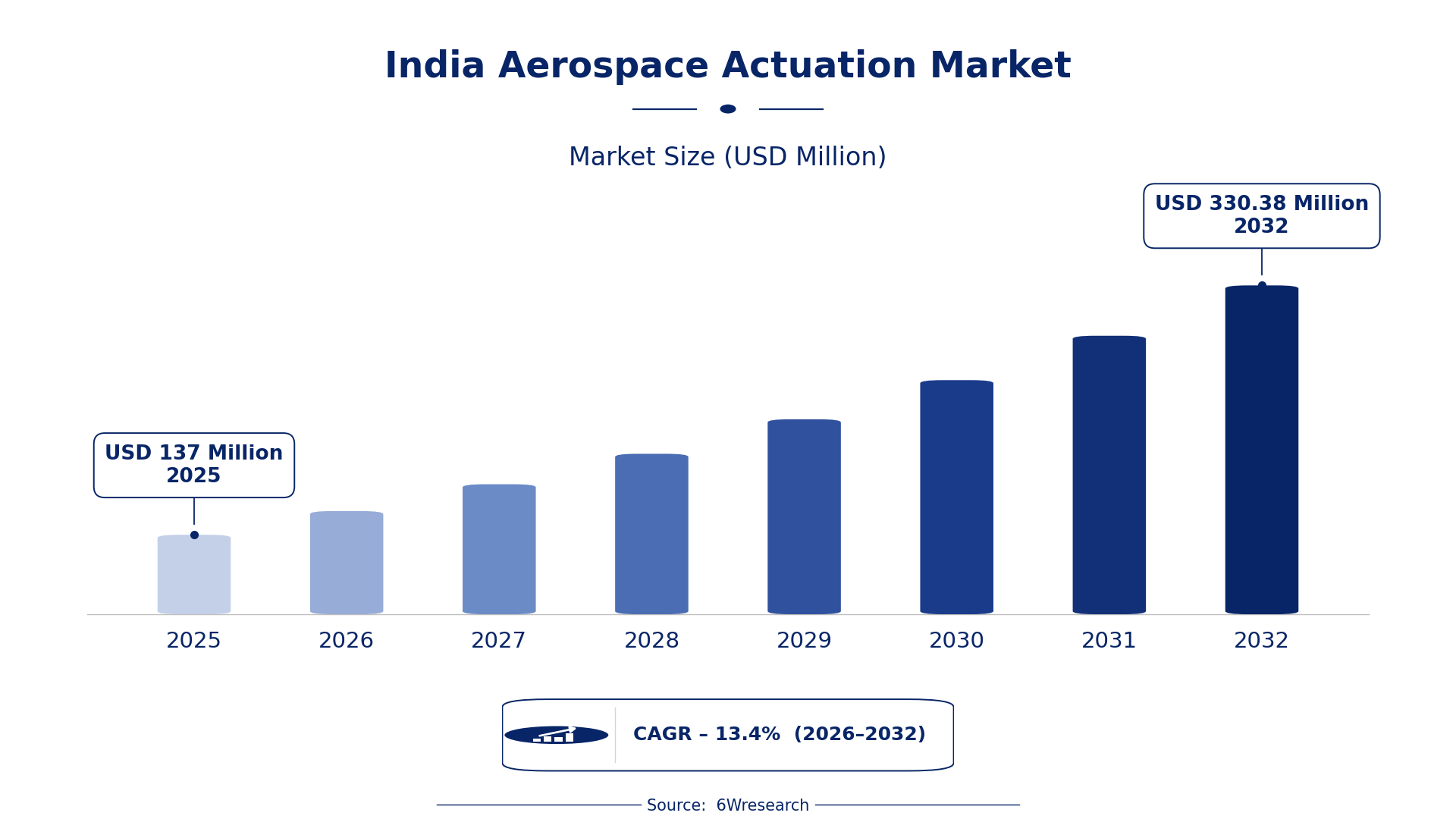
According to 6Wresearch internal database and industry insights, the India Aerospace Actuation Market was valued at USD 137 million in 2025 and is projected to reach USD 330.38 million by 2032, growing at a CAGR of approximately 13.4% during 2026–2032.
India Aerospace Actuation Market Highlights
| Report Metric | Details |
| Report Name | India Aerospace Actuation Market |
| Market Size 2025 | USD 137 million |
| Market Size 2032 | USD 330.38 million |
| Absolute Growth 2025–2032 | USD 193.38 million |
| CAGR 2026–2032 | 13.4% |
| Peak Annual Growth | 15.5% in 2029 |
| Forecast Period | 2026–2032 |
| Historical Data | 2022–2025 |
| Base Year | 2025 |
| Leading Product Type, 2025 | Linear Actuators (45% share) |
| Leading Actuation Mechanism, 2025 | Electric (33% share) |
| Leading Application Area, 2025 | Landing Gear Systems (37% share) |
| Leading Distribution Channel, 2025 | OEMs (40% share) |
| Leading End User, 2025 | Aircraft Manufacturers (44% share) |
| Fastest-Growing Product Type | Rotary Actuators (15.3% CAGR) |
| Fastest-Growing Actuation Mechanism | Hydraulic (16.2% CAGR) |
| Fastest-Growing Application Area | Wing Control Surfaces (14.6% CAGR) |
| Fastest-Growing Distribution Channel | Government Contracts (14.7% CAGR) |
| Fastest-Growing End User | Military Aerospace (16.1% CAGR) |
| Growing Sector | Military Aerospace |
| Key End Users | Aircraft Manufacturers, Military Aerospace, Commercial Aviation |
India Aerospace Actuation Market Year-wise Growth Rate and Key Drivers (2022–2032)
This graph illustrates the annual growth rates of the market from 2022 to 2032, highlighting a steady upward trajectory and projected market expansion over the forecast period.
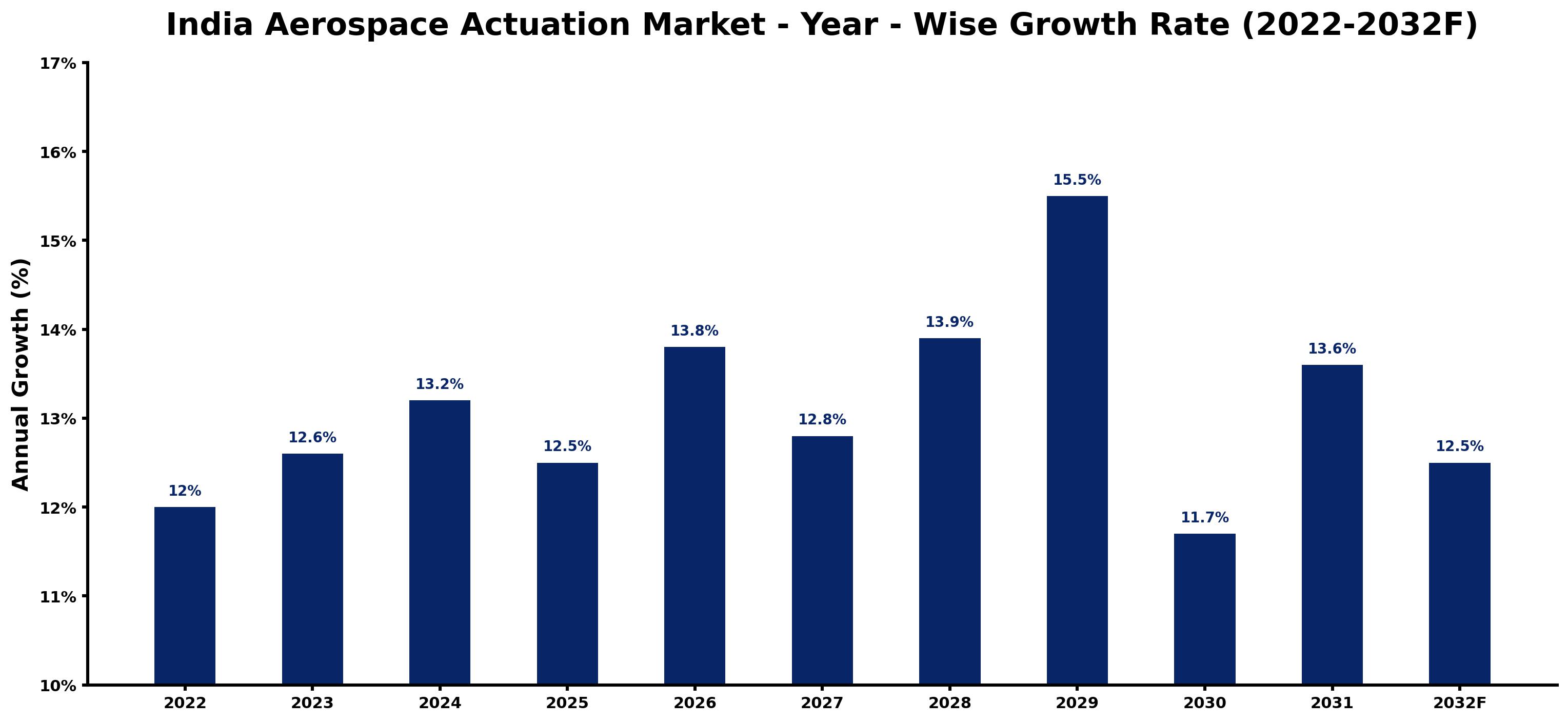
Below, each year's estimated growth is shown next to the factor that most influenced it.
| Year | Estimated Annual Growth (%) | Market Rationale |
| 2022 | 12.0 | The market experienced steady growth, driven by increased domestic aircraft manufacturing activity. |
| 2023 | 12.6 | Growth accelerated due to rising investments in indigenous aerospace technologies and military applications. |
| 2024 | 13.2 | Demand surged as the Defence Research and Development Organisation advanced local aerospace capabilities. |
| 2025 | 12.5 | Growth slowed slightly as the market adjusted to previous high rates of expansion. |
| 2026 | 13.8 | Investment in hydraulic actuation systems increased, boosting demand across various aircraft segments. |
| 2027 | 12.8 | The market continued to grow, supported by ongoing military aerospace projects and contracts. |
| 2028 | 13.9 | Demand rose as the Indian Air Force expanded its aircraft fleet and modernization efforts. |
| 2029 | 15.5 | The market peaked due to heightened investments in defence and aerospace sectors. |
| 2030 | 11.7 | Growth moderated as the market stabilised after reaching peak demand levels in 2029. |
| 2031 | 13.6 | Demand increased again, driven by ongoing government initiatives to promote local production. |
| 2032 | 12.5 | The market experienced a slowdown, yet growth remained steady due to sustained military demand. |
Note: Market size estimations and growth projections presented in this report are based on 6Wresearch's proprietary forecasting methodology, utilizing the latest available industry data, government publications, and primary research inputs.
India Aerospace Actuation Market Synopsis
Aerospace Actuation systems in India are essential for precise control in aircraft, enabling movement of landing gear and control surfaces. These systems are manufactured using advanced technologies such as electric and hydraulic mechanisms. The India Aerospace Actuation Market is expanding rapidly, driven by the country's active aircraft manufacturing sector and military applications. With over 400 aircraft manufacturing units and substantial investments from the Defence Research and Development Organisation, demand is expected to rise. The government's initiatives, such as 'Make in India', further stimulate local production and investment in aerospace technologies.
Market Dynamics Impact Analysis (2026–2032)
| Factor | Type | Impact | Primary Segment Affected |
| Growing demand from military aerospace projects | Driver | High | Military Aerospace |
| Increased investment in indigenous aerospace technologies | Driver | High | Electro-Mechanical Actuators |
| Expansion of local manufacturing capabilities | Opportunity | High | Aircraft Manufacturers |
| Rising domestic passenger traffic and aircraft production | Opportunity | High | Commercial Aviation |
| High costs associated with advanced aerospace technologies | Restraint | Medium | Linear Actuators |
| Regulatory compliance and safety standards can delay production | Restraint | Medium | Electro-Mechanical Actuators |
| Supply chain disruptions affecting timely delivery of components | Challenge | High | Pneumatic Actuators |
| Skilled workforce shortages impacting production capacity | Challenge | Medium | Aircraft Manufacturers |
Evaluation of Drivers in India Aerospace Actuation Market (2026–2032)
The table below links each growth driver to the segment it affects and the evidence for it.
| Drivers | Primary Segment Affected | Why It Matters (Evidence) |
| Increased military spending | Military Aerospace | The Indian government allocated $2.5 billion for defence modernization in 2023, increasing demand for actuation systems. |
| Growing domestic aircraft manufacturing | Aircraft Manufacturers | With over 400 aircraft manufacturing units, the sector is expanding, leading to higher actuation system requirements. |
| Investment in indigenous aerospace technologies | Electro-Mechanical Actuators | The Defence Research and Development Organisation's initiatives are driving demand for advanced actuation systems. |
| Rising passenger traffic in civil aviation | Commercial Aviation | The Indian civil aviation market is projected to carry over 500 million passengers by 2030, boosting aircraft production. |
| Government contracts for defence projects | Government Contracts | The Aerospace and Defence Manufacturing Policy aims to increase domestic production by 2025, enhancing demand. |
The Aerospace Actuation market in India is expanding due to rising military expenditure, an increase in domestic aircraft manufacturing, and investments in homegrown aerospace technologies. The sector, comprising over 400 aircraft manufacturing units, is growing, leading to heightened requirements for these systems. The civil aviation market is anticipated to serve over 500 million passengers by 2030, further stimulating aircraft production.
Evaluation of Restraints in India Aerospace Actuation Market
The main factors holding the market back are set out below.
| Market Restraint | Primary Segment Affected | Why It Matters (Evidence) |
| High costs associated with advanced aerospace technologies | Linear Actuators | The complexity of manufacturing advanced actuation systems leads to higher production costs, limiting affordability. |
| Regulatory compliance and safety standards can delay production | Electro-Mechanical Actuators | Strict adherence to the Aircraft Act can prolong the certification process for new technologies. |
| Supply chain disruptions affecting timely delivery of components | Pneumatic Actuators | Global supply chain issues have caused delays in receiving critical components, impacting production schedules. |
| Limited availability of skilled workforce | Aircraft Manufacturers | A shortage of trained professionals in aerospace manufacturing can hinder growth and production efficiency. |
| Competition from international manufacturers | Rotary Actuators | Foreign manufacturers often have established supply chains and lower production costs, making competition challenging. |
India Aerospace Actuation Market Challenges
Buyers and suppliers in the India Aerospace Actuation Market face stringent regulatory challenges, as the Aircraft Act mandates strict safety standards that can delay product approvals by up to six months, affecting project timelines. Suppliers encounter fierce competition from both domestic and foreign manufacturers, which can squeeze profit margins and compel producers to lower prices. The high costs associated with advanced materials, essential for aerospace actuation systems, can inflate production expenses by around 20%, making it difficult for buyers to secure cost-effective solutions. Additionally, a shortage of skilled engineers in aerospace complicates recruitment, resulting in project delays that hinder manufacturers' ability to meet growing demand.
Trends in the India Aerospace Actuation Market
Below mentioned are some of the trends shaping the India Aerospace Actuation Market growth.
- Shift towards Electric Actuation Systems: Since 2021, the aerospace industry in India has increasingly adopted electric actuation systems for their efficiency and reliability. The Electric segment is projected to hold a 33% market share by 2025, reflecting this trend.
- Emergence of Indigenous Aerospace Technologies: The Defence Research and Development Organisation has been promoting indigenous technologies since 2020, leading to a rise in local production capabilities. This initiative has attracted $2.5 billion in funding for defence modernisation.
- Growth in Military Aerospace Demand: The military aerospace sector has seen a surge in demand since 2022, driven by increased government spending. The Indian Air Force operates over 1,500 aircraft, requiring extensive actuation systems.
- Expansion of Commercial Aviation: The Indian civil aviation market is projected to carry over 500 million passengers by 2030, significantly impacting aircraft production. This growth is driving demand for various aerospace actuation systems.
Investment Opportunities in the India Aerospace Actuation Market
Some of the investment opportunities in the India Aerospace Actuation Market are mentioned below.
- Investment in Indigenous Manufacturing: With the government's push for local production, there is an opportunity to invest in indigenous aerospace technologies. The Aerospace and Defence Manufacturing Policy aims to increase domestic production by 2025, creating a favourable environment.
- Growing Military Aerospace Projects: The Indian Air Force's expansion plans present a significant opportunity for suppliers of actuation systems. The government allocated $2.5 billion for defence modernisation in 2023, driving demand.
- Partnerships with Local Manufacturers: Now is an ideal time to form joint ventures with local aerospace manufacturers to tap into the growing market. Collaborating with established players in Bengaluru, a key aerospace hub, can facilitate market entry.
- Focus on Electric Actuation Systems: The demand for electric actuation systems is rising, driven by their efficiency and reliability. Suppliers targeting the Aircraft Manufacturers segment can benefit from this trend.
Government Initiatives in the India Aerospace Actuation Market
The National Aerospace and Defence Policy, updated in 2021, promotes competitiveness in the aerospace sector by encouraging local production and innovation. This policy builds on the Aircraft Act, which regulates safety standards for aerospace components, ensuring compliance and quality in manufacturing. The updated policy aims to increase domestic production by 2025, supporting local manufacturers and enhancing their capabilities.
The Defence Research and Development Organisation (DRDO) is responsible for approving and funding indigenous aerospace projects. It has invested significantly in local technologies, aiming to strengthen the domestic aerospace industry and reduce reliance on imports. The DRDO's initiatives will enhance local capabilities, benefiting both producers and buyers in the aerospace actuation market.
Future Insight of the India Aerospace Actuation Market
The India Aerospace Actuation Market will undergo significant changes by 2032, driven by rising domestic production and enhanced government support. The Defence Research and Development Organisation's focus on indigenous technologies will improve local manufacturing capabilities. The updated National Aerospace and Defence Policy aims to increase competitiveness, encouraging innovation in design and production. With the Indian Air Force's requirement for actuation systems for over 1,500 aircraft, and the civil aviation market projected to accommodate over 500 million passengers by 2030, demand for these systems will continue to grow.
Market Segmentation Analysis
The report offers a comprehensive study of the following market segments and their leading categories in the market.
By Product Type – Linear Actuators Dominated, Rotary Actuators Expected to Grow Fastest
According to Ravi Bhandari, Research Head at 6Wresearch, Linear Actuators held a 45% share of the India Aerospace Actuation Market by product type in 2025. Linear actuators hold the largest market share as they are essential for precise control in various aircraft systems, particularly in landing gear applications. Their widespread use across over 400 aircraft manufacturing units in India highlights their critical role in ensuring operational safety and efficiency. Rotary Actuators are set to record the highest CAGR in this split, 15.3% over 2026–2032. Rotary actuators are witnessing rapid growth due to their increasing application in advanced aircraft designs that require rotational movement. This surge is driven by the rising demand for automation in the aerospace sector, supported by government initiatives promoting indigenous technologies. Suppliers should focus on enhancing their rotary actuator offerings to meet the growing demand in the aerospace actuation market.
By Actuation Mechanism – Electric Dominated, Hydraulic Expected to Grow Fastest
In 2025, Electric led the actuation mechanism split with a 33% share. Electric actuation mechanisms lead the market share due to their efficiency and reliability, making them a preferred choice for various aircraft systems. Their extensive application across different aircraft types reinforces their strong foothold in the Indian aerospace sector. Hydraulic is projected to grow fastest, at a CAGR of 16.2% during 2026–2032. Hydraulic actuation mechanisms are experiencing the fastest growth as they are commonly employed in larger aircraft for power-intensive applications. The Indian government's substantial investment in defence modernization is further driving the demand for robust hydraulic systems. Buyers should consider investing in hydraulic actuation systems to meet the operational requirements of larger aircraft.
By Application Area – Landing Gear Systems Dominated, Wing Control Surfaces Expected to Grow Fastest
Landing Gear Systems accounted for a 37% market share by application area in 2025. Landing gear systems command the largest application area share as they are vital for ensuring aircraft safety and functionality during takeoff and landing. The operational requirements of the Indian Air Force, which operates over 1,500 aircraft, underscore the critical importance of this segment. The quickest growth will come from Wing Control Surfaces, forecast to expand at a CAGR of 14.6% between 2026 and 2032. Wing control surfaces represent the fastest-growing application area, essential for maintaining aerodynamic control in modern aircraft designs. The increasing focus on enhancing flight safety and operational efficiency in the Indian civil aviation market fuels this rapid growth. Suppliers must prioritise advancements in wing control surface technologies to stay competitive in this expanding segment.
By Distribution Channel – OEMs Dominated, Government Contracts Expected to Grow Fastest
OEMs took a 40% share of distribution channel in 2025, more than any other category. OEMs are the leading distribution channel, serving as the primary link between manufacturers and the market for aerospace actuation systems. Their established relationships with aircraft manufacturers ensure a consistent demand for these critical components. Over 2026–2032, Government Contracts are expected to post the fastest growth, at a CAGR of 14.7%. Government contracts are emerging as the fastest-growing distribution channel, reflecting a significant source of demand from defence projects. The Indian government's initiatives to promote local manufacturing in aerospace further support this trend. Suppliers should actively pursue government contracts to capitalise on this expanding revenue stream.
By End User – Aircraft Manufacturers Dominated, Military Aerospace Expected to Grow Fastest
The largest end user category in 2025 was Aircraft Manufacturers, with a 44% share of total revenue. Aircraft manufacturers constitute the largest end-user segment, as they require substantial quantities of actuation systems for new aircraft production. The ongoing expansion of the aerospace industry in India, supported by over 400 manufacturing units, solidifies their dominant position. Military Aerospace is set to record the highest CAGR in this split, 16.1% over 2026–2032. Military aerospace is the fastest-growing end-user segment, driven by increasing defence budgets and the need for advanced aircraft capabilities. The Indian government's $2.5 billion allocation for defence modernization in 2023 highlights the urgency for military applications. Suppliers must align their strategies to cater to the growing demands of the military aerospace sector.
Key Attractiveness of the Report
- 10 Years of Market Numbers
- Historical Data Starting from 2022 to 2025
- Base Year 2025
- Forecast Data until 2032
- Key Performance Indicators Impacting the Market
- Major Upcoming Developments and Projects
Key Highlights of the Report:
- India Aerospace Actuation Market Outlook
- Market Size of India Aerospace Actuation Market, 2025
- Forecast of India Aerospace Actuation Market, 2032
- Historical Data and Forecast of India Aerospace Actuation Revenues & Volume for the Period 2022 - 2032F
- India Aerospace Actuation Market Trend Evolution
- India Aerospace Actuation Market Drivers and Challenges
- India Aerospace Actuation Price Trends
- India Aerospace Actuation Porter's Five Forces
- India Aerospace Actuation Industry Life Cycle
- Historical Data and Forecast of India Aerospace Actuation Market Revenues & Volume By Product Type for the Period 2022 - 2032F
- Historical Data and Forecast of India Aerospace Actuation Market Revenues & Volume By Linear Actuators for the Period 2022 - 2032F
- Historical Data and Forecast of India Aerospace Actuation Market Revenues & Volume By Rotary Actuators for the Period 2022 - 2032F
- Historical Data and Forecast of India Aerospace Actuation Market Revenues & Volume By Electro-Mechanical Actuators for the Period 2022 - 2032F
- Historical Data and Forecast of India Aerospace Actuation Market Revenues & Volume By Pneumatic Actuators for the Period 2022 - 2032F
- Historical Data and Forecast of India Aerospace Actuation Market Revenues & Volume By Actuation Mechanism for the Period 2022 - 2032F
- Historical Data and Forecast of India Aerospace Actuation Market Revenues & Volume By Electric for the Period 2022 - 2032F
- Historical Data and Forecast of India Aerospace Actuation Market Revenues & Volume By Hydraulic for the Period 2022 - 2032F
- Historical Data and Forecast of India Aerospace Actuation Market Revenues & Volume By Servo-Driven for the Period 2022 - 2032F
- Historical Data and Forecast of India Aerospace Actuation Market Revenues & Volume By Air-Driven for the Period 2022 - 2032F
- Historical Data and Forecast of India Aerospace Actuation Market Revenues & Volume By Application Area for the Period 2022 - 2032F
- Historical Data and Forecast of India Aerospace Actuation Market Revenues & Volume By Landing Gear Systems for the Period 2022 - 2032F
- Historical Data and Forecast of India Aerospace Actuation Market Revenues & Volume By Wing Control Surfaces for the Period 2022 - 2032F
- Historical Data and Forecast of India Aerospace Actuation Market Revenues & Volume By Braking Systems for the Period 2022 - 2032F
- Historical Data and Forecast of India Aerospace Actuation Market Revenues & Volume By Seat & Cargo Systems for the Period 2022 - 2032F
- Historical Data and Forecast of India Aerospace Actuation Market Revenues & Volume By Distribution Channel for the Period 2022 - 2032F
- Historical Data and Forecast of India Aerospace Actuation Market Revenues & Volume By OEMs for the Period 2022 - 2032F
- Historical Data and Forecast of India Aerospace Actuation Market Revenues & Volume By Government Contracts for the Period 2022 - 2032F
- Historical Data and Forecast of India Aerospace Actuation Market Revenues & Volume By Direct Sales for the Period 2022 - 2032F
- Historical Data and Forecast of India Aerospace Actuation Market Revenues & Volume By Industrial Suppliers for the Period 2022 - 2032F
- Historical Data and Forecast of India Aerospace Actuation Market Revenues & Volume By End User for the Period 2022 - 2032F
- Historical Data and Forecast of India Aerospace Actuation Market Revenues & Volume By Aircraft Manufacturers for the Period 2022 - 2032F
- Historical Data and Forecast of India Aerospace Actuation Market Revenues & Volume By Military Aerospace for the Period 2022 - 2032F
- Historical Data and Forecast of India Aerospace Actuation Market Revenues & Volume By Commercial Aviation for the Period 2022 - 2032F
- Historical Data and Forecast of India Aerospace Actuation Market Revenues & Volume By Business Jet Operators for the Period 2022 - 2032F
- India Aerospace Actuation Import Export Trade Statistics
- Market Opportunity Assessment By Product Type
- Market Opportunity Assessment By Actuation Mechanism
- Market Opportunity Assessment By Application Area
- Market Opportunity Assessment By Distribution Channel
- Market Opportunity Assessment By End User
- India Aerospace Actuation Top Companies Market Share
- India Aerospace Actuation Competitive Benchmarking By Technical and Operational Parameters
- India Aerospace Actuation Company Profiles
- India Aerospace Actuation Key Strategic Recommendations
Market Covered
Segments analysed in this report are listed below.
By Product Type
- Linear Actuators
- Rotary Actuators
- Electro-Mechanical Actuators
- Pneumatic Actuators
By Actuation Mechanism
- Electric
- Hydraulic
- Servo-Driven
- Air-Driven
By Application Area
- Landing Gear Systems
- Wing Control Surfaces
- Braking Systems
- Seat & Cargo Systems
By Distribution Channel
- OEMs
- Government Contracts
- Direct Sales
- Industrial Suppliers
By End User
- Aircraft Manufacturers
- Military Aerospace
- Commercial Aviation
- Business Jet Operators































