India Aerospace Aerodynamics Market Size & Growth Rate
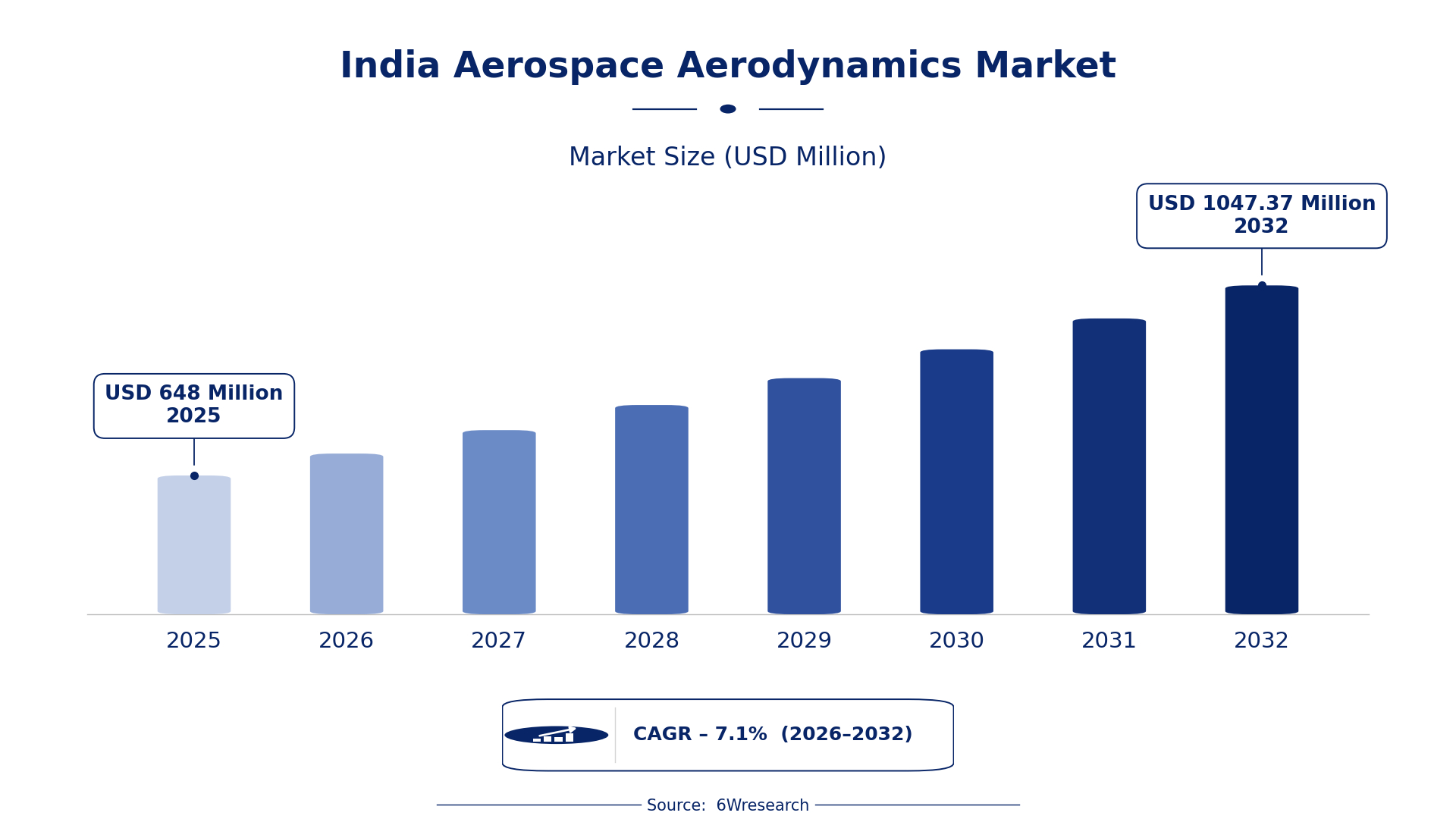
According to 6Wresearch internal database and industry insights, the India Aerospace Aerodynamics Market was valued at USD 648.0 million in 2025 and is projected to reach USD 1,047.37 million by 2032, growing at a CAGR of approximately 7.1% during 2026–2032.
India Aerospace Aerodynamics Market Highlights
| Report Metric | Details |
| Report Name | India Aerospace Aerodynamics Market |
| Market Size 2025 | USD 648.0 million |
| Market Size 2032 | USD 1,047.37 million |
| Absolute Growth 2025–2032 | USD 399.37 million |
| CAGR 2026–2032 | 7.1% |
| Peak Annual Growth | 9.4% in 2026 |
| Forecast Period | 2026–2032 |
| Historical Data | 2022–2025 |
| Base Year | 2025 |
| Leading Product Type, 2025 | Winglets (49% share) |
| Leading Technology Type, 2025 | Flow Control Devices (47% share) |
| Leading Distribution Channel, 2025 | OEMs (45% share) |
| Leading End User, 2025 | Aircraft Manufacturers (48% share) |
| Fastest-Growing Product Type | Vortex Generators (9.7% CAGR) |
| Fastest-Growing Technology Type | Lift Enhancement Tech (9.2% CAGR) |
| Fastest-Growing Distribution Channel | Government Contracts (9.0% CAGR) |
| Fastest-Growing End User | Aerospace R&D Centers (8.7% CAGR) |
| Growing Sector | Aerospace Manufacturing |
| Key End Users | Aircraft Manufacturers, Defense Contractors, Aerospace R&D Centers, Commercial Airlines |
India Aerospace Aerodynamics Market Year-wise Growth Rate and Key Drivers (2022–2032)
This graph illustrates the annual growth rates of the market from 2022 to 2032, highlighting a steady upward trajectory and projected market expansion over the forecast period.
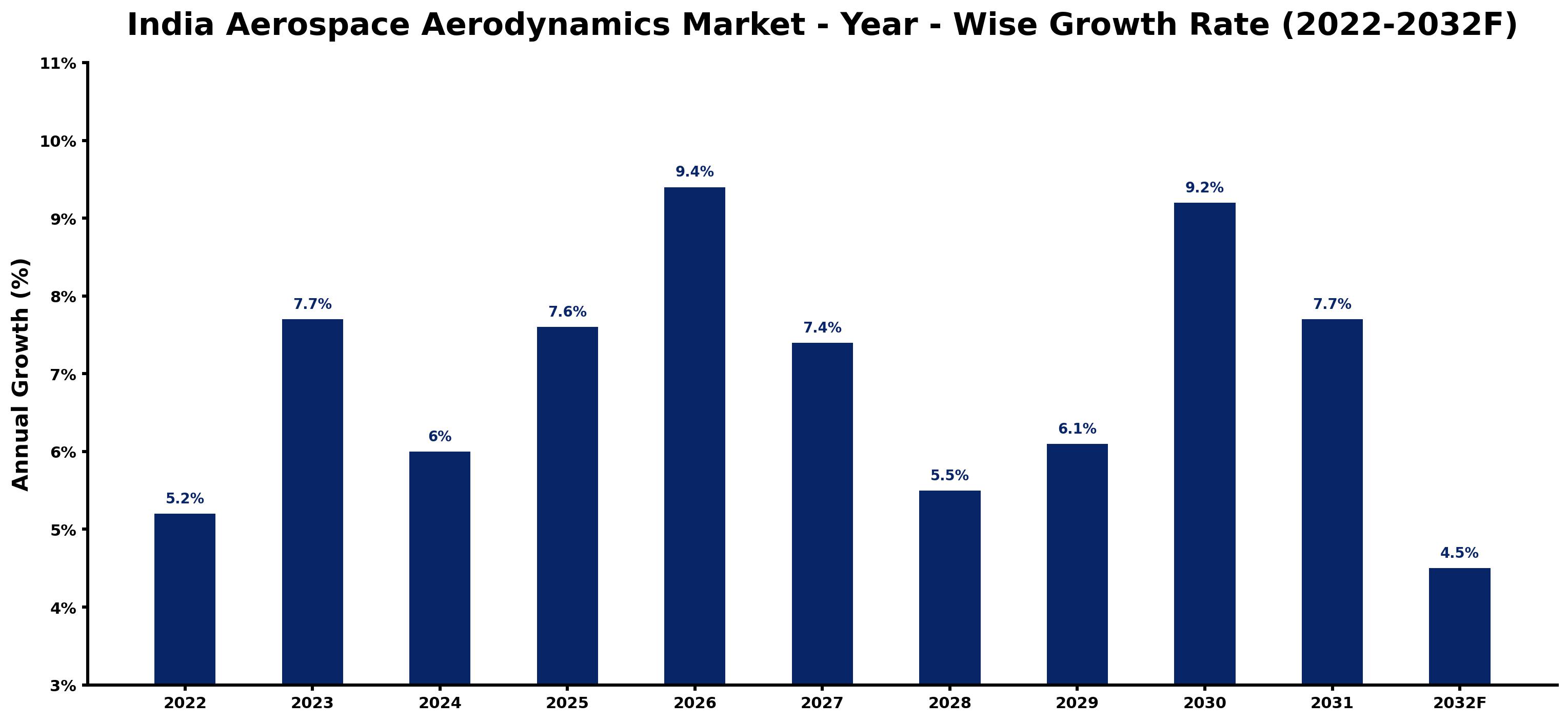
The following table presents the estimated annual growth rate for each year together with the principal factor influencing market performance.
| Year | Estimated Annual Growth (%) | Market Rationale |
| 2022 | 5.2 | The market experienced steady growth due to ongoing modernization programs in the aerospace sector. |
| 2023 | 7.7 | Growth accelerated as domestic aircraft manufacturers increased their investment in aerodynamic technologies. |
| 2024 | 6.0 | A slowdown occurred as some projects faced delays, impacting overall demand for aerodynamics. |
| 2025 | 7.6 | Demand rose again as the Indian Air Force focused on fleet performance through aerodynamic improvements. |
| 2026 | 9.4 | The market peaked with significant investments in advanced aerodynamics for both commercial and defense applications. |
| 2027 | 7.4 | Growth slowed slightly as companies adjusted to new regulatory standards in aerospace manufacturing. |
| 2028 | 5.5 | A further slowdown was seen as firms consolidated operations and focused on efficiency. |
| 2029 | 6.1 | Demand picked up as commercial airlines sought to improve fuel efficiency through aerodynamic innovations. |
| 2030 | 9.2 | Growth accelerated again as the National Aerospace Policy spurred investments in local manufacturing. |
| 2031 | 7.7 | A slowdown occurred as the market began to stabilise after rapid growth in previous years. |
| 2032 | 4.5 | The market continues to grow, albeit at a slower rate as competition intensifies and projects mature. |
Note: Market size estimations and growth projections presented in this report are based on 6Wresearch's proprietary forecasting methodology, utilizing the latest available industry data, government publications, and primary research inputs.
India Aerospace Aerodynamics Market Synopsis
The Aerospace Aerodynamics Market in India covers the study of air behavior around aircraft, employing advanced simulations and wind tunnel testing. This field optimizes aircraft performance, fuel efficiency, and safety. The market is expanding due to rising demand from domestic aircraft manufacturers and defense contractors. Significant investments are being made, particularly with the Indian Air Force's modernization programs and the National Aerospace Policy, which aims to enhance indigenous capabilities. With over 400 aerospace companies operating in various segments, the market is set for considerable growth.
Market Dynamics Impact Analysis (2026–2032)
| Factor | Type | Impact | Primary Segment Affected |
| Increasing investments in aerospace R&D | Driver | High | Flow Control Devices |
| Growing demand from defense contractors for advanced aerodynamics | Driver | High | Lift Enhancement Tech |
| Expansion of local manufacturing capabilities | Opportunity | High | Vortex Generators |
| Emerging demand for fuel-efficient aircraft designs | Opportunity | High | Aerodynamic Fairings |
| High costs associated with R&D in aerodynamics | Restraint | High | Drag Reduction Design |
| Regulatory challenges affecting product approvals | Restraint | Medium | Passive Systems |
| The Aerospace Aerodynamics market in India faces significant regulatory hurdles | Challenge | High | OEMs |
| Limited access to advanced technologies for smaller firms | Challenge | Medium | Engineering Firms |
Evaluation of Drivers in India Aerospace Aerodynamics Market (2026–2032)
Key forces behind demand, with the segment each one moves most, are listed below.
| Drivers | Primary Segment Affected | Why It Matters (Evidence) |
| Increased funding for aerospace R&D projects | Flow Control Devices | The government allocated ₹1,000 crores for aerospace and defense manufacturing, boosting R&D efforts. |
| Demand for advanced aerodynamics in military applications | Lift Enhancement Tech | The Defense Research and Development Organization (DRDO) focuses on aerodynamics for defense applications. |
| Rising commercial aviation needs for fuel efficiency | Vortex Generators | India's population exceeding 1.4 billion drives demand for improved commercial aviation. |
| Modernization programs in the Indian Air Force | Aerodynamic Fairings | The Indian Air Force aims to enhance its fleet's aerodynamic performance through modernization initiatives. |
| Growing focus on indigenous capabilities | Drag Reduction Design | The National Aerospace and Defense Policy promotes local manufacturing and reduces import reliance. |
The Aerospace Aerodynamics market in India is growing on the back of increased funding for aerospace R&D projects, with the government allocating ₹1,000 crores for this purpose. Demand for advanced aerodynamics in military applications is also rising, as the Defense Research and Development Organization focuses on developing defense technologies. The burgeoning commercial aviation sector, driven by a population exceeding 1.4 billion, pushes for improved fuel efficiency. Modernization programs in the Indian Air Force further stimulate demand for aerodynamic solutions, particularly in fleet performance. The emphasis on indigenous capabilities under the National Aerospace and Defense Policy supports local manufacturing, stimulating market growth.
Evaluation of Restraints in India Aerospace Aerodynamics Market
The table below lists the restraints and the evidence behind each.
| Market Restraint | Primary Segment Affected | Why It Matters (Evidence) |
| High costs associated with R&D in aerodynamics | Drag Reduction Design | Research and development expenses can exceed ₹200 crores for advanced aerodynamic technologies. |
| Regulatory challenges affecting product approvals | Passive Systems | Compliance with the Bureau of Indian Standards can delay the introduction of new products. |
| Limited access to advanced technologies for smaller firms | Engineering Firms | Many smaller engineering firms struggle to invest in advanced aerodynamic solutions. |
| Competition from established international players | OEMs | Foreign companies dominate the market, making it difficult for local firms to compete effectively. |
| Slow adoption of new technologies by traditional manufacturers | Lift Enhancement Tech | Established manufacturers often prefer proven technologies over new aerodynamic solutions. |
India Aerospace Aerodynamics Market Challenges
The Aerospace Aerodynamics market in India encounters notable supply chain disruptions that hinder aircraft manufacturers' projects. These disruptions arise from a reliance on imported technologies, which may take up to six months to arrive, leading to costly production delays. For suppliers, outdated technology limits the accuracy of aerodynamic simulations, prolonging development cycles and jeopardising valuable contracts as buyers seek more effective solutions. Increased competition from foreign firms compels local suppliers to reduce prices, potentially compromising product quality and raising safety concerns. Regulatory compliance with the Bureau of Indian Standards can extend project timelines for suppliers, complicating their operations.
Trends in the India Aerospace Aerodynamics Market
Below mentioned are some of the trends shaping the India Aerospace Aerodynamics Market growth.
- Shift from Traditional to Advanced Aerodynamic Solutions: Bengaluru is seeing a shift towards advanced aerodynamic solutions, with a growing number of engineering firms embracing new technologies. In 2021, over 50% of new projects concentrated on advanced designs.
- Emergence of Government Initiatives for Local Manufacturing: The Atmanirbhar Bharat initiative encourages self-reliance in aerospace manufacturing, with a budget of ₹500 crores allocated for research and development. This trend is reshaping supply chain dynamics in the sector.
- Increasing Focus on Fuel Efficiency in Aircraft Design: Aircraft manufacturers are prioritising fuel-efficient designs, with 30% of new aircraft featuring advanced aerodynamic attributes. This trend is driven by escalating fuel costs and environmental regulations.
- Growth of Collaborative R&D Projects in Aerospace: Aerospace R&D Centres are increasingly partnering with government agencies to advance aerodynamic technologies. In 2021, 15 major projects were initiated, focusing on advanced aerodynamic solutions.
Investment Opportunities in the India Aerospace Aerodynamics Market
The following opportunities in the India Aerospace Aerodynamics Market pair current demand with a clear way in.
- Partner with Local Engineering Firms: Investing in partnerships with local engineering firms in Bengaluru, a major aerospace hub, is timely. This collaboration can tap into the growing demand for advanced aerodynamic solutions, with investments exceeding ₹200 crores.
- Supply Advanced Aerodynamic Technologies: There is an opportunity to supply advanced aerodynamic technologies, particularly to defense contractors. The Indian government allocated ₹1,000 crores for aerospace and defense manufacturing, creating a favourable environment for new entrants.
- Invest in R&D for Advanced Solutions: With the National Aerospace Policy promoting innovation, investing in R&D for advanced aerodynamic solutions is timely. This policy aims to significantly increase the sector's contribution to GDP by 2025.
- Focus on Government Contracts: The growing emphasis on government contracts presents an opportunity for suppliers. Government Contracts are projected to grow at a rate of 9.0%, driven by increased defense spending.
Government Initiatives in the India Aerospace Aerodynamics Market
The National Aerospace Policy 2021 aims to increase the aerospace sector's contribution to GDP by promoting innovation and investment, initiated by the Ministry of Defence. This policy complements existing measures, such as the Make in India initiative, which focuses on enhancing domestic capabilities. The combined effect of these policies is expected to boost local manufacturing and reduce reliance on imports. The government allocated ₹500 crores for aerospace and defence manufacturing, which directly impacts the Aerospace Aerodynamics sector by fostering innovation and local production.
The Technology Development Fund (TDF) managed by the Ministry of Defence supports R&D projects in aerospace technologies. With a budget of ₹500 crores, the TDF funds projects that improve aerodynamics. Additionally, the Defence Production and Export Promotion Policy 2020 aims to achieve a turnover of ₹1.75 lakh crores in defence manufacturing by 2025, including aerospace technologies, further driving growth in this sector. These initiatives enable producers to develop advanced technologies and enhance their competitive edge.
Future Insight of the India Aerospace Aerodynamics Market
The Aerospace Aerodynamics market in India is expected to evolve significantly by 2032, driven by advancements in computational fluid dynamics and government initiatives. The Indian Air Force's modernisation programmes will enhance fleet performance, while the National Civil Aviation Policy aims to boost commercial aviation. The Indian Space Research Organisation's focus on aerodynamics for satellite launch vehicles will create new opportunities for suppliers. By 2032, the government plans to allocate ₹1,500 crores for aerospace and defence manufacturing, fostering indigenous capabilities and decreasing dependence on foreign technologies.
Market Segmentation Analysis
Each segment group is reviewed below, with the leader by share and the fastest grower by CAGR.
By Product Type – Winglets Dominated, Vortex Generators Expected to Grow Fastest
According to Ravi Bhandari, Research Head at 6Wresearch, in 2025, Winglets led the product type split with a 49% share. Winglets capture the largest market share because they are vital for enhancing fuel efficiency by reducing drag, a necessity for contemporary aircraft. Their adoption across various aircraft types illustrates manufacturers' focus on performance and cost-effectiveness. Over 2026–2032, Vortex Generators are expected to post the fastest growth, at a CAGR of 9.7%. Vortex Generators are experiencing rapid growth as they significantly enhance airflow and control at different speeds, which is crucial for aircraft efficiency. The increasing demand for advanced aerodynamic features in new aircraft designs is propelling this segment's swift expansion. This trend indicates that suppliers should focus on developing advanced vortex generator technologies to meet the evolving needs of aircraft manufacturers.
By Technology Type – Flow Control Devices Dominated, Lift Enhancement Tech Expected to Grow Fastest
The largest technology type category in 2025 was Flow Control Devices, with a 47% share of total revenue. Flow Control Devices dominate the market share as they are essential for actively managing airflow to enhance aircraft performance. Their widespread application among manufacturers underscores the industry's dedication to achieving superior aerodynamic efficiency. Lift Enhancement Tech is set to record the highest CAGR in this split, 9.2% over 2026–2032. Lift Enhancement Technology is rapidly gaining traction as it boosts lift capabilities for various flight conditions, which is vital for both commercial and military aircraft. The growing emphasis on performance optimisation in aerospace designs is driving this segment's rapid growth. Suppliers should prioritise the development of innovative lift enhancement solutions to satisfy the increasing demand from manufacturers aiming to elevate aircraft performance.
By Distribution Channel – OEMs Dominated, Government Contracts Expected to Grow Fastest
OEMs took a 45% share of distribution channel in 2025, more than any other category. OEMs hold the largest market share as they serve as the primary manufacturers of aircraft components, ensuring a steady demand for aerodynamic technologies. Their established relationships with aircraft manufacturers create reliable revenue streams within this channel. Government Contracts are projected to grow fastest, at a CAGR of 9.0% during 2026–2032. Government Contracts are the fastest-growing distribution channel, representing a significant revenue source for aerospace projects, especially in defence applications. The government's increased investment in aerospace initiatives is accelerating this channel's growth. This suggests that suppliers should strategically engage with government procurement processes to leverage emerging opportunities in the aerospace sector.
By End User – Aircraft Manufacturers Dominated, Aerospace R&D Centers Expected to Grow Fastest
With a 48% revenue share in 2025, Aircraft Manufacturers was the largest end user category. Aircraft Manufacturers command the largest market share as they are the main users of aerodynamic technologies, integrating these advancements into their designs to improve performance. Their continuous innovation in aircraft design drives the demand for cutting-edge aerodynamic solutions. The quickest growth will come from Aerospace R&D Centers, forecast to expand at a CAGR of 8.7% between 2026 and 2032. Aerospace R&D Centers are the fastest-growing end user segment as they focus on researching new aerodynamic technologies, pushing the boundaries of aircraft design. The increasing emphasis on research and development within the aerospace sector is fuelling this segment's growth. This implies that suppliers should collaborate closely with R&D centers to develop next-generation aerodynamic technologies that meet future industry demands.
Key Attractiveness of the Report
- 10 Years of Market Numbers
- Historical Data Starting from 2022 to 2025
- Base Year 2025
- Forecast Data until 2032
- Key Performance Indicators Impacting the Market
- Major Upcoming Developments and Projects
Key Highlights of the Report:
- India Aerospace Aerodynamics Market Outlook
- Market Size of India Aerospace Aerodynamics Market, 2025
- Forecast of India Aerospace Aerodynamics Market, 2032
- Historical Data and Forecast of India Aerospace Aerodynamics Revenues & Volume for the Period 2022 - 2032F
- India Aerospace Aerodynamics Market Trend Evolution
- India Aerospace Aerodynamics Market Drivers and Challenges
- India Aerospace Aerodynamics Price Trends
- India Aerospace Aerodynamics Porter's Five Forces
- India Aerospace Aerodynamics Industry Life Cycle
- Historical Data and Forecast of India Aerospace Aerodynamics Market Revenues & Volume By Product Type for the Period 2022 - 2032F
- Historical Data and Forecast of India Aerospace Aerodynamics Market Revenues & Volume By Winglets for the Period 2022 - 2032F
- Historical Data and Forecast of India Aerospace Aerodynamics Market Revenues & Volume By Vortex Generators for the Period 2022 - 2032F
- Historical Data and Forecast of India Aerospace Aerodynamics Market Revenues & Volume By Aerodynamic Fairings for the Period 2022 - 2032F
- Historical Data and Forecast of India Aerospace Aerodynamics Market Revenues & Volume By Blended Wing Designs for the Period 2022 - 2032F
- Historical Data and Forecast of India Aerospace Aerodynamics Market Revenues & Volume By Technology Type for the Period 2022 - 2032F
- Historical Data and Forecast of India Aerospace Aerodynamics Market Revenues & Volume By Passive Systems for the Period 2022 - 2032F
- Historical Data and Forecast of India Aerospace Aerodynamics Market Revenues & Volume By Flow Control Devices for the Period 2022 - 2032F
- Historical Data and Forecast of India Aerospace Aerodynamics Market Revenues & Volume By Drag Reduction Design for the Period 2022 - 2032F
- Historical Data and Forecast of India Aerospace Aerodynamics Market Revenues & Volume By Lift Enhancement Tech for the Period 2022 - 2032F
- Historical Data and Forecast of India Aerospace Aerodynamics Market Revenues & Volume By Distribution Channel for the Period 2022 - 2032F
- Historical Data and Forecast of India Aerospace Aerodynamics Market Revenues & Volume By OEMs for the Period 2022 - 2032F
- Historical Data and Forecast of India Aerospace Aerodynamics Market Revenues & Volume By Direct Sales for the Period 2022 - 2032F
- Historical Data and Forecast of India Aerospace Aerodynamics Market Revenues & Volume By Government Contracts for the Period 2022 - 2032F
- Historical Data and Forecast of India Aerospace Aerodynamics Market Revenues & Volume By Engineering Firms for the Period 2022 - 2032F
- Historical Data and Forecast of India Aerospace Aerodynamics Market Revenues & Volume By End User for the Period 2022 - 2032F
- Historical Data and Forecast of India Aerospace Aerodynamics Market Revenues & Volume By Aircraft Manufacturers for the Period 2022 - 2032F
- Historical Data and Forecast of India Aerospace Aerodynamics Market Revenues & Volume By Commercial Airlines for the Period 2022 - 2032F
- Historical Data and Forecast of India Aerospace Aerodynamics Market Revenues & Volume By Defense Contractors for the Period 2022 - 2032F
- Historical Data and Forecast of India Aerospace Aerodynamics Market Revenues & Volume By Aerospace R&D Centers for the Period 2022 - 2032F
- India Aerospace Aerodynamics Import Export Trade Statistics
- Market Opportunity Assessment By Product Type
- Market Opportunity Assessment By Technology Type
- Market Opportunity Assessment By Distribution Channel
- Market Opportunity Assessment By End User
- India Aerospace Aerodynamics Top Companies Market Share
- India Aerospace Aerodynamics Competitive Benchmarking By Technical and Operational Parameters
- India Aerospace Aerodynamics Company Profiles
- India Aerospace Aerodynamics Key Strategic Recommendations
Market Covered
The report offers an extensive study of the following market segments.
By Product Type
- Winglets
- Vortex Generators
- Aerodynamic Fairings
- Blended Wing Designs
By Technology Type
- Passive Systems
- Flow Control Devices
- Drag Reduction Design
- Lift Enhancement Tech
By Distribution Channel
- OEMs
- Direct Sales
- Government Contracts
- Engineering Firms
By End User
- Aircraft Manufacturers
- Commercial Airlines
- Defense Contractors
- Aerospace R&D Centers































