India Aerospace Alloys Market Size & Growth Rate
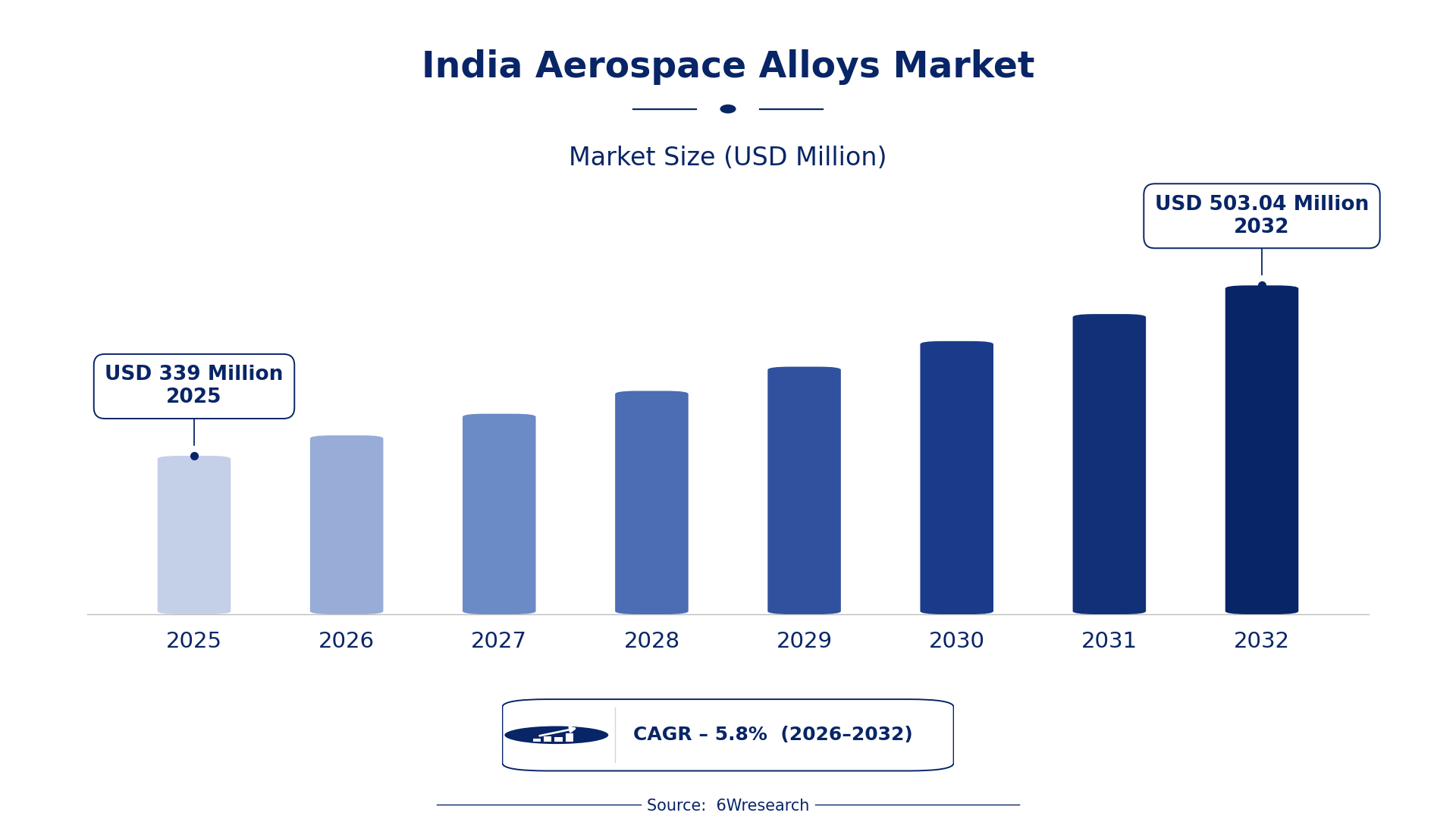
According to 6Wresearch internal database and industry insights, the India Aerospace Alloys Market was valued at USD 339.0 million in 2025 and is projected to reach USD 503.04 million by 2032, growing at a CAGR of approximately 5.8% during 2026–2032.
India Aerospace Alloys Market Highlights
| Report Metric | Details |
| Report Name | India Aerospace Alloys Market |
| Market Size 2025 | USD 339.0 million |
| Market Size 2032 | USD 503.04 million |
| Absolute Growth 2025–2032 | USD 164.04 million |
| CAGR 2026–2032 | 5.8% |
| Peak Annual Growth | 8.4% in 2028 |
| Forecast Period | 2026–2032 |
| Historical Data | 2022–2025 |
| Base Year | 2025 |
| Leading Alloy Type, 2025 | Aluminum Alloys (42% share) |
| Leading Material Base, 2025 | Aluminum-Based (48% share) |
| Leading Distribution Channel, 2025 | OEMs (37% share) |
| Leading End User, 2025 | Aircraft Manufacturers (45% share) |
| Fastest-Growing Alloy Type | Titanium Alloys (7.7% CAGR) |
| Fastest-Growing Material Base | Titanium-Based (7.9% CAGR) |
| Fastest-Growing Distribution Channel | Industrial Suppliers (8.3% CAGR) |
| Fastest-Growing End User | Commercial Aviation (8.1% CAGR) |
| Growing Sector | Commercial Aviation |
| Key End Users | Aircraft Manufacturers, Jet Engine OEMs, Spacecraft Component Makers |
India Aerospace Alloys Market Year-wise Growth Rate and Key Drivers (2022–2032)
This graph illustrates the annual growth rates of the market from 2022 to 2032, highlighting a steady upward trajectory and projected market expansion over the forecast period.
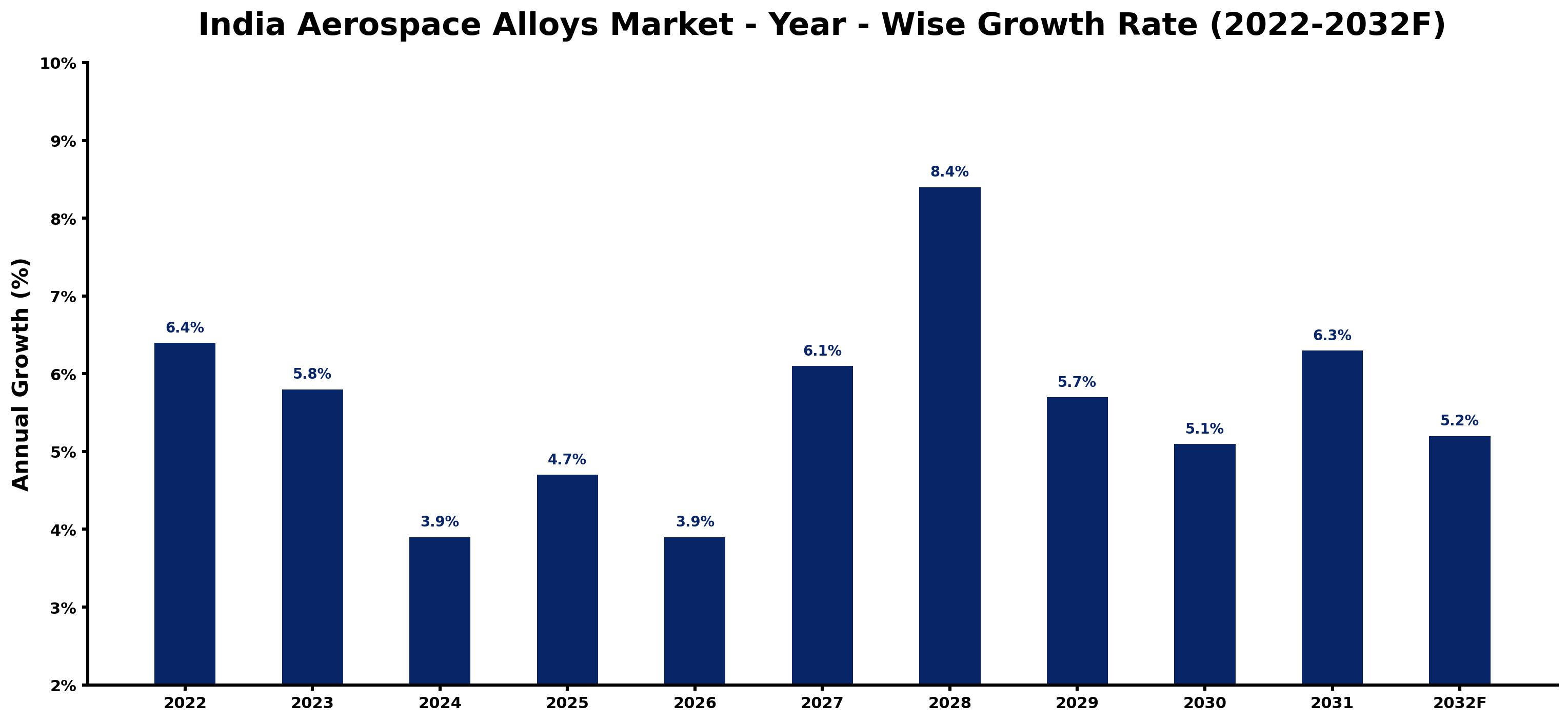
Annual growth estimates for each year appear below with the principal reason behind them, explaining the shifts that set the pace of the market.
| Year | Estimated Annual Growth (%) | Market Rationale |
| 2022 | 6.4 | The market experienced strong demand due to increased aircraft production by domestic manufacturers. |
| 2023 | 5.8 | Growth slowed as the market adjusted to supply chain challenges affecting aerospace materials. |
| 2024 | 3.9 | Demand continued to decelerate as manufacturers faced rising costs for raw materials and production. |
| 2025 | 4.7 | Growth accelerated as new aircraft programmes initiated increased orders for aerospace alloys. |
| 2026 | 3.9 | The market slowed again as production stabilised after a period of rapid expansion. |
| 2027 | 6.1 | Demand rose as investment in aerospace infrastructure began to yield results in production capacity. |
| 2028 | 8.4 | The market peaked with heightened demand driven by commercial aviation recovery and expansion. |
| 2029 | 5.7 | Growth slowed as manufacturers faced challenges in sourcing high-quality materials. |
| 2030 | 5.1 | Demand continued to decelerate as the market adjusted to changing aerospace standards. |
| 2031 | 6.3 | Growth rebounded as new aerospace projects were launched, boosting orders for alloys. |
| 2032 | 5.2 | The market slowed as competition increased and production capacities reached maturity. |
Note: Market size estimations and growth projections presented in this report are based on 6Wresearch's proprietary forecasting methodology, utilizing the latest available industry data, government publications, and primary research inputs.
India Aerospace Alloys Market Synopsis
Aerospace Alloys Market in India encompasses specialized metal alloys utilised in aircraft and spacecraft applications. These alloys, primarily made from titanium, aluminium, nickel, and magnesium, serve critical functions in structural components and engine parts. The market is expanding due to heightened demand from domestic aircraft manufacturers and substantial investments in aerospace development. The 'Aerospace and Defence Manufacturing Policy' introduced in 2020 aims to boost local production capabilities, further propelling growth in this sector. With over 400 active aerospace companies, India is establishing itself as a significant player in the global aerospace industry.
Market Dynamics Impact Analysis (2026–2032)
| Factor | Type | Impact | Primary Segment Affected |
| Growing demand for lightweight materials in aircraft manufacturing | Driver | High | Aluminum Alloys |
| Increased investment in indigenous aerospace development | Driver | High | Titanium Alloys |
| Rising demand for advanced aerospace materials | Opportunity | High | Titanium Alloys |
| Significant growth in commercial aviation sector | Opportunity | High | Aluminum Alloys |
| High production costs of aerospace alloys | Restraint | High | Nickel Alloys |
| Limited domestic supply of specialized materials | Restraint | Medium | Magnesium Alloys |
| Regulatory hurdles in material approvals | Challenge | High | Aluminum Alloys |
| Competition from international suppliers | Challenge | Medium | Titanium Alloys |
Evaluation of Drivers in India Aerospace Alloys Market (2026–2032)
The factors lifting demand, and the evidence behind each, are summarised below.
| Drivers | Primary Segment Affected | Why It Matters (Evidence) |
| Increasing demand for lightweight materials | Aluminum Alloys | The need for lightweight materials in airframe structures drives orders from aircraft manufacturers, with aluminum alloys accounting for 42% of market share by 2025. |
| Rising aerospace exports | Titanium Alloys | With aerospace exports reaching $1.5 billion in 2022, manufacturers are investing in titanium alloys to meet international standards and specifications. |
| Government incentives for local production | Aluminum-Based | The 'Aerospace and Defence Manufacturing Policy' encourages local production, increasing demand for aluminum-based alloys in commercial aviation. |
| Technological advancements in manufacturing | Titanium-Based | Improvements in manufacturing processes are enhancing the performance of titanium-based alloys, leading to increased orders from jet engine OEMs. |
| Growing domestic aircraft fleet | Commercial Aviation | The Indian Air Force's operation of over 600 aircraft boosts demand for aerospace alloys, particularly from commercial aviation sectors. |
Growth in the Aerospace Alloys market in India stems from increasing end-use demand, greater investment in local manufacturing, and rising aerospace exports. The Indian aerospace sector recorded exports of $1.5 billion in 2022, intensifying the need for high-performance alloys. The allocation of ₹1,000 crores for indigenous aerospace development has further stimulated demand for alloys. With over 600 aircraft in operation, the Indian Air Force's requirements are driving procurement. The focus on local production is resulting in higher orders for aluminium and titanium alloys as manufacturers aim to satisfy domestic needs.
Evaluation of Restraints in India Aerospace Alloys Market
The table below lists the restraints and the evidence behind each.
| Market Restraint | Primary Segment Affected | Why It Matters (Evidence) |
| High production costs of aerospace alloys | Nickel Alloys | Manufacturers face rising costs, impacting profitability and pricing strategies in the market. |
| Limited domestic supply of specialized materials | Magnesium Alloys | This scarcity affects production timelines and increases reliance on imports, complicating supply chains. |
| Regulatory hurdles in material approvals | Aluminum Alloys | Stricter compliance requirements slow down the approval process for new materials, delaying market entry. |
| Competition from international suppliers | Titanium Alloys | Foreign competitors often offer lower prices, making it challenging for local producers to compete effectively. |
| Fluctuating demand from the aerospace sector | Aluminum Alloys | Variability in aircraft production schedules creates uncertainty in alloy orders, affecting planning. |
India Aerospace Alloys Market Challenges
The India Aerospace Alloys Market encounters regulatory hurdles that delay the approval of new materials, costing producers valuable time and limiting their ability to meet demand from local aircraft manufacturers. Compliance with the Bureau of Indian Standards can prolong approval times by up to six months, restricting manufacturers' responsiveness to the Indian Air Force's needs, which operates over 600 aircraft. Technological gaps in local manufacturing processes necessitate reliance on imports, increasing costs for buyers by around 10%. Skills shortages in the aerospace sector further complicate production, potentially delaying project timelines by 20% for local manufacturers. Supply chain disruptions in sourcing raw materials can inflate costs by 15%, affecting profitability for producers.
Trends in the India Aerospace Alloys Market
Several trends are reshaping the India Aerospace Alloys Market; the most important are set out below.
- Shift towards Advanced Lightweight Materials: Bangalore is experiencing a shift towards advanced lightweight materials in aerospace manufacturing, driven by the need for fuel efficiency. In 2022, the demand for titanium alloys increased by 15%, reflecting this trend.
- Transition from Traditional to Innovative Manufacturing Techniques: The change in manufacturing techniques began in 2021, with a focus on additive manufacturing for aerospace alloys. This innovation has resulted in a 20% reduction in production time for certain components.
- Emergence of Sustainable Aerospace Practices: The aerospace sector in India is prioritising sustainability, with new standards set in 2021 for eco-friendly materials. This shift has led to a 30% increase in demand for recyclable aerospace alloys.
- Growing Focus on Domestic Production: The 'Make in India' initiative has accelerated domestic production since 2014, with a 25% increase in local alloy manufacturing capacity reported in 2022.
Investment Opportunities in the India Aerospace Alloys Market
Some of the investment opportunities in the India Aerospace Alloys Market are mentioned below.
- Investment in Aerospace Alloy Production: The Indian aerospace alloy production sector is experiencing a gap in supply, with a projected increase of 40% in demand by 2025. Investing in local manufacturing facilities in Bangalore can capture this opportunity.
- Supply of Advanced Aerospace Materials: With aerospace exports reaching $1.5 billion in 2022, there is an opportunity to supply advanced aerospace materials to exporters. Collaborating with aircraft manufacturers can facilitate market entry.
- Development of High-Performance Alloys: The demand for high-performance alloys is increasing, with a projected growth rate of 7.9% for titanium-based alloys. Focusing on R&D can position suppliers to meet this demand effectively.
- Expansion of Aerospace Manufacturing Hubs: Bangalore is expanding as an aerospace manufacturing hub, with over 400 active companies. Establishing partnerships with local firms can enhance market presence and access.
Government Initiatives in the India Aerospace Alloys Market
The 'Aerospace and Defence Manufacturing Policy' launched in 2020 by the Ministry of Defence aims to enhance domestic production capabilities, building on earlier laws. This policy seeks to reduce reliance on imports and boost local manufacturing, providing incentives for companies to invest in aerospace production. The 'National Policy on Aerospace' updated in 2021 promotes research and development in aerospace technologies, further supporting local manufacturers. The Ministry of Defence allocated ₹1,000 crores for indigenous aerospace development in 2021, which is expected to stimulate innovation and production capacity.
Buyers, particularly aircraft manufacturers, benefit from the 'Make in India' initiative, which offers various funding opportunities. This initiative has led to increased local sourcing of aerospace components, with many manufacturers receiving support for technology transfer and skill development. The 'Defence Production Policy' revised in 2021 encourages private sector participation in aerospace manufacturing, focusing on technology transfer. The National Aerospace Laboratories is involved in developing advanced aerospace materials, further enhancing the capabilities of local producers.
Future Insight of the India Aerospace Alloys Market
By 2032, buyers and suppliers in the India Aerospace Alloys Market can expect substantial advancements in local manufacturing capabilities, driven by the 'Aerospace and Defence Manufacturing Policy' and the 'Make in India' initiative. The National Aerospace Laboratories will play a crucial role in developing advanced materials, improving the performance of alloys used in aircraft. The Ministry of Defence's ₹1,000 crores allocation for indigenous aerospace development is anticipated to stimulate local production. India's aerospace exports reached $1.5 billion, indicating strong international demand that is projected to rise as domestic manufacturing capabilities improve.
Market Segmentation Analysis
The report offers a comprehensive study of the following market segments and their leading categories in the market.
By Alloy Type – Aluminum Alloys Dominated, Titanium Alloys Expected to Grow Fastest
According to Ravi Bhandari, Research Head at 6Wresearch, Aluminum Alloys held a 42% share of the India Aerospace Alloys Market by alloy type in 2025. Aluminum alloys hold the largest share in the India Aerospace Alloys Market due to their lightweight properties, which are crucial for airframe structures. Their widespread application by local aircraft manufacturers, especially in Bangalore, solidifies their leading position in this segment. Titanium Alloys are set to record the highest CAGR in this split, 7.7% over 2026–2032. Titanium alloys are witnessing rapid growth as they are essential for critical structural components in aerospace applications, reflecting the industry's focus on high-performance materials. This surge is supported by increased investments in advanced aerospace projects across India. Suppliers should focus on developing titanium alloys to meet the rising demands from aerospace manufacturers.
By Material Base – Aluminum-Based Dominated, Titanium-Based Expected to Grow Fastest
Aluminum-Based took a 48% share of material base in 2025, more than any other category. Aluminum-based alloys dominate the market share in India, being extensively used in commercial aviation for airframe construction. The country's established manufacturing capabilities and infrastructure further reinforce the significance of aluminum-based materials. The quickest growth will come from Titanium-Based, forecast to expand at a CAGR of 7.9% between 2026 and 2032. Titanium-based materials are experiencing the highest growth rate, being vital for high-performance aerospace applications as the industry aims to improve efficiency and safety. The ongoing emphasis on advanced aerospace technologies significantly drives this segment's rapid expansion. Buyers should consider diversifying their procurement strategies to include titanium-based alloys for high-performance applications.
By Distribution Channel – OEMs Dominated, Industrial Suppliers Expected to Grow Fastest
OEMs accounted for a 37% market share by distribution channel in 2025. OEMs represent the largest share in the distribution of aerospace alloys, acting as primary customers for these materials. Their established relationships with manufacturers ensure a steady demand for aluminum and titanium alloys. Over 2026–2032, Industrial Suppliers are expected to post the fastest growth, at a CAGR of 8.3%. Industrial suppliers are the fastest-growing distribution channel, playing a crucial role in supplying materials to OEMs and manufacturers, thus enhancing supply chain flexibility. The increasing complexity of aerospace projects necessitates reliable industrial suppliers to meet diverse needs. Suppliers should strengthen partnerships with industrial suppliers to enhance market reach and responsiveness.
By End User – Aircraft Manufacturers Dominated, Commercial Aviation Expected to Grow Fastest
In 2025, Aircraft Manufacturers led the end user split with a 45% share. Aircraft manufacturers are the largest end users of aerospace alloys, requiring these materials for various aircraft components. The robust growth of the Indian aerospace sector sustains high demand from this user group. Commercial Aviation is projected to grow fastest, at a CAGR of 8.1% during 2026–2032. Commercial aviation is the fastest-growing end-user segment, driven by rising demand for new aircraft and the expansion of air travel in India. This trend presents significant opportunities for aerospace alloy suppliers to cater to the needs of commercial aviation. Suppliers must align their production capabilities to meet the increasing requirements of the commercial aviation sector.
Key Attractiveness of the Report
- 10 Years of Market Numbers
- Historical Data Starting from 2022 to 2025
- Base Year 2025
- Forecast Data until 2032
- Key Performance Indicators Impacting the Market
- Major Upcoming Developments and Projects
Key Highlights of the Report:
- India Aerospace Alloys Market Outlook
- Market Size of India Aerospace Alloys Market, 2025
- Forecast of India Aerospace Alloys Market, 2032
- Historical Data and Forecast of India Aerospace Alloys Revenues & Volume for the Period 2022 - 2032F
- India Aerospace Alloys Market Trend Evolution
- India Aerospace Alloys Market Drivers and Challenges
- India Aerospace Alloys Price Trends
- India Aerospace Alloys Porter's Five Forces
- India Aerospace Alloys Industry Life Cycle
- Historical Data and Forecast of India Aerospace Alloys Market Revenues & Volume By Alloy Type for the Period 2022 - 2032F
- Historical Data and Forecast of India Aerospace Alloys Market Revenues & Volume By Titanium Alloys for the Period 2022 - 2032F
- Historical Data and Forecast of India Aerospace Alloys Market Revenues & Volume By Aluminum Alloys for the Period 2022 - 2032F
- Historical Data and Forecast of India Aerospace Alloys Market Revenues & Volume By Nickel Alloys for the Period 2022 - 2032F
- Historical Data and Forecast of India Aerospace Alloys Market Revenues & Volume By Magnesium Alloys for the Period 2022 - 2032F
- Historical Data and Forecast of India Aerospace Alloys Market Revenues & Volume By Material Base for the Period 2022 - 2032F
- Historical Data and Forecast of India Aerospace Alloys Market Revenues & Volume By Titanium-Based for the Period 2022 - 2032F
- Historical Data and Forecast of India Aerospace Alloys Market Revenues & Volume By Aluminum-Based for the Period 2022 - 2032F
- Historical Data and Forecast of India Aerospace Alloys Market Revenues & Volume By Nickel-Based for the Period 2022 - 2032F
- Historical Data and Forecast of India Aerospace Alloys Market Revenues & Volume By Magnesium-Based for the Period 2022 - 2032F
- Historical Data and Forecast of India Aerospace Alloys Market Revenues & Volume By Distribution Channel for the Period 2022 - 2032F
- Historical Data and Forecast of India Aerospace Alloys Market Revenues & Volume By OEMs for the Period 2022 - 2032F
- Historical Data and Forecast of India Aerospace Alloys Market Revenues & Volume By Industrial Suppliers for the Period 2022 - 2032F
- Historical Data and Forecast of India Aerospace Alloys Market Revenues & Volume By Direct Sales for the Period 2022 - 2032F
- Historical Data and Forecast of India Aerospace Alloys Market Revenues & Volume By Specialty Stores for the Period 2022 - 2032F
- Historical Data and Forecast of India Aerospace Alloys Market Revenues & Volume By End User for the Period 2022 - 2032F
- Historical Data and Forecast of India Aerospace Alloys Market Revenues & Volume By Aircraft Manufacturers for the Period 2022 - 2032F
- Historical Data and Forecast of India Aerospace Alloys Market Revenues & Volume By Commercial Aviation for the Period 2022 - 2032F
- Historical Data and Forecast of India Aerospace Alloys Market Revenues & Volume By Jet Engine OEMs for the Period 2022 - 2032F
- Historical Data and Forecast of India Aerospace Alloys Market Revenues & Volume By Spacecraft Component Makers for the Period 2022 - 2032F
- India Aerospace Alloys Import Export Trade Statistics
- Market Opportunity Assessment By Alloy Type
- Market Opportunity Assessment By Material Base
- Market Opportunity Assessment By Distribution Channel
- Market Opportunity Assessment By End User
- India Aerospace Alloys Top Companies Market Share
- India Aerospace Alloys Competitive Benchmarking By Technical and Operational Parameters
- India Aerospace Alloys Company Profiles
- India Aerospace Alloys Key Strategic Recommendations
Market Covered
The report offers an extensive study of the following market segments.
By Alloy Type
- Titanium Alloys
- Aluminum Alloys
- Nickel Alloys
- Magnesium Alloys
By Material Base
- Titanium-Based
- Aluminum-Based
- Nickel-Based
- Magnesium-Based
By Distribution Channel
- OEMs
- Industrial Suppliers
- Direct Sales
- Specialty Stores
By End User
- Aircraft Manufacturers
- Commercial Aviation
- Jet Engine OEMs
- Spacecraft Component Makers































